

TL;DR: Most hair transplant patients see visible regrowth starting around month 3-4, with 60-80% of final density present by month 12 and full results at 18 months. Before and after photos look dramatic because they compare a shaved, pre-op scalp against a grown-out result. The change is real, but timeline, donor supply, and surgeon skill determine everything.
What do hair transplant before and after results actually show?
Before and after hair transplant photos are the most common thing people search before booking a consultation. They're also the most misleading, because the "before" image almost always shows a freshly shaved scalp under clinical lighting, which makes the loss look more severe than it does in daily life. The "after" is taken 12-18 months later with the hair styled to its best advantage.
That said, the underlying change is real. A well-executed FUE (follicular unit excision) or FUT (follicular unit transplantation) procedure moves hair that is genetically resistant to DHT from the back and sides of the scalp to the thinning or bald zones. Those transplanted hairs behave like donor-zone hairs for life. They don't fall out the way native hairs do in androgenetic alopecia.
What before and after pictures can't show you: the shed phase around weeks 2-8 where all the transplanted hairs fall out (this is normal and expected), the patchy awkward phase at months 3-5, or how much of the result depends on continuing to protect your non-transplanted native hairs with finasteride or minoxidil. A transplant fills in what's gone. It doesn't stop the loss of hairs you still have.
The most honest thing a photo can tell you is the coverage potential for a person with a Norwood stage and donor density like yours. For a closer look at what a hair transplant procedure involves clinically, that's a good place to start.
What does the timeline look like month by month after surgery?
The timeline surprises almost everyone, because the first few months look like failure.
Weeks 1-2: The recipient area is red, there are tiny crusts around each graft, and the transplanted hairs sit in small follicular units visibly above the scalp. Donor strip or punch sites are healing. Most surgeons ask you to avoid direct sun, sweating, and any pressure on the grafts.
Weeks 2-8: Shock loss. The transplanted hairs shed. This is called effluvium and it happens because the follicles enter a telogen (resting) phase after the trauma of transplantation [1]. Patients who aren't warned about this sometimes panic and think the procedure failed. It didn't. The follicle is still alive under the skin.
Months 3-5: Fine, thin hairs begin emerging. The texture is often wispy at first and the coverage looks uneven. This is the hardest phase aesthetically. Some patients contact their surgeon during this window thinking something went wrong, when the timeline is simply running normally [2].
Months 6-9: Real density becomes visible. Most people can see a meaningful before-and-after difference from a smartphone photo by month 6. The hairs are still maturing, the caliber (thickness) is increasing, and coverage keeps improving.
Months 10-12: Roughly 60-80% of the total result is present. This is when most clinic "after" photos are taken, because it looks good and the patient is still engaged.
Months 12-18: Final maturation. Some patients, particularly those with coarse or curly hair, see continued improvement past 18 months. The clinical consensus is that you should not judge a hair transplant result until at least 12 months post-op, and ideally 15-18 months [2].
Why resting-phase shedding happens is easier to understand once you know the full hair growth cycle, which is covered in hair loss telogen phases.
How much density can you realistically expect to gain?
This is where real numbers matter, and where a lot of clinics get vague.
Normal scalp density is roughly 65-85 follicular units per square centimeter [3]. Hair transplants typically achieve a maximum graft density of 30-45 follicular units per cm² in a single session, because packing grafts too densely risks compromising blood supply to the grafts and lowering survival rates. A transplant can restore meaningful coverage but rarely restores the exact density of a full native scalp.
Graft survival rates matter enormously here. In experienced hands, survival rates of 90-95% are reported for FUE [4]. At lower-quality clinics, survival can drop to 70% or below, which means you paid for 2,000 grafts and effectively got 1,400.
The number of grafts you can safely harvest is limited by your donor zone. Most people have between 6,000 and 8,000 total extractable grafts over a lifetime, though this varies a lot by donor density and scalp laxity. A Norwood 6 or 7 patient needing coverage of a large area may simply not have enough donor hair for a natural-looking full result in one or two sessions. This is the fact missing from most before and after gallery pages.
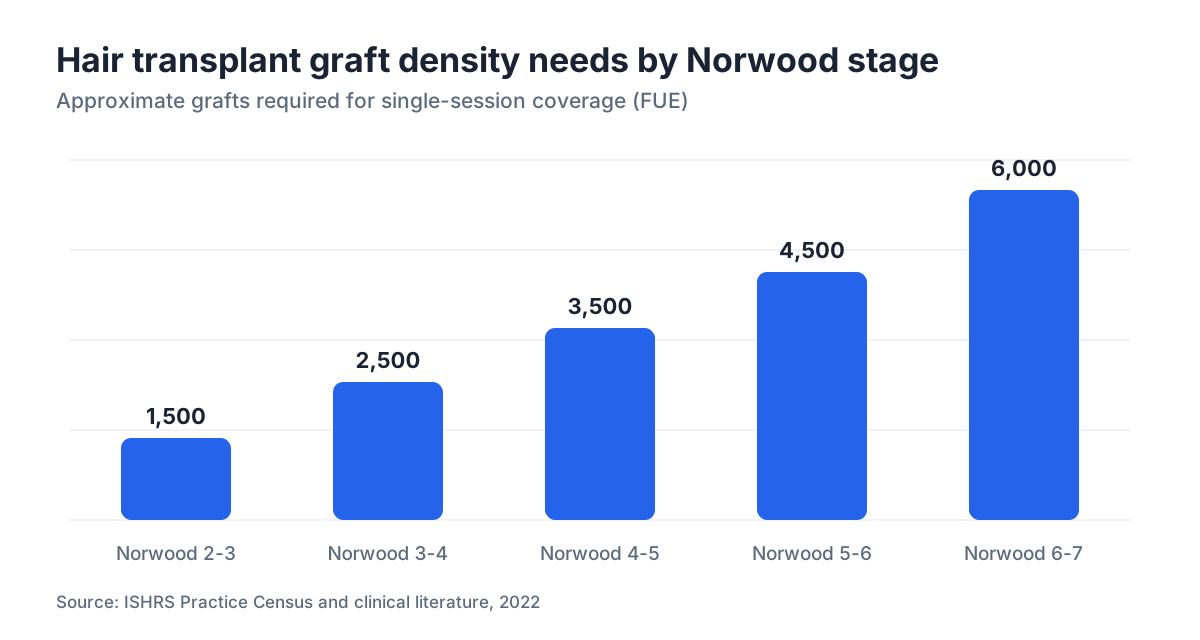
A single session typically moves 1,500 to 3,500 grafts. Two sessions covering a Norwood 5 area might use 4,000-5,000 grafts total, which for many patients is the majority of their lifetime donor supply. That's why most good surgeons factor in future loss when planning the design, rather than just filling in what's bald today.
| Norwood Stage | Approx. grafts needed (1 session) | Realistic coverage outcome |
|---|---|---|
| NW 2-3 | 800-1,500 | Excellent, natural hairline |
| NW 3-4 | 1,500-2,500 | Good, meaningful density |
| NW 4-5 | 2,000-3,500 | Moderate-good, may need 2nd session |
| NW 5-6 | 3,000-4,500+ | Partial coverage, donor limits apply |
| NW 6-7 | 4,000-6,000+ | Limited, realistic expectations required |
What makes before and after photos from Turkey different from other countries?
Turkey has become the dominant destination for hair transplant tourism, handling an estimated 1 million procedures per year by recent industry counts, a figure cited repeatedly by Turkish health tourism bodies [5]. Hair transplant Turkey before and after photos dominate the search results for a simple reason: volume. Clinics there produce enormous galleries because they operate at enormous scale.
The average cost in Istanbul for 2,000-3,000 grafts is roughly $1,500-$3,000 including hotel and transfers, compared to $6,000-$15,000 for comparable graft counts in the United States, UK, or Germany [6]. That price gap drives demand, and demand creates more photos.
Here's what the Turkey hair transplant before and after pictures often don't tell you.
Many Turkish clinics use a "mega-session" model, transplanting 4,000-6,000 grafts in a single day. The literature on graft survival at very high single-session counts is genuinely mixed. A 2021 review in the Journal of Dermatological Treatment noted that transection rates (damaged follicles) increase when technicians rather than physicians perform most of the extractions, a common practice model in high-volume Turkish clinics [7].
That's not a categorical argument against going to Turkey. There are excellent surgeons there, and many patients get results every bit as good as they'd get in London or New York. The risk is that you're picking a surgeon at a distance, largely on photos that may be cherry-picked. The best Turkey galleries show the 12-18 month marks, not 8-9 months. They show patients with starting Norwood stages like yours. And they'll connect you with past patients directly.
For a broader breakdown of cost factors, hair transplant expenses covers what drives price differences across countries and clinic types.
What does the before and after look like for FUE vs. FUT?
The end result, meaning the hair that grows in, is essentially identical between FUE and FUT when performed well. The differences in the before and after pictures show up at the donor site, not the recipient.
FUT (strip method) leaves a linear scar along the back of the scalp. With skilled closure it's a thin white line, usually hidden by 1.5-2cm of hair. If you keep your hair short at the back, it can be visible. In the "after" photos, FUT patients need a bit more hair length to wear naturally at the donor site.
FUE leaves small circular punch scars, typically 0.8-1mm each, scattered across the donor zone. At the densities involved in a 2,000+ graft procedure, these are invisible to the naked eye at normal hair length, but can show as a mottled or slightly diffuse appearance if you shave your head completely.
FUE is the procedure most modern clinics use, and it dominates the before and after photo landscape because most patients prefer not to carry a strip scar. Recovery is faster too. Most patients return to desk work in 3-5 days and look socially presentable (with a cap) in 7-10 days.
With FUT you can often harvest more grafts per session, because strip harvest is more efficient than individual punch extraction. That matters for high-Norwood patients with limited donor reserves, which is why some surgeons still recommend it for specific cases. The decision isn't cosmetic preference. It's a function of your lifetime graft budget.
How do hairline design decisions show up in before and after photos?
The hairline is where hair transplant results either look natural or look obviously done. Scrutinize it hardest in clinic galleries.
A natural hairline is not a straight line. It has what surgeons call "micro-irregularity": individual single-hair grafts placed at the very front edge, with slightly varying angles and depths. The hairs at the frontal edge point slightly forward and downward. Behind them, the density builds with two-hair and three-hair follicular units.
The worst before and after photos, and the worst real-world results, show hairlines that look pluggy, too perfectly geometric, or set unnaturally low on the forehead. The pluggy look is less common now than it was in the punch-graft era (1960s-1990s), but it still happens when a surgeon uses only multi-hair grafts at the leading edge to fake faster density.
A hairline placed too low is a serious long-term problem. A 25-year-old getting a transplant to Norwood 2 specifications may keep losing hair behind that hairline for decades. If the hairline was set at age-18 levels and the crown and mid-scalp thin out, the result looks strange in middle age. This is why patient age and projected future loss matter so much, and why reputable surgeons often want patients on finasteride for at least a year before surgery to establish a stable baseline.
When you evaluate before and after hair transplant pictures from any clinic, look at the hairline from a side-angle photo, more than head-on. Side views reveal depth, angle, and whether the transition from temple to hairline looks natural.
What do before and after photos look like when a hair transplant doesn't work?
Failed or poor results are underrepresented in clinic galleries for obvious reasons. They're still worth understanding, because the signs show up in a recognizable pattern.
Low graft survival (below 70%) looks like sparse, patchy growth at 12 months with visible gaps in the recipient zone. The density never fills in. The usual causes: poor graft handling (grafts drying out or being stored incorrectly outside the body), too-dense packing, or extraction by inexperienced technicians with high transection rates.
Cobblestoning is a texture abnormality where the skin around the transplanted grafts looks raised or bumpy. It was common with older techniques and remains a risk when grafts are placed too superficially in the recipient sites.
Unnatural direction or angle produces hairs that grow straight up rather than lying flat and forward. This is a placement error, not a graft survival issue, and it's essentially permanent without corrective work.
Overharvested donor zones look thin, moth-eaten, or show clear extraction scars at normal hair lengths. This happens when a clinic pulls too many grafts from a small donor area, permanently damaging the zone. Good surgeons leave enough density in the donor area that it looks normal at 1-2cm length.
If you've had a poor result, the options are a corrective transplant to fill gaps (requires remaining donor supply), scalp micropigmentation to camouflage sparse areas, or accepting the result and managing remaining hair with minoxidil for men or finasteride and minoxidil combination therapy.
How should you use before and after photos when choosing a surgeon?
Most people use before and after galleries wrong. They find the most impressive transformation in the gallery and ask "can I look like that?" That's the wrong question. Here's how to use photos well.
Find photos of patients with a Norwood stage like yours, a hair texture like yours (fine, medium, coarse), and similar hair color relative to skin tone. Dark hair on light skin shows thinning far more clearly than dark hair on dark skin, so density comparisons aren't apples-to-apples across those groups. Ask the clinic to find comparison photos that match your profile. Any good clinic can do this.
Verify the timeline. A photo labeled "12 months post-op" is credible evidence. A photo with no date, or one labeled "results may vary," is just marketing. Ask for photos with documented month labels, more than before and after pairs.
Look at the donor zone. This is what clinics almost never photograph in the "after" image. Ask directly: do you have after photos showing the donor area? If a clinic can't show you a clean donor zone at 12 months, they may be over-harvesting.
Ask to speak with a past patient with a case like yours. Good surgeons with genuinely happy patients can usually arrange this. It's a higher bar than showing you a gallery, and clinics that can clear it earn more trust.
If you want to understand your own loss pattern before booking consultations, the free AI hair analysis at MyHairline can give you a Norwood stage assessment and help you see what kind of result is realistically in scope for someone at your stage.
To place your current position more precisely, read receding hairline.
Do you need medications after a transplant to keep your results?
This is the question most clinics underplay in their marketing, because the answer complicates the pitch.
A transplant moves DHT-resistant hairs. Those hairs will stay. But the native hairs around the transplanted grafts are still vulnerable to DHT if you have androgenetic alopecia, which is the reason you needed a transplant in the first place. Ignore that ongoing loss and you can end up years later with a transplanted hairline framing a thinning or bald mid-scalp and crown, because those areas kept shedding while the transplanted zone stayed full.
Finasteride is the only oral DHT-blocker with FDA approval for male androgenetic alopecia [8]. The original clinical trials showed it reduced further hair loss in 83% of men and produced visible regrowth in 66% at two years [9]. Most hair transplant surgeons recommend patients be on finasteride before and after surgery to stabilize the loss pattern. The evidence base for this is strong.
Minoxidil (topical or oral) can also help retain native hairs and may improve graft health in the post-op period, though the surgery itself is the primary driver of the result [12]. Combining both medications with a transplant is, in the view of most dermatologists who work with hair loss, the most complete approach for long-term maintenance.
The FDA-approved labeling for finasteride [8] and for minoxidil [11] are both publicly available on the FDA's drug database. Read them, particularly the side effect profiles, before you start either.
What should you realistically expect from a hair transplant at different ages?
Age changes everything about what before and after results look like and how long they last.
Patients in their 20s typically show the most dramatic transformations in photos, because they still have good skin elasticity, dense donor zones, and enough native hair to blend with the transplanted grafts. They also carry the highest long-term risk of an unnatural result, because their loss pattern is still evolving. A 22-year-old who transplants to a Norwood 2 hairline may be a Norwood 5 by 40, and that transplanted hairline will look stranded without ongoing medication and possibly a second procedure.
Patients in their 30s and 40s, particularly those who have been on finasteride for several years with a relatively stable pattern, generally get the best long-term outcomes. The loss has declared itself, the design can account for the full likely trajectory, and they still have adequate donor supply.
Patients in their 50s and 60s often get aesthetically excellent results because their loss has stabilized, expectations are realistic (nobody is trying to recreate a 22-year-old hairline), and fine gray hair against an older scalp camouflages lower density well. The main limit is donor quality, which thins somewhat with age.
The American Academy of Dermatology recommends a thorough evaluation of the cause of hair loss before surgery, because non-androgenetic causes (thyroid disorders, nutritional deficiencies, alopecia areata) don't respond to transplantation and may cause the transplanted hairs to fail [10]. Sorting out what causes hair loss is worth doing before committing to any surgical plan.
How much does a hair transplant cost and does price predict results?
Price is a real but imperfect signal of quality. The range is enormous: roughly $1,500-$3,500 in Turkey, $4,000-$8,000 in Eastern Europe, and $7,000-$20,000 in the US, UK, or Australia, for comparable graft counts [6]. The variation within any single country is also large.
What drives cost: physician time (is the surgeon doing the extractions and placements, or supervising technicians?), graft counting and quality control methods, clinic infrastructure, the country's cost-of-living baseline, and marketing overhead.
High price does not guarantee a good result. Some of the priciest US and UK clinics produce mediocre outcomes, and some Istanbul clinics with competitive pricing produce excellent work. But below a certain threshold ($1,200-$1,500 for a meaningful number of grafts) the economics simply don't support adequate physician involvement, graft handling equipment, and follow-up care. At that price point you're almost certainly getting a technician-heavy operation.
The best cost predictor of outcome quality isn't the per-graft price. It's whether a physician is physically present and performing the critical steps: hairline design, recipient site creation, and quality control during extraction. Ask flatly: who performs each step, and will that person be in the room for my entire procedure?
| Region | Typical cost per session (2,000-2,500 grafts) | Notes |
|---|---|---|
| Turkey | $1,500-$3,000 | Includes accommodation at most clinics |
| Eastern Europe | $3,500-$6,000 | Poland, Czech Republic, Hungary |
| United Kingdom | $6,000-$12,000 | Varies widely by city and clinic |
| United States | $8,000-$20,000 | California, NYC at upper end |
| Australia | $7,000-$15,000 | Limited certified providers |
A fuller breakdown of cost factors lives at hair transplant expenses.
Sources
- U.S. National Library of Medicine / StatPearls: Hair Transplantation
- International Society of Hair Restoration Surgery (ISHRS): Patient Education
- PubMed: Bernstein RM et al. Standardizing the classification and description of follicular unit transplantation and mini-micrografting techniques. Dermatol Surg. 1998
- PubMed: Gupta AK et al. FUE graft survival rates review. J Cutan Aesthet Surg. 2020
- ISHRS: Global Practice Census (health tourism volume figures for Turkey)
- ISHRS: 2022 Practice Census Results
- Journal of Dermatological Treatment: Technician-performed FUE and transection rates. 2021
- FDA: Propecia (finasteride) Prescribing Information
- New England Journal of Medicine: Finasteride clinical trial. Kaufman KD et al. 1998;338:1000-1006
- American Academy of Dermatology: Hair Loss Overview and Treatment Recommendations
- FDA: Rogaine (minoxidil) OTC labeling
- PubMed: Avram MR, Rogers NE. The use of minoxidil in the hair transplant setting. Dermatol Surg. 2009