
TL;DR: Hair transplants in Chicago cost roughly $5,000 to $15,000 or more, priced per graft at $3 to $10 each. FUE dominates the market. Full results take 12 to 18 months to show. Turkey offers the same procedures for $1,500 to $3,500 all-in, but carries real risks around standards, follow-up care, and revision if something goes wrong.
What does a hair transplant in Chicago actually cost?
It depends almost entirely on how many grafts you need. Chicago clinics price per graft, and that rate runs $3 to $10, with most reputable surgeons landing in the $5 to $8 range [1]. A modest hairline restoration might need 1,500 grafts. A crown job or full thinning scalp could need 3,000 to 4,500. Do the math and the range gets wide fast.
Here's what people actually spend. A 2,000-graft FUE procedure at a mid-tier Chicago clinic usually lands between $8,000 and $14,000 all-in. A smaller FUT strip procedure can come in lower, closer to $5,000 to $8,000, because the extraction is faster [2]. The high-end surgeons, the ones with academic or media profiles, charge toward $15,000 or beyond regardless of graft count, because you're partly paying for the name.
A few line items catch people off guard. Anesthesia fees are usually bundled but sometimes billed separately. Post-op medications like finasteride or minoxidil that most surgeons want you to start or continue add cost. And PRP add-ons get pushed hard during the consultation.
PRP is not required. It costs $500 to $1,500 extra and the evidence that it improves graft survival is mixed at best [3]. Skip it unless your surgeon makes a specific case based on your scalp.
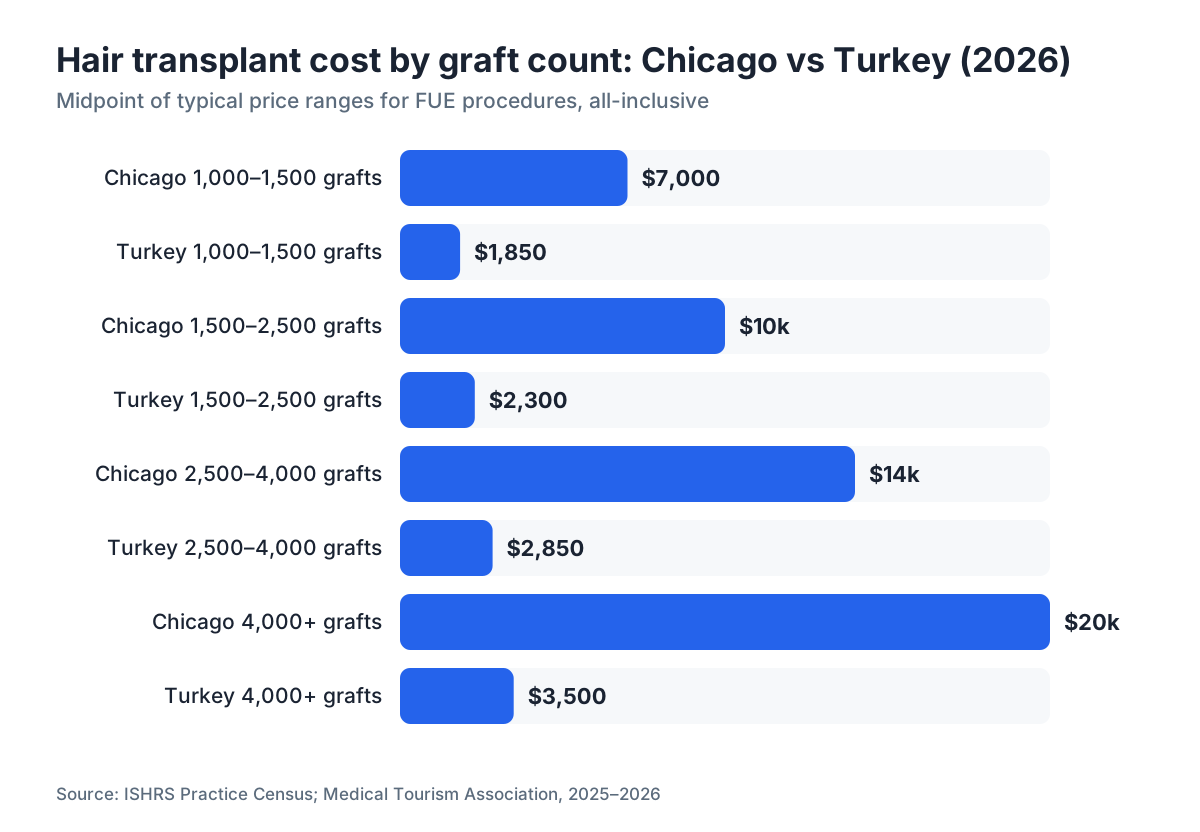
| Graft count | Typical Chicago price range | Typical Turkey price range |
|---|---|---|
| 1,000 to 1,500 | $5,000, $9,000 | $1,500, $2,200 |
| 1,500 to 2,500 | $7,000, $13,000 | $1,800, $2,800 |
| 2,500 to 4,000 | $10,000, $18,000 | $2,200, $3,500 |
| 4,000+ | $15,000, $25,000+ | $2,500, $4,500 |
No one can give you a binding price without seeing your scalp. Any clinic that quotes a firm number over the phone before a consultation is guessing. Require an in-person or detailed video consultation before you commit.
FUE vs FUT: which method do Chicago surgeons use and what's the difference?
Almost every Chicago clinic leads with FUE (follicular unit extraction). A handful still offer FUT (follicular unit transplantation, the strip method), and a few specialists do both. Which one fits your situation matters more than following whatever the clinic is marketing this year.
FUE pulls individual follicular units one at a time with a small punch tool, usually 0.8 to 1.0 mm across. No linear incision, no linear scar. The tradeoff: it takes longer in the operating room, needs more labor, and costs more per graft. Visible recovery is faster. Most people are back at a desk in 5 to 7 days [2].
FUT removes a strip of scalp from the donor zone, dissects it into grafts under magnification, and closes the donor site with sutures. That leaves a linear scar at the back of the head, which matters if you like your hair very short. But FUT can produce more grafts in a single session, and some surgeons argue graft survival is slightly better because the follicles spend less time outside the body. The survival data is genuinely close. Neither method has a decisive lead in published research [4].
For most men in their 30s and 40s who keep their hair at medium length and are losing ground at the hairline or crown, FUE is the sensible default. If you need 4,000 or more grafts in one session, ask your surgeon whether FUT is worth discussing. The FUT scar usually hides under hair grown to even moderate length.
How much does a hair transplant cost in Turkey in 2026, and is it worth the trip?
Turkey runs roughly $1,500 to $3,500 all-inclusive for most cases in 2026, and that price usually covers airport transfers, hotel, and post-op medications [5]. Istanbul has built an entire surgical tourism industry around hair restoration. The volume is enormous. Estimates put the number of procedures performed in Turkey each year in the hundreds of thousands, which is why Turkish surgeons and technicians have logged extraordinary repetitions.
That all-in price looks great against a $10,000 to $14,000 Chicago quote. The question is what you trade for the savings.
The main risk usually isn't the surgery itself. The real vulnerabilities are who does the actual work (many Turkish clinics use technicians, not the named surgeon, for extraction and placement), what happens if you need a revision (you're on a plane, not 20 minutes from the clinic), and what the regulatory standard is for the facility. The Turkish Ministry of Health has tightened its rules in recent years, but enforcement varies across Istanbul's hundreds of clinics.
A crown transplant packs grafts into a round, visible area with a spiral growth angle, and it's especially sensitive to technician skill. If placement is off, it shows. For a crown job specifically, the case for a higher-cost, surgeon-led Chicago procedure is stronger than for a simple hairline lowering.
If you do choose Turkey, look for clinics accredited by the Joint Commission International (JCI) or affiliated with the International Society of Hair Restoration Surgery (ISHRS), confirm the surgeon is present for the full procedure, and budget for follow-up consultations back in the US at six and twelve months.
For a fuller breakdown of what drives hair transplant costs globally, the surgical methods, and what to ask any clinic, that article is a useful next read.
What Norwood stage are you, and does it change whether a transplant makes sense?
The Norwood scale runs from 1 (minimal or no recession) to 7 (only a horseshoe of hair left around the sides and back). Your stage at the time of surgery matters for two reasons: how many grafts you need now, and whether your donor zone has enough hair to cover future loss. Learn more about receding hairline stages and what they signal at each Norwood level.
Surgeons get cautious with Norwood 2 and 3 patients in their 20s. The pattern of future loss isn't set. Transplant hair to your current hairline, keep losing ground behind it, and you either need another procedure or you live with an island of transplanted hair surrounded by bare scalp. That's a bad outcome.
Norwood 3 to 5 patients in their late 30s and beyond with a stable loss pattern are the clearest candidates. The donor zone is usually adequate, future loss is more predictable, and the density gain is genuinely noticeable. Norwood 6 and 7 patients have limited donor supply and deserve honest expectations: a transplant can improve appearance but cannot restore full density.
One thing changes the math. If you're on finasteride and your loss has been stable for two or more years, a surgeon can plan around a more predictable future state. Read more about how finasteride affects your hair loss trajectory and how it interacts with transplant planning.
How do I find a reputable hair transplant surgeon in Chicago?
Board certification in plastic surgery or dermatology is the floor, not a differentiator. The credential that means something for hair restoration is ISHRS membership, and specifically fellowship membership, which requires demonstrated volume and peer review. The ISHRS runs a public surgeon finder at ishrs.org [6].
Beyond credentials, look at before-and-after photos that show hairline design and crown density. A lot of clinic galleries are cherry-picked. Ask to see results from patients with a similar Norwood stage, hair texture, and graft count to yours. Ask how many procedures the surgeon personally performs per year. If that number tops 300 or 400, ask how big the surgical team is and how the work gets divided.
Consult at least two clinics. The consultations should be free. Any clinic charging for one is out of step with Chicago's market. During each visit, have the surgeon walk you through exactly what they'd do: where the recipient sites go, how they'd design the hairline, what graft count they recommend. If two consultations give you wildly different graft counts, ask both surgeons why.
Red flags worth walking away over: a guarantee of a specific density or exact outcome (no honest surgeon does this), a hard sell on same-day booking discounts, a clinic that won't name who does the extractions, and before-and-after photos that look inconsistent between shots (different lighting, angles, or styling).
What is the recovery timeline after a hair transplant?
The short version: you look rough for a week, normal within a month, and you can't judge the real result for a year. Here's the timeline in detail.
Day 1 to 3: The scalp is tender, red, and swollen. Many patients get forehead swelling as fluid moves down. It looks alarming and resolves on its own by day 5 or 6. Sleeping elevated helps.
Day 7 to 10: The small scabs around each graft fall off naturally. Do not pick them. Disrupting a graft before it anchors can kill it. Most surgeons have a specific wash protocol for this window, usually a gentle spray rather than rubbing.
Week 2 to 4: You look almost normal. Most people are back in social settings with nothing obviously visible.
Month 2 to 3: Shock loss. This is the part that panics people who weren't warned. The transplanted hairs shed. It's normal and expected [2]. The follicle is alive and resting; the shaft falls because the follicle is resetting into a new growth cycle. Don't read this as the transplant failing.
Month 4 to 6: New hairs start to grow. They're fine and sometimes curly at first. They thicken and straighten over time.
Month 10 to 18: This is when you can actually judge the result. Most surgeons call 12 months a fair evaluation point, but coarser, denser growth can continue to 18 months. Anyone who shows you 6-month photos as the final product is jumping the gun.
During recovery, your surgeon will almost certainly recommend starting or continuing a medical hair loss treatment. If you're not already on something, read up: minoxidil for men and finasteride and minoxidil together are the standard combination most surgeons suggest alongside a transplant.
What are the real risks and side effects of a hair transplant?
The procedure is outpatient and done under local anesthesia in the US, so the risks tied to general anesthesia don't apply. There are still real complications to know about.
Infection happens in fewer than 1% of cases at accredited US facilities and is more common when post-op hygiene instructions get ignored [4]. The warning signs are increasing redness, warmth, and discharge after day 5 rather than steady improvement. Antibiotics usually clear it.
Scarring at the donor site is expected and varies by technique: linear for FUT, scattered small dots for FUE. Raised or hypertrophic scarring is uncommon but possible, especially in patients with a history of keloids. Tell your surgeon before the procedure if that's you.
Graft failure is the outcome that turns a $10,000 procedure into wasted money. It happens when a large share of grafts simply don't survive and grow. Causes include poor technique, inadequate scalp preparation, grafts drying out between extraction and implantation, and poorly trained personnel doing the insertion. This is one reason the training of everyone in the room, more than the lead surgeon, matters so much.
Numbness or altered sensation at both the donor and recipient sites is common and usually resolves within three to six months. Numbness that persists past a year is uncommon.
Then there's the risk of unrealistic expectations. The American Academy of Dermatology notes that results vary significantly based on patient characteristics and surgical skill, and that no procedure guarantees a specific outcome [7]. A 90% graft survival rate is very good. A 70% rate is below par. Ask your surgeon what their average reported survival rate is, knowing that self-reported numbers carry obvious bias.
If you're shedding and aren't sure whether it's normal post-transplant shock loss or something else like telogen effluvium, that article explains the difference.
Should I fix my hair loss medically before getting a transplant?
Most experienced surgeons say yes. A transplant moves existing follicles from a permanent zone into a thinning one. But the follicles that weren't transplanted keep responding to DHT and can keep falling out after surgery. Do nothing about that ongoing loss and you're adding transplanted density into a zone that's still actively thinning around it.
Finasteride (1 mg daily, FDA-approved for male pattern baldness) cuts DHT at the scalp and slows or stops progressive thinning in most men who take it [8]. The FDA label states the drug increased hair count relative to placebo at the vertex (crown) scalp in men aged 18 to 41 in randomized controlled trials. Start it before a transplant, not after, so you know whether your loss is stable enough to plan around.
Minoxidil (topical 2% or 5% for men, FDA-approved for androgenetic alopecia) increases hair thickness and can slow recession. It works through a different mechanism than finasteride [9]. Using both together, often called combination therapy, is supported by the clinical literature as more effective than either one alone [11]. For the downsides, minoxidil side effects covers what you'd actually feel.
The mechanism, in short: androgenetic alopecia is driven by dihydrotestosterone (DHT) binding to follicle receptors and shrinking them over time. A DHT blocker like finasteride interrupts that. Without interrupting it, even a well-executed transplant is operating on a still-moving target.
Some people arrive at a consultation wanting surgery as the only answer and resist medication. That's a personal choice. But if you're asking whether the result looks better and lasts longer with medical treatment in the background, the answer is yes.
Is a hair transplant worth it? Honest expectations vs the marketing
Done well, a hair transplant is one of the more permanent and natural-looking options for androgenetic alopecia. The results are real. Transplanted hairs come from the back of the head, so they're DHT-resistant and don't miniaturize the way the original hairs in the recipient zone did. They grow, they can be cut, they behave normally.
"Worth it" depends on what you're comparing against. Against doing nothing, a good transplant is a visible improvement that needs no daily effort. Against medications, it costs far more upfront but doesn't lock you into ongoing pharmaceutical use. Against wigs, hairpieces, or scalp micropigmentation, it means surgery and real recovery time but produces actual growing hair.
Here's what a transplant cannot do: it cannot give you hair you don't have. Donor supply is finite. A typical donor zone holds roughly 6,000 to 8,000 extractable grafts, and not all of them can be harvested without thinning the donor area itself. If you're a Norwood 6 or 7, an honest surgeon will tell you full coverage isn't achievable and that the goal is strategic improvement in the most visible areas.
The patients who end up unhappy usually had inflated expectations, chose the cheapest option without vetting the clinic, or ignored ongoing loss around the transplanted area. The patients who end up glad they did it went in realistic, chose a surgeon with verifiable experience, and treated the transplant as one piece of a broader hair plan.
Want a baseline before you book consultations? MyHairline's free AI hair analysis (/scan) gives you a Norwood estimate and a starting framework from photos, so you can walk into those visits already knowing the right questions to ask.
What questions should I ask at a Chicago hair transplant consultation?
The consultation is your one real chance to size up the surgeon and the clinic before handing over several thousand dollars. Most are free. Use them fully.
Ask the surgeon: how many procedures do you personally perform per year, and what is your role on the day of my surgery? This tells you whether you're buying the surgeon's hands or just their name attached to a clinic.
Ask for your proposed graft count in writing, with the hairline design sketched out. Any surgeon who won't commit a plan to paper is not someone to pay in advance.
Ask directly: who performs the extractions and the implantations? In many high-volume clinics the surgeon designs the hairline and makes the recipient incisions, but technicians do the graft insertion. That's not inherently wrong. You just need to know it.
Ask to see 20 or more before-and-after photos of patients with a pattern like yours, with at least 12-month follow-up. If the clinic can't produce 20 cases like yours, they may not have the volume.
Ask what happens if you need a touch-up or revision. Get the answer in writing. A clinic confident in its work has a clear, reasonable policy.
Finally, ask: given my pattern and age, what do you recommend I do medically before or alongside this surgery? A surgeon who never mentions finasteride or minoxidil for a patient with active androgenetic alopecia is leaving out an important part of the picture. Understanding the full scope of what drives pattern loss, including factors beyond DHT, helps you ask sharper questions: what causes hair loss is a useful primer before those consultations.
Hair transplant cost in Chicago vs Turkey: which makes sense for your situation?
This is the question most people show up with, so here's the straight take.
If your budget is genuinely tight and the real choice is between a Turkish clinic with ISHRS-affiliated surgeons and doing nothing, Turkey isn't a reckless option. Hundreds of thousands of procedures happen there every year, and plenty produce good results. The skill ceiling in Istanbul's best clinics is real.
If your budget can stretch to Chicago and the gap is $6,000 to $10,000, ask what that money buys. It buys proximity for follow-up. It buys a surgeon you can physically sit across from before and after. It buys recourse if something needs revision. It buys a regulatory environment (the Illinois Medical Practice Act, facility accreditation through the American Association for Accreditation of Ambulatory Surgery Facilities) with defined standards [10].
For most complex cases, crowns, second procedures, patients with tight donor zones, and anyone who's already had a transplant elsewhere, I'd spend the money domestically and find a Chicago surgeon with the exact experience the case needs. For a straightforward hairline in someone mid-30s with good donor density, Turkey's best clinics are a defensible choice if you vet them seriously.
One more variable. Turkey's 2026 prices reflect the lira's slide against the dollar, which has made procedures much cheaper in dollar terms over the last several years [5]. That can shift. Locking in a Turkey booking assumes the exchange rate advantage holds, and it's not guaranteed.
The bottom line on cost: a mid-range Chicago case runs $8,000 to $14,000, versus $1,800 to $3,500 all-in for Turkey. The per-graft output can be similar. The risk and accountability profile is not. Your call rests on case complexity, your risk tolerance, and whether you have realistic access to follow-up care.
Sources
- International Society of Hair Restoration Surgery (ISHRS), Practice Census
- American Society of Plastic Surgeons, Hair Transplant Procedure overview
- American Academy of Dermatology, platelet-rich plasma for hair loss overview
- Journal of the American Academy of Dermatology, hair restoration surgery review
- Medical Tourism Association, Hair Transplant Destination Data
- International Society of Hair Restoration Surgery, Find a Surgeon
- American Academy of Dermatology, Hair Loss Treatment overview
- FDA, Propecia (finasteride 1mg) approved labeling
- FDA, Rogaine (minoxidil topical) approved labeling
- American Association for Accreditation of Ambulatory Surgery Facilities (AAAASF)
- JAMA Dermatology, androgenetic alopecia and finasteride combination therapy