
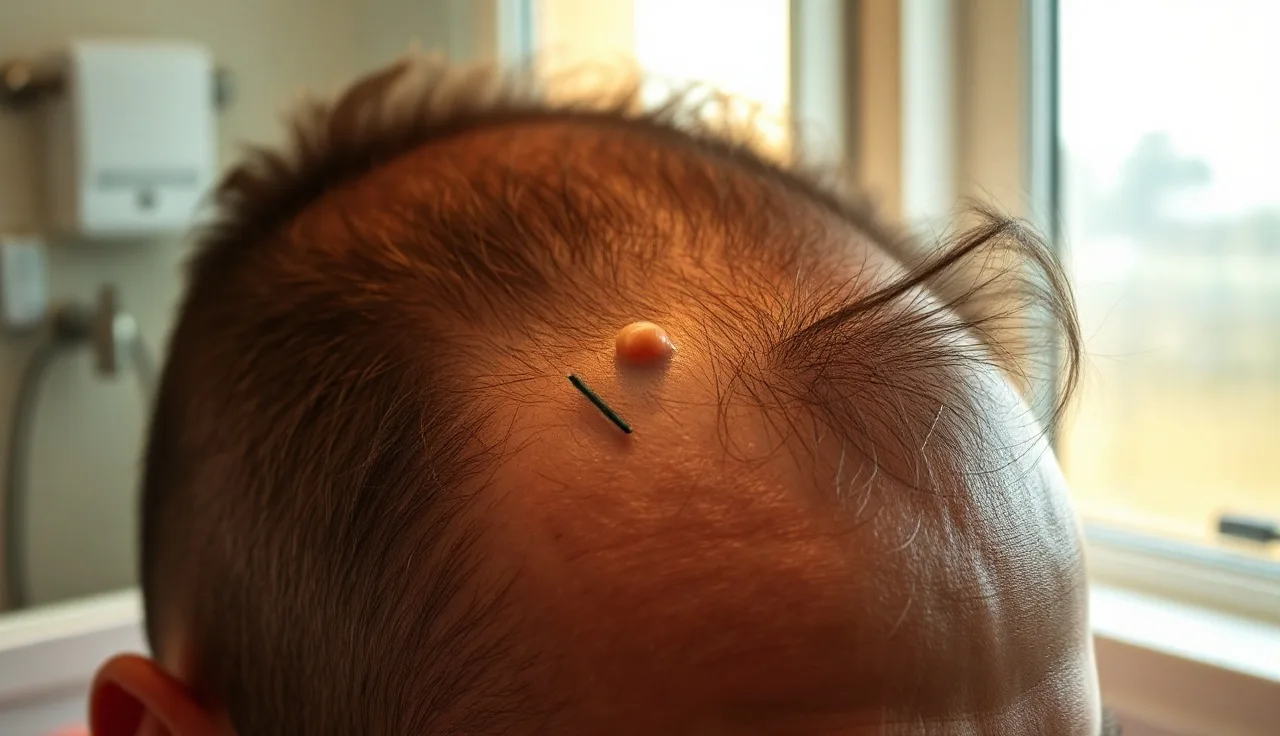
TL;DR: At 10 days after a hair transplant, most scabs have shed or are shedding, swelling is gone, and the transplanted hairs are entering a resting phase before they fall out temporarily. This is normal. Redness, itching, and sparse-looking grafts are all expected. The grafts are anchored by now. The hair growth you paid for won't start until around month 3 to 4.
What does a hair transplant look like at 10 days?
Your scalp looks rough at day 10. That's normal, and it's the part that rattles people most. The transplanted area has small crusts sitting at the base of each graft, and many are flaking off on their own or with gentle washing. The donor zone (a strip scar if you had FUT, small circular punch sites if you had FUE) is healing but still pink or red. The recipient hairline looks thin and patchy.
Here's what most surgeons don't say clearly enough before surgery: the grafts are secure now. The dangerous window for dislodging a graft was the first 7 to 10 days. After that, the follicles have bonded to surrounding tissue through fibrous anchoring. You can wash more normally, wear a loose hat, and sleep without worrying about destroying what you paid for [1].
Swelling, if you had it in the forehead and around the eyes on days 2 through 5, is almost entirely gone by day 10. Puffiness that lingers past 2 weeks deserves a call to your clinic.
Is scab shedding at day 10 normal?
Yes. Scab shedding between days 7 and 14 is one of the most predictable parts of the whole timeline. Each tiny crust forms around an implanted follicular unit as the skin seals itself. When it drops off, it usually takes the visible hair shaft with it, leaving a short pink stub or nothing you can see at all.
This panics a lot of patients. They see scabs in the sink and assume the grafts went with them. They didn't. The scab holds the dead hair shaft, not the living follicle. The root stays in the scalp [2].
Don't pick, and don't scrub to force the scabs off. Yanking a scab before day 7 can pull a graft with it. By day 10, most clinics clear you to gently massage the scalp with your fingertips during washing. Use lukewarm water and a mild shampoo (many clinics supply a saline or baby-formula wash), and let the scabs soak and release on their own. Anything still stuck at day 14 is a question for your surgeon, not something to pull off yourself.
What is shock loss and does it start at 10 days?
Shock loss, more precisely telogen effluvium triggered by surgical trauma, usually begins between weeks 2 and 6 after a transplant. Day 10 sits right at the edge of that window. Some patients see the first signs now: a few extra hairs on the pillow or in the drain [3].
There are two kinds. The first is shedding of the transplanted hair shafts. That's expected and universal. The follicle drops into a resting (telogen) phase after the trauma of being moved, the shaft falls out, and the follicle sits dormant for roughly 3 months before it produces new growth. The second kind is shedding of your existing native hairs near the recipient zone, stressed by the surgery around them. This one upsets patients more and gets talked about less. It's also usually temporary.
A 2018 study by Mysore in the Journal of Cutaneous and Aesthetic Surgery reported that reactive telogen effluvium after hair transplantation typically resolves within 3 to 6 months in most patients [3]. If your native hair loss is aggressive and keeps going, that's a separate problem worth raising with your dermatologist. You can read more about telogen effluvium and why it shows up after any real physical stress.
If you don't already have a long-term hair transplant plan that includes medication to protect your native hair, day 10 is a good time to have that talk.
What does healing look like week by week after a transplant?
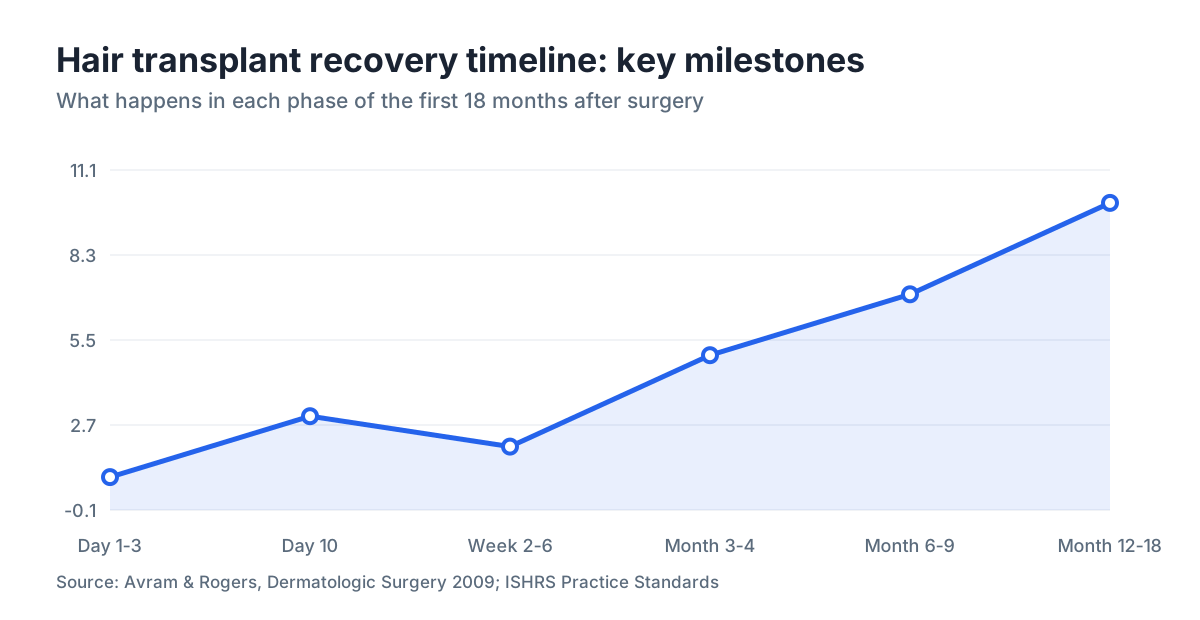
The first year follows a fairly predictable arc, though timing shifts with the person, the procedure type, and the graft count.
| Timeframe | What's happening |
|---|---|
| Days 1-3 | Swelling peaks, crusts form, grafts most vulnerable |
| Days 4-7 | Swelling recedes, scabs harden, no vigorous activity |
| Day 10 | Scabs shedding, grafts anchored, light activity OK |
| Weeks 2-6 | Transplanted hairs shed (shock loss phase) |
| Months 1-3 | Scalp looks sparse, follicles dormant, patience required |
| Months 3-6 | New fine hairs emerge, growth accelerates |
| Months 6-12 | Hair thickens, texture normalizes |
| Month 12-18 | Final result visible; coarse mature hair fully grown |
These timelines come mostly from clinical observation and surgical training data rather than large randomized trials. Surgeons agree on the broad arc. Individual variation is real [1][4].
At day 10 you're in the hardest stretch psychologically: the grafts are secure but the mirror looks worse than it did before surgery. That's not failure. That's the procedure doing exactly what it's supposed to do.
What activity restrictions still apply at day 10?
By day 10, most surgeons lift the strictest rules. You can generally wash your hair normally, sleep in any position, and walk outdoors. What stays restricted, depending on your clinic, is heavy exercise, swimming, and direct sun.
High-intensity exercise raises blood pressure and heart rate enough to cause minor bleeding or edema in tissue that's still healing. Most clinics say no gym, no running, no contact sports until at least day 14, and some push strenuous activity out to 3 weeks [4].
Pools and hot tubs are off limits for at least 3 to 4 weeks. Chlorinated or bacteria-heavy water can enter healing follicle openings and cause infection. The sea carries the same risk. Your scalp needs to be fully re-epithelialized before you go in the water.
Direct sun on the scalp is restricted for 4 to 6 weeks in most protocols, because UV can damage new graft tissue and cause hyperpigmentation in the recipient zone. A loose hat (not a tight baseball cap) is fine from day 10 at most clinics. Confirm with your surgeon.
Go easy on alcohol and blood thinners a while longer. Alcohol dilates blood vessels and can cause micro-bleeding, so many surgeons say 2 weeks dry post-op. If you take aspirin, ibuprofen, or high-dose fish oil, check with your clinic before restarting.
How should you wash your hair at day 10 after a transplant?
Washing technique matters more in the first 10 days than at any other point. By day 10, the rules loosen a lot.
Most clinics recommend this at the 10-day mark: wet the scalp gently with lukewarm water, work in a small amount of mild shampoo (no harsh sulfates), and use the pads of your fingertips, not your nails, to massage the recipient and donor zones. Let any remaining scabs soften and fall on their own. Rinse with a low-pressure flow, not a hard jet.
Skip hot water. It increases scalp inflammation and vasodilation. Skip vigorous towel rubbing too. Pat dry or air dry. A hair dryer on cool is generally fine by day 10; save the hot setting for another week or two.
If your clinic gave you a post-transplant spray or lotion, keep using it as instructed. Many clinics rely on saline sprays or growth-support formulas in the first two weeks. After day 10, most patients move back to their normal shampoo, though fragrance-free and sulfate-free formulas stay gentler on a healing scalp.
When should you be worried at day 10? Signs of infection or graft failure
Most complications that show up after a transplant appear in the first 10 days. By now you have a reasonable read on whether things are going well.
Signs worth a same-day call to your clinic:
Pus or green/yellow discharge from any graft site or the donor scar. This points to bacterial infection, which hits roughly 1% of cases and needs prompt antibiotics [5].
A cluster of grafts that has turned dark or gray instead of the normal pink-beige. This can mean folliculitis or poor graft survival in one spot.
Fever above 38 degrees Celsius (100.4 Fahrenheit) with scalp tenderness. Systemic infection after a transplant is rare but real.
Pain that's climbing instead of easing. Normal healing pain is worst in days 1 through 3 and tapers steadily. Pain that worsens after day 7 is abnormal.
Signs that look scary but are actually normal at day 10: redness that hasn't fully faded, mild itching (a sign of healing), small pink bumps in the recipient zone (folliculitis or milia), and sparse hair because the transplanted shafts have shed.
The American Academy of Dermatology's guidance on surgical site care notes that post-surgical scalp infections, though uncommon, need prompt evaluation to prevent scarring and permanent follicle damage [5]. Don't wait and hope. Call.
Should you start or restart minoxidil and finasteride at day 10?
This is one of the most common day-10 questions, and the answer depends on your pre-surgery protocol and your surgeon's guidance.
For minoxidil for men: most surgeons tell patients to stop topical minoxidil roughly 2 weeks before surgery because it can increase bleeding during the procedure. By day 10, many clear patients to restart. Some prefer to wait until day 14 or until the scalp is fully de-crusted. Restarting matters because stopping minoxidil for more than a few weeks can trigger a shed of its own, and you don't want that stacked on top of the normal post-transplant shed.
For finasteride: most surgeons keep patients on finasteride straight through surgery and recovery without a break. If you stopped pre-op, resuming at day 10 is generally safe. Finasteride protects the native, non-transplanted hairs from DHT-driven miniaturization, which is arguably as important as the transplant itself. A transplant without a DHT blocker strategy leaves your native hair exposed, and plenty of patients end up needing a second procedure sooner than they otherwise would.
The combination of finasteride and minoxidil has the strongest evidence for holding and improving density alongside a transplant. A 2003 study by Kaufman and colleagues in Dermatologic Surgery found patients on finasteride had significantly better long-term outcomes after hair transplantation than those who had surgery alone [6].
Confirm restart timing with your own surgeon. Their protocol can shift based on your graft count, the area treated, and how you're healing.
Why does your scalp look worse at day 10 than it did before surgery?
Nobody warns you about this clearly enough. At day 10, your hairline and the transplanted zone often look thinner and patchier than they did before surgery. It's normal, and it's temporary.
Here's what's happening. The transplanted hairs are shedding their shafts. The recipient skin is still pink and irritated. Native hairs near the incision sites may have slipped into their own resting phase. And the gap between the hope you walked in with and the sparse reality in the mirror is wide.
The term for the transplanted-hair shed is the anagen-to-telogen transition. The physical stress of harvesting and implanting a follicle pushes it out of the growth phase (anagen) and into the resting phase (telogen). That telogen phase runs roughly 8 to 16 weeks, then the follicle re-enters anagen and grows a new shaft [2].
Most patients see the first new fine hairs from transplanted follicles around months 3 to 4. Hair that looks mature and reads as real density usually lands between months 6 and 12. Final results, the ones you'll actually judge the procedure by, are typically assessed at 12 to 18 months.
If you want an honest baseline, the free AI hair scan at MyHairline can document your density so you have a real reference point instead of trying to remember what your hairline looked like a year ago.
What should your diet and lifestyle look like at day 10?
Healing tissue needs protein, micronutrients, and blood flow. None of that is controversial. Few post-op sheets get specific enough about it.
Protein is the macronutrient most directly tied to follicle recovery. Keratin, the main structural material of hair, is a protein. The FDA's daily reference value for protein is 50 grams, though many dietitians push higher during recovery. Lean meat, eggs, legumes, and fish all work. A 2019 review by Almohanna and colleagues in Dermatology and Therapy named iron deficiency and protein malnutrition among the most common nutritional drivers of hair loss and poor post-procedure recovery [7].
Check your iron with a blood test if you haven't lately. Low ferritin (the stored form of iron) impairs follicle function even when hemoglobin reads normal. Some dermatologists use a ferritin target of 40 to 70 micrograms per liter for good hair growth, though that cutoff isn't an official clinical standard and the evidence behind it is debated [7].
Sleep matters more than most patients think. Human growth hormone, involved in tissue repair and follicle cycling, releases mainly during deep sleep. Aim for 7 to 9 hours in the first few weeks. Alcohol wrecks sleep architecture even in moderate amounts, so it's working against you twice.
Smoking constricts blood vessels and cuts oxygen delivery to healing tissue. Every major surgical society tells patients to stop smoking before and after any procedure. If you haven't quit, quit now. The evidence linking smoking to poor wound healing is about as solid as surgical evidence gets [4].
How do you know if your grafts are actually surviving?
You can't fully know at day 10. There's no at-home test for graft survival, and even a clinic check-up at this stage is about wound inspection, not viability. True survival only becomes clear once regrowth starts around months 3 to 4.
What a surgeon looks at on a 10-day check: no infection, a normal scab-shedding pattern, and a donor site healing without odd scarring. Nobody is counting follicles under a microscope yet.
Published survival rates for FUE and FUT sit in the 85 to 95% range in experienced hands, but that figure hides big variation driven by surgeon skill, how the grafts were stored, and how the patient heals [1][4].
Red flags for poor survival in a specific zone: persistent dark crusting with no normal shed, an area showing no pink granulation tissue under the scabs, or a patch that stays fully bald at the 6-month mark with no new fine hairs. At that point, book a follow-up and possibly a dermoscopy evaluation.
To track your own progress between visits, a consistent photo protocol (same light, same angle, same distance, once a month) is the most practical tool you have. Some patients take hair loss supplements during recovery to cover nutritional gaps, though the evidence that supplements improve graft survival specifically is thin.
What causes ongoing hair loss after a transplant, and how do you stop it?
A transplant moves hair. It doesn't stop the reason you're losing it. If you have androgenetic alopecia (the most common type, affecting roughly 50% of men by age 50 [8]), the same DHT-driven miniaturization that thinned your hair before surgery keeps running after it.
Transplanted hairs taken from the occipital donor zone are genetically resistant to DHT and won't miniaturize. Your native hairs, especially in the mid-scalp and crown, get no such protection from the transplant. Without medical management, many patients watch their native hair keep thinning in the years after surgery, which builds an unnatural contrast between the dense transplanted hairline and the fading scalp behind it.
Getting clear on what causes hair loss is where a plan to protect your investment starts. The two FDA-approved treatments for androgenetic alopecia are topical minoxidil and oral finasteride [9][10]. Both belong in most post-transplant plans unless you have a specific contraindication.
For patients with a receding hairline who are earlier in the loss process, starting medication before a transplant, not after, tends to produce better long-term outcomes. If you're at day 10 and haven't had this conversation with a dermatologist, it's overdue.
Sources
- International Society of Hair Restoration Surgery (ISHRS), Practice Standards
- Messenger AG et al., 'Hair follicle biology', British Journal of Dermatology
- Mysore V, 'Telogen effluvium after hair transplant', Journal of Cutaneous and Aesthetic Surgery 2018
- Avram MR, Rogers NE, 'Contemporary hair transplantation', Dermatologic Surgery 2009
- American Academy of Dermatology, Surgical Site Infections guidance
- Kaufman KD et al., 'Finasteride in the treatment of men with androgenetic alopecia', Dermatologic Surgery 2003
- Almohanna HM et al., 'The role of vitamins and minerals in hair loss', Dermatology and Therapy 2019
- American Academy of Dermatology, Hair Loss Overview
- U.S. Food and Drug Administration, Minoxidil label
- U.S. Food and Drug Administration, Finasteride (Propecia) label