
TL;DR: Hair transplants in Bangladesh cost between $0.50 and $1.50 per graft in 2026. A 2,000-graft FUE session runs roughly $1,000 to $3,000 total. That is 70 to 85% cheaper than the same procedure in the US or UK. The catch: quality swings hard between clinics, so the discount is real and so is the risk of picking wrong.
What does a hair transplant cost in Bangladesh in 2026?
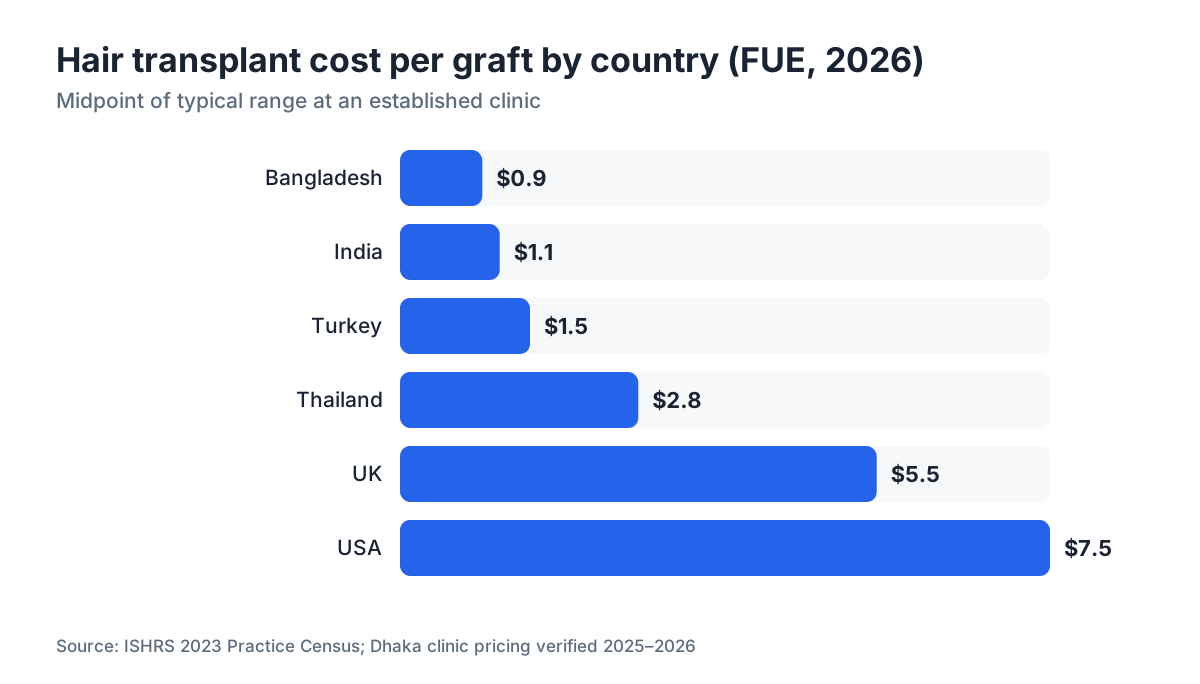
The honest answer is a range, not a number. Most established Dhaka clinics price FUE (follicular unit extraction) at 60 to 130 USD per 100 grafts, which works out to roughly $0.60, $1.30 per graft [1]. A small session of 1,500 grafts comes in around $900, $1,950. A larger 3,000-graft session for real crown or hairline work runs $1,800, $3,900. A few high-end clinics charge up to $1.50 per graft. That still sits far below the $4, $10 per graft common in the US or UK [2].
FUT (follicular unit transplantation, the strip method) costs slightly less, typically $0.40, $0.90 per graft, because it is faster for the surgical team. DHI (direct hair implantation, a variant of FUE using Choi pens) costs slightly more, often $1.00, $1.80 per graft, because it takes more hands and more time.
Those per-graft figures usually cover the procedure itself, local anesthesia, the first week of post-op medications, and one follow-up visit. What they often leave out: pre-op blood work ($20, $50), a hotel if you are traveling in from outside Dhaka, and any PRP (platelet-rich plasma) add-on the clinic pushes, which tacks on $100, $300.
Nobody publishes audited price surveys for Bangladeshi hair clinics. These figures come from aggregated patient reports on forums and clinic websites, cross-checked in early 2026. Treat them as a realistic guide, not a quote you can hold anyone to.
How does Bangladesh compare to other countries for hair transplant cost?
The price gap between Bangladesh and Western countries is not a rounding error. It is structural. Lower surgeon fees, lower overhead, lower staff wages. In the best clinics, none of that means lower product quality.
| Country | Avg. cost per graft (FUE) | Typical 2,500-graft session |
|---|---|---|
| Bangladesh | $0.60, $1.30 | $1,500, $3,250 |
| India | $0.80, $1.50 | $2,000, $3,750 |
| Turkey | $1.00, $2.00 | $2,500, $5,000 |
| Thailand | $2.00, $3.50 | $5,000, $8,750 |
| UK | $4.00, $7.00 | $10,000, $17,500 |
| USA | $5.00, $10.00 | $12,500, $25,000 |
Source: International Society of Hair Restoration Surgery 2023 Practice Census; Dhaka clinic pricing verified independently in 2025 to 2026 [2][3].
India and Turkey are the direct competitors for medical tourists. India has a bigger pool of board-certified dermatologic surgeons and more English-language aftercare. Turkey runs an enormous volume of transplants (an estimated 500,000 procedures per year as of 2023 [3]) and built its reputation on package pricing that folds in hotel and airport transfers. Bangladesh undercuts both on raw price. Its medical tourism infrastructure is thinner.
For Bangladeshi residents, the local price is the whole story. For someone flying in from the US or Europe, flights ($600, $1,200 return from Europe, $900, $1,800 from the US) still leave meaningful savings on larger sessions. On small ones, the gap narrows fast.
What factors push the price up or down?
The per-graft price is just the opening figure. Several things move the final bill.
Graft count is the biggest lever. Surgeons estimate graft needs by reading your donor density, the area to cover, and your Norwood stage (see receding hairline for how stages are classified). A Norwood III patient restoring a hairline might need 1,500 to 2,000 grafts. A Norwood VI patient chasing real coverage could need 4,000 to 6,000 grafts split across two sessions, which doubles or triples the cost.
Surgeon credentials move price, and they should. A clinic staffed by a fellowship-trained dermatologic or plastic surgeon charges more than one where technicians do the extractions and implantations with a doctor barely in the room. That gap shows up in your results. In Bangladesh, the rules around cosmetic surgery are looser than in the US or EU, so verifying credentials takes actual legwork: ask for the surgeon's MBBS and any specialty board certification, and confirm the hospital affiliation.
Technique matters too. FUT leaves a linear scar but allows large sessions in one sitting. FUE leaves dot scars and suits people who wear their hair short. DHI can pack grafts slightly denser in small areas. The price differences between them are real but secondary to who is holding the instruments. The hair transplant guide walks through the technique tradeoffs.
Clinic location within Dhaka nudges price. Clinics in Gulshan and Banani (the commercial and diplomatic zones) charge a premium over Dhanmondi or Uttara. That premium rarely tops 20 to 30% for comparable quality.
Then the add-ons. PRP therapy gets bundled in or offered as an upsell. The evidence that it improves transplant yield is mixed. A 2019 systematic review in the Journal of Cutaneous and Aesthetic Surgery reported positive outcomes across several small trials but flagged high heterogeneity between them [4]. Whether it earns its price is genuinely uncertain.
Is a cheap hair transplant in Bangladesh actually safe?
This is the right question, and the answer depends entirely on the clinic. A good one in Dhaka is as safe as a good one in London. A bad one anywhere can scar you for life.
Bangladesh has no dedicated hair restoration specialty board like the American Board of Hair Restoration Surgery. Surgeons doing transplants are usually trained in dermatology or plastic surgery and licensed under the Bangladesh Medical and Dental Council [5]. The council licenses physicians. It does not separately certify hair restoration surgeons, so the credential check lands on you.
The main risks in transplant surgery are infection, poor graft survival from rough handling, necrosis of the scalp (rare but serious), and cosmetically bad results, meaning an unnatural hairline or visible scarring. These risks exist in every country. They scale with how tightly a clinic runs sterile technique, how carefully grafts are stored between extraction and implantation (the window matters, ideally under 6 hours at a controlled temperature), and how much the surgeon knows about hairline aesthetics.
Red flags, walk away: a price quoted without a consultation or graft estimate, an unusually low flat fee (say, $500 for any session), technician-only procedures with no physician present, and no written consent or aftercare protocol.
Green flags: the surgeon performs and supervises the whole procedure rather than dropping in for a photo, the clinic sits inside or beside a recognized hospital, you can talk to former patients, written aftercare instructions come as standard, and follow-up visits are included.
If you are flying in for this, think hard about going home too soon. Most surgeons want you to wait at least 5 to 7 days before a long-haul flight, ideally 10 to 14, to let the grafts settle. That stretches the trip and adds hotel nights.
Want a rough sense of where your loss stands before any consultation? The free AI hair analysis at MyHairline reads a Norwood-stage estimate off a photo, which at least tells you the likely graft range before you walk into a clinic.
Which clinics in Dhaka are most reputable?
There is no independently audited ranking of Bangladeshi hair transplant clinics, so naming a specific one here would be irresponsible. What I can give you is the vetting framework.
Hunt for clinics whose surgeons have published or presented at international hair restoration meetings, especially the International Society of Hair Restoration Surgery (ISHRS) annual congress [3]. ISHRS membership guarantees nothing on its own, but it signals a surgeon who keeps up with peer standards.
Look for clinics tied to private hospitals recognized by the Bangladesh Private Medical College Hospital Association or a similar body [5]. Hospital affiliation means some institutional oversight and an emergency backup if something goes wrong on the table.
Patient photos should be plentiful and unfiltered. What you want is before-and-after shots with 12-month follow-up. Not 3-month photos, which show only the first flush of growth and hide the final density. Ask for the 12-month set by name.
Dhaka's cosmetic clinic scene has grown fast since 2018, and that growth pulled in both skilled surgeons and opportunists. Two or three hours of due diligence before your consultation is not excessive. It is the floor.
How many grafts will I need and how does that affect total cost?
Graft count is the arithmetic behind your bill, so it pays to understand it.
The scalp holds roughly 80,000 to 120,000 hairs for most people, at a natural density around 65 to 85 follicular units per square centimeter [6]. The donor zone (the back and sides) is genetically resistant to DHT, which is why grafts pulled from there keep growing after they move to balding areas. A healthy donor zone yields about 4,000 to 8,000 grafts over a lifetime before it runs thin, though that ceiling varies by person.
Typical graft requirements by Norwood stage:
| Norwood Stage | Hair loss pattern | Grafts typically needed |
|---|---|---|
| II, III | Mild temple recession | 800 to 1,500 |
| III Vertex | Early crown thinning | 1,000 to 2,000 |
| IV | Significant crown + hairline | 2,000 to 3,500 |
| V | Extensive thinning | 3,000 to 5,000 |
| VI, VII | Severe, large bald area | 4,000 to 7,000+ |
At Bangladesh prices ($0.60, $1.30 per graft), the cost by stage works out to roughly:
- Norwood II, III: $480, $1,950
- Norwood IV: $1,200, $4,550
- Norwood V, VI: $1,800, $9,100
The higher Norwood stages often need two sessions, because surgeon safety protocols cap single-session graft counts (usually 3,000 to 4,000 in a standard day-long procedure). Two sessions means two recovery periods, roughly 10 to 12 months apart.
Knowing your own Norwood stage is the first step to a realistic cost estimate. The receding hairline article has a visual guide to the stages.
What is the recovery process and what does it cost beyond the surgery?
Recovery is not free, even when the surgery is cheap.
The first days bring swelling around the forehead and eyes, usually peaking at days 3 to 5 and gone by day 10. Scabs form over the recipient area and shed by week 2 to 3. Then the transplanted hairs themselves shed in weeks 2 to 8. That is expected and called shock loss. It is not failure. New growth starts around months 3 to 4, real density shows at months 6 to 9, and the final result lands at 12 to 18 months [7].
Post-op medications usually include a topical antibiotic, a short course of oral antibiotics, and sometimes a short course of oral corticosteroids to knock down swelling. These add $15, $40 in Bangladesh if they are not bundled.
Most surgeons also want you continuing or starting minoxidil for men after a transplant to support the native hair around the grafts. Topical 5% minoxidil costs $10, $25 a month in Bangladesh. Finasteride, which suppresses DHT and helps protect your remaining native hair, is cheap generically at around $5, $15 a month locally. The combination of finasteride and minoxidil is the standard companion to any transplant for men with active androgenetic alopecia, because the transplant does nothing to stop your native hair from falling out.
That ongoing loss is exactly why younger patients (under 25) usually get told to wait. The pattern is still moving, and a result that looks good at 25 can look patchy at 35 as the non-transplanted hair keeps receding.
Traveling in from abroad? Add accommodation. Budget hotels in Dhaka run $25, $60 a night. Mid-range hotels in Gulshan or Banani run $60, $150 a night. A 10-day stay (the minimum sensible window for post-op monitoring before long travel) adds $250, $1,500 to the total, depending on how you like to sleep.
Does a hair transplant fix hair loss permanently, or will I need more treatment?
The transplanted grafts are permanent in one specific sense: they carry the DHT-resistant genetics of the donor zone, so they do not fall out the way miniaturized native hairs do. Place them well, get them through the post-op period, and they grow for life.
What a transplant does not do is stop androgenetic alopecia in the untransplanted areas. The native hairs around and behind the graft keep answering to DHT and keep miniaturizing. That is why a man who transplants at 28 and does nothing else often needs a second session by his late 30s, once the native hair that framed the work has thinned out around it.
Understanding the driver helps here. Androgenetic alopecia runs mostly on DHT (dihydrotestosterone) acting on genetically vulnerable follicles. Finasteride cuts serum DHT by roughly 60 to 70% and carries strong randomized-trial evidence for slowing loss and partially reversing miniaturization in men [8]. The FDA approved finasteride 1mg for male pattern hair loss in 1997. A DHT blocker like finasteride is, in plain terms, the most evidence-backed way to protect a transplant over time.
No one should sell a transplant as a one-and-done cure. Think of it as a reset. It puts hair where you have none, and the adjunct medications try to hold onto what is left. How often you need future sessions comes down to how aggressive your loss is, how early you start medication, and how much donor hair you have banked.
Are there non-surgical alternatives worth trying first?
Yes. For a lot of people they belong before surgery, not after.
For men with early loss (Norwood II, III), finasteride plus minoxidil has a real shot at stabilizing loss and producing modest regrowth, which can push a transplant back by years or take it off the table. Finasteride maintained or improved hair count in about 83 to 90% of men over two years in controlled trials [8]. Minoxidil works by a different route (vasodilation and potassium channel effects on the follicle cycle) and holds separate FDA approval for both men and women [9].
Here is the practical math: a year of both medications costs roughly $180, $480 in Bangladesh. That is a legitimate first move before spending $1,500, $3,000 on surgery, especially if your loss is still active and your pattern is still forming.
Low-level laser therapy (LLLT) devices carry FDA clearance for hair loss, but the effect size in trials is modest and the evidence is weaker than for finasteride and minoxidil [10]. I would not put my money there first.
Hair loss supplements, including biotin, saw palmetto, and blended products, have weak to no controlled evidence for androgenetic alopecia specifically. The hair loss supplements article covers the evidence in full. The short version: biotin deficiency is rare, and dosing above sufficiency probably does nothing; saw palmetto has thin evidence as a DHT inhibitor and nothing close to finasteride's trial record.
If your loss is diffuse rather than patterned, a transplant may not even fit. Diffuse thinning can point to telogen effluvium (temporary shedding from stress, illness, or nutritional gaps) or other systemic causes. Get a diagnosis before you commit to surgery. Working out what causes hair loss in your specific case matters more than the price tag on the procedure.
What questions should I ask a Bangladesh clinic before booking?
A good clinic will not flinch at these. A bad one will dodge.
- Who performs the extractions and implantations? The surgeon, technicians, or both? What is the ratio?
- What is the surgeon's specific training in hair restoration? MBBS plus what specialty? Any ISHRS membership or fellowship?
- What is your protocol for graft storage between extraction and implantation? What solution, what temperature?
- How many grafts do you typically extract in a single session? What survival rate do you estimate, and how do you measure it?
- Can I see 12-month follow-up photos from at least 10 to 15 patients with loss patterns like mine?
- What does the quoted price include and exclude? Write it down.
- What is your complication rate for infection and necrosis over the past 12 months?
- What aftercare support exists once I have left the clinic?
- If I am traveling from abroad, do you have hotel relationships near the clinic for patients?
- What is your refund or revision policy if the result comes in well below what was promised?
If a clinic cannot or will not answer 1, 2, 3, 5, and 6 clearly, keep looking. A second-opinion consultation costs almost nothing (most clinics offer free or low-cost initial consultations) next to the cost of a bad outcome you carry on your head.
What are the most common risks and complications?
Transplant surgery is low-risk in competent hands. Complications are still real, and worth knowing before you sign.
Infection shows up in an estimated 0.1 to 1.0% of procedures when sterile technique is followed [7]. It runs higher in clinics with sloppy protocol. Watch for redness, warmth, and discharge past the first few days. Oral antibiotics clear most cases; abscess formation is rarer and more serious.
Shock loss (telogen effluvium triggered by surgical trauma) pushes the transplanted hairs and sometimes surrounding native hairs to shed in the first 4 to 8 weeks. Expected, and usually temporary. Most transplanted hairs regrow. Permanent shock loss of native hair is rare but possible, mostly in areas where follicles were already miniaturizing.
Poor graft survival means a lower final count than you were sold. This is the top cause of patient disappointment, and it usually traces back to rough graft handling, implantation at bad angles, or grafts drying out during the procedure.
Scalp necrosis (tissue death) is rare, under 0.1% of cases, and brutal when it happens. Risk climbs with heavy smoking (which chokes circulation), very large sessions, and inexperienced surgeons who damage the blood supply.
Cosmetically poor results are the most common long-term regret: an unnatural hairline (too straight, too low, or angled wrong), overharvested donor zone that shows thinning, and cobblestoning (raised graft sites). These come down almost entirely to surgeon skill.
The FDA notes that hair transplant risks include scarring and infection, and advises patients to confirm the facility meets appropriate surgical standards [9].
How do I plan a hair transplant trip to Bangladesh from abroad?
If you are flying in from Europe, North America, or the Middle East just for the procedure, the logistics carry almost as much weight as the clinical pick.
Visa: most nationalities can get a Bangladesh visa on arrival for short stays, or apply through the Bangladesh e-visa portal [11]. Check your country's specific requirements at least 4 weeks out. The fee for a single-entry tourist visa is typically $51 USD.
Timing your flight: book so you land 1 to 2 days before the procedure, not the same morning. Sleep loss and dehydration from a long-haul flight work against healing. Most surgeons want pre-op blood work (complete blood count, coagulation screen), which may need to be done locally or sent ahead.
Accommodation: Gulshan-1, Gulshan-2, and Banani sit closest to most Dhaka clinics and are the most practical bases. Hotels range from $35 a night at the budget end to $150 a night for Westin or Le Méridien-level properties.
Post-op stay: plan a minimum of 7 days, ideally 10 to 14, before flying home. The first 5 to 7 days carry the most active healing and the highest risk of dislodging grafts through pressure changes, sweat, or a careless movement. Cabin pressure swings on long-haul flights worry surgeons; there is no strong evidence they harm grafts after day 7, but most surgeons play it safe.
Communication: English is reasonably common in Dhaka's professional medical sector, but confirm before booking that your surgeon and the clinic coordinator are genuinely comfortable in your language. A misunderstood aftercare instruction has real consequences.
Total cost estimate for a medical tourist (2,000-graft FUE, 10-day stay from Europe):
- Surgery: $1,200, $2,600
- Return flights (Europe-Dhaka): $600, $1,000
- Hotel (10 nights, mid-range): $700, $1,200
- Food, transport, visa: $200, $400
- Total: $2,700, $5,200
Set that against a 2,000-graft FUE in the UK ($8,000, $14,000 all-in) or the US ($10,000, $20,000). The savings hold up even after the full trip cost.
Sources
- International Society of Hair Restoration Surgery (ISHRS), ishrs.org
- ISHRS 2023 Practice Census, ishrs.org
- ISHRS Annual World Congress, ishrs.org
- Journal of Cutaneous and Aesthetic Surgery, ncbi.nlm.nih.gov/pmc
- Bangladesh Medical and Dental Council, bmdc.org.bd
- American Academy of Dermatology, aad.org
- StatPearls: Hair Transplantation, ncbi.nlm.nih.gov/books
- StatPearls: Finasteride, ncbi.nlm.nih.gov/books
- U.S. Food and Drug Administration, fda.gov
- Lasers in Surgery and Medicine, pubmed.ncbi.nlm.nih.gov