
TL;DR: Hair transplant problems run from minor (temporary shock loss, infection) to permanent (visible scarring, unnatural hairlines, dead grafts). Serious complications happen in under 4% of procedures done by qualified surgeons, per a 2021 JAAD review. Botched results are far more common at low-cost overseas clinics. Revision surgery, scar repair, and medication fix many bad outcomes. Some damage is permanent.
What does a hair transplant gone wrong actually look like?
A botched hair transplant is not one problem. It runs across a spectrum, from a hairline that sits slightly off to a scalp full of scarring with no new growth at all. Figuring out which category you fall into matters, because the fix changes completely depending on the cause.
The complaints that show up most in dermatology literature are these: unnatural hairline design, a visible plug or "doll hair" look, linear scarring from strip surgery (FUT), pitting or cobblestoning around grafts, widespread graft failure, and post-operative infections that killed follicles before they could take. [1]
There is a quieter failure mode that trips people up. A transplant can grow hair, but the wrong hair, set at the wrong angle, giving a hairline that does not move naturally or fit the face. That is a design failure, not a surgical one, and it is harder to correct than it sounds.
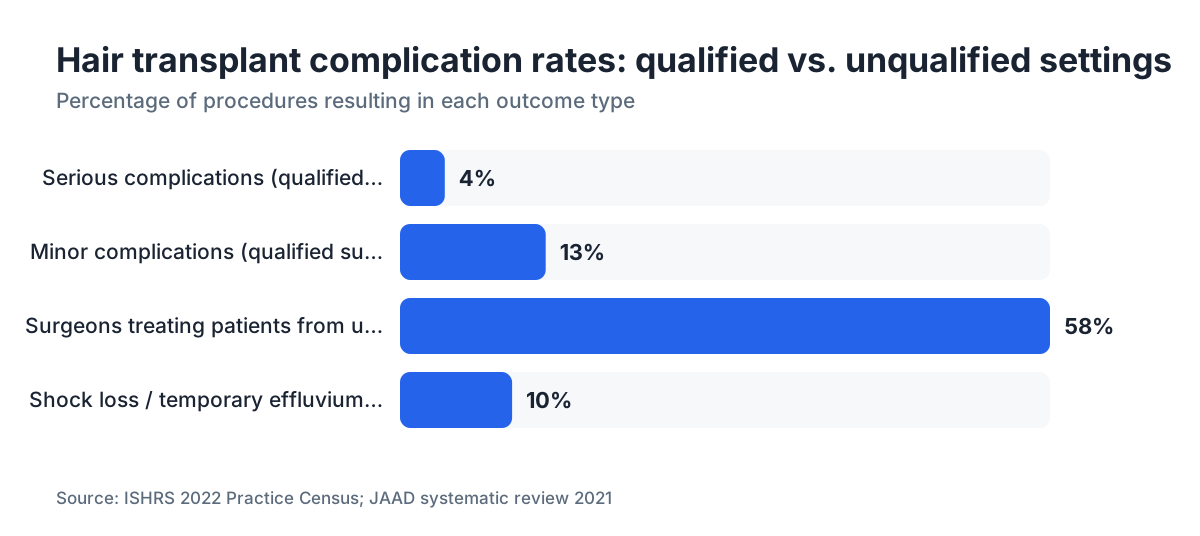
Shock loss belongs in its own bucket. Around 5% to 10% of patients shed transplanted hair in the first few weeks as follicles drop into a resting phase called telogen effluvium from the stress of surgery. Most of that hair grows back within three to six months. [2] It feels like a disaster when it happens. It usually is not. Telogen effluvium has a full explainer if you want the mechanism.
Permanent bad results, temporary bad results, and design failures. They look alike from the outside. The cause decides the treatment.
How common are hair transplant complications?
Real complication data is harder to pin down than you would think. The industry is fragmented, mostly self-reported, and stretches from board-certified restoration surgeons in the US to unlicensed technicians in overseas pop-up clinics.
A 2021 systematic review in the Journal of the American Academy of Dermatology pulled outcomes across multiple studies and found that serious complications, meaning the kind needing medical or surgical intervention, hit fewer than 4% of procedures done by qualified surgeons. [1] Minor problems like temporary swelling, folliculitis, or shock loss showed up more often, in roughly 10% to 15% of cases.
The International Society of Hair Restoration Surgery (ISHRS) keeps flagging a different figure. In their 2022 practice census, over 58% of hair restoration surgeons said they had treated patients who came in with botched procedures from unlicensed or unqualified facilities. [3] That does not tell you what share of all transplants go wrong. It tells you experienced surgeons see the damage constantly.
Turkey, Thailand, and parts of Eastern Europe sell transplants at a fraction of US or UK prices. Some of those clinics are excellent. Many are not. The core risk is structural: in high-volume discount clinics, the surgeon often designs the hairline and nothing else, while unlicensed technicians do the extraction and implantation. That split in responsibility is where most catastrophic outcomes start. [3]
Had a hair transplant and something feels off? The first move is figuring out whether what you see is normal healing or a real complication.
What are the most serious complications from a hair transplant?
Some outcomes hurt but pass. Others leave permanent damage. Here is what the literature and clinical reports actually document.
Visible scarring. FUT (strip) surgery leaves a linear scar at the donor site. Done well, it is thin and hides easily under surrounding hair. Done badly, it can be wide, raised, or hypertrophic, running ear to ear and showing at any hair length under a few inches. FUE leaves tiny circular scars, but when a surgeon overharvests, pulls follicles too densely, or uses the wrong punch size, the back of the scalp ends up moth-eaten and pitted. [1]
Graft failure and necrosis. Grafts that get mishandled, kept out of solution too long, set at the wrong depth, or planted into badly prepared recipient sites just die. Widespread failure leaves bald patches in the transplanted area and can add scarring. Necrosis, where skin tissue actually dies, is rare but real, mostly in huge single-day sessions run without proper blood supply planning. [4]
Infection. Post-operative infection can destroy follicles before they establish. Staphylococcal infections in particular are a real risk in facilities with weak sterilization. The FDA has logged adverse event reports tied to hair restoration procedures done in unsanitary settings. [5]
Scalp numbness or nerve damage. Damage to the greater occipital nerve or supratrochlear nerve can cause prolonged or permanent numbness, tingling, or pain across parts of the scalp. It shows up more with FUT but has been reported with FUE too. [4]
Effluvium in the native hair. Surgical trauma can shove existing, non-transplanted hair into the shedding phase. For patients with diffuse thinning instead of a stable donor zone, this can expose hair loss that was being hidden. Not technically a surgical complication, but a real consequence of operating on a scalp with fragile hair. [2]
Why does a transplanted hairline look unnatural?
Hairline design is the hardest part of a hair transplant, and it is pure artistic judgment. A surgeon who is technically sharp at extraction and implantation can still turn out a result that looks deeply wrong because the shape, density, or angle was miscalculated.
A natural hairline has features most people never notice on purpose: a slight irregularity along the front edge (not a razor-straight line), a gradual transition zone where single-follicle grafts hand off to two- and three-follicle grafts further back, and angles that match the direction native hair grows, which shifts zone to zone across the scalp. [1]
The old "plug" look from 1980s and 1990s work happened because surgeons dropped multi-follicle grafts (four to eight hairs per plug) into the front hairline, leaving unnatural clusters with visible scalp between them. Modern FUE avoids this when it is done right. But if a surgeon uses two- or three-follicle units at the very front edge, or sets grafts at the wrong angle, you get a hairline that moves oddly when the face moves, catches light wrong, or just looks placed instead of grown.
Placement is a separate problem from design. A hairline set too low for a patient's age or facial proportions looks unnatural right away and looks worse as surrounding native hair keeps receding over the next decade. A good surgeon protects the donor supply and plans for realistic long-term progression of hair loss. A surgeon chasing a patient's fantasy usually does not.
If the only issue is angle or direction, a second procedure adding correctly oriented grafts between the bad ones can sometimes soften the look. Redesigning a dramatically wrong hairline is a major revision.
What is shock loss after a hair transplant and is it permanent?
Shock loss, properly called post-operative effluvium, is the shedding of transplanted or native hair within two to eight weeks of surgery. The mechanism matches telogen effluvium: the physical stress of surgery, plus local inflammation and disrupted blood supply, pushes follicles out of the active growth phase (anagen) into the resting phase (telogen), and they shed.
For transplanted grafts, shock loss is common and almost always temporary. The follicle itself is alive and intact under the scalp. Regrowth usually starts between three and six months, with final results at twelve to eighteen months. [2]
For native hair, shock loss is the part to watch. If existing hair near the recipient or donor zone sheds and those follicles were already miniaturized by androgenetic alopecia, the shedding can be permanent, because the trauma just sped up an already-failing follicle. That is exactly why patients with active, progressive loss should already be on a stable regimen, usually finasteride and/or minoxidil for men, before any transplant. Staying on these after surgery protects native hair and may help graft survival, though the graft-survival evidence is observational, not from controlled trials.
The distinction patients need to hold onto: temporary shock loss feels like a catastrophe but is not. Permanent effluvium, where the hairline recedes behind or between the transplanted zones, is a genuine complication that needs a plan.
Can a bad hair transplant be fixed?
Sometimes yes, sometimes partly, sometimes no. The honest answer turns on what went wrong and how much donor hair you have left.
Repair procedures for botched transplants are among the most technically demanding cases in hair restoration. They call for a surgeon who specifically advertises and can document revision experience. Not every transplant surgeon does this work.
Here is how the different failure types get handled in practice:
FUT linear scar repair: Trichophytic closure, where the scar edge is trimmed so hair grows through it, can cut scar visibility a lot. FUE grafts placed straight into the scar tissue camouflage it further. Scalp micropigmentation (tattooing) is a non-surgical option for men who want to shave their heads. [6]
FUE overharvesting and pitting: If the donor area is depleted or damaged, options shrink. Body hair transplantation (BHT), using follicles from the beard or chest, can add to scalp donor supply, but body hair grows shorter and coarser and results vary. [6]
Graft failure in the recipient zone: If follicles genuinely died (not temporary shock loss), those sites can potentially be re-transplanted after enough healing, usually twelve months minimum. Scar tissue in failed recipient sites makes implantation harder and drops graft survival in revision cases.
Unnatural hairline: This is the most fixable of the bunch. Adding finer grafts in a transition zone, filling gaps, and softening the front edge with single-follicle units can dramatically improve a hairline that looks placed. It needs enough donor supply.
Depleted donor zone: This is the worst situation. Once follicles are gone, they are gone. Body hair is the only real alternative, and it has real limits. Some patients have no good repair option.
If you are sizing up your own case, get an analysis of your current donor density before you commit to revision. MyHairline's free AI hair scan at /scan gives you a baseline read on density and pattern, useful data to bring into any consultation with a revision surgeon.
What causes graft failure and how do you know if it happened?
Graft failure means transplanted follicles do not survive and grow hair. It differs from shock loss, where the follicle lives but sheds its hair for a while. True graft failure is permanent.
The causes split across surgeon error and patient factors:
Out-of-body time. Extracted follicles have to sit in a chilled, isotonic solution (usually Lactated Ringer's or saline with additives like ATP or ACELL) and get implanted inside a set window. Studies suggest graft survival drops off sharply after four to six hours out of body. [4] In high-volume single-day sessions of 4,000 grafts or more, the last grafts implanted may have been out of the body way too long.
Wrong implantation depth. Grafts set too shallow dry out and die. Too deep, and they sit in poor blood supply. Getting angle and depth right across thousands of tiny recipient sites takes skill that builds over years.
Smoking. Nicotine constricts blood vessels and cuts blood supply to healing skin. Multiple studies have found higher complication rates and lower graft survival in smokers. Most reputable surgeons require patients to stop smoking two to four weeks before and after surgery. [4]
Poor scalp vascularity. Patients with previous procedures, significant scarring, or underlying skin conditions may have reduced blood supply in recipient areas.
How you know it happened: at twelve to sixteen months, transplanted hair that is not growing is not going to grow. Shock loss resolves well before that. Bald areas in the transplanted zone past twelve months is graft failure. A trichoscopy exam (a scalp check with a dermatoscope) by a dermatologist can confirm whether follicles are present or absent.
What are the signs of a hair transplant infection?
Post-operative infection is uncommon in accredited facilities, but it is one of the more time-sensitive complications, because it can destroy grafts and cause scarring if you do not treat it fast.
Normal healing includes redness, mild crusting around grafts, and small pimples (folliculitis) in the first two to four weeks. All expected. Infection looks different: spreading redness, warmth, heavy swelling past the first 72 hours, pus or discharge, fever, or a wound pulling open. [5]
The FDA's MedWatch adverse event system has logged reports of infections after hair transplant procedures, including methicillin-resistant Staphylococcus aureus (MRSA) in cases tied to poorly sterilized instruments or non-sterile technique. [5] This shows up most with overseas clinics or places that skip proper surgical suite protocols.
Suspect infection? See a physician within 24 hours. Oral antibiotics usually handle early, localized infections. Wait too long and you risk abscess formation, follicle destruction, and permanent hair loss in the affected areas.
Prophylactic antibiotics are standard in most reputable clinics, prescribed for five to seven days after surgery. If your clinic did not give you any, that is a red flag about their standards.
How do you choose a hair transplant surgeon to avoid a bad outcome?
The biggest variable in your outcome is who does the procedure. Specifically, which parts they personally do.
The ISHRS recommends checking that your surgeon is a physician member of the ISHRS or a fellow of the American Board of Hair Restoration Surgery (ABHRS), which requires documented case experience and a passed board exam. [3] These credentials do not guarantee a good result. Their absence is a meaningful warning sign.
Ask straight out: who does the extractions and implantations? At many discount clinics, the answer is medical technicians or nurses with no surgical credentials. The surgeon may show up only for the hairline design and then leave. This is an industry-wide problem, not an overseas one. Some US chains run on the same model.
Photos matter, but look for donor-area photos, more than recipient-area shots. A shady clinic shows you the front of the scalp and nothing else. A surgeon confident in their harvest technique will show you close-ups of healed FUE extraction sites.
Before-and-after photos should include cases that look like yours: same degree of loss (look up Norwood scale staging), similar texture, similar age at procedure. Results on dense, coarse, straight hair look dramatically better than results on fine, curly hair, because of optical density. Make sure you are comparing the right cases.
Get at least two in-person or telemedicine consultations before you agree to anything. Any surgeon who pushes you to book at the first consultation, or dangles a big discount that expires today, is working against you.
What role does continuing hair loss play in a bad long-term result?
This is one of the most underrated causes of disappointing transplant outcomes, and it is not the surgeon's fault. Transplanted hair is permanent because the grafts come from the occipital donor zone, which is genetically resistant to dihydrotestosterone (DHT). But native hair in the recipient area keeps following its genetic programming. If it was going to thin and fall out, it will.
A patient who gets a transplant at 28 with heavy ongoing loss and no medical management may look great at 30, then watch his native hair thin behind and around the transplanted zone by 35. The transplanted hair sits there like an island of density surrounded by thinning, which often looks worse than if he had never had the transplant.
That is why pairing a transplant with a DHT blocker like finasteride is standard practice at most hair restoration societies for male patients with androgenetic alopecia. Finasteride does not protect transplanted hair (it does not need protecting), but it slows the loss of native hair around it, keeping the overall result intact. The finasteride and minoxidil combination has more outcome data behind it than either drug alone for this kind of maintenance.
A surgeon who agrees to transplant a 24-year-old with active diffuse loss and no talk of ongoing medical management is, in a real sense, building a failure. The surgical result can be technically perfect and still look terrible a decade later because the surrounding native hair was left unprotected.
Thinking about a transplant? Read about what causes hair loss first, specifically whether your current pattern is stable or still moving.
What should you do right now if your transplant looks wrong?
First thing: do not panic before twelve months are up. Results at six months look nothing like results at twelve to fifteen months. Shock loss, uneven growth, and visible grafts are all part of normal healing inside that window. Plenty of patients who are sure it failed at four months have excellent results at fourteen.
Document everything from day one. Take date-stamped photos in consistent lighting, same spot, same angle, every four weeks. That is useful data for any follow-up consultation.
Contact your original surgeon. Most reputable surgeons will see you for a follow-up at no charge and may offer corrective work if a failure is confirmed. Get that assessment in writing. If your surgeon is overseas or unresponsive, find a hair restoration dermatologist at home, someone affiliated with the ISHRS or the American Academy of Dermatology who takes revision cases. [7]
Suspect infection? See a physician immediately. That one is time-sensitive. Everything else can wait for the twelve-month mark and a meaningful assessment.
For ongoing management of native hair, your options are well-studied: topical minoxidil, oral minoxidil, finasteride, or a combination. None reverse a botched surgical result, but they protect what you have. Worth understanding minoxidil side effects and how oral minoxidil stacks up against topical before you start.
MyHairline's free AI hair scan (/scan) helps you see your current density and coverage pattern objectively, which gives you something concrete to bring to a revision consultation instead of trying to describe it out loud.
How much does it cost to fix a bad hair transplant?
Revision surgery costs more than primary surgery. Almost every time. The tissue is scarred, the donor supply is smaller, the cases run longer and demand more skill. Surgeons who are good at revision work know their worth and price for it.
Broad US ranges as of 2025: primary FUE transplants run roughly $4,000 to $15,000 depending on graft count and surgeon reputation. Revision work for scar repair or re-transplantation in failed areas runs from around $3,000 for a targeted small fix to $20,000 or more for full repair across multiple zones. [8]
Scalp micropigmentation, a non-surgical way to camouflage scars or add the look of density, typically costs $2,000 to $4,000 for a full scalp treatment in the US. It does not grow hair. It creates the look of shaved stubble and needs touch-ups every few years.
Insurance does not cover transplants or revisions in the vast majority of cases, since they are classed as cosmetic. There are narrow exceptions, like reconstructive surgery after burns or trauma, handled case by case.
Do the math. A patient who spends $2,500 at a discount overseas clinic and then needs $10,000 in revision work at home has paid more in total than if he had gone to a qualified surgeon at the start, and he lived with a bad result for a year or two in between. That is the real price of chasing the lowest number.
Sources
- Journal of the American Academy of Dermatology, Avram et al. systematic review on hair transplant complications (2021)
- American Academy of Dermatology, hair loss overview and telogen effluvium information
- International Society of Hair Restoration Surgery, 2022 Practice Census Results
- Dermatologic Surgery, Bernstein & Rassman review of follicular unit transplantation complications and graft survival factors
- U.S. Food and Drug Administration, MedWatch Adverse Event Reporting System
- Plastic and Reconstructive Surgery, Umar et al. on body hair transplantation and FUT scar repair techniques
- American Academy of Dermatology, find a dermatologist directory and hair loss resources
- ISHRS, hair restoration cost and pricing guidance for patients
- FDA, finasteride (Propecia) prescribing information and approved indication
- Journal of the American Academy of Dermatology, Adil & Godwin meta-analysis on minoxidil and finasteride combination therapy
- National Institutes of Health, MedlinePlus: hair transplant procedure overview
- Dermatology and Therapy, Dhurat & Saraogi review on growth factors and graft survival enhancement in hair transplantation