
TL;DR: FUE hair transplant graft survival averages 90 to 95% when an experienced surgeon handles and stores grafts properly. Rates fall below 70% with poor technique, long out-of-body time, or bad aftercare. Surgeon skill is the single biggest variable. What you do in the first two weeks after surgery matters almost as much.
What is FUE graft survival rate, and what does 90 to 95% actually mean?
Graft survival rate is the percentage of transplanted follicular units that take root, build a blood supply, and grow hair. Place 2,000 grafts, watch 1,800 grow, and your survival rate is 90%.
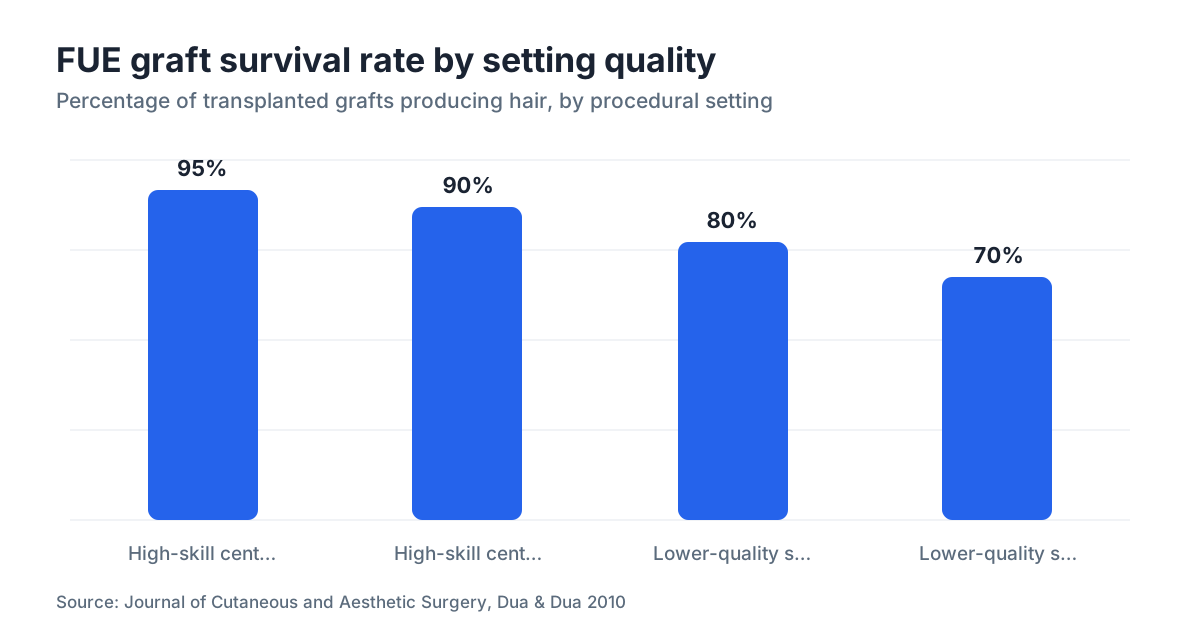
The 90 to 95% figure comes from published clinic audits and independent studies. A review in the Journal of Cutaneous and Aesthetic Surgery found survival in the 90 to 95% range at centers with strict graft-handling protocols, while lower-quality settings dropped to 70 to 80% [1]. That gap is huge in practice. On a 2,000-graft procedure, the difference between 95% and 75% survival is 400 grafts. That is the difference between a hairline that looks like it grew there and one that looks patchy.
Survival is not the same as immediate "take." Grafts that survive still spend the first two to four months looking like nothing happened. Most transplanted hairs shed three to six weeks after surgery as the follicles drop into a telogen rest phase (this is telogen effluvium, and it is normal). Real growth starts around month three to four. Full density takes 12 to 18 months to judge [2].
So when a clinic quotes a survival rate, ask when they measured it. At six months, most patients look thinner than they will at twelve.
How does FUE compare to FUT for graft survival?
FUT (follicular unit transplantation, the strip method) has traditionally held a slight survival edge because grafts spend less time outside the body. The strip stays in holding solution while technicians dissect individual units, which cuts total handling time.
FUE extracts each graft one at a time with a small punch. Every graft sits in solution from the moment it comes out until it goes in hours later. That longer out-of-body time is the main reason some studies show FUE survival running a few points behind FUT when everything else is held equal [3].
Skilled FUE teams close most of that gap with better holding solutions (more below) and faster extraction-to-implantation workflows. For most patients, the final result from a good FUE surgeon and a good FUT surgeon is close. The real choice comes down to scarring: a linear scar with FUT, scattered pinpoint scars with FUE, and how short you plan to wear your hair.
| Method | Typical survival rate | Scar type | Recovery |
|---|---|---|---|
| FUE | 90 to 95% (skilled hands) | Tiny circular scars | 7 to 10 days |
| FUT (strip) | 92 to 97% (skilled hands) | Linear scar | 10 to 14 days |
Data from published clinical reviews [1][3].
What factors most affect FUE graft survival rate?
Several variables stack on top of each other. Some belong to the surgeon. Some belong to you.
Surgeon and technician skill. This is the big one. Extraction angle, punch size, depth control, and speed decide how many grafts come out whole versus transected (damaged at the root). Transection under 5% is excellent. Above 10%, it eats into your final result [1]. Extraction is the most skill-dependent step in the whole procedure.
Out-of-body time. Every minute a graft sits outside the scalp, it is ischemic, meaning no oxygen and no nutrients reaching it. Grafts left in plain saline for more than six hours at room temperature show measurable cell death [4]. A clinic running one very long session with thousands of grafts and a slow team is taking a real gamble here.
Holding solution quality. Plain saline keeps grafts alive for a few hours. Better solutions stretch that window. ATP-containing solutions and hypothermic storage (chilling grafts to about 4°C) cut cell damage during the wait [4]. HypoThermosol and similar commercial solutions can extend safe out-of-body time to eight hours or more in lab settings. Ask what your clinic uses.
Graft dehydration. Grafts dry out fast under surgical lights. Good teams keep extracted grafts misted and move quickly. A dehydrated graft can still look intact while its cells are already dying.
Recipient site creation. The density, angle, and depth of the tiny slits where grafts go decide whether each graft gets enough blood supply and whether the result looks natural. Sites packed too tightly starve neighboring grafts.
Patient age and donor density. Younger patients with thick, dense donor hair tend to do better. Age-related changes in scalp blood supply and donor quality both matter [2].
Scalp health at baseline. Active seborrheic dermatitis or scarring from prior procedures makes both extraction and implantation harder and can lower survival.
How does out-of-body (ischemia) time damage grafts, and what is the safe window?
A hair follicle is a living structure that needs a steady blood supply. Once it is out and sitting in a dish, it runs on whatever oxygen and ATP it already holds. At room temperature, that reserve burns off in a few hours.
A study in Dermatologic Surgery found a statistically significant drop in graft viability once out-of-body time passed four to six hours without added ATP or cold storage [4]. At eight or more hours in plain saline at room temperature, viability fell sharply.
Cold storage slows cell metabolism and buys a lot more time. Most published protocols keep grafts at 4 to 8°C in a nutrient-supplemented solution. Some centers use platelet-rich plasma (PRP) as a holding medium, arguing that its growth factors prime the grafts, though the evidence for PRP as a storage solution is thinner than the marketing lets on [5].
The practical takeaway is simple. A procedure that extracts, implants, and finishes within four to five hours using a cold, well-supplemented solution is safer than a marathon eight-hour session in warm saline. Megasessions of 3,000 grafts or more need a well-drilled team to keep those timelines under control.
What should you do after surgery to protect graft survival?
The first 14 days are when grafts are weakest. They have no blood supply yet and hold on with nothing but a thin fibrin clot. Break that clot, whether by touch or by swelling, and grafts can pop out before they anchor.
Most surgeons give near-identical instructions because the physiology does not change from clinic to clinic.
Do not touch the recipient area for 5 to 7 days. No rubbing, no pillow pressure, no hats pressing down on the grafts. Sleeping at a 45-degree incline for the first few nights keeps forehead swelling from pushing fluid into the transplant zone.
Skip strenuous exercise for 2 weeks. Higher blood pressure raises scalp bleeding and can dislodge grafts. Sweat saturates the scalp and softens those fibrin anchors.
No alcohol for at least 5 to 7 days. Alcohol widens blood vessels and thins the blood. Both raise bleeding risk in the early days.
Do not smoke. Nicotine constricts blood vessels and cuts tissue perfusion. Smoking is one of the clearest predictors of poor wound healing in the surgical literature, and surgeons routinely ask patients to quit for at least two weeks before and after [6].
Follow the washing protocol exactly. Most clinics start gentle saline sprays on day one to stop crusts from forming. Dry, crusted grafts invite infection, and picking at a crust can rip a graft out with it.
Watch sun exposure. Direct UV on healing recipient sites can cause hyperpigmentation and inflammation. After day 10, a loose hat that does not press on the grafts or SPF 50 applied around (not on) the transplant zone is the usual advice.
Does minoxidil or finasteride improve graft survival?
This comes up constantly, and the honest answer has two parts.
Minoxidil does not directly protect grafts in the mechanical sense. Grafts live or die based on the first days after surgery. But some surgeons prescribe minoxidil starting two to four weeks post-op to shorten the telogen rest phase and speed up visible growth. A small randomized trial found patients using topical minoxidil after transplant showed visible growth earlier and somewhat better density at six months than controls [7]. The effect on 12-month outcomes was less clear. If you were already on minoxidil for men before surgery, most surgeons tell you to keep going.
Finasteride works differently. It does not protect transplanted grafts, which are generally DHT-resistant because they keep the genetic programming of the occipital donor zone. But finasteride matters a lot for the native hair you still have. If you have pattern hair loss and you skip finasteride after a transplant, you keep losing the non-transplanted hair around the grafts, and your overall result looks worse over the years even if every single graft survived [8]. The transplanted grafts are permanent. Everything else is not.
Running finasteride and minoxidil together post-transplant is what most hair loss specialists do for their patients with androgenetic alopecia, and often for themselves. That pairing covers both jobs: minoxidil for faster growth in the transplanted area, finasteride for keeping the rest of the scalp.
What is a realistic number of grafts per session, and does mega-session size hurt survival?
A typical FUE session runs 1,500 to 3,000 grafts. Sessions above 3,000 grafts in one day are megasessions, sold by some clinics as a way to finish faster or lower the cost per graft.
The worry with megasessions is simple. More grafts means longer out-of-body time for the ones pulled early. If a clinic is extracting graft number 2,800 near hour seven, that graft has been sitting in solution far longer than graft number one.
A well-organized clinic with several trained technicians working in parallel can blunt this. An understaffed clinic offering 4,000-graft sessions at a deep discount is risking real attrition in the late-extracted grafts. Ask how many technicians will be in the room and what their holding-time protocol is.
Donor depletion is the other megasession risk. Every follicle extracted is gone from the donor area for good. Over-harvesting one zone leaves it thin and creates a problem if you want a second procedure years later as your hairline keeps receding. A good surgeon plans across your whole lifetime of likely loss, more than the session in front of them. Understanding what causes hair loss in your own case is the right place to start that conversation.
How do you evaluate a clinic's claimed survival rate before surgery?
A clinic that tells you its survival rate is 95% or higher may be telling the truth. The problem is you cannot verify it in advance, and it is not even the sharpest question to ask.
Here is what actually tells you something.
Transection rate, not survival rate. Ask the surgeon their average transection rate, the percentage of grafts damaged during extraction. Under 5% is excellent. Many skilled surgeons can quote their number from memory. A clinic that cannot answer has probably never measured it.
Before-and-after photos at 12 months. Results at six months look worse than at twelve. Any clinic leaning on six-month photos as its main evidence is either showing the least flattering version of a good result or hiding a bad one. Look at hairline cases close to your own Norwood stage. You can check your stage against a receding hairline reference guide.
Who does the extractions. At some high-volume clinics, technicians do most or all of the extractions while the surgeon handles only implantation or recipient site creation. This is contested. Technician extraction is not automatically bad (experienced techs can be excellent), but you should know whose hands are on your head.
Published peer-reviewed work. A handful of surgeons have published their outcomes in indexed journals. Publication is not the only mark of quality, but it shows a surgeon willing to be held to a standard.
Myhairline's free AI scan (/scan) reads your current loss pattern and helps you frame the right questions about which zones need coverage, giving you a baseline before any consultation.
Can a failed graft zone be repaired, and what does that cost?
Yes, failed zones can usually be repaired. It is expensive, slow, and not always fully fixable.
If survival was poor across the board (say, below 70%), the standard move is a second FUE session targeting the same zones once the scalp has fully healed, which takes at least 12 months. Scar tissue from the first procedure makes donor extraction a bit harder and recipient implantation more variable the second time.
If failure was patchy, some zones took well and others did not, targeted fill sessions handle the specific areas. These are smaller and easier to plan.
Repair cost swings widely. In the US, FUE pricing runs roughly $5 to $10 per graft at quality practices [9]. A 1,500-graft repair session therefore runs about $7,500 to $15,000. Some clinics discount or guarantee repeat procedures, but free repeats are rare and usually come wrapped in fine print about what counts as a qualifying failure.
The better investment is getting the first surgery right. Picking a surgeon on price alone is the most reliably bad decision in this space.
What role does the recipient site (scalp receiving grafts) play in survival?
A large one, and patient-facing discussions rarely give it enough weight.
The recipient site is the tiny incision each graft goes into. Its angle sets whether the hair grows in a natural direction. Its depth sets whether the follicle bulb lands at the right layer of the dermis. Its density sets whether neighboring grafts fight each other for blood supply.
Too shallow, and the bulb sits too high and never connects to the dermal papilla blood supply it needs. Too deep, and the graft can migrate or form cysts. Too many sites crammed into too small an area in one session, and the blood supply to that zone collapses, dragging survival down across the whole dense patch.
Angle matters more cosmetically than biologically. Hair growing at the wrong angle looks wrong no matter how many grafts survived.
Recipient site creation is often the part the surgeon does personally, even at clinics where technicians run extraction. Some surgeons use pre-loaded implanter pens (Choi implanters) that combine site creation and graft placement in one motion, which shrinks the window between opening a site and filling it and can improve survival in dense-packing cases.
Scalp laxity and old scarring in the recipient zone also shape outcomes. Patients with prior procedures or scarring alopecia get less predictable take and should be counseled honestly about it.
Does DHT affect transplanted grafts, and do you need a DHT blocker after surgery?
Transplanted grafts come from the occipital (back of the scalp) donor zone, generally treated as permanent because those follicles are genetically DHT-resistant. This is donor dominance theory, and it is why transplants last even in men who keep losing hair elsewhere.
DHT-resistant does not mean DHT-proof. Some long-term evidence suggests that in men with very aggressive androgenetic alopecia, or with grafts placed at the edges of the stable donor zone, a fraction of transplanted hair can thin over decades [8]. That is the exception, not the rule.
Where DHT absolutely bites post-transplant is in the native hair around the grafts. If you are a Norwood 3 on the day of your transplant and you do nothing about DHT, you can progress to a Norwood 5 over the next decade, leaving your transplanted frontal hairline stranded on bald scalp with no grafts behind it. The transplant looks more artificial every year, not because the grafts failed but because everything around them fell out.
A DHT blocker like finasteride is the standard recommendation for stopping that slide. The evidence for finasteride in slowing androgenetic alopecia is strong: the original FDA approval trials showed a statistically significant slowing of hair loss and modest regrowth versus placebo in men with male pattern hair loss [10].
What does shock loss mean, and is it the same as graft failure?
Shock loss is not graft failure. Knowing the difference will save you months of needless panic after surgery.
Shock loss (also called effluvium) is the shedding of existing native hair in and around the transplant zone, set off by the trauma of surgery. The follicles are not destroyed. They drop into a temporary telogen phase and grow back. Shock loss usually shows up two to eight weeks after surgery and clears by month four to six [2].
Graft failure is different. A failed graft is one that will never grow because the follicle died during or shortly after implantation. You tell them apart by what sheds. Normal post-op shedding produces hairs with a small white telogen bulb attached. Graft failure shows up as zones with no new growth at all by month six to nine, with no sign the follicle is even trying to cycle.
Some temporary shock loss to existing hair is close to universal in the recipient zone. It is more common and more obvious in patients who had good density going in, because there were simply more native hairs to shock. Oddly, some patients with advanced loss see less shock loss, because there was less native hair left to lose.
If you are seeing diffuse shedding several months out and worrying it means something permanent, reading up on telogen effluvium will walk you through the mechanism.
Sources
- Journal of Cutaneous and Aesthetic Surgery, Dua & Dua 2010 (survival rate and transection review)
- American Academy of Dermatology, Hair loss: Diagnosis and treatment
- Dermatologic Surgery, Rassman et al. 2002, FUE technique description and outcomes
- Dermatologic Surgery, graft ischemia and storage study
- International Journal of Trichology, PRP in hair transplantation review
- National Institutes of Health, National Library of Medicine, smoking and wound healing
- Dermatologic Surgery, Avram & Rogers 2009, minoxidil post-transplant randomized trial
- International Society of Hair Restoration Surgery, donor dominance and long-term outcomes
- American Board of Hair Restoration Surgery, cost overview
- U.S. Food and Drug Administration, finasteride (Propecia) approval and labeling