
TL;DR: In the United States, hair transplant grafts run $3 to $10 each. Most FUE procedures land between $5,000 and $15,000 total, and larger sessions reach $20,000 to $30,000. The per-graft price shifts with technique, clinic location, surgeon experience, and how many grafts you need. Insurance won't touch it. Overseas clinics charge far less and carry real risks.
What does hair transplant cost per graft actually mean?
When a clinic quotes a per-graft price, they mean the cost of each follicular unit they move from your donor area to your thinning areas. A follicular unit is a natural cluster of one to four hairs, so one graft might give you a single hair or it might give you four. Most surgeons count grafts, not individual hairs, when they price the job.
This matters. Two clinics can both quote 2,000 grafts and mean completely different things about how full your result looks, depending on average graft size and how they select and place them. Ask what the average hairs-per-graft is in your quoted session.
The math is simple. If a clinic charges $6 per graft and your surgeon estimates 2,500 grafts, your total is $15,000 before any facility or anesthesia fees. Some clinics bundle everything. Others tack on charges for the operating room, PRP treatments, or post-op medications. Get an itemized quote in writing.
What is the average cost per graft in the US right now?
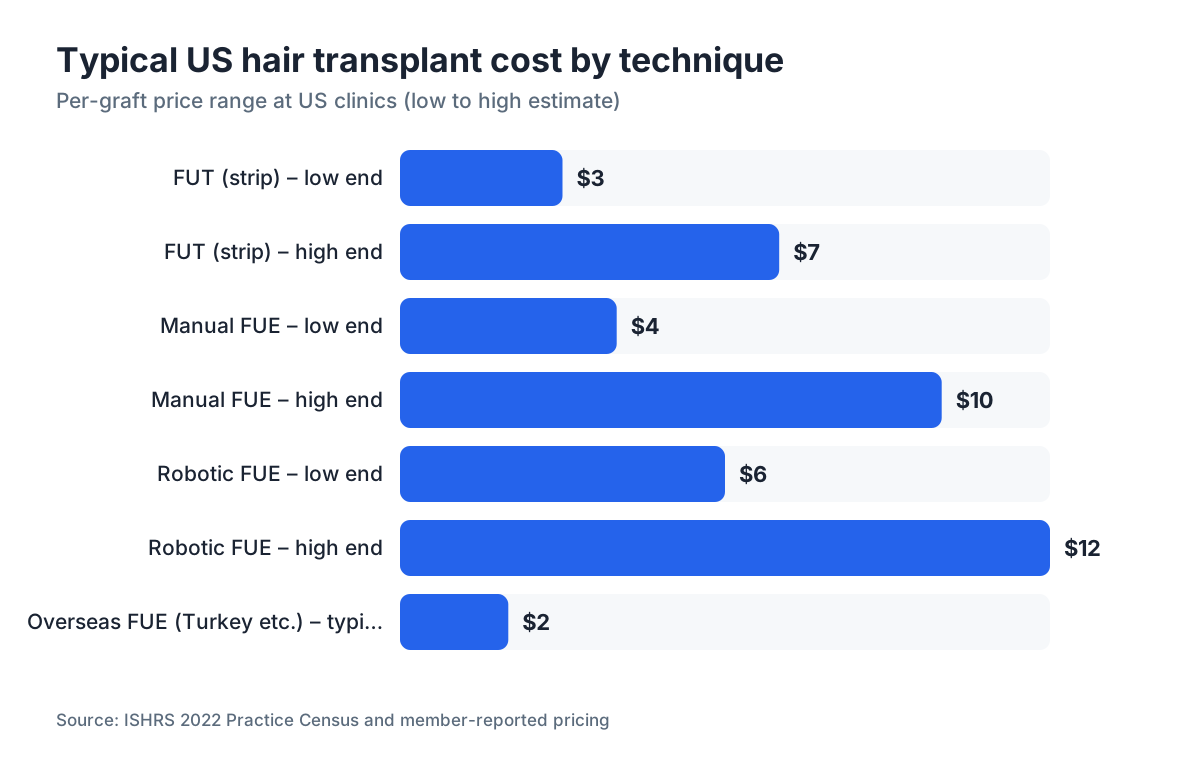
Across American hair restoration clinics, the per-graft rate usually falls between $3 and $10, with most reputable FUE surgeons charging $4 to $8 [1]. Strip (FUT) procedures come in a dollar or two lower per graft because the extraction step is faster for the surgeon. Robotic-assisted FUE, like the ARTAS system, often runs at the higher end, sometimes $8 to $12 per graft, because the equipment is expensive.
Those numbers put a typical FUE session of 2,000 to 3,000 grafts at roughly $8,000 to $24,000. A patient rebuilding a fully receded hairline who needs 4,000 or more grafts can easily clear $25,000 at a major US clinic [2].
FUT strip procedures average somewhat less. The International Society of Hair Restoration Surgery's 2022 practice census found average global session prices near $14,000 USD for FUE and about $8,500 USD for FUT, though US prices skew above those global averages [2].
One honest note. Nobody publishes a US-specific price database updated every year. The ISHRS practice census is the closest thing to an industry-wide benchmark, and even that is self-reported by member surgeons. Local variation is real and large.
How does the technique (FUE vs FUT vs robotic) change the price?
The biggest technical split is FUE (follicular unit excision) versus FUT (follicular unit transplantation, also called strip surgery).
With FUT, a surgeon cuts a strip of scalp from the back of your head, dissects it into individual grafts under microscopes, and closes the donor site with sutures. It leaves a linear scar but allows large graft counts in one session. Because the extraction step is less labor-intensive per graft than FUE, FUT typically runs $3 to $7 per graft in the US.
With FUE, grafts are punched out one by one with a small circular tool, leaving tiny dot scars instead of a line. It takes more time and more surgeon or technician attention per graft. That's why FUE runs $4 to $10 per graft at most US practices, sometimes more.
Robotic FUE (ARTAS or similar systems) uses image-guided robotics for the extraction step. Some clinics charge a premium of $1 to $3 per graft here because the machine costs a lot to buy and maintain. Whether robotic extraction beats skilled manual FUE is genuinely debated. A 2018 comparative study found no statistically significant difference in graft survival between robotic and manual FUE [3]. If a clinic charges a big premium for robotic assistance, ask what evidence they have for better outcomes at their own practice.
| Technique | Typical US range per graft | Scar type | Best for |
|---|---|---|---|
| FUT (strip) | $3, $7 | Linear line | Large sessions, budget-conscious, shorter hair not a concern |
| Manual FUE | $4, $10 | Tiny punch dots | Buzz-cut wearers, smaller sessions |
| Robotic FUE | $6, $12 | Tiny punch dots | Patients who want tech-assisted extraction |
| DHI / implanter pen | $5, $10 | Tiny punch dots | High density needs, some clinics charge more |
Why does surgeon experience and location change the price so much?
A board-certified surgeon who has done thousands of procedures, publishes results, and has a wait list charges more. That's supply and demand. At the top of the US market you'll find surgeons billing $8 to $12 per graft, and their results often justify it, because graft survival rate, hairline design, and natural placement swing enormously with skill.
Location drives cost too. New York, Los Angeles, Miami, and other high cost-of-living metros tend to run 20 to 40 percent higher than practices in mid-sized cities, even for the same caliber of surgeon. Rent, malpractice insurance, and staff salaries all feed into per-graft pricing.
Some of the lowest US prices, sometimes $3 to $4 per graft, come from newer surgeons building a patient base or clinics that lean heavily on technicians for the implantation step rather than the surgeon. That's not automatically bad. But you should ask exactly who is performing each step of your procedure. In many states, no specific law prevents non-physician technicians from performing parts of a hair transplant, which is a real regulatory gap [4].
If you're comparing quotes, the right question isn't "who charges less per graft." It's "who charges less per graft for the same level of surgeon involvement and demonstrated result quality."
How many grafts do you actually need, and how does that change total cost?
Your Norwood scale stage is the starting point for estimating graft needs. A Norwood II or III with mild recession might need 1,000 to 2,000 grafts. A Norwood V or VI covering large areas of the crown and top might need 4,000 to 6,000 or more, sometimes across multiple sessions [5].
Graft count interacts with per-graft price in a useful way. Many clinics use a sliding scale, charging less per graft for larger sessions. A clinic might charge $7 per graft for the first 2,000 and $5 per graft for grafts 2,001 through 4,000. So your per-graft cost can actually drop as your session grows, even as your total bill climbs.
Donor density matters here too. Some patients simply don't have enough donor hair to reach the coverage they want, no matter the budget. A surgeon should assess your donor area density, scalp laxity (for FUT), and projected future loss before locking in a graft count. Spending $15,000 on grafts while your native hair keeps thinning without finasteride or minoxidil for men is a common and expensive mistake.
| Norwood Stage | Approximate grafts needed | Rough US cost range |
|---|---|---|
| II, III (early recession) | 800 to 2,000 | $4,000, $16,000 |
| III, IV (moderate thinning) | 2,000 to 3,500 | $10,000, $28,000 |
| V, VI (significant loss) | 3,500 to 6,000+ | $17,000, $50,000+ |
These ranges come from ISHRS published guidance and surgeon estimates widely reported in peer-reviewed literature [2][5]. Individual anatomy varies. Treat these as planning figures, not quotes.
Does going overseas save money, and what are the real risks?
Yes, it saves money. A lot of it. Turkey is the most common destination, where FUE often runs $1,500 to $4,000 for a full session, roughly $0.75 to $2 per graft at some clinics [2]. Other popular spots include India, Thailand, and Mexico, with per-graft prices typically $1 to $4.
The savings are real. So are the risks.
The regulatory environment differs. Turkish hair clinics operate under Health Ministry oversight, but enforcement quality and the training requirements for performing transplants vary. Some clinics in popular medical tourism hubs market hard and push very high patient volumes with heavy technician reliance.
Recourse is the second problem. A botched hairline design, visible scarring, low graft survival, or infection is much harder to manage when your surgeon is in another country. Revision surgery, if you need it, costs you again.
Follow-up is the third. Hair transplant results develop over 12 to 18 months. Having a surgeon you can actually sit in front of if something worries you is worth something.
Some overseas clinics produce excellent results, and dismissing all medical tourism isn't honest. The real issue is variance. The upside is a good result at a fraction of US cost. The downside is a failed or distorted transplant that needs expensive revision. If you go this route, verify the specific surgeon's credentials and portfolio, more than the clinic's brand.
If you want a preliminary sense of how much loss you're dealing with before booking a consultation, MyHairline's free AI hair scan (/scan) can help you map your current pattern and identify your likely Norwood stage.
What hidden fees push the final bill higher than the per-graft quote?
The per-graft price rarely tells the full story. Here are the fees that regularly show up as line items after the initial quote.
Consultation fees: Some high-end practices charge $100 to $500 for a surgical consultation, sometimes credited toward the procedure. Many practices offer free consultations.
Anesthesia and sedation: Local anesthesia is standard and usually included. Oral or IV sedation for anxiety can add $300 to $1,000.
Facility fees: Separate operating room or surgical suite fees sometimes add $500 to $2,000, especially at hospital-affiliated practices.
PRP (platelet-rich plasma): Many clinics offer PRP injections at the time of surgery to potentially improve graft survival. Evidence is mixed [6]. This often costs $500 to $2,000 extra.
Post-op medications: Antibiotics, anti-inflammatory drugs, and minoxidil are sometimes included, sometimes not. Budget $100 to $300 if not.
Travel and lodging: If you're traveling to the clinic, multi-night stays add up. Medical tourism packages to Turkey or India often bundle hotel and transport, which is part of their pitch.
Always ask for a written itemized estimate showing the graft count, per-graft rate, all additional fees, and what's specifically excluded. A clinic that resists this is a red flag.
Does insurance cover hair transplant surgery?
Almost never. Health insurance classifies hair restoration surgery as cosmetic for the overwhelming majority of patients, which puts it outside coverage [7]. There are narrow exceptions. If hair loss results from burns, trauma, or certain documented medical conditions, some insurers may cover reconstructive procedures. Alopecia areata and androgenetic alopecia are not covered.
HSA (Health Savings Account) and FSA (Flexible Spending Account) funds generally can't be used for cosmetic procedures under IRS rules, so a hair transplant for pattern baldness wouldn't qualify [8].
Financing is available through most clinics via third-party lenders like CareCredit or Prosper Healthcare Lending. They offer promotional zero-interest periods (often 12 to 24 months) but flip to high interest (often 26 to 30 percent APR) if the balance isn't paid off by the end of the promo window. Read the terms.
If cost is a real barrier, here's the honest comparison. Finasteride and minoxidil for men together cost roughly $30 to $100 per month and have clinical evidence behind them from FDA-approved indications [9][10]. For many patients, medication can slow or partly reverse loss without the $10,000+ outlay. A transplant works best as a complement to medication, not a replacement for it.
How do you compare quotes from different clinics fairly?
The number on the quote sheet is nearly useless without context. Here's what to standardize across clinics so you're actually comparing the same thing.
Get the same estimated graft count from each. Surgeons often disagree on how many grafts you need, sometimes by 500 to 1,000, which swings the total dramatically. If one surgeon says 1,800 and another says 2,800, ask both to explain their reasoning based on your donor density and coverage goals.
Ask who performs each step. In the ideal case, the surgeon performs or directly supervises extraction and places the grafts. In volume clinics, technicians often handle implantation. Neither is automatically wrong, but you should know what you're buying.
Ask about graft survival rate from their own patient data. Some clinics publish survival rates of 90 to 95 percent for FUE. Others won't tell you. This matters more than the per-graft price.
Check credentials. The American Board of Hair Restoration Surgery (ABHRS) and the International Alliance of Hair Restoration Surgeons (IAHRS) maintain member directories of surgeons who meet minimum training and procedural standards [11].
Look at before and after photos from patients whose hair loss matches yours, ideally with documented graft counts. Ask to speak with past patients if you can. Most reputable practices can arrange it.
For a fuller look at what the procedure involves and what realistic outcomes look like, the hair transplant overview is worth reading before any consultation.
Does the per-graft price tell you anything about quality?
Somewhat, but not as much as people assume. Very low prices, say under $2 per graft at a US clinic, are a genuine warning sign. Harvesting, sorting, storing, and implanting grafts well takes skilled labor and time. If a clinic prices below what that labor costs, something is being cut.
High prices don't guarantee quality either. Some expensive clinics have mediocre results. Price is a floor indicator, not a ceiling guarantee.
The most predictive factors of a good outcome, based on peer-reviewed evidence, are graft survival rates, surgeon skill in designing the hairline (which is aesthetic judgment as much as technical skill), and proper graft handling and storage during the procedure [12]. None of those show up on a price sheet.
A $6 per graft surgeon with 90+ percent graft survival and 15 years of documented results beats a $4 per graft clinic with 70 percent survival and thin before-and-after documentation. Do the math. If a $4/graft clinic loses 30 percent of your grafts and you paid for 2,500, you're effectively paying $5.70 per surviving graft and getting a worse result.
If you're still early in understanding your hair loss, reading about what causes hair loss and receding hairline patterns can help you figure out what kind of transplant, if any, even makes sense for you.
What should you do before committing to a procedure?
See at least two surgeons for in-person or video consultations before deciding. Consultations are free or low-cost at most practices, and the gap between the recommendations you get will tell you a lot.
Get on a medical hair loss treatment if you aren't already. A transplant into a field of continuing loss is a temporary fix. The American Academy of Dermatology recommends finasteride and minoxidil as first-line treatments for androgenetic alopecia [13]. Starting these before or alongside a transplant protects your native hair and may improve transplant outcomes. If side effects worry you, read up on finasteride and minoxidil together.
Be realistic about timeline. Results take 12 to 18 months to fully appear. You'll shed the transplanted hairs in the first few weeks, look roughly the same as before surgery for several months, and see gradual improvement from month four onward. Expecting dramatic results at three months leads to needless panic.
If you have a condition like telogen effluvium causing temporary shedding rather than permanent loss, a transplant may not be appropriate at all until the underlying cause is resolved.
MyHairline's free AI hair analysis (/scan) can give you a starting point for understanding your current loss pattern and Norwood stage before you walk into a clinic, so you're not starting from zero.
Sources
- International Society of Hair Restoration Surgery (ISHRS) - Patient Resources
- ISHRS 2022 Practice Census
- Journal of Cutaneous and Aesthetic Surgery - Robotic vs manual FUE comparison (2018)
- American Board of Hair Restoration Surgery - Standards and Credentials
- American Academy of Dermatology - Hair Loss: Diagnosis and Treatment
- Dermatologic Surgery - PRP for hair loss systematic review
- HealthCare.gov - What Marketplace health plans cover
- IRS Publication 502 - Medical and Dental Expenses
- International Alliance of Hair Restoration Surgeons (IAHRS) - Surgeon Directory
- Journal of the American Academy of Dermatology - Follicular unit transplantation outcomes review