
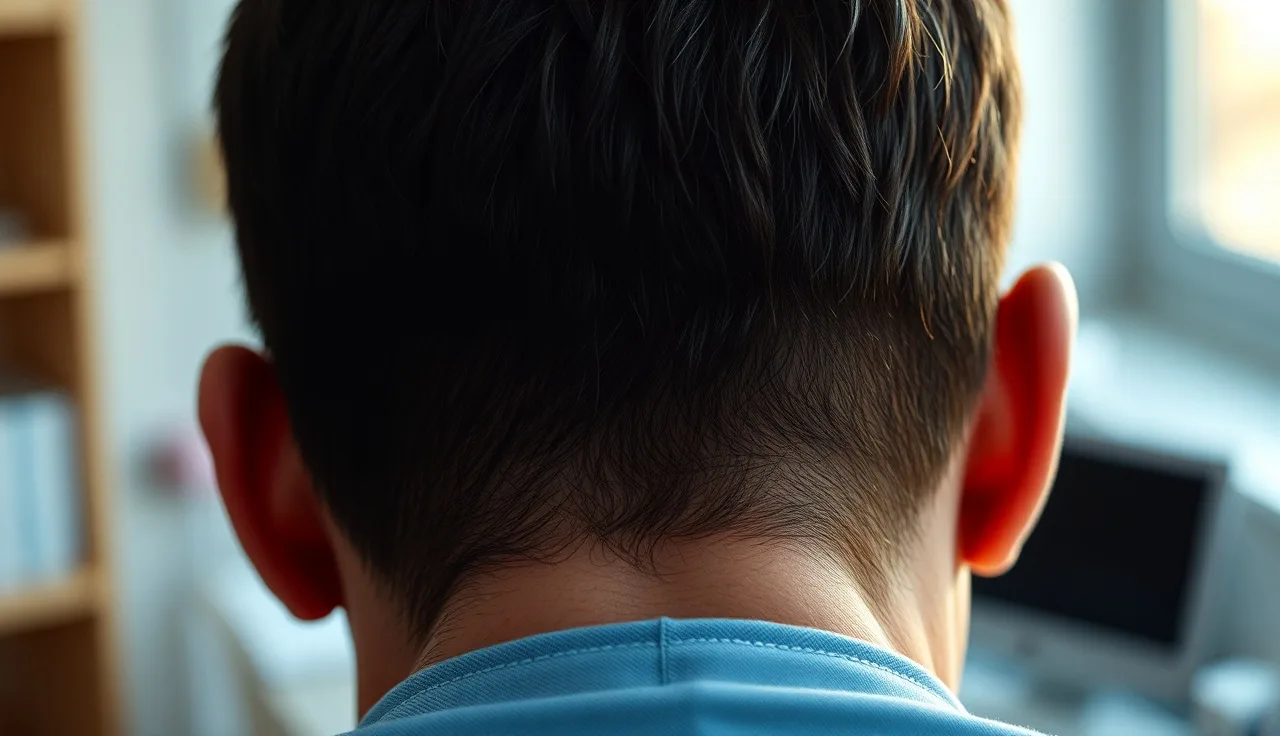
TL;DR: FUT (strip) hair transplants leave a linear donor scar closed with sutures or staples that come out 10 to 14 days after surgery. FUE transplants have no stitches to remove. Removal takes about 15 minutes, causes minimal discomfort, and marks the point where most normal activities resume. Redness and tightness can linger for several more weeks.
What kind of stitches does a hair transplant actually leave?
Not every transplant involves stitches. The answer depends entirely on which technique your surgeon used.
FUT (follicular unit transplantation, also called the strip method) removes a horizontal strip of scalp from the donor area, usually across the back of the head. That incision is closed with either sutures or metal staples. The strip is then divided under a microscope into individual grafts and placed into tiny recipient sites on top. Those recipient sites are too small to need stitches. They close on their own within a day or two [1].
FUE (follicular unit excision) punches out individual follicles one at a time using a circular tool 0.8 to 1.0 mm in diameter. The tiny punch wounds heal without sutures, leaving small round scars scattered across the donor zone. No stitches means no stitch removal appointment with FUE [1].
If your surgeon used FUT, plan on a removal visit roughly two weeks after surgery. If they used FUE, skip this section and read the general healing timeline instead.
When do hair transplant stitches come out?
The standard window is 10 to 14 days post-op for most FUT patients [2]. Some surgeons stretch this to 12 to 14 days to let the wound edges gain more tensile strength before the suture comes out. Pull them early, say at seven days, and the wound can open slightly under tension. Leave them much past 14 days and you risk a tissue reaction or track marks alongside the main scar.
A small number of surgeons use absorbable sutures (such as Monocryl or Vicryl) for the deeper layer and non-absorbable sutures (like nylon) for the surface. In those cases the surface sutures still come out at 10 to 14 days. You never touch the absorbable layer underneath. It dissolves on its own over 60 to 90 days [2].
Metal staples follow the same 10 to 14 day timeline, but removal needs a staple remover rather than scissors and forceps. A tiny bit more pressure, not meaningfully more uncomfortable.
Follow your specific surgeon's instructions. The 10 to 14 day window is a guideline. Individual healing varies with age, nutrition, tension on the closure, and how much you moved around in the first week.
What does stitch removal actually feel like?
Most patients describe mild pulling or a brief pinch, not real pain. By day 10 the area has usually regained enough sensation that you feel something, but the donor scalp is nowhere near as sensitive as your fingertip.
The appointment is short. A nurse or physician assistant usually does the removal. They part the hair, clean the area with an antiseptic solution, cut each suture loop with fine-pointed scissors, then pull the thread through with forceps. A standard FUT closure might involve 20 to 40 individual suture passes depending on strip length, and the whole thing is done in 10 to 20 minutes.
You do not need local anesthetic for suture removal. Some patients ask for a topical numbing spray and many clinics offer it, but most people get through without.
Afterward the area feels tender and tight for a day or two. Some patients notice a slight ridge or bumpy texture along the scar line right after removal. That almost always softens over the following weeks as the scar matures.
What does the donor area look like right after stitches are removed?
Expect a pink or red linear scar, slightly raised. The surrounding skin may still feel swollen or firm. There is usually a band of numbness in the scalp below the incision, because the nerve branches running through that area were cut. The numbness can last a few weeks to a few months before it gradually resolves [3].
Hair in the donor area near the scar was shaved or trimmed before surgery. New growth in that zone usually starts around the 4 to 6 week mark, which helps camouflage the line. By 3 to 4 months most patients with a conservative strip harvest can cover the scar completely with hair at a normal length [3].
The scar keeps changing for 12 to 18 months. It usually starts wide and pink, then narrows and fades toward skin tone. Final width depends heavily on donor-area tension at closure and on individual genetics. Some people heal with a fine 1 mm line. Others, especially those who had very tight closures or went back to hard exercise too early, end up with a wider or stretched scar [3].
Significant redness, warmth, pus, or fever after suture removal is a same-day call to your surgeon. Infection after FUT is uncommon but it happens, and early antibiotics keep the complication from touching graft survival.
What is the full healing timeline after a hair transplant?
Seeing where stitch removal fits in the broader recovery keeps your expectations honest.
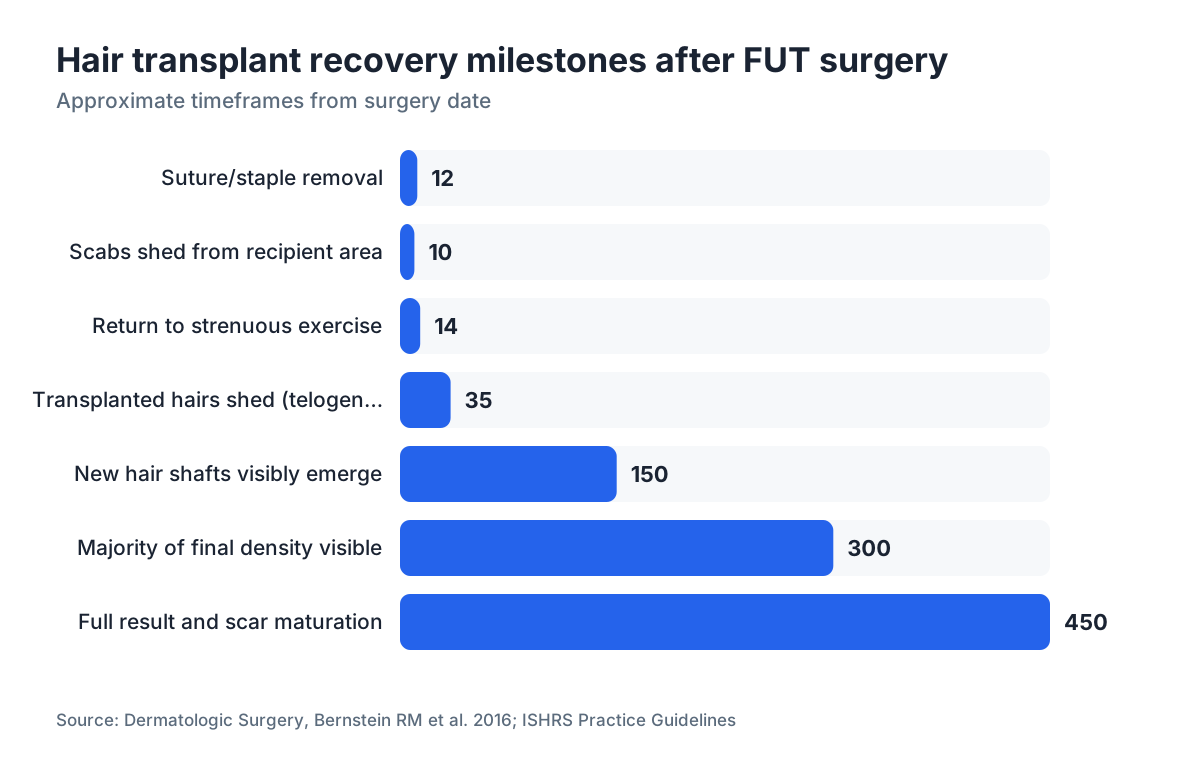
| Timeframe | What is happening |
|---|---|
| Days 1 to 3 | Donor area bandaged; recipient sites form scabs; swelling peaks around day 2 to 3 |
| Days 4 to 7 | Scabs on recipient sites begin to dry; grafts are anchored but fragile; light activity only |
| Days 7 to 10 | Most scabs have shed or can be gently washed off per clinic protocol; grafts are more secure |
| Days 10 to 14 | Suture/staple removal for FUT patients; normal shampooing usually cleared |
| Weeks 3 to 6 | Transplanted hairs shed (this is normal and expected; see note below) |
| Months 2 to 4 | Follicles in resting phase; minimal visible new growth; patience required |
| Months 4 to 6 | New hair shafts emerge through skin; texture may be fine or wavy at first |
| Months 9 to 12 | Majority of final density visible |
| Month 12 to 18 | Full result, including scar maturation [4] |
The shedding around weeks 3 to 6 alarms almost every patient who was not warned about it. This is telogen effluvium of the transplanted hairs, a normal stress response where the follicle drops the existing shaft before it enters the growth phase [5]. It is not a sign the grafts failed. Our guide to telogen effluvium walks through the whole process.
Graft survival rates in published literature run roughly 85% to 95% when an experienced team uses proper technique [4]. That number is not a promise for any individual patient, and it covers everything from donor harvesting to recipient site creation to post-op care.
What can you do (and not do) while the stitches are still in?
The 10 to 14 days before suture removal carry the heaviest restrictions. The wound is healing but not healed, and the stitches sit under tension every time you turn your neck or bend forward.
Safe during this period: sleeping with your head elevated, light walking, gentle shampooing of the recipient area (following your clinic's exact protocol), and most desk work. A loose-fitting hat is generally fine after day 3 or 4 as long as it does not press on the donor scar.
Not safe: any exercise that spikes your heart rate (running, weightlifting, cycling), swimming or submerging the scalp, direct sun on the unprotected donor area, and scratching or picking at either the donor scar or the recipient scabs. Alcohol thins the blood and is usually off the table for the first week.
Sex is a common question patients ask privately. Most surgeons say light activity is fine after day 5 or 6, but anything strenuous should wait until after suture removal. The worry is not infection. It is the blood pressure and scalp tension that come with exertion.
Sun on the donor scar deserves respect even after the stitches come out. A healing scar hit with UV light can hyperpigment, turning darker than the skin around it, and that is much harder to reverse than to prevent. SPF 30 or higher on the donor area, or keeping it covered, for the first three to four months is a smart habit [6].
Can you remove hair transplant stitches yourself at home?
The mechanics of suture removal are simple. Doing it yourself is still a bad idea, for a few reasons.
First, you cannot see the back of your own head clearly enough to work safely. The donor scar runs horizontally across the occipital scalp, and even with mirrors the angle is awkward. You risk cutting your skin instead of the suture, or pulling the thread the wrong way and tearing the healing wound edge.
Second, your surgeon needs to inspect the scar at the removal visit. They are checking wound apposition, looking for early signs of infection or cyst formation along the suture track, and setting you up for the next phase of recovery. Skip the visit and you skip that assessment.
Third, if something goes wrong, a minor wound dehiscence (gap in the closure) or an embedded suture, you want to be in a clinical setting where it gets handled on the spot.
If travel or cost is a real barrier, call the clinic and ask whether a local GP or dermatologist can do the removal and send photos back to your transplant surgeon. That is a reasonable workaround. Drugstore scissors at your bathroom mirror is not.
Will the donor scar be visible long-term?
This is the question most FUT patients care about most, and the honest answer is: it depends, and it takes time to know.
A well-executed FUT closure leaves a fine linear scar that disappears under hair at a length of about 1.5 to 2 cm. Men who keep their hair at a number 2 or 3 clipper guard or longer generally conceal it without trouble. Men who shave their heads or wear their hair very short will see it [7].
What predicts a better (narrower, less visible) scar: younger age, good nutrition, lower donor-zone tension at closure, a trichophytic closure (where one wound edge is beveled so hair grows through the scar), and following post-op restrictions carefully in the first two weeks [7].
What predicts a wider or more visible scar: prior FUT procedures in the same area (each additional strip adds tension), a tight closure under high tension, early return to strenuous exercise, and genetics (some people simply scar more broadly no matter the technique).
When a scar does widen, options exist. Scalp micropigmentation can tattoo the look of hair follicles into the scar to make it less obvious. A scar revision, where a skilled surgeon excises the old scar and re-closes under lower tension, helps in some cases. Neither should be attempted until the scar has fully matured at 12 to 18 months [7].
Does FUE really have no stitches at all?
Correct. FUE leaves no linear incision and needs no sutures. The punch sites, typically 0.8 to 1.0 mm in diameter, are small enough to heal by secondary intention, meaning the wound edges contract and the skin fills in on their own with no closure material [1].
This is one of the main reasons FUE has grown so popular. No linear scar, no removal appointment, and a recovery that feels less dramatic in the first two weeks. That appeals to patients who want to wear their hair short.
FUE is not universally better, though. Grafts available per session are sometimes lower, the procedure often costs more, and it takes far longer in the operating room because each follicle comes out individually. FUT can often deliver a higher graft count in a single session, which matters for patients with heavy hair loss [4]. The right technique depends on your goals, your donor supply, and your surgeon's honest read. Understanding the full picture of a hair transplant helps you ask better questions before committing.
Some patients combine the two: FUE for the first session to avoid any linear scar, then FUT if they need more grafts later, or the reverse. That call is surgeon-specific and depends on donor density and scalp laxity.
What should you tell your surgeon before the removal appointment?
A few things are worth flagging before you sit down for suture removal.
If you have been taking any blood thinners, prescription or over-the-counter (aspirin, ibuprofen, large doses of fish oil), mention it. Removal rarely causes bleeding, but it is relevant context.
If the donor area has felt unusually warm, gotten more tender since about day 5 or 6, or leaked any discharge from the suture line, tell the clinic before your appointment, not when you walk in. That could warrant an earlier visit and maybe a short antibiotic course.
If you started finasteride or minoxidil around the time of your transplant, tell your surgeon the timing. Both medications change the scalp environment and your surgeon may want to coordinate their recommendations. Our guides on finasteride and finasteride and minoxidil together cover how they interact and what timeline is realistic.
If you had any unusual bleeding during or right after surgery, or you have a history of keloid scarring anywhere on your body, make sure the removal team knows. Keloid formers can develop a thickened raised scar at the FUT line and may benefit from early intervention like silicone sheeting or intralesional steroid injection [6].
How do you care for the donor scar after stitches are removed?
The two weeks after removal matter more for scar quality than the two weeks before it. The wound is closed but the scar is still actively remodeling.
Gentle moisturizing: a fragrance-free emollient, or the specific product your clinic recommends, keeps the skin supple and cuts itching as the scar matures. Petroleum jelly (Vaseline) is cheap and works. Some clinics recommend silicone gel, which has reasonable evidence behind it for reducing scar thickness and redness over a 2 to 3 month period [6].
Massage: once the sutures are out and the wound edges are fully closed, gentle massage along the scar line (about 5 minutes twice daily) can keep the underlying tissue from forming a tight fibrous band that pulls or feels stiff. Most surgeons suggest starting around week 3 or 4, not right after removal.
Sun protection: keep the scar out of direct sun or apply SPF 30 or higher for the first few months. A hat works fine and is easier to remember than sunscreen on the back of your head.
Stop smoking if you possibly can. Nicotine cuts microvascular blood flow and links to worse wound healing and wider scars across every kind of surgery [8]. The window that matters most is the first month after surgery.
If you are losing hair beyond the transplant zone, this is the moment for a real conversation with your surgeon about a medical maintenance plan. Transplanted hairs are generally resistant to DHT because they came from the permanent zone, but native hairs in the recipient area can still miniaturize and fall out without treatment [9]. Our guide to DHT blockers explains the mechanism and what the evidence says.
The MyHairline free AI hair analysis helps you track the overall pattern of your hair loss over time, useful context for those ongoing conversations with your surgeon.
What are the signs that something is wrong with the donor wound?
Most FUT closures heal without problems. Knowing which signs warrant a call versus a wait-and-see approach is worth learning.
Call your surgeon the same day if you notice: fever over 38°C (100.4°F), increasing pain or throbbing in the donor area after day 5 (pain should be dropping, not climbing), pus or cloudy discharge from the wound, or a section of the suture line that has opened up (wound dehiscence).
Watch and mention at your removal appointment: mild itching along the suture line (normal and common), numbness or tingling below the scar (normal nerve regeneration), a firm ridge under the scar (normal early scar tissue), or mild redness limited to the immediate wound edges.
Infection rates after FUT are low. A 2018 review in the Journal of the American Academy of Dermatology reported overall complication rates for hair transplant surgery in the range of 1 to 2%, with infection among the more common complications in that small group [10]. Low in absolute terms, but worth taking seriously, because untreated infection can damage donor follicles and broaden the final scar.
One complication that surprises patients is an ingrown hair or follicular cyst forming along the scar line weeks after the wound heals. It happens when a transected follicle near the wound edge tries to grow but cannot break through the skin. It shows up as a small red bump or pimple. Your surgeon can lance it in under a minute. Do not squeeze it yourself.
Sources
- American Academy of Dermatology, Hair loss types and treatments
- StatPearls (NCBI Bookshelf), Suturing Techniques
- International Society of Hair Restoration Surgery (ISHRS)
- Dermatologic Surgery, Bernstein RM et al. 2016, Graft survival and outcomes in hair transplantation
- MedlinePlus (NIH), Telogen effluvium
- Plastic and Reconstructive Surgery, Mustoe TA et al. 2002, International clinical recommendations on scar management
- Journal of Cutaneous and Aesthetic Surgery, Nusbaum BP, 2012, Trichophytic donor closure
- NIH National Library of Medicine, Wound Healing and Smoking review
- FDA, Drugs@FDA database (Propecia/finasteride prescribing information)
- Journal of the American Academy of Dermatology, Avram MR et al. 2018, Complications in hair transplantation
- FDA, Drugs@FDA database (Rogaine/minoxidil topical label)