

TL;DR: Your Norwood stage is the best single predictor of how many grafts a transplant needs. Norwood 2 usually needs 500 to 1,500 grafts. Norwood 6 to 7 can need 6,000 or more. At $3 to $10 per graft in the US, total cost runs from about $4,000 to well past $30,000. Donor supply, hair caliber, and surgeon judgment all move that number.
What is the Norwood scale and why does it drive graft estimates?
The Norwood-Hamilton scale is a seven-stage classification of male pattern baldness. James Hamilton published the first version in 1951 and O'Tar Norwood revised it in 1975 [1]. It runs from Stage 1 (no visible recession) to Stage 7 (a thin strip of hair around the back and sides). Every surgical plan starts here because the stage tells you roughly how many square centimeters of scalp have lost cosmetically useful density, and that area sets the graft count.
The scale also captures shape. Stages 3 through 5 describe recession and thinning across the crown and temples. Stage 3 Vertex is a variant where the crown thins before the hairline moves much. Stage 4 and up show both zones thinning at once. Stage 2 is the earliest reasonable surgical candidate: visible temporal recession, hairline still mostly intact.
Staging gives patient and surgeon a shared language. When a surgeon says 'you're a Norwood 4 and I'm planning 3,500 grafts,' he's pointing to a known area estimate and a known density target. Skip the classification and you have no reproducible baseline to argue about.
How does a graft calculator actually work?
A graft calculator is arithmetic on three inputs: the bald or thinning area in square centimeters, the target density in grafts per square centimeter, and the estimated yield per graft (how many hairs each follicular unit carries). Change any one and the output swings hard.
The formula is this:
Grafts needed = Recipient area (cm²) × Target density (grafts/cm²)
Most surgeons aim for 30 to 45 grafts per cm² in one session to get a natural result [2]. Native scalp in non-balding areas runs 65 to 85 follicular units per cm², so transplanting at 40/cm² gives you roughly 50 to 60 percent of original density [10]. That sounds thin. It isn't, because transplanted hair grows through surrounding native hair or stubble, and the eye reads that as full.
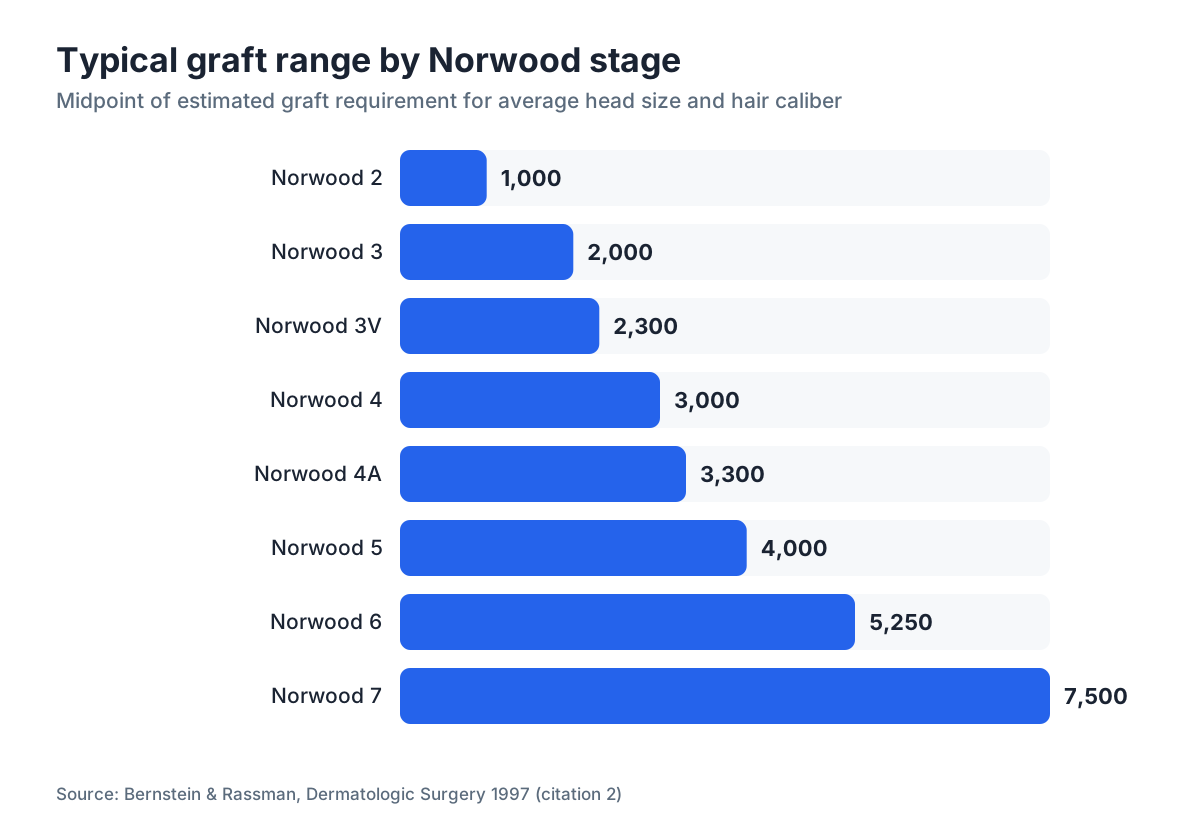
Here is where Norwood staging feeds the math. Research in Dermatologic Surgery estimated average bald surface areas by stage [2]:
| Norwood Stage | Approximate bald/thinning area (cm²) | Typical graft range |
|---|---|---|
| 2 | 20-40 | 500-1,500 |
| 3 | 60-80 | 1,500-2,500 |
| 3 Vertex | 70-90 | 1,800-2,800 |
| 4 | 100-120 | 2,500-3,500 |
| 4A | 110-130 | 2,800-3,800 |
| 5 | 140-170 | 3,500-4,500 |
| 6 | 180-220 | 4,500-6,000 |
| 7 | 230-300+ | 6,000-9,000+ |
These are population medians, not promises. A Norwood 5 with a small head and coarse hair might need 3,200. A Norwood 5 with a big head and fine hair might need 5,000.
Women get staged on the Ludwig or Savin scale, not Norwood. The diffuse thinning pattern makes their graft math work differently.
What is the typical graft count for a Norwood 2 hair transplant?
Norwood 2 is where most men first take surgery seriously. The hairline has pulled back at the temples into shallow triangular inlets, but the midscalp and crown are intact. The bald area is small, usually 20 to 40 cm², and you can set density fairly high because you're rebuilding a hairline, not blanketing a field.
Most surgeons plan 500 to 1,500 grafts for a Norwood 2 [2]. The low end fits minimal recession and a conservative, age-appropriate hairline. The high end fits deeper temporal recession or a patient who wants a denser, lower hairline.
A norwood scale 2 hair transplant is often one session with a short recovery. The small recipient area means donor supply almost never limits you at this stage, which is a real advantage.
Here's the honest caveat. Norwood 2 patients get over-sold on surgery more than anyone. If you're 22 and just starting to recede, the smarter move is finasteride and minoxidil for men first, and surgery only after your pattern settles. Transplant into an early Norwood 2 without medical therapy and you risk watching the native hair behind your new line keep falling, which leaves a transplanted hairline stranded on a balding scalp. Any surgeon who skips that conversation is a surgeon to walk away from.
Does donor supply limit how many grafts you can actually get?
Yes. This is the constraint patient-facing calculators almost never mention. You can need 7,000 grafts and only have 5,000 safely extractable from your donor zone. The permanent donor area, that horseshoe band at the back and sides, has a fixed follicle count and no refills.
The average person has roughly 6,000 to 8,000 extractable follicular units for FUE (follicular unit excision), and somewhat more for FUT (follicular unit transplantation, the strip method), because FUT can reach grafts FUE can't [3]. That total has to cover your entire life, including future sessions as your pattern keeps moving.
A good surgeon measures donor density, donor area size, and hair caliber. Coarse, dark, dense donor hair is the best case. Fine, light, sparse donor hair gives you far less room to work with.
For Norwood 6 and 7 patients who need 6,000 grafts or more, donor limitation is the first real conversation, before you book anything. Some surgeons pull body hair from the beard or chest as supplemental donor, though survival is lower and results are less predictable [4]. Nobody has clean long-term data on body hair outcomes in large groups. The closest evidence is small case series showing 60 to 75 percent yield against 85 to 95 percent for scalp hair [4].
How much does a hair transplant cost by Norwood stage?
In the US, most clinics charge per graft. The range is roughly $3 to $10, with $4 to $7 most common at established FUE clinics [5]. FUT (strip) often runs a little cheaper per graft because extraction is faster, though you trade that for a linear scar.
Apply those prices to the Norwood-stage graft ranges:
| Norwood Stage | Typical graft range | Low estimate ($3/graft) | High estimate ($8/graft) |
|---|---|---|---|
| 2 | 500-1,500 | $1,500 | $12,000 |
| 3 | 1,500-2,500 | $4,500 | $20,000 |
| 4 | 2,500-3,500 | $7,500 | $28,000 |
| 5 | 3,500-4,500 | $10,500 | $36,000 |
| 6 | 4,500-6,000 | $13,500 | $48,000 |
| 7 | 6,000-9,000 | $18,000 | $72,000 |
Those upper numbers reflect elite clinics in big US cities. Most patients land in the $4 to $6 range, which puts a Norwood 4 procedure at $10,000 to $21,000.
Medical tourism to Turkey, Thailand, or Eastern Europe can cut cost by 60 to 80 percent. Turkish clinics commonly charge a flat $2,000 to $5,000 for a full FUE session no matter the graft count [5]. You trade that saving for harder follow-up, uneven quality control, and the cost of a second trip if you need touch-ups. The FDA does not regulate foreign surgical facilities, and a complication managed abroad is hard to fix at home.
Insurance almost never covers this. The IRS treats hair transplant surgery as cosmetic in most cases, so it isn't a deductible medical expense.
Before price even enters the picture, the hair transplant overview walks through both FUE and FUT in full.
FUT vs FUE: does the technique change your graft count estimate?
The technique doesn't change how many grafts you need. It changes how many you can safely get, how fast, and what healing looks like.
FUT (strip harvesting) removes a linear strip of scalp from the donor area and dissects it into single follicular units under magnification. One session can yield 3,000 to 5,000 grafts or more. The trade-off is a permanent linear scar. Wear your hair very short and that scar may show.
FUE punches out individual follicular units one at a time with a 0.7 to 1.0 mm circular punch. No linear scar, but each punch leaves a tiny dot scar spread across the donor zone. FUE extraction is slower, and most clinics cap a session at 2,000 to 3,500 grafts before donor depletion risk climbs [3]. High-Norwood patients often need staged FUE sessions, which adds time and cost.
Robotic FUE (the ARTAS system) is a subset of FUE with FDA 510(k) clearance for harvesting follicular units [6]. Studies comparing robotic to manual FUE show similar graft survival. The real advantage is consistent punch depth and angle, not dramatically better outcomes.
For Norwood 5 to 7 patients, some surgeons run a FUT session first to bank a large graft count, then use FUE later to fill remaining areas while sparing the donor zone. That combination is worth raising if your stage puts you past 4,500 grafts.
How many hairs per graft should you expect, and why does it matter?
A follicular unit graft holds 1 to 4 hairs. The average across a full donor harvest is 2.1 to 2.4 hairs per graft [2]. This matters a lot, because hair count is not graft count.
Surgeons quote in grafts because grafts are what they extract and implant. What you see in the mirror is hairs. A 3,000-graft procedure at 2.2 hairs per graft gives you about 6,600 hairs. The same 3,000 grafts, with mostly single-hair units placed at the hairline and denser multi-hair units in the crown, might deliver 5,500 to 7,000 hairs depending on distribution.
This is one reason two quotes for the same patient sound different. One surgeon quotes 2,500 grafts, another quotes 2,800, but if the first surgeon's donor area has denser multi-hair units, the actual hair count can come out nearly identical.
When you compare quotes, ask for graft count and estimated hair count. Ask what share of grafts are expected to be 2-hair, 3-hair, and 4-hair units. That's a far more honest comparison than graft count alone.
Should you do a hair transplant before stabilizing hair loss with medication?
This is the question that matters most, and most calculator tools ignore it completely.
A transplant moves hair. It doesn't stop hair loss. Transplant at Norwood 3, keep losing native hair for a decade, and you can reach Norwood 5 with a transplanted hairline floating in front of a bald midscalp. It looks wrong and it needs more surgery.
The standard clinical advice is to stabilize loss with medication before surgery, or at least plan a conservative hairline that still looks natural if the pattern advances [7]. The two evidence-based drugs are finasteride (oral or topical) and minoxidil (topical or oral). A randomized trial reported in the Journal of the American Academy of Dermatology found finasteride 1 mg/day reduced hair loss progression in 83 percent of men over two years [8]. Minoxidil doesn't block DHT-driven loss, but it extends the growth phase and thickens miniaturizing hairs.
Running finasteride and minoxidil together before and after a transplant is the approach most restoration specialists prefer. It protects the native hair you still have, cuts the total graft load you'll need across your life, and improves post-transplant density because the shrinking hairs around your grafts bulk up instead of falling out.
The FDA approved finasteride 1 mg for male pattern hair loss in 1997 [8]. Side effects are real, though Phase 3 trial rates were low: sexual side effects in roughly 3.8 percent of men versus 2.1 percent on placebo. The finasteride article covers what to expect in full.
If you're not sure where you sit on the Norwood scale and want a baseline before booking consultations, the free AI scan at MyHairline gives you an objective starting point.
What factors make a surgeon's graft estimate more or less reliable?
An online calculator gives an approximation. An in-person consultation with a board-certified surgeon still gives an approximation, but a much sharper one. Here's what separates them.
Caliber and texture of donor hair: coarse, dark hair covers more surface per graft than fine, light hair. A surgeon who has physically felt your hair can set the density target accordingly.
Actual donor density measurement: most experienced surgeons use a dermoscope or digital trichoscope to count follicular units per cm² in your donor zone. That number tells them how many grafts they can pull without leaving visible thinning behind.
Extraction philosophy: some surgeons stay conservative about donor depletion. Others push closer to the edge. Both have trade-offs, and you want to know which one you're hiring.
Your age and likely progression: a 28-year-old at Norwood 3 with a family history of Norwood 6 is a completely different candidate from a 52-year-old at Norwood 3 whose pattern has held steady for ten years. The younger man's plan should reserve donor grafts and design a more conservative hairline.
Any honest surgeon will tell you the estimate is a range, not a fixed figure, and that it may shift on surgery day once extraction starts and yield becomes clear. Be wary of anyone quoting an exact number before they've seen your scalp in person.
What questions should you ask at a hair transplant consultation?
Most patients spend the consultation listening. That's backwards. Here are the questions that actually change your decision.
What is my current Norwood stage, and what stage do you expect I'll reach eventually? This tells you whether the plan accounts for future loss.
How many grafts do I have available: for this session, and across my lifetime? If the answer is 5,000 total and you need 6,000, everything changes.
What technique are you recommending and why? A clinic that pushes one method without explaining why it fits your case is waving a red flag.
Will you show me before and after photos of patients with my Norwood stage and hair type? Not the best results. The representative ones.
What happens to the transplanted hairline if my native hair keeps receding behind it? Any answer that doesn't include 'you'll likely need another procedure' or 'medication helps protect against that' is incomplete.
How many sessions will I realistically need to hit my goal? For high-Norwood patients the honest answer is often two or three over several years.
Before committing to surgery, the what causes hair loss article is worth reading to understand what's driving your loss. And if you've noticed sudden heavy shedding, that might be telogen effluvium rather than pattern baldness, which changes the surgical math entirely.
MyHairline's AI scan can hand you a Norwood stage assessment before you set foot in a clinic, so you walk in already speaking the vocabulary.
Are online graft calculators accurate enough to trust?
Somewhat. They're good for setting expectations before a consultation. They're useless for making the surgical decision.
Most calculators ask for your Norwood stage (or have you click a diagram), your hairline goals, and sometimes your hair texture. Then they run the area-density formula and hand you a range. The catch is they can't assess your donor density, hair caliber, head size, or how fast your pattern is moving.
A calculator that says '3,200 grafts' for a Norwood 4 is telling you the median. You might need 2,600. You might need 4,100. That range is real, and it matters for your budget and your donor supply.
Treat a graft calculator the way you'd treat a BMI calculator: directionally useful, not clinically diagnostic. It gets you to the right ballpark before a real consultation.
The best pre-consultation tool pairs a standardized photo analysis (which strips out the guesswork of staging yourself) with a graft range. That combination beats either one alone, because self-staging is notoriously unreliable. Studies on patient self-assessment of Norwood stage find substantial disagreement with dermatologist assessment, and the gap is widest in the middle stages, 3 through 5, exactly where the difference matters most for surgical planning.
Sources
- Norwood OT. Male pattern baldness: classification and incidence. Southern Medical Journal, 1975
- Bernstein RM, Rassman WR. Follicular transplantation: patient evaluation and surgical planning. Dermatologic Surgery, 1997
- Rassman WR et al. Follicular unit extraction: minimally invasive surgery for hair transplantation. Dermatologic Surgery, 2002
- Umar S. Body hair transplant by follicular unit extraction: my experience with 122 patients. Aesthetic Surgery Journal, 2016
- International Society of Hair Restoration Surgery. ISHRS Practice Census Results 2022
- US Food and Drug Administration. Medical device 510(k) clearances database
- American Academy of Dermatology. Hair loss: diagnosis and treatment
- Kaufman KD et al. Finasteride in the treatment of men with androgenetic alopecia. Journal of the American Academy of Dermatology, 1998
- Price VH. Treatment of hair loss. New England Journal of Medicine, 1999
- Shapiro J, Price VH. Hair regrowth: therapeutic agents. Dermatologic Clinics, 1998