
TL;DR: Hair transplant results unfold over 12 to 18 months. Grafts shed in weeks 3 to 8, new growth starts around month 3 to 4, and most patients reach 60 to 80 percent of their final density by month 9. Graft survival averages 90 to 95 percent in skilled hands. Technique, donor supply, and whether you use finasteride after surgery all shape the end result.
What do hair transplant results actually look like, and are they permanent?
Transplanted hair is permanent. The follicles come from the back and sides of your scalp (the donor zone), which are genetically resistant to DHT, the hormone that drives male and female pattern hair loss. Once those follicles root in their new spot, they keep that resistance. They grow, they grey, they behave exactly like the hair that used to sit in the donor zone.
But permanent is doing a lot of work in that sentence. The transplanted grafts don't fall out from pattern baldness. The native hairs around them, the ones you were already losing before surgery, will keep thinning. That's the part clinics soft-pedal. A great result at 30 can look patchy at 45, not because the transplant failed, but because the surrounding hair kept receding. This is why long-term use of a DHT blocker or finasteride after a transplant matters as much as the surgery itself.
What does a good result look like up close? A well-done FUE or FUT transplant on the right candidate is genuinely hard to spot. Hairline design, graft angle, and density decide whether it reads as natural. Single-hair grafts go at the hairline, multi-hair grafts sit further back, copying the natural gradient. Done well, even a barber cutting close won't catch it. Done badly, you get the doll-hair plug look that gave transplants a bad name in the 1980s and 90s. That era is mostly over. Mostly [1].
What is the hair transplant growth timeline month by month?
Here's the honest month-by-month. New growth starts around month 3 to 4, most patients hit 60 to 80 percent of final density by month 9, and the full result lands at 12 to 18 months. The timeline is slower than almost every patient expects, and knowing it in advance prevents a lot of panic.
Month 0 to 1: Right after surgery, the grafts are pink, scabby, and the new hairline looks swollen and obvious. Most of that clears in 10 to 14 days. The grafts look like they're growing. They aren't. Not yet.
Weeks 3 to 8 (the shed): The transplanted hairs fall out. This is shock loss, or effluvium, and it happens to nearly every patient. It's frightening if nobody warned you. The shaft detaches but the follicle stays alive underground. It's a forced telogen effluvium triggered by surgical trauma [2]. Some patients also lose existing native hairs for a while from the shock.
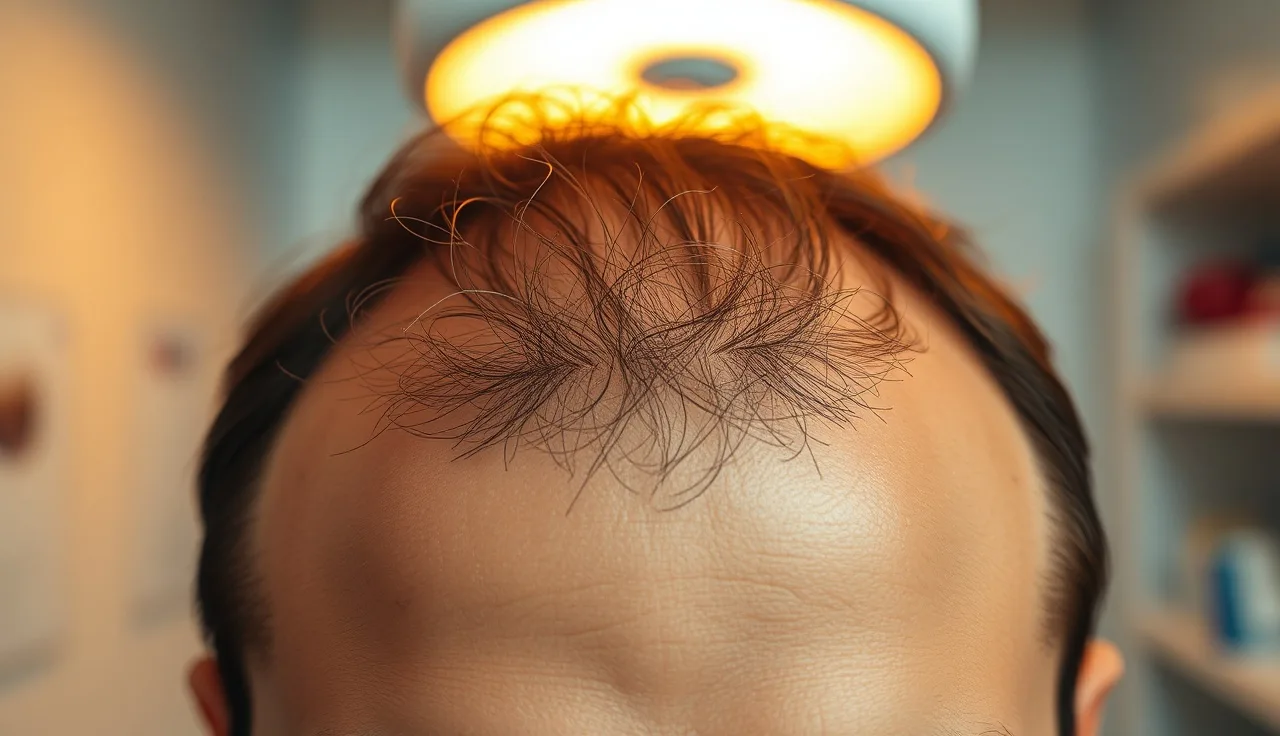
Months 3 to 4: Thin, fine hairs start breaking through. They look wispy and may come in curly or irregular. Normal. The texture normalizes as the shaft thickens.
Months 6 to 9: This is when most patients first feel genuinely happy. Density is building, hairs are thickening, and the hairline starts to match the goal. Published data puts 60 to 80 percent of final coverage visible by month 9 [3].
Months 12 to 18: Final result. Patients with coarser or curlier hair often keep improving out to 18 months. If something still looks sparse at 18 months, that's the result you're working with.
| Month | What's happening | What you see |
|---|---|---|
| 0 to 2 | Grafts rooting, then shedding | Scabs, then hair loss |
| 3 to 4 | New shafts emerging | Thin, fine regrowth |
| 5 to 8 | Shafts thickening | Visible but incomplete |
| 9 to 12 | Density filling in | 60 to 80% of final result |
| 12 to 18 | Final maturation | Full result visible |
What is a realistic hair transplant survival rate for grafts?
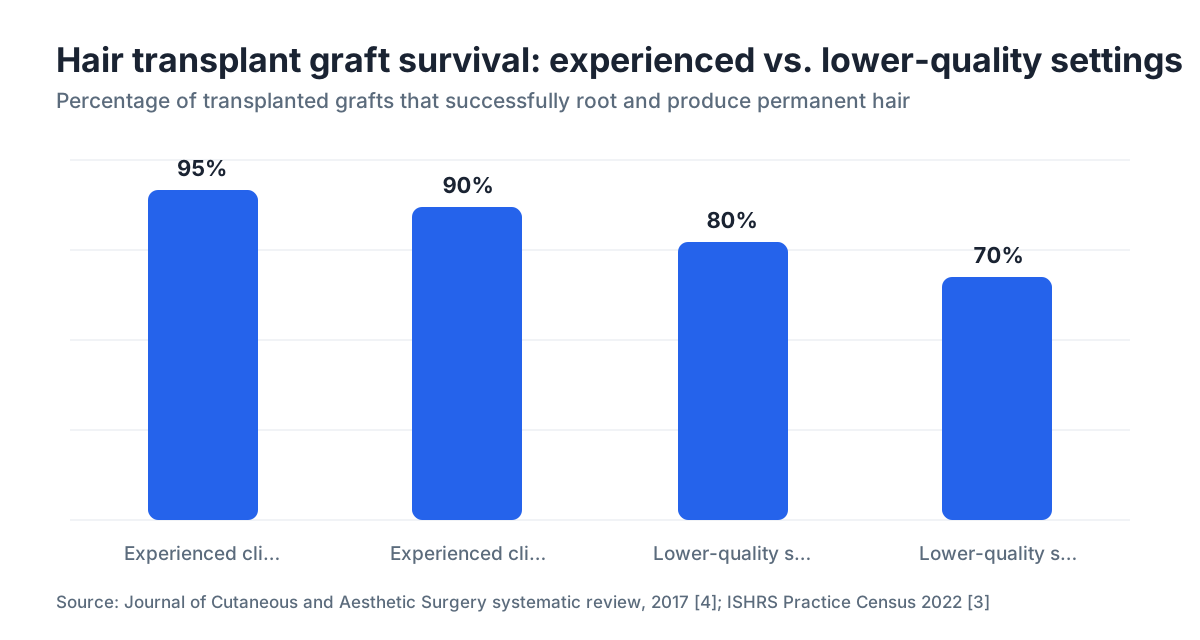
Graft survival is the share of transplanted follicles that root and produce permanent hair. In skilled hands it runs 90 to 95 percent [3][4]. It's one of the most important numbers in this whole conversation and one of the least discussed in marketing.
90 to 95 percent sounds great, and mostly it is. But even a perfect surgery loses 5 to 10 percent of grafts. On a 3,000-graft procedure, that's 150 to 300 follicles that never make it. At 80 percent survival (a lower but not unusual rate at less skilled clinics), you lose 600 grafts from that same session. That gap shows up in your final density.
What pushes survival down? Time out of body is the biggest factor. A graft sitting on a tray dies faster than one going straight back in. Good teams keep that window short. Implantation depth and angle matter too: too shallow and the graft pops out, too deep and it gets buried without enough oxygen. Dehydration during the procedure kills grafts. So does weak storage solution (normal saline is baseline; hypothermosol and ATP-enriched solutions improve survival in some studies [4]).
Red flags that track with lower survival: huge graft counts promised in a single day (more than 4,000 to 5,000 stretches any team thin), surgical technicians running extraction and implantation without physician oversight, and suspiciously cheap per-graft pricing that says corners are getting cut on time and staffing.
How many grafts do you need, and what density can a transplant actually achieve?
Normal scalp density in untouched hair runs about 80 to 100 follicular units per square centimeter [5]. Each unit holds one to four hairs, so thick native hair is actually 200 or more individual hairs per cm².
A transplant can't fully match that. Surgeons aim for 40 to 60 follicular units per cm² in the recipient area, which looks dense without draining the donor zone [5]. Most people can't tell 40 units from 100 if the coverage is placed well, because the hair around and behind the transplanted area fills in the picture visually.
Graft counts for common Norwood stages shake out roughly like this:
| Norwood Stage | Typical graft range | Area being addressed |
|---|---|---|
| II, III | 800 to 1,500 | Frontal zone / temples |
| III, IV | 1,500 to 2,500 | Front and mid-scalp |
| IV, V | 2,500 to 3,500 | Front to crown |
| V, VI | 3,500 to 5,000+ | Extensive coverage |
One session has limits. The donor zone (back and sides) holds a finite number of grafts, somewhere around 4,000 to 8,000 lifetime grafts for most men, depending on scalp laxity, donor density, and hair caliber [3]. Thick, wavy hair covers more ground than fine, straight hair. This lifetime cap is why planning matters. Spend 4,500 grafts at 28 to rebuild a full hairline and you may have nothing left in reserve if your loss keeps moving through your 30s.
Trying to figure out what stage you're at before you decide? Reading up on the receding hairline progression is a good place to start.
FUE vs FUT: which technique gives better results?
In terms of graft quality and final hair, both techniques produce comparable results when a skilled surgeon does the work. The real differences are scarring, recovery, and how many grafts you can harvest. This debate runs hot in transplant forums and confuses a lot of patients, so keep that first sentence in mind.
FUT (Follicular Unit Transplantation, the strip method) removes a strip of scalp from the donor zone. The follicular units get dissected out of that strip under microscopes. It leaves a linear scar that hides under surrounding hair at normal lengths but shows if you shave to a grade 1 or shorter. The upside: FUT can yield more grafts per session with less transection (accidentally cutting follicles during extraction), which some data links to slightly higher survival in very large sessions.
FUE (Follicular Unit Excision) removes units one by one with a punch tool. No linear scar, just tiny circular marks that fade to near-invisible after healing. You can wear your hair short. Recovery is faster. The trade-off: each punch carries a small risk of transecting the follicle, and extraction is slower, so it either takes longer or needs a very experienced team to hold quality across thousands of grafts.
How to choose: want short hair, do physical work, or hate the idea of a visible scar? FUE. Need maximum grafts in one session and don't mind a scar you can cover? FUT may give a slightly bigger harvest. Plenty of experienced surgeons use both depending on the patient [1].
Before you book a consultation, it's worth understanding what hair transplant surgery involves from start to finish.
What factors most affect your hair transplant results?
The surgeon's skill is the biggest variable. It's not the only one. Several things about you shape the result no matter who's holding the punch tool.
Hair caliber. Coarse, thick hair covers more surface per graft than fine hair. Someone with thick Mediterranean or West African hair can look fully dense with fewer grafts than someone with fine Scandinavian hair. Good surgeons factor this into the plan.
Hair color contrast with scalp. High contrast (dark hair on light skin) makes both good and bad density more obvious. Low contrast (blonde or grey hair on light skin) forgives more.
Donor density and scalp laxity. A looser scalp with high donor density gives the surgeon more to work with. Low donor density limits what's possible, full stop.
Age and future loss trajectory. A 24-year-old at Norwood III with a father and maternal grandfather who hit Norwood VI by 40 is a risky hairline candidate, because his own loss will catch up to the transplant. Experienced surgeons stay conservative with young patients for exactly this reason.
Post-op medication. Ongoing loss of native hair is the main way a good result falls apart over years. Using finasteride and minoxidil after a transplant has evidence behind it. A 2022 trial in the Journal of the American Academy of Dermatology found patients on finasteride after FUE had significantly better donor area density and overall outcome scores at 12 months versus controls [6].
Post-op care. Sleeping elevated the first week, skipping exercise that spikes blood pressure for 2 to 3 weeks, not scratching the grafts, and following your clinic's washing protocol all affect whether grafts root.
What does the research say about hair transplant success rates?
Published success rates are hard to read because clinics define success differently. Some report graft survival. Some report patient satisfaction. Some report objective density. Lining them up side by side is tricky.
What the peer-reviewed literature shows fairly consistently:
A 2017 systematic review in the Journal of Cutaneous and Aesthetic Surgery found graft survival between 85 and 95 percent across studies, with lower survival in cases of poor storage or long out-of-body time [4]. The American Society of Plastic Surgeons reports that hair transplants sit among the highest-satisfaction elective procedures, with satisfaction above 80 percent in most reported groups [7].
The FDA has cleared several devices used in FUE extraction (NeoGraft, ARTAS) as Class II devices. That means they're cleared for the intended use, not approved as drugs, and the evidence bar for device clearance is lower than for drug approval [8]. This matters because you'll see "FDA-cleared" sold as a quality signal. It is one. It does not mean those robotic systems beat manual FUE in skilled hands.
On whether transplants work better with medication: a 2021 paper in Dermatologic Surgery found patients using minoxidil for men after a transplant had faster early growth and higher perceived density at 6 months versus placebo, though 12-month outcomes matched [9]. Read plainly: minoxidil may get you to your result faster, even if the endpoint is the same.
Want a baseline picture of where your own loss stands before deciding? The free AI scan at MyHairline maps your Norwood stage and density from photos, which gives you something concrete to bring to a surgeon.
How long do hair transplant results last?
The transplanted follicles last effectively forever, barring illness or conditions that cause hair loss body-wide (autoimmune alopecia, severe nutritional deficiency, chemotherapy). The DHT resistance is baked into the follicle's genetics, not its location, so moving it changes nothing.
The appearance of the result over time is a separate question. Transplanted hair ages the way the donor hair ages. It greys when the donor zone greys. It keeps its growth cycle. What won't hold is the surrounding native hair if pattern loss keeps going.
Have a transplant and do nothing to slow ongoing loss, and the result can look worse over a decade, not because the transplant degraded, but because the frame around it thinned out. This shows up hardest at the temples and crown in men who rebuilt the front and ignored the vertex.
The most durable results come from patients who pair a transplant with medical therapy to stabilize native loss [6]. Finasteride at 1 mg daily has Level I evidence for slowing androgenetic alopecia in men, with a 5-year trial showing a 48 percent improvement in hair count versus baseline against continued loss in the placebo group [10]. That's not a small edge when you're protecting a $10,000 to $20,000 result.
What are the most common reasons hair transplant results disappoint?
Bad outcomes cluster around a handful of causes. Knowing them helps you dodge the situations that create them.
Most common: a clinic that over-promised graft counts and under-delivered density. "4,000 grafts" sounds impressive until you learn 4,000 grafts on a Norwood V scalp won't give full coverage, and the clinic knew that when they booked you.
Second: wrong hairline placement. A hairline set too low looks fake, and it looks worse as you age and your face changes. Experienced surgeons place the hairline conservatively and spend grafts in the mid-scalp, which gives more visual payoff per graft than a dramatically low front.
Third: the patient kept losing native hair and skipped medication. This one is partly on the patient. It's also on clinics that don't spell out that ongoing medical therapy is part of the deal.
Fourth: complications from poor sterile technique or bad post-op compliance. Infection, folliculitis, and low graft survival from early trauma (getting hit in the head, aggressive scalp rubbing) all drag the result down.
Fifth: picking a provider on price. Medical tourism has real pull at $1,500 to $3,000 for procedures that cost $10,000 to $20,000 at home, but the outcome spread is wide. There are excellent surgeons in Turkey, Thailand, and beyond. There are also facilities where barely trained technicians do most of the work. The per-graft price gap often reflects exactly that staffing gap.
What does hair transplant recovery look like and how does it affect results?
Recovery shapes results more than patients think. A graft that gets displaced or damaged in the first two weeks doesn't grow.
The first 72 hours carry the highest risk. The grafts haven't anchored yet. Touching, rubbing, sleeping face-down, or any pressure on the recipient area can knock them loose. Most clinics hand you a surgical headband or pillow wedge to keep you sleeping at 45 degrees.
Days 3 to 10 bring scab formation around each graft. The scabs fall off on their own by day 10 to 14 with gentle washing. Picking them early is the number one way patients wreck their own results.
Weeks 2 to 4: the transplanted hairs shed. This looks like failure. It isn't. The follicle is alive; the shaft is cycling out before new growth begins.
Months 1 to 3: the quiet stretch. Nothing shows on the surface, but the follicles are building blood supply and getting ready to push new shafts. This is when patients message their clinic in a panic.
From month 3 on, biology takes over from behavior. One exception: sun protection. UV exposure on a healing scalp can cause hyperpigmentation of the recipient area, which shows up clearly in light-skinned patients through the first 6 months. SPF 30 or higher, or a hat, is standard guidance.
Platelet-rich plasma (PRP) injections during and after surgery get pitched by many clinics as a survival booster. The evidence is genuinely mixed. A 2019 meta-analysis in Dermatologic Surgery found PRP improved early hair density in some studies but flagged high heterogeneity and methodological limits across trials. It's not proven standard of care, but it's low risk [11].
Should you combine a hair transplant with finasteride or minoxidil?
For most patients, yes, especially men with androgenetic alopecia. The transplant handles what's already gone. Finasteride and minoxidil handle what's still there and still thinning.
Without them, native loss continues. With them, the native hair that frames your transplant holds longer, and the whole result looks better for more years.
Finasteride at 1 mg daily is FDA-approved specifically for male pattern hair loss [10]. It blocks 5-alpha reductase, the enzyme that converts testosterone to DHT in scalp tissue. Less DHT means less follicle miniaturization. It doesn't regrow much hair on its own for most people, but it's very good at slowing loss. The main side effects (sexual dysfunction, affecting roughly 1 to 2 percent of users in the clinical trial data) are real and worth understanding before you start [10].
Topical minoxidil for men (2% or 5%) is FDA-approved for androgenetic alopecia and works differently, widening scalp blood vessels and stretching the anagen growth phase. Used after a transplant, it may speed early growth in the recipient area. Its side effect profile is friendlier than finasteride's, though scalp irritation and unwanted facial hair from contact happen.
Oral minoxidil at low doses (0.625 to 2.5 mg daily) is used off-label for hair loss and has a growing evidence base. It's not FDA-approved in oral form for hair loss, but dermatologists prescribe it often. If you're considering it, that's a conversation for your prescribing physician.
Worried about minoxidil side effects, or already tried topical minoxidil without luck? Oral minoxidil or a change in approach is worth raising with a dermatologist before you book surgery.
How much do hair transplants cost, and does price predict results?
In the US, hair transplants generally run $4,000 to $20,000+ depending on graft count, technique, and clinic prestige. Most are priced per graft, typically $3 to $10 per graft at US clinics [7]. A 2,000-graft FUE session at a mid-range clinic runs roughly $6,000 to $12,000. Larger sessions at top-tier clinics can pass $20,000.
Medical tourism runs cheaper. Turkey is the most common destination, with all-inclusive packages (flights, hotel, surgery) at $1,500 to $4,000 for sessions that cost three to five times more in the US or UK. Quality varies enormously. Some Turkish clinics have world-class surgeons and excellent outcomes with strong photo documentation. Others run high volume, high turnover, technician-led procedures with inconsistent results. Go this route and research matters more, not less.
Price doesn't perfectly predict results, but very low pricing in a high-cost country is a warning sign. Grafts are labor-intensive. If a US clinic offers $1 per graft, or $2,000 all-in for 2,000 grafts, the math only works by cutting labor hard.
Insurance doesn't cover hair transplants. They count as cosmetic. Hair loss from medically necessary causes (alopecia totalis, post-chemo regrowth support) is sometimes covered under other treatment categories, but the transplant surgery itself is not [7].
Want a grounded read on your pattern and density before you start collecting surgeon quotes? The free AI scan at MyHairline gives you a starting assessment.
Sources
- American Academy of Dermatology (AAD) – Hair loss: diagnosis and treatment
- StatPearls (NCBI Bookshelf) – Telogen Effluvium
- International Society of Hair Restoration Surgery (ISHRS) – Practice Census 2022
- Journal of Cutaneous and Aesthetic Surgery – Systematic review of follicular unit transplantation graft survival
- Seminars in Plastic Surgery – Follicular unit density and transplant planning
- Journal of the American Academy of Dermatology – Finasteride post-FUE outcomes trial, 2022
- American Society of Plastic Surgeons (ASPS) – Hair transplant procedure statistics and costs
- U.S. Food and Drug Administration (FDA) – 510(k) premarket notifications for hair restoration devices
- U.S. Food and Drug Administration (FDA) – Propecia (finasteride) prescribing information