
TL;DR: An itchy scalp and hair loss can happen together when conditions like seborrheic dermatitis, scalp psoriasis, tinea capitis, or scarring alopecia inflame the follicle. Scratching itself rarely causes permanent loss, but the underlying inflammation can. Most causes are treatable once correctly identified. A few, like lichen planopilaris, need early action to prevent irreversible damage.
Does an itchy scalp actually cause hair loss?
Scratching alone almost never causes permanent hair loss. The itch is the alarm, not the fire.
What does cause hair loss is the same inflammation that makes your scalp itch in the first place. When the follicle is surrounded by immune cells, fungal organisms, or scale buildup, it can shrink, get stuck in a prolonged shedding phase, or in the worst cases get replaced by scar tissue. The itch is a symptom that points directly at the disease.
Aggressive scratching does add insult. It pulls on fragile shafts and can introduce a secondary bacterial infection, which layers on more inflammation. So you don't need to panic every time your head itches. But a persistent itch paired with visible thinning deserves a real diagnosis, not a new shampoo.
The American Academy of Dermatology lists inflammatory scalp conditions among the causes of hair loss that get overlooked, because patients and sometimes clinicians focus on the hair rather than the skin underneath it [1].
What conditions cause both an itchy scalp and hair loss at the same time?
Six conditions cover almost every case of itch plus shedding. They run from common and easily treated to rare and urgent.
Seborrheic dermatitis is the most common cause of a persistently itchy, flaking scalp. An overgrowth of Malassezia yeast drives it, producing greasy yellow-white scale, redness, and real itch. It does not destroy follicles directly, but chronic inflammation can push hairs into telogen (the resting phase) and speed up shedding. Estimates put seborrheic dermatitis at 1 to 5 percent of the general population, higher in men [2].
Scalp psoriasis goes further. Rapid skin cell turnover creates thick silvery plaques that physically choke follicles. Roughly 45 to 56 percent of people with psoriasis have scalp involvement, per the National Psoriasis Foundation [3]. Scratching plaques off can trigger the Koebner phenomenon, where new lesions form at sites of trauma and the cycle worsens.
Tinea capitis (scalp ringworm) is a fungal infection most common in children but not rare in adults. It produces circular patches of loss with stubble-like broken hairs, heavy itch, and sometimes pustules. It spreads, and it needs oral antifungal treatment, not a medicated shampoo.
Alopecia areata is an autoimmune condition where the immune system attacks follicles. Before patches show up, many patients report a tingle or mild itch at the spot. A 2013 study in the Journal of the American Academy of Dermatology reported trichodynia (scalp pain or sensitivity) in a meaningful subset of alopecia areata patients before visible shedding began [4].
Lichen planopilaris (LPP) and frontal fibrosing alopecia (FFA) are scarring alopecias. These are the ones where speed matters. LPP causes redness, scaling, and burning or itching tight around hair follicles, then permanent destruction as scar tissue forms. FFA targets the frontal hairline and eyebrows and hits postmenopausal women hardest [1]. Because the damage is permanent, early dermatologist referral is not optional.
Contact dermatitis from hair dyes, chemical treatments, or even some minoxidil formulations can produce sharp itch, inflammation, and reactive shedding. The usual culprit is para-phenylenediamine (PPD) in dark hair dyes. Patch testing finds it.
| Condition | Itch level | Hair loss type | Reversible? | First-line treatment |
|---|---|---|---|---|
| Seborrheic dermatitis | Moderate | Diffuse telogen shedding | Yes | Ketoconazole or zinc pyrithione shampoo |
| Scalp psoriasis | Moderate-severe | Diffuse, around plaques | Yes | Topical steroids, tar shampoos, biologics |
| Tinea capitis | Moderate | Patchy, with broken hairs | Yes | Oral griseofulvin or terbinafine |
| Alopecia areata | Mild-moderate | Smooth round patches | Often | Intralesional steroids, JAK inhibitors |
| Lichen planopilaris | Burning/itch | Patchy, scarring | No (scarred areas) | Anti-inflammatory systemic agents |
| Contact dermatitis | Severe | Reactive diffuse shed | Yes | Remove allergen, topical steroids |
Why does seborrheic dermatitis cause hair shedding specifically?
Seborrheic dermatitis earns its own section because it is almost certainly the most common scalp itch anyone will ever meet, and it gets misunderstood constantly.
Malassezia yeast breaks sebum down into fatty acids that irritate the skin. That irritation sets off an inflammatory response. Sustained inflammation around the follicle is thought to push a higher-than-normal share of hairs from the anagen (growth) phase into telogen. When those hairs shed two to three months later, people blame stress or diet instead of their scalp.
Ketoconazole 2% shampoo, which needs a prescription in the U.S. at that strength, has the most evidence for both cutting Malassezia load and modestly slowing androgenetic hair loss as a side benefit. A randomized trial published in the journal Dermatology found ketoconazole shampoo used every 2 to 4 days increased hair density over six months, comparable to low-dose minoxidil [5]. That does not make it a hair loss drug, but it does mean controlling the fungal load matters.
Over-the-counter options include zinc pyrithione (Head & Shoulders), selenium sulfide (Selsun Blue), and coal tar shampoos. Rotating between two of them lowers the chance Malassezia adapts. Use a medicated shampoo, leave it on three to five minutes, then rinse. Ten seconds under running water does almost nothing.
If itching and flaking don't respond within four to six weeks of steady use, see a dermatologist. Seborrheic dermatitis and scalp psoriasis look alike and need different treatment.
What does lichen planopilaris look like, and why is it urgent?
Lichen planopilaris is rare, but missing it is one of the costliest mistakes in hair loss care. Unlike androgenetic hair loss or seborrheic dermatitis, LPP destroys follicles and replaces them with fibrotic tissue. That loss is permanent.
Early signs are quiet: redness or pink scaling tight around individual follicles (called perifollicular erythema), then itch or burning. As it moves, the scalp develops smooth, pale, shiny patches where hairs are simply gone. Hairs at the border of an active patch pull out too easily.
Frontal fibrosing alopecia is now understood as a variant of LPP. It causes a band-like recession of the frontal hairline, loss of eyebrow hair, and sometimes facial hair. FFA has grown more common over the past two decades, and researchers aren't sure why. One leading hypothesis points to photoprotective facial sunscreens disrupting the scalp microbiome or triggering a local immune reaction, but that remains debated [1].
Here is the pattern to catch. If you're a woman with hair loss at the front of your head, plus itch or burning at the hairline, and you can see a receding line of smooth skin where the hairline used to be, ask about FFA by name. Female hair loss at the front has several causes (including female-pattern androgenetic alopecia, which usually spares the frontal edge), but FFA is specific enough that a scalp biopsy can confirm or rule it out.
Treatment for LPP and FFA aims to halt progression: topical or intralesional steroids, hydroxychloroquine, and in some cases 5-alpha reductase inhibitors used off-label. None regrow hair in scarred areas. Earlier diagnosis means more follicles saved.
Can minoxidil or finasteride cause scalp itching?
Yes, both can. This matters because people sometimes quit a working medication thinking their scalp is getting worse, when the treatment itself is the irritant.
Topical minoxidil solution and foam often cause scalp dryness and itch, especially the propylene glycol-based solution. Propylene glycol is a known contact irritant for some people. The foam was developed partly to cut that down. If your scalp starts itching after you begin topical minoxidil, switching from solution to foam is a sensible first move before you abandon the drug. The FDA-approved minoxidil label lists scalp irritation and contact dermatitis as known adverse effects [6]. More on the full side-effect picture in our article on minoxidil side effects.
Finasteride is rarely tied to scalp irritation. Its side effects are systemic, related to DHT suppression rather than anything touching the skin. If your scalp itches while you take finasteride, the pill is probably not the cause. Read more about how finasteride works on the DHT pathway.
Oral minoxidil, increasingly used off-label for hair loss, sidesteps the topical irritation problem entirely, though it carries its own risks including fluid retention and facial hypertrichosis. Oral minoxidil is worth understanding if topical formulations keep irritating your scalp.
Here is a simple test. If a topical treatment brings on new or worsening itch, stop it for two weeks and watch. If the itch resolves, you have your answer.
How is female hair loss at the top and front of the head related to scalp itch?
Women deserve a direct answer here, because they present differently than men, get misdiagnosed more often, and face a wider set of causes for the same visible pattern.
Female-pattern hair loss (androgenetic alopecia in women) tends to thin the top of the head diffusely while sparing the frontal hairline, the reverse of the typical male pattern. This pattern, sometimes called female hair loss on top of head, is usually not itchy. Prominent itch alongside crown thinning points toward an inflammatory component rather than pure androgenetic alopecia.
Hair loss at the front of the head in women has a broader list of suspects than most people expect: FFA (described above), traction alopecia from tight hairstyles, temporal triangular alopecia (a congenital condition), or androgenetic alopecia that has crept forward into the frontal zone. Traction alopecia often comes with follicular itch in the early stages, because mechanical tension on the follicle triggers a local inflammatory response.
Telogen effluvium is another big driver of hair loss at the top of the head in women. It produces diffuse shedding two to three months after a physical or emotional stressor. It's usually not itchy either. But when it overlaps with seborrheic dermatitis (which it can), the mix of itch and heavy shedding feels alarming. Treating the dermatitis and removing the stressor are the two levers you have.
If you're dealing with female hair loss at the front and you're not sure of the cause, a trichoscopy exam by a dermatologist can tell these patterns apart without a biopsy in most cases. At that point an accurate diagnosis beats any product recommendation.
For a preliminary read before a clinic visit, the free AI scan at MyHairline can identify your visible hair loss pattern from photos and flag whether the distribution suggests a specific type worth chasing down.
What does trichodynia mean, and is scalp pain a real symptom?
Trichodynia is the medical term for scalp pain or sensitivity without a visible skin lesion. Patients describe burning, tenderness, or pain when touching or moving the hair. It sounds obscure. It's more common than that.
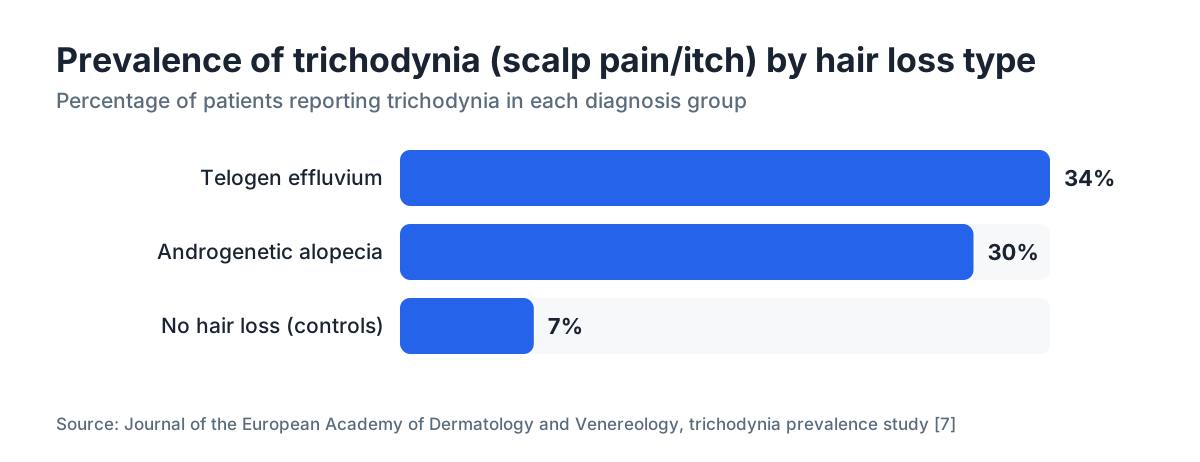
A study in the Journal of the European Academy of Dermatology and Venereology found trichodynia in roughly 30 percent of patients with androgenetic alopecia and about 34 percent of patients with telogen effluvium [7]. The proposed mechanism involves substance P, a neuropeptide tied to neurogenic inflammation, released around stressed or shrinking follicles.
This matters in practice because trichodynia patients sometimes get no diagnosis at all, or get told it's in their head. It isn't. If your scalp hurts or feels hypersensitive in an area where you're also losing hair, that's a real finding to raise with a dermatologist.
Trichodynia has no standalone treatment. Addressing the underlying hair loss condition usually eases it. Low-level laser therapy has some anecdotal support here, but the evidence is thin and the studies are small.
When should you see a dermatologist instead of treating yourself?
Self-treatment with OTC shampoos is fine for mild, clearly seborrheic dermatitis-type itch. Try a ketoconazole or zinc pyrithione shampoo for four to six weeks and see if it clears.
See a dermatologist without waiting if any of these apply:
- Hair loss is speeding up alongside the itch, past a few extra hairs in the shower into visibly thinning patches.
- The sensation is burning or painful, more than itchy.
- You can see smooth, shiny, or pale skin where hair used to be. That is a possible scarring alopecia sign.
- You have patches of broken-off hair stubs with scale, especially if you're under 18 or have had contact with children. That pattern suggests tinea capitis, which needs prescription antifungals.
- OTC treatments have done nothing after six weeks.
- The hair loss sits at the frontal hairline and you're a woman, particularly if you're postmenopausal.
A dermatologist can do trichoscopy (dermoscopy of the scalp) in-office and often reach a working diagnosis without a biopsy. When the diagnosis stays uncertain, a biopsy takes four to five millimeters of tissue and gives a definitive histological answer. It's a small procedure, not a big one.
Understanding what causes hair loss more broadly can help you frame the conversation with your doctor.
What treatments actually work for itch-related hair loss?
The treatment has to match the diagnosis. No single product works across all these conditions, and some that help one will worsen another.
For seborrheic dermatitis: Ketoconazole 2% shampoo (prescription), zinc pyrithione or selenium sulfide OTC shampoos, and short courses of topical steroids for flares. Maintenance is lifelong, because Malassezia never leaves for good.
For scalp psoriasis: Prescription-strength topical corticosteroids, coal tar, calcipotriol (a vitamin D analogue), and for moderate-to-severe disease, biologics targeting TNF-alpha or IL-17. The FDA has approved several biologics for plaque psoriasis with scalp involvement [8].
For tinea capitis: Oral griseofulvin is the old standard. Oral terbinafine is at least as effective and runs a shorter course. Topical antifungals alone don't reach the follicle deeply enough.
For alopecia areata: Intralesional triamcinolone injections stay the most common first move for patchy disease. The FDA approved baricitinib (Olumiant) in 2022 and ritlecitinib (Litfulo) in 2023 as the first systemic treatments specifically indicated for severe alopecia areata [9]. These JAK inhibitors are a genuine shift in what's achievable for patients with extensive disease.
For scarring alopecias (LPP, FFA): Anti-inflammatory agents to stop progression. No treatment regrows hair in scarred areas. Hair transplant into scarred tissue is generally not recommended unless the disease has been quiet for at least two years, and results are less predictable than in non-scarring loss [10]. If you're thinking about a transplant after a scarring alopecia, read about hair transplant candidacy first.
For contact dermatitis: Find and remove the allergen, use topical steroids during the acute phase, and antihistamines for itch control.
For androgenetic hair loss that sits alongside scalp inflammation, treat the inflammation first. After the scalp settles, DHT blockers or minoxidil come into play. Combining finasteride and minoxidil is the most evidence-supported strategy for androgenetic hair loss once inflammatory causes are ruled out.
Are there scalp care habits that make itch-related hair loss worse?
Yes. Several everyday habits either trigger or drag out scalp inflammation.
Washing too rarely is a big one. Most people with seborrheic dermatitis or oily scalps need to wash at least every other day. Going a week without washing because someone told you frequent washing causes hair loss backfires for inflammatory scalp conditions. It lets sebum and Malassezia pile up.
Washing too hard is the opposite mistake. Nails-on-scalp scrubbing strips scale for a moment but wrecks the skin barrier and invites more irritation. Use your fingertip pads, not your nails.
Hot water dries out and irritates the scalp. Warm is fine. Ending a shower with cool water does drop scalp redness a little, though the effect is modest.
Tight hairstyles (ponytails, braids, extensions) pull on follicles. For women with hair loss at the front or the temples, traction is an overlooked contributor that can ride alongside other inflammatory causes. Give those follicles mechanical rest while you treat the primary condition.
Some hair loss supplements pack biotin in very high doses. High-dose biotin can throw off thyroid and hormone blood tests, and thyroid dysfunction is itself a cause of shedding and sometimes scalp discomfort. Not a reason to skip supplements, but flag it if you have bloodwork coming.
How do doctors diagnose the cause of itchy scalp hair loss?
The workup usually follows a set order.
First, a clinical exam. The dermatologist looks at how the loss is distributed, how the scalp skin looks, and whether any scarring signs are present. They check the follicle openings: smooth, empty skin means scarring, while preserved openings point to non-scarring disease.
Second, trichoscopy. A handheld or video dermatoscope magnifies the scalp 10 to 70 times. It can separate perifollicular scale (suggesting LPP) from dirty dots (tinea capitis) from yellow dots (alopecia areata) without touching the skin. It has cut the need for biopsy in many straightforward cases.
Third, a potassium hydroxide (KOH) prep. If tinea capitis is suspected, a few hairs go into KOH solution and under the microscope for fungal hyphae. Results come back in minutes.
Fourth, a scalp biopsy. For scarring alopecias or ambiguous cases, a 4mm punch biopsy sent to a dermatopathologist gives a histological diagnosis. It is the gold standard. Results usually take one to two weeks.
Bloodwork sometimes gets added: ferritin (low iron stores link to telogen effluvium), thyroid-stimulating hormone, complete blood count, and in women, androgen levels if the pattern hints at hormonal drivers.
Most of this happens in one dermatology visit. It is not a six-month diagnostic odyssey. The main hurdle is usually just landing the appointment.
What is the connection between stress, itch, and hair loss?
Stress is genuinely linked to both, though not in the way most people assume.
Chronic psychological stress raises cortisol and sets off an immune response that can flare seborrheic dermatitis and psoriasis, both well documented. It can also set off telogen effluvium, where a large batch of hairs syncs into the resting phase and sheds two to three months later.
The itch feeds a loop. An itchy scalp is distracting and distressing. The distress feeds back into the stress response. Scratching brings a moment of relief but signals the brain that the threat is real, which reinforces the itch-scratch cycle.
Neurogenic inflammation, the release of substance P and calcitonin gene-related peptide from nerve endings in the scalp, is increasingly understood as a bridge between psychological stress and skin inflammation. This is not a metaphor and not a psychosomatic dodge. It's a real physiological path from stress hormones to local scalp inflammation.
Practically, that means managing stress with actual behavioral tools, rather than vitamins, can lower itch severity and may slow stress-induced shedding. Telogen effluvium from a stressor is usually self-limiting over six to nine months once the stressor resolves, assuming nothing else is driving it.
Here is the threshold. A persistent itchy scalp during a high-stress stretch, paired with accelerating shedding, that hasn't improved within three months is worth a dermatologist visit rather than more waiting.
If you're tracking your hairline over time and want a baseline to compare against, the free AI analysis at MyHairline can document your current distribution and flag changes worth discussing with a doctor.
Sources
- American Academy of Dermatology, Hair loss types and causes overview
- MedlinePlus (National Library of Medicine), Seborrheic dermatitis
- National Psoriasis Foundation, scalp psoriasis information
- Journal of the American Academy of Dermatology, Trichodynia and alopecia, 2013
- Dermatology (Karger), Ketoconazole shampoo vs minoxidil for hair density, 1998
- FDA, Minoxidil topical solution drug label
- Journal of the European Academy of Dermatology and Venereology, Trichodynia prevalence in hair loss patients
- FDA, Drug approvals and databases
- FDA, News and events for human drugs
- American Academy of Dermatology, Hair transplant guidance
- Centers for Disease Control and Prevention, Ringworm (tinea)
- NIAMS, Alopecia areata information