TL;DR: Hers offers FDA-approved 2% and 5% topical minoxidil for women with female-pattern hair loss. Clinical trials show 2% minoxidil regrows hair in roughly 60% of women after 32 weeks. The 5% formula works faster but carries a higher risk of facial hair. Both are available without a prescription. Expect to wait 3-6 months before seeing real results.
What exactly is Hers minoxidil and what does it contain?
Hers is a telehealth brand that sells minoxidil directly to women, mostly as a topical solution or foam you apply to your scalp. The active ingredient is minoxidil, a vasodilator that the FDA approved for treating androgenetic alopecia (female-pattern hair loss) in 1991 [1]. There is nothing proprietary about the molecule itself. Minoxidil is a generic drug, and Hers sources it in the same two concentrations you'd find at any pharmacy: 2% solution and 5% foam.
The 2% concentration is the one specifically FDA-labeled for women. The 5% concentration was originally approved for men, but the FDA's own drug label acknowledges women have used it off-label, and a 2004 trial published in the Journal of the American Academy of Dermatology found it produced greater hair density gains in women than 2% [2]. Hers offers both concentrations, typically through a short online intake that a licensed clinician reviews before approving the order.
The solution vehicle (the liquid that carries minoxidil) contains propylene glycol and alcohol. Some women find these irritating, particularly on a sensitive scalp. The foam formulation skips propylene glycol, which makes it gentler for most people. If you've had scalp irritation with the solution in the past, the foam is usually the better starting point.
A quick note on what Hers is not: it is not a prescription-only product for minoxidil. Topical minoxidil has been over-the-counter since the FDA switched its status. Hers adds the convenience of online consultation and auto-ship, but the drug itself is identical to what you'd buy at a drugstore for less. Whether that convenience is worth the price difference is a real question, and we'll get to it.
Does minoxidil work for women's hair loss?
The short answer is yes, for the right type of hair loss. The right type is androgenetic alopecia, which in women typically shows up as diffuse thinning at the crown and a widened part, rather than the receding hairline pattern common in men. If your hair loss fits that description, the evidence for minoxidil is solid [1].
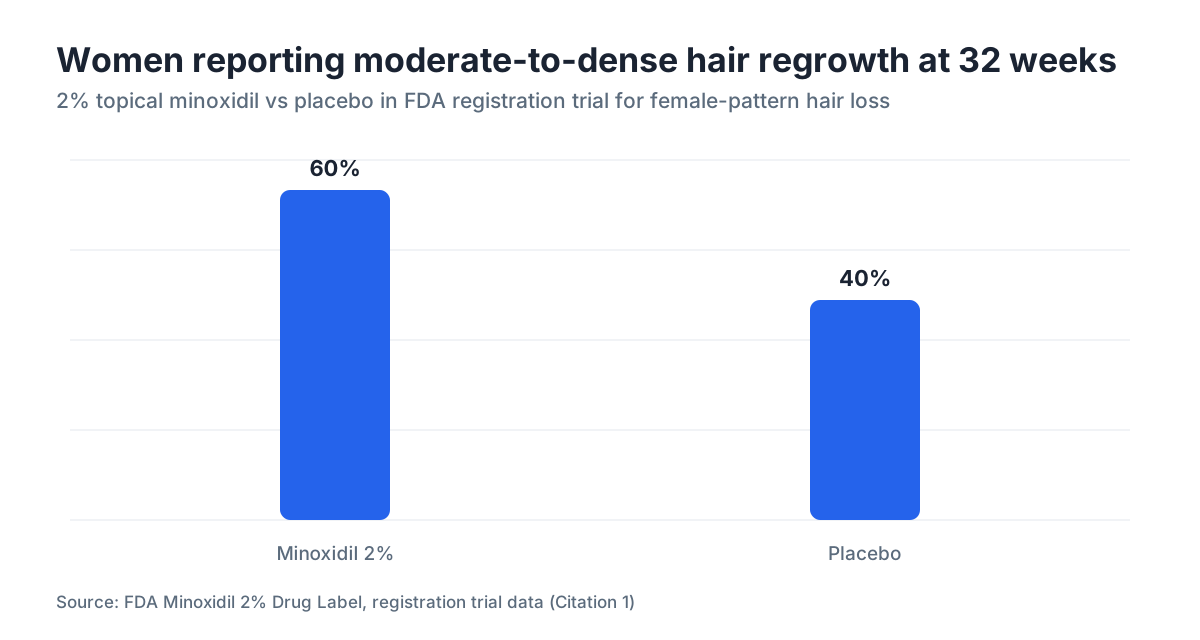
The registration trial the FDA relied on for the 2% women's approval enrolled 256 women with androgenetic alopecia. After 32 weeks, 60% of women in the minoxidil group reported moderate to dense hair regrowth, compared to 40% in the placebo group [1]. That gap matters. It means minoxidil is doing real work above placebo, though the placebo response is itself a reminder that some hair cycling happens on its own.
The 5% foam has its own data. A 2011 randomized controlled trial in the Journal of the American Academy of Dermatology compared once-daily 5% foam to twice-daily 2% solution in 113 women over 24 weeks [3]. The 5% once-daily group achieved non-inferior hair counts, with a somewhat better side-effect profile for scalp dryness. That study is why many dermatologists now reach for the 5% foam first.
Minoxidil does not work for hair loss caused by thyroid disorders, severe iron deficiency, telogen effluvium, traction alopecia, or scarring alopecia. If you're not sure what causes your hair loss, getting a proper diagnosis before spending money on minoxidil is genuinely the right call. Treating the wrong type of hair loss with minoxidil for six months is a frustrating waste of time.
The mechanism involves widening blood vessels around hair follicles and prolonging the anagen (growth) phase. Minoxidil doesn't address the androgen sensitivity that causes follicle miniaturization in the first place, which is why it's a management tool, not a cure. Stop using it, and most of the regrown hair sheds within a few months [1].
What are the differences between 2% and 5% minoxidil for women?
The two concentrations have different FDA approval histories, different dosing schedules, and meaningfully different side-effect profiles. Here's how they compare:
| 2% Solution | 5% Foam | |
|---|---|---|
| FDA approval for women | Yes (1991) | Off-label; same active ingredient [1] |
| Dose | 1 mL twice daily | 0.5 capful once daily |
| Regrowth evidence in women | ~60% at 32 weeks [1] | Non-inferior to 2%, achieved in 24 weeks [3] |
| Propylene glycol | Yes | No |
| Facial hair risk | Lower | Higher (but still low) |
| Typical retail cost | $15-25/month | $20-30/month |
The facial hair concern is real but often overstated. In the 5% trials, unwanted facial hair was reported by roughly 3-5% of women, and it typically resolved after stopping or reducing use [3]. The mechanism is probably accidental transfer: if you apply foam and then touch your face before washing your hands, minoxidil migrates. Applying at night and washing hands immediately after reduces this risk substantially.
For most women starting out, dermatologists tend to recommend 5% foam once daily because the single daily dose improves adherence, the foam vehicle is gentler, and the efficacy data is at least as good. The 2% solution twice daily is a reasonable alternative if cost is a concern or if your doctor specifically recommends it.
How does Hers compare to buying generic minoxidil at a pharmacy?
This is the question Hers would rather you not ask too directly. The active ingredient is identical. Generic 5% minoxidil foam from Kirkland (Costco's brand) costs roughly $25-35 for a six-month supply, which works out to about $5/month [4]. Hers minoxidil, depending on the subscription tier at the time you check, typically runs $25-40/month. That's a real price gap over a year or two of continuous use.
What Hers charges for beyond the drug itself: a clinician review of your intake form, a branded experience, auto-ship convenience, and access to messaging with a provider if you have questions. Whether those extras are worth $20-30 extra per month depends entirely on how comfortable you are navigating OTC options on your own. If you already have a dermatologist, you probably don't need Hers. If you've never used minoxidil and find the clinical consultation reassuring, the markup may be worth it to you.
One genuine advantage of platforms like Hers: they can prescribe oral minoxidil (typically 0.25-1 mg daily for women), which requires a prescription and is not available OTC. Oral minoxidil is getting significant attention in the dermatology literature right now for women who don't respond to topical or who find daily application difficult. If that's a direction you want to explore, a telehealth platform or dermatologist is the only path.
A few things to check before subscribing: confirm the concentration you're getting, verify the cancellation policy (some telehealth subscriptions have made this harder than it should be), and compare the per-unit cost against your local pharmacy. The American Academy of Dermatology's patient resources on minoxidil are a useful free baseline before you decide [5].
What side effects should women expect from minoxidil?
The most common side effect is initial shedding. In the first 2-8 weeks of use, many women experience an increase in hair fall. This is real, it is alarming, and it is temporary. What's happening is that minoxidil pushes hairs in the resting (telogen) phase into active growth, which forces the old hair out first. The FDA label for minoxidil specifically describes this initial shedding as expected [1]. It resolves on its own. Stopping minoxidil because of early shedding is the single most common reason women don't see results.
Scalp irritation, dryness, and itching affect some users, more commonly with the 2% solution because of propylene glycol. Switching to the foam formulation resolves this for most people [3].
Systemic (whole-body) side effects from topical minoxidil are rare at standard doses. The drug can cause fluid retention and a drop in blood pressure at higher oral doses, but the amount absorbed through the scalp from a 1 mL topical application is small. Women with heart conditions should still talk to a doctor before starting, but for healthy adults, topical minoxidil is well tolerated [1].
Facial hair growth, as noted above, affects a minority of users of 5% formulations. It usually appears on the temples or upper lip. Reducing dose, switching to 2%, or applying before bed and rinsing in the morning are the common management strategies.
For a thorough breakdown of the full side-effect profile including less common reactions, see our minoxidil side effects deep-explainer.
How long does it take for minoxidil to work for women?
Three to six months before you see meaningful regrowth. That's not a hedge; it's the clinical timeline. Hair grows roughly half an inch per month, and the follicle has to complete a full anagen cycle before the new hair is visible at the scalp surface.
Here's a rough timeline based on the trial data:
- Weeks 1-8: Possible initial shedding. No visible improvement. Many women quit here.
- Weeks 8-16: Shedding resolves. Vellus (fine, short) hairs may begin to appear at the crown.
- Weeks 16-32: Terminal hair thickening becomes more noticeable. This is the window the 32-week registration trial used to measure efficacy [1].
- Months 12+: Maximum density is typically reached around 12-18 months of consistent use.
Photographing your part width under consistent lighting every four weeks is the most practical way to track progress at home. It's harder to see gradual change in the mirror day-to-day than in a side-by-side photo comparison.
If you're at the six-month mark with zero change, it's worth revisiting the diagnosis. Either the hair loss has a different cause that minoxidil won't address, or you're not applying enough or consistently enough. Twice-daily application of 2% solution or once-daily 5% foam every single day is the standard. Skipping weekends or applying sporadically cuts efficacy significantly. This is also where an AI hair scan can give you an objective look at what's changed: the free scan at MyHairline analyzes your part width and crown density from photos you take at home, which takes the guesswork out of tracking.
Can women use 5% minoxidil, or is 2% the only safe option?
Women can absolutely use 5% minoxidil. The 2%-only recommendation you'll sometimes hear is outdated, rooted in the original FDA approval from 1991 before 5% foam had been studied in women. Current evidence supports 5% foam as safe and effective for women with female-pattern hair loss [3].
The American Academy of Dermatology's clinical guidance on hair loss treats 5% minoxidil as an appropriate option for women [5]. A 2019 review in the Journal of Dermatological Treatment concluded that both concentrations are effective, with 5% showing faster response in some measures [6].
The key safety caveat: women who are pregnant, trying to conceive, or breastfeeding should not use any concentration of topical minoxidil. The drug is classified FDA Pregnancy Category C, meaning animal studies have shown adverse effects and there are no adequate human trials. This is not a minor warning to wave off [1].
What if minoxidil alone is not enough?
Minoxidil works on the symptom (follicle shrinkage) rather than one root cause of female-pattern hair loss (androgen sensitivity at the follicle). For women whose hair loss is driven primarily by androgens, adding a DHT blocker to a minoxidil regimen often produces better results than either alone.
Spironolactone, an oral anti-androgen, is the most commonly prescribed add-on for women in the United States. It requires a prescription and is not appropriate for women who may become pregnant. Finasteride is used off-label in post-menopausal women in some cases, though the evidence base in women is thinner than in men and it carries a strict pregnancy contraindication [7].
For women who want to explore the combination of topical minoxidil and an oral treatment, a comparison of the two main topical options alongside combination approaches is in our finasteride and minoxidil article.
If medical treatment hasn't produced satisfactory results after 12-18 months, or if the hair loss is advanced, a consultation about a hair transplant is reasonable. Transplants in women work differently from men because the donor area needs to be stable, and women with diffuse loss don't always have a strong donor zone. A specialist evaluation is essential before pursuing that route.
For women who prefer non-prescription adjuncts, the evidence for hair loss supplements like biotin, iron, and saw palmetto is genuinely weaker than for minoxidil, but correcting actual deficiencies (low ferritin, low vitamin D) can make a real difference if deficiency is part of the picture.
Is Hers minoxidil FDA-approved, or is it off-label?
The drug itself, minoxidil, is FDA-approved for female-pattern hair loss. The 2% concentration has carried that indication for women since 1991 [1]. The 5% foam's FDA label is technically for men, so prescribing or recommending it for women is off-label, but that is an extremely common and well-supported clinical practice.
Hers as a company is not FDA-approved; companies don't get approved, drugs do. What matters for your safety is whether the minoxidil in the product meets USP standards and is manufactured in an FDA-registered facility. For branded OTC minoxidil products from established manufacturers, this is standard. For any compounded minoxidil (custom formulations from a compounding pharmacy), the FDA oversight is different and somewhat less rigorous, so it's worth asking whether what you're buying is a finished pharmaceutical product or a compounded one.
The FDA's label for minoxidil topical solution states: "If you do not see hair regrowth in 4 months, stop using this product and see your doctor" [8]. That's a useful benchmark and a reminder that minoxidil is not a one-size-fits-all answer.
Who should not use Hers minoxidil?
The clearest contraindications: pregnant women, women trying to become pregnant, and breastfeeding women should not use minoxidil [1]. This is firm, not precautionary. Women with a known allergy to minoxidil or propylene glycol (in the solution formulation) should avoid those products. Women with scalp conditions like psoriasis or eczema that have broken the skin barrier may absorb more drug systemically; medical guidance is appropriate before starting.
Women with cardiovascular conditions, low blood pressure, or who take other vasodilatory medications should consult a physician first. Topical absorption at standard doses is low, but not zero [1].
Minoxidil is also not the right treatment for hair loss that isn't androgenetic alopecia. Scarring alopecias (like lichen planopilaris or frontal fibrosing alopecia) can actually be worsened or unaffected by minoxidil while the underlying inflammation goes untreated. Alopecia areata has its own separate treatment pathway. Telogen effluvium caused by stress, illness, or hormonal shifts often resolves on its own; minoxidil may help supportively but treating the root trigger is more important [see our article on telogen effluvium].
If your receding hairline or hair loss pattern doesn't look like classic female-pattern (diffuse crown thinning), a dermatologist visit to confirm the diagnosis before spending money on minoxidil is the most useful $150-250 you can spend.
Is Hers minoxidil worth it? An honest assessment
For most women with straightforward female-pattern hair loss, generic OTC minoxidil from a pharmacy does the same thing for a fraction of the price. The drug is identical. If you're comfortable reading the label, applying it consistently, and monitoring your own progress, there is no clinical reason to pay a significant premium for the Hers brand.
Where Hers earns its fee: if you value the clinician consultation, want a prescription for oral minoxidil or a combination treatment, or simply find the accountability of a subscription helpful for adherence. Adherence is the biggest variable in minoxidil outcomes. A subscription that makes you more likely to apply it every day is worth something real, even if the drug itself is not proprietary.
The honest bottom line: minoxidil works for female-pattern hair loss, the evidence is solid, and starting sooner beats starting later because follicles that miniaturize long enough eventually stop producing hair at all. The brand you get it from matters far less than whether you use it consistently and at the right concentration for your needs.
Before you commit to any subscription, take a baseline photo of your part and crown in natural light. You'll thank yourself in six months. The free AI hair scan at MyHairline is one way to get an objective starting-point analysis if you're not sure how to interpret what you're seeing.
Sources
- FDA, Minoxidil Topical Solution 2% Drug Label
- Olsen EA et al., Journal of the American Academy of Dermatology, 2004
- Blume-Peytavi U et al., Journal of the American Academy of Dermatology, 2011
- Costco / Kirkland Signature Minoxidil Foam, retail pricing reference
- American Academy of Dermatology, Hair Loss in Women patient resource
- Badri T et al., Journal of Dermatological Treatment, 2019
- Varothai S & Bergfeld WF, American Journal of Clinical Dermatology, 2014
- FDA, Minoxidil Topical Solution label statement on treatment duration
- National Institutes of Health, MedlinePlus, Minoxidil Topical
- Gupta AK & Talukder M, Journal of Cosmetic Dermatology, 2022