
TL;DR: For hair loss, a 0.5mm dermaroller is safe to use 2-3 times per week at home alongside minoxidil and works well for most people. A 1.5mm roller triggers a stronger wound-healing response but should only be used once every 3-4 weeks and carries higher infection risk. Clinical trials show microneedling combined with minoxidil outperforms minoxidil alone.
What does a dermaroller actually do for hair loss?
A dermaroller is a small handheld wheel covered in tiny needles. When you roll it across your scalp, it creates hundreds of micro-injuries in the skin. That sounds backwards, but those micro-injuries kick off a wound-healing cascade: your body floods the area with platelet-derived growth factors, turns up Wnt/beta-catenin signaling, and increases blood flow to follicles that have been slowly starving. For people with androgenetic alopecia (the most common kind of hair loss in men and women), this is exactly the stimulus dormant follicles need.
Needle depth matters a lot here. The dermis, where hair follicles live, starts at roughly 1mm below the surface of the scalp. A 0.5mm needle reaches only the epidermis. A 1.5mm needle punches into the upper dermis. Neither depth reaches the hair bulb, which sits 3-4mm down, so you are not damaging the follicle itself. You are waking up the tissue around it.
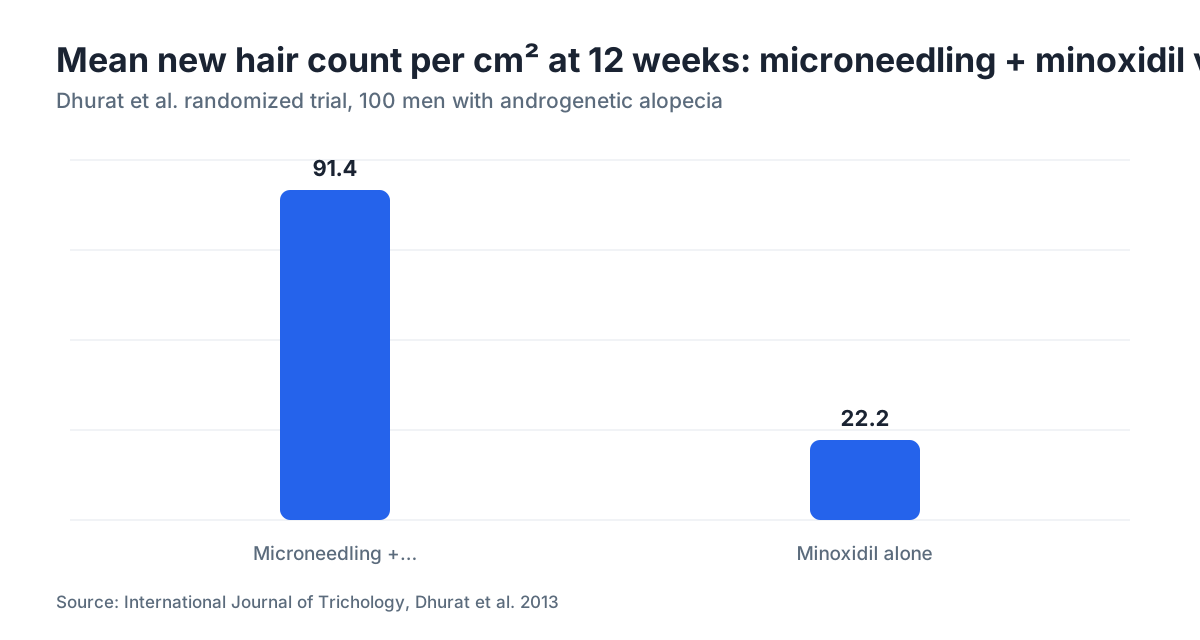
A 2013 study in the International Journal of Trichology by Dhurat et al. randomized 100 men with androgenetic alopecia to either weekly 1.5mm microneedling plus minoxidil or minoxidil alone. After 12 weeks, the microneedling group had a mean hair count of 91.4 new hairs per cm² versus 22.2 in the minoxidil-only group [1]. That is a stark gap, and it is the most-cited trial in this space.
If you want the full biological picture of why follicles miniaturize in the first place, see our piece on what causes hair loss.
What is the difference between 0.5mm and 1.5mm needle depth?
The two depths overlap but do different jobs, and the right choice depends on your goals, your pain tolerance, and whether you have professional supervision.
| Feature | 0.5mm | 1.5mm |
|---|---|---|
| Skin layer reached | Epidermis | Upper dermis |
| Frequency | 2-3x per week | Once every 3-4 weeks |
| Pain level | Minimal (1-2/10) | Moderate to significant (4-7/10) |
| Recovery time | None to a few hours of redness | 24-72 hours of redness, possible swelling |
| Infection risk | Low | Higher (open dermal channels) |
| Growth factor stimulation | Mild | Strong |
| Can apply minoxidil same day? | Yes, immediately after | No, wait 24 hours minimum |
| Supervision needed? | No | Recommended |
| Cost of roller | $10-30 | $15-40 |
The 0.5mm depth is where most people start and where most people stay. It is genuinely effective, low-risk, and works alongside daily minoxidil. The 1.5mm depth is a higher-intensity tool. Some dermatologists use 1.5mm rollers or dermapens in-office and go up to 2.5mm in controlled settings, but at home, 1.5mm is the practical ceiling.
One thing that trips people up: a deeper needle does not automatically mean better results. Overuse of a 1.5mm roller, say every few days, actually impairs the wound-healing response because the tissue never finishes its repair cycle. Healing is where the growth happens, not the injury itself.
What does the clinical evidence say about microneedling for hair growth?
The Dhurat et al. 2013 trial is the most-cited study here [1], but it is not the only one. A 2019 meta-analysis in the Journal of the American Academy of Dermatology reviewed several randomized controlled trials on microneedling for androgenetic alopecia and concluded that microneedling combined with topical treatments consistently outperformed topical treatments alone, though the authors noted that protocols varied a lot in needle depth (0.5-1.5mm) and frequency [2].
A separate 2021 study in Dermatologic Surgery compared 0.6mm microneedling (using a dermapen) to 1.5mm and found that both groups showed statistically significant hair count improvement over 12 weeks, with the 1.5mm group posting slightly higher density gains but also more adverse events [3]. So the evidence says 0.5-0.6mm works. You do not have to go to 1.5mm to see results.
What the trials agree on: microneedling works best combined with an active hair loss treatment, particularly minoxidil for men. On its own, without any topical therapy, the evidence is thinner. Microneedling appears to boost minoxidil absorption and independently stimulate growth factors, so the combination is genuinely additive.
For finasteride and minoxidil users already on a medical protocol, adding a dermaroller is a reasonable next step if you want to push results further. The trials suggest you will likely see incremental benefit.
Nobody has clean data on exactly how many sessions produce maximum results before diminishing returns kick in. The closest we have is the Dhurat protocol (12 weeks, weekly 1.5mm sessions), which showed the biggest gains in weeks 6-12.
How do you use a 0.5mm dermaroller at home, step by step?
This is the protocol most people should follow, and it is low enough risk to do without a dermatologist's oversight if you are careful.
Before you start
Wash your scalp with a gentle shampoo. Let it dry completely. Damp skin tears more easily. Sterilize your dermaroller by soaking it in 70% isopropyl alcohol for 5-10 minutes, then let it air dry. Never use a roller straight out of the packaging without sterilizing it first.
The rolling technique
Section your hair so the target area is exposed. Apply light pressure and roll in one direction 8-10 times, then lift the roller and roll perpendicular 8-10 times, then diagonally if you want thorough coverage. Do not drag the roller sideways. Lift, reposition, roll. You should see mild pinkness, not bleeding. If you are bleeding, you are pressing too hard or using a worn-out roller.
Focus on thinning areas: the crown, temples, or hairline. A 0.5mm roller over a normal density area is fine but adds little.
After rolling
Apply your minoxidil immediately or within 10 minutes. The micro-channels the roller creates increase minoxidil absorption significantly, which is part of why the combination works so well. Some studies suggest absorption can jump by up to 40-fold through microneedled skin compared to intact skin, though the clinical relevance of that number depends heavily on the specific conditions of the study [4].
Frequency
2-3 times per week is the standard for 0.5mm. Every other day works well. Daily use is probably fine for 0.5mm but offers diminishing returns.
Roller maintenance
Replace your roller every 2-3 months, or sooner if the needles feel rough or you can see visible bending under a light. Bent needles cause tears, not clean punctures, and they raise infection risk.
How do you use a 1.5mm dermaroller safely?
The 1.5mm protocol is more intense and demands more discipline, especially around spacing sessions far enough apart.
Who should consider 1.5mm
People who have already used 0.5mm for 2-3 months without irritation, or those who want to copy the Dhurat trial protocol more closely. If you have any active scalp conditions (seborrheic dermatitis, psoriasis, scalp folliculitis), do not use 1.5mm at home. Deeper punctures on an already-inflamed scalp are asking for an infection.
Preparation is the same as 0.5mm but add a numbing step if you want: a topical lidocaine cream (available over the counter) applied 30-45 minutes before rolling makes the process much more comfortable. OTC topical anesthetics in the US are generally limited to 4% lidocaine; prescription formulations go higher and are what most dermatologists use in-office [5].
Rolling technique
Same directional approach as 0.5mm: horizontal, vertical, diagonal. But use slightly less pressure than you think you need. The longer needles do the work. You will see more redness than with 0.5mm. Pinpoint bleeding is normal and even expected at 1.5mm. Heavy bleeding is not.
After rolling
Do not apply minoxidil or any topical treatment for at least 24 hours. The open dermal channels at 1.5mm depth mean anything you apply absorbs systemically in a way that is not predictable. Minoxidil applied to a fresh 1.5mm-treated scalp could cause cardiovascular side effects (rapid heart rate, dizziness) because absorption spikes. This is a real risk, not a theoretical one.
For more on what minoxidil does at excessive systemic doses, see minoxidil side effects.
Frequency
Once every 3-4 weeks. Strictly. The dermal repair cycle after 1.5mm punctures takes around 3 weeks to finish. Rolling before that is done disrupts the collagen remodeling phase and can cause paradoxical shedding or inflammation.
Aftercare
Keep the scalp clean for 72 hours. Avoid heavy sweating (gym, sauna) for 48 hours. Sleep on a clean pillowcase. Watch for signs of infection: increasing redness after 48 hours, warmth, pus, or fever. See a doctor immediately if those appear.
Can you use a dermaroller with minoxidil and finasteride at the same time?
Yes, and this combination is generally considered the most effective non-surgical protocol for androgenetic alopecia. Finasteride, minoxidil, and microneedling hit hair loss through three separate pathways: DHT suppression (finasteride), direct follicle stimulation and vasodilation (minoxidil), and mechanical growth factor induction (microneedling). There is no known drug interaction between finasteride and microneedling.
The timing rule is the same as above: with 0.5mm, apply minoxidil right after. With 1.5mm, wait at least 24 hours before applying minoxidil. Finasteride is an oral medication (or topical, in some formulations) and is not affected by microneedling timing.
One thing worth knowing: some people see a temporary shed (telogen effluvium) in the first few weeks of starting any new hair loss protocol, including microneedling. This is not a sign the treatment is failing. If you want to understand what that shed is and when it stops, the telogen effluvium article covers it in detail.
If you are adding microneedling to an existing regimen, give it 12 weeks before judging results. Hair cycles are slow. The Dhurat trial showed meaningful differences at 12 weeks, but the largest gains came in weeks 8-12, not the first month [1].
How often should you replace your dermaroller and how do you keep it clean?
This is the question most people skip, and it matters more than they think.
Dermaroller needles are made of surgical steel or titanium. Surgical steel dulls faster. After roughly 8-10 sessions for a 0.5mm roller used every other day, which is about 3-4 weeks of use, needle quality drops enough to affect the experience. Most manufacturers say their rollers last 2-3 months with proper cleaning, but that assumes weekly use. If you are rolling 3x per week, replace it every 4-6 weeks.
To clean after each session: rinse off any product residue under running water, then soak the head in 70% isopropyl alcohol for at least 5 minutes. Store it in the protective case it came with. Never leave it open on the bathroom counter. Bathrooms run humid and bacteria-heavy.
Never share a dermaroller. This should be obvious but it is not: sharing is how bloodborne pathogens transmit. Each roller is a single-user device.
How to tell when to replace it: hold the roller up to a bright light and look at the needle tips. If any are visibly bent, asymmetrical, or the rolling feels scratchy rather than smooth, it is done. You can also run the needles lightly over a piece of tissue paper: a dull roller will catch or snag it.
Who should not use a dermaroller on their scalp?
Microneedling is not right for everyone, and the contraindications matter.
Active scalp infections. Any bacterial, fungal, or viral infection on the scalp (folliculitis, ringworm, active cold sores) means do not roll. You will spread the infection into deeper tissue layers.
Active inflammatory scalp conditions. Seborrheic dermatitis, psoriasis, and lichen planopilaris are all reasons to hold off, particularly on 1.5mm. A low-grade dermatitis might tolerate 0.5mm with caution, but get a dermatologist's opinion first.
Blood thinners or clotting disorders. Warfarin, apixaban, aspirin therapy, or conditions like hemophilia make even minor scalp bleeding harder to control.
Recent scalp surgery. If you have had a hair transplant within the last 12 months, do not roll over the recipient area. Grafts take months to fully anchor, and microneedling over them can dislodge or damage them. Wait at least 12 months and get your surgeon's clearance.
Keloid-prone skin. If you scar easily and produce raised scars, dermal-level injury (1.5mm especially) carries more risk of creating scar tissue on the scalp.
Accutane use or recent use. Isotretinoin changes skin healing. Most dermatologists recommend waiting 6-12 months after stopping Accutane before any needling procedure.
Alopecia areata. The evidence for microneedling in alopecia areata is mixed. Some small studies show benefit, but the inflammatory nature of AA means aggressive needling could theoretically worsen it. This is a case for a specialist, not home treatment.
What results can you realistically expect and how long does it take?
Honest answer: microneedling slows loss and can regrow some hair, but it is not going to fully reverse a Norwood 5 or 6 hairline. Set expectations accordingly.
The Dhurat trial showed an average of 91.4 new hairs per cm² in the microneedling plus minoxidil group after 12 weeks [1]. That is meaningful density. But these were men with mild to moderate androgenetic alopecia, not advanced loss. The more follicles you still have (even miniaturized ones), the more a microneedling protocol can do.
Typical timeline:
- Weeks 1-4: No visible change. Possible temporary shedding.
- Weeks 4-8: Reduced shedding rate in some users. No new visible growth yet.
- Weeks 8-12: Early regrowth (fine, colorless vellus hairs) in some areas. Existing hairs may look slightly thicker.
- Months 4-6: Vellus hairs may mature into terminal (pigmented, thicker) hairs. Density improvement more visible.
- Month 12+: The most realistic point to judge full response.
If you have been at this for 6 months with a consistent protocol (correct depth, correct frequency, combined with minoxidil or finasteride) and see nothing at all, talk to a dermatologist about whether you are a candidate for more aggressive options. At some point, if follicles are fully fibrosed, no amount of microneedling will bring them back.
Curious where you stand on the hair loss spectrum? A free AI hair scan at MyHairline can help you identify your current loss pattern before you spend on a protocol.
For surgical options when topical and microneedling approaches are not enough, see hair transplant.
Does the type of dermaroller (titanium vs surgical steel) matter?
It matters a little, but not as much as the marketing suggests.
Titanium needles are harder than surgical steel. They hold their edge longer, which matters if you are comparing roller lifespan. Surgical steel needles are cheaper and perfectly effective when new; they just dull faster. Either material works well for the first several sessions.
What matters more than material: needle quality consistency across the roller head. A cheap roller with uneven needle placement produces uneven micro-injuries, so some areas get overtreated and others undertreated. Look for rollers from brands that publish needle specs (diameter, tip angle) rather than just needle count.
Needle count (192-needle roller vs 540-needle roller, etc.) affects how evenly coverage spreads but does not fundamentally change efficacy if you roll multiple passes. A 540-needle roller at 0.5mm and a 192-needle roller at 0.5mm produce similar results with slightly different technique.
Dermapen-style devices (electric stamp microneedlers) are generally preferred by dermatologists over rollers because they create vertical punctures rather than the angled punctures a rolling motion produces. Angled punctures can cause more epidermal drag. If you are spending more than $50 on a device, a dermapen is worth considering over a roller, particularly at 1.5mm depth.
Is a 1.5mm dermaroller better than professional microneedling treatments?
For most people, professional treatments done by a dermatologist or trained aesthetician produce better outcomes than home rolling at 1.5mm. Here is why.
In-office microneedling often uses dermapens with needle depths of 1.5-2.5mm on the scalp, topical numbing so the provider can apply consistent pressure, sterile technique across the whole session, and sometimes platelet-rich plasma (PRP) injected alongside the microneedling. PRP is not something you can replicate at home.
That said, the cost difference is real. Home rollers cost $15-40. Professional scalp microneedling sessions typically run $200-800 per session, and a standard course is 4-6 sessions [6]. For many people, a consistent home protocol at 0.5mm with minoxidil is more sustainable and, based on the available evidence, genuinely effective.
The path many dermatologists suggest: use 0.5mm at home 2-3 times per week as your maintenance protocol, and do a professional 1.5-2mm session every 1-2 months if budget allows. That pairs the frequency benefit of shallow rolling with the stronger stimulus of deeper professional treatment.
For how microneedling stacks up against medications and supplements, the hair loss supplements article compares the evidence on various add-ons.
Sources
- International Journal of Trichology, Dhurat et al. 2013, "A Randomized Evaluator Blinded Study of Effect of Microneedling in Androgenetic Alopecia"
- Journal of the American Academy of Dermatology, Issa and Hafez 2019 meta-analysis on microneedling for androgenetic alopecia
- National Center for Biotechnology Information, PubMed, study on microneedling-enhanced drug absorption through skin
- FDA, Over-the-Counter Topical Anesthetic Drug Products for Use on Intact Skin
- NIH National Institute of Arthritis and Musculoskeletal and Skin Diseases, Androgenetic Alopecia overview
- FDA, Minoxidil OTC labeling and drug facts
- MedlinePlus (National Library of Medicine), Androgenetic Alopecia
- International Journal of Dermatology, Fertig et al. 2016, "Non-surgical treatments for androgenetic alopecia"