

TL;DR: Hair loss triggered by hormonal birth control is reversible for most people. Shedding peaks 2 to 4 months after stopping the pill, then hair regrows over 6 to 12 months. A small number of women with underlying androgenetic alopecia find the pill unmasked permanent thinning. Patience does most of the work. Minoxidil can speed up visible regrowth.
What actually causes hair loss from birth control?
Birth control pills change your hormone levels. They suppress ovulation using synthetic estrogen and progestogen, and that hormonal shift is what can knock the hair growth cycle off balance.
Hair grows in phases: anagen (active growth, lasting 2 to 7 years), catagen (a brief transition), and telogen (resting, about 3 months), after which the hair sheds and a new one starts. Estrogen stretches out the anagen phase, keeping more hairs growing at once. Start a pill, stop one, or switch formulations, and the sudden change in estrogen and progesterone can push a big share of follicles out of anagen and into telogen together. That condition is called telogen effluvium. It shows up as diffuse shedding across the whole scalp, not a receding hairline pattern. [1]
The second mechanism is androgenic. Some older or progestogen-only pills contain progestins with high androgenic activity, meaning they bind androgen receptors much like DHT, the hormone behind pattern baldness. Norethindrone, levonorgestrel, and norgestrel sit at the high end. Pills with low or anti-androgenic progestins like drospirenone or desogestrel are less likely to cause this kind of shedding, and may actually reduce androgen-related thinning in some women. [2]
So two separate pathways are in play. One is telogen effluvium from the hormonal shift itself, whether you start or stop. The other is androgenic miniaturization from a progestin that behaves a bit like DHT. From the outside they look alike. Their long-term outcomes are very different. [3]
Does hair loss start when you begin the pill or when you stop it?
Both, and that trips people up.
Start a hormonal contraceptive, especially one with a high-androgenic progestin, and some women notice slow thinning over months as the androgenic effect builds on susceptible follicles. Others hit a shedding episode 2 to 4 months after starting, when the hormonal adjustment sets off a telogen effluvium.
Stop the pill and the drop in synthetic estrogen removes its anagen-prolonging effect. A batch of follicles that were held in the growth phase enter telogen together, then shed roughly 3 months later. This is postpill telogen effluvium, and it feels cruel: you quit the thing you blamed, and the shedding gets worse instead of better. [1]
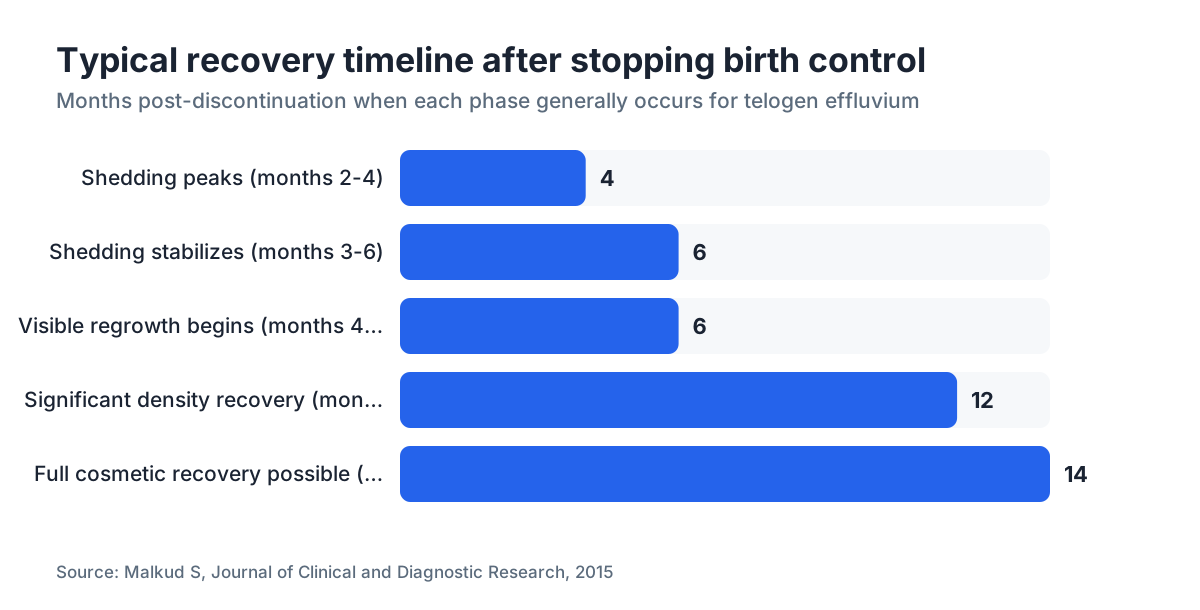
Here's the rough timeline. Stop the pill in January. Notice heavier shedding in March or April. Peak around May or June. Then stabilization and the first signs of regrowth (short, fine new hairs at the scalp surface) from about month 6 on. Full cosmetic recovery can take 12 months or longer, depending on how much you shed and how fast your own cycle runs. [4]
Is birth control hair loss actually reversible?
For most women, yes. Pure telogen effluvium, the kind that comes from the hormonal disruption of starting or stopping a pill, runs its course and stops. Once the trigger is gone and your natural estrogen rhythm returns, the follicles go back to normal cycling. Studies on telogen effluvium from many causes show the same thing: it resolves on its own in most cases, usually within 6 to 12 months of the trigger being removed. [1]
The wrinkle is androgenetic alopecia (AGA), the hereditary pattern that runs in families. Some women carry a genetic sensitivity to DHT but never see obvious thinning until something amplifies it: a high-androgenic pill taken for years, or the estrogen drop after quitting any pill. In those cases the pill wasn't the root cause. It sped up or revealed a process that was already there. That share of the loss may not fully reverse. If your mother or maternal grandmother has visible thinning or a wider part, pay attention to that. [3]
A 2019 review in the Journal of the American Academy of Dermatology (Starace et al) noted that drug-induced hair loss is "frequently reversible once the offending agent is discontinued," while cautioning that recovery is incomplete in some patients with concurrent AGA. [5] That's the honest picture. Reversible for most, partly reversible for some, and almost never a cause of complete permanent loss on its own.
How long does regrowth take after stopping the pill?
Regrowth breaks into three rough phases.
Months 1 to 3 after stopping: shedding often keeps going or gets worse. This is the hardest stretch mentally, because it looks like the wrong direction. The follicles that entered telogen when you quit are now finishing that phase and letting go of the hair. Nothing is broken. The cycle is doing its job.
Months 3 to 6: shedding slows and settles. Look closely at the scalp or run your fingers through your hair and you may spot short, fine baby hairs near the hairline or along a part. These are vellus hairs turning back into terminal hairs. They're easy to miss.
Months 6 to 12: visible density improvement for most people. The new hairs are still short, so the scalp may look thinner than before, especially under overhead lighting. By 12 months, most women with pure postpill telogen effluvium have most of their volume back.
Past 12 months: if real thinning is still there at the one-year mark, that's your signal to see a dermatologist. Thinning that won't budge a full year after the trigger is gone points to something else, usually AGA or a nutritional gap like iron deficiency or low ferritin. Blood work is worth it at that stage. [4]
So the honest answer to "how long" is 6 to 12 months, with wide variation between people. You can't compress it much. Hair grows about half an inch per month, and that clock doesn't run faster on demand.
Which birth control pills are most and least likely to cause hair loss?
Androgenic index is what matters. Progestins with higher androgenic activity are more likely to worsen DHT-sensitive follicle miniaturization. Progestins that are low or anti-androgenic are less likely to cause androgenic shedding, and can even improve acne and androgenic hair loss in some women.
| Progestin | Androgenic activity | Examples |
|---|---|---|
| Norethindrone | Moderate | Ortho Micronor, Junel, Loestrin |
| Levonorgestrel | High | Aviane, Seasonale, Plan B |
| Norgestrel | High | Lo/Ovral |
| Desogestrel | Low | Apri, Desogen, Mircette |
| Norgestimate | Low | Ortho Tri-Cyclen |
| Drospirenone | Anti-androgenic | Yaz, Yasmin, Beyaz |
| Dienogest | Anti-androgenic | Natazia (estradiol valerate formulation) |
If you have a family history of androgenetic alopecia, or you already see pattern thinning, drospirenone or desogestrel pills are the better bet over high-androgenic options. Prescribing information for individual pills describes their progestin, and your prescriber should walk through it if hair is a concern. [6]
Progestogen-only pills (the mini-pill) depend on which progestin they use. The drospirenone-only pill (Slynd in the US) carries low androgenic risk. Norethindrone-only options carry moderate risk. Hormonal IUDs like Mirena release levonorgestrel locally in the uterus with little systemic absorption, so the androgenic effect on the scalp is much smaller than with oral progestins, though some women still report hair changes. [6]
What can you do to speed up hair regrowth after stopping birth control?
Nothing shortcuts the biological cycle dramatically, but a few things carry real evidence.
Minoxidil is the most evidence-backed topical. It stretches out the anagen phase and widens follicles. The FDA has approved 2% minoxidil solution and 5% minoxidil foam for women with androgenetic alopecia, and dermatologists use it off-label for telogen effluvium too. A 2012 Cochrane review found that 5% minoxidil produced greater increases in hair count than 2% in women with AGA, with more scalp irritation at the higher concentration. [7] Expect to wait at least 3 to 4 months before results show, and for AGA you keep using it indefinitely. For pure postpill telogen effluvium, some dermatologists use it as a bridge through the regrowth phase, then taper off once recovery is done.
Check your ferritin and iron. Low ferritin (stored iron) is one of the most common and most overlooked drivers of diffuse shedding in women, and it often rides alongside hormonally triggered loss. A serum ferritin below 30 ng/mL is associated with hair shedding, and some researchers argue levels under 70 ng/mL may slow regrowth in susceptible people. [4] If yours is low, fixing it with diet or supplements is simple and genuinely helps.
Protein counts too. Hair is almost pure keratin protein. Women eating below roughly 45 to 50 grams of protein a day can regrow more slowly, because the body puts non-essential protein use like hair production near the back of the line. This isn't about miracle powders. It's basic nutritional adequacy.
Want to know whether your density and shedding pattern look like telogen effluvium or something else? MyHairline's free AI scan (/scan) gives you a visual baseline to track against over the coming months. That kind of documentation earns its keep when you're watching slow regrowth week to week.
What lacks strong evidence for this situation: biotin supplements (unless you're actually deficient, which is rare), collagen powders, and most hair vitamins marketed to women. They won't hurt you. They're also not doing what the label implies. See our hair loss supplements guide for the details.
How do you know if your hair loss is from the pill or something else?
Timing is the biggest tell. Postpill telogen effluvium lags 2 to 4 months behind the hormonal change. Stop the pill in March, start shedding heavily in May or June, and that fits.
Pattern is the next tell. Telogen effluvium is diffuse, shedding evenly across the scalp rather than piling up at the temples or crown. Androgenetic alopecia has a shape: women usually get a widening part and crown thinning (the Ludwig pattern), while men get a receding hairline and crown loss. Postpill loss that follows the Ludwig pattern hints that AGA was sitting underneath.
A pull test helps. Grip 40 to 60 hairs between thumb and forefinger and pull with smooth, moderate traction. More than 6 hairs coming out counts as a positive test and suggests active shedding. In telogen effluvium, most shed hairs carry a small white bulb at the root (a telogen club hair). In AGA, shed hairs are often thin and tapered.
Other common causes of diffuse shedding to rule out: thyroid trouble (hypothyroidism especially), polycystic ovary syndrome (PCOS), iron deficiency anemia, crash dieting, serious illness, and heavy psychological stress. Any of these can overlap with or follow stopping birth control, which muddies the picture. A basic blood panel (TSH, CBC, ferritin, and sometimes DHEA-S and free testosterone) can sort them out. [4]
Reading up on what causes hair loss more broadly can help you judge whether the pill is really the only factor in your case.
Can switching to a different birth control stop the hair loss without quitting entirely?
Yes, for some women. If your shedding started after switching to a high-androgenic pill, moving to a low or anti-androgenic formulation like a drospirenone pill can slow or stop the androgenic part of the loss. The telogen effluvium from the switch itself will still happen briefly (another hormonal change means another mild shed 2 to 3 months later), but the underlying androgenic pressure on the follicles drops.
Dermatologists sometimes prescribe Yasmin or Yaz (drospirenone/ethinyl estradiol) on purpose, because drospirenone blocks androgen receptors and cuts the scalp's exposure to DHT's effects. The FDA has not approved any combined oral contraceptive specifically for hair loss, but the prescribing information for drospirenone pills notes the anti-androgenic effect. [6]
If you take birth control for something other than contraception, like PCOS or endometriosis, this conversation with your prescriber is especially worth having. There may be a formulation that handles your main reason while going easier on your hair.
One thing switching won't do: reverse AGA-related miniaturization that already happened. It can stop further androgenic damage, but it can't undo follicles that already shrank. For that, minoxidil or (for women with AGA after menopause, or off-label) low-dose finasteride are the evidence-backed routes. See the finasteride and DHT blocker pages for more on those.
Should you see a doctor about post-pill hair loss, and when?
Not always, and not right away, if the timing and pattern match straightforward telogen effluvium and you're otherwise healthy. Plenty of women ride this out with nothing more than patience and decent nutrition.
See a dermatologist, ideally a board-certified one who works with hair disorders, if any of these are true:
Shedding is severe (filling a brush several times a day, patches of scalp showing through).
Shedding hasn't improved at all by 6 months after the hormonal change.
You see distinctly patterned thinning at the crown or temples instead of even, diffuse loss.
You have other symptoms that could point to thyroid disease (fatigue, weight changes, cold intolerance) or PCOS (irregular cycles, acne, excess facial hair).
You're thinking about adding minoxidil or a prescription and want a proper diagnosis first.
The American Academy of Dermatology recommends evaluation for hair loss tied to scalp changes like redness or scaling, rapid or patchy loss, or loss that drags on past what a known trigger would explain. [8]
A dermatologist can run a trichoscopy (dermoscopy of the scalp) to check for follicle miniaturization, take a scalp biopsy if the diagnosis is murky, and order the bloodwork that counts. That workup earns its place if you're not recovering on schedule.
What about IUDs, implants, injections, or other hormonal contraceptives?
The pill gets most of the attention. Other hormonal methods can cause the same trouble.
Hormonal IUDs (Mirena, Kyleena, Liletta, Skyla) release levonorgestrel locally. Systemic absorption is low, around 20 mcg per day early on for Mirena and declining over time, far below oral pill doses. Even so, some women report shedding after insertion. Because levonorgestrel is a high-androgenic progestin, even low systemic levels can nudge sensitive follicles. [9]
The Depo-Provera injection (medroxyprogesterone acetate) holds a prolonged hormonal state because each shot lasts 12 weeks. Hair loss can happen, and the lag to recovery after the last injection runs longer than with a pill because the hormone clears slowly. Some women wait 6 months or more after their final Depo shot before their natural rhythm fully returns.
The implant (Nexplanon) releases etonogestrel, which has low androgenic activity. It's less often linked to shedding than high-androgenic methods, though individual reports exist.
The patch (Xulane) and vaginal ring (NuvaRing) deliver ethinyl estradiol plus lower-androgenic progestins, so their hair loss risk looks a lot like equivalent-dose combined oral pills.
Same rule across all of them. If the shedding is pure telogen effluvium from the hormonal shift, it's likely reversible. If it's been amplifying underlying AGA, recovery may be partial.
Are there any treatments that have strong evidence for post-pill regrowth?
Honest answer: the evidence base for "postpill telogen effluvium" specifically is thin. Most trial data covers AGA in women, or telogen effluvium from other causes. The biology barely changes by cause, though, so what works for the broader category is fair to apply here.
Minoxidil (2% or 5% topical, or low-dose oral) has the strongest trial evidence for women's hair loss of any type. The FDA approved topical minoxidil for women's hair loss in 1991. Oral minoxidil at 0.25 to 1 mg daily is increasingly used off-label after several small but solid trials showed real hair count increases at doses well below those used for blood pressure. [10] See the oral minoxidil page for how that stacks up against topical.
Spironolactone (an aldosterone antagonist with anti-androgenic effects) is used off-label by many dermatologists for women with AGA. It blocks androgen receptors and lowers circulating androgens. A 2010 retrospective study in JAAD (Rathnayake and Sinclair) found that 74.6% of women with AGA on spironolactone reported improvement or no further loss. [11] It's not for women trying to conceive.
Finasteride at 1 mg daily is approved for men's AGA, not women, mostly because of teratogenicity risk in pregnancy. Post-menopausal women get it off-label, and some studies show benefit, but the evidence in premenopausal women is limited. See finasteride and minoxidil for a comparison of the two.
Low-level laser therapy (LLLT) devices (FDA-cleared, not approved) have moderate evidence for AGA. For telogen effluvium the evidence is thinner still. It's probably not a first choice here.
None of these cure anything. Minoxidil and spironolactone work while you take them. Stop, and you usually drift back to baseline over months.
Sources
- Malkud S, Journal of Clinical and Diagnostic Research (2015): Telogen Effluvium review
- Raudrant D, Tourne G, European Journal of Contraception and Reproductive Health Care (2004): Progestogens with anti-androgenic properties
- US FDA, Drugs section (prescribing information and drug safety guidance for hormonal contraceptives)
- Phillips TG et al, American Family Physician (2017): Hair Loss: Common Causes and Treatment
- Starace M et al, Journal of the American Academy of Dermatology (2019): Drug-induced alopecia
- US FDA, Drugs@FDA database (Yaz drospirenone/ethinyl estradiol prescribing information)
- van Zuuren EJ et al, Cochrane Database of Systematic Reviews (2012): Interventions for female pattern hair loss
- American Academy of Dermatology: Hair loss public education section
- US FDA, Drugs@FDA database (Mirena levonorgestrel prescribing information)
- Randolph M, Tosti A, Journal of the American Academy of Dermatology (2021): Oral minoxidil treatment for hair loss
- Rathnayake D, Sinclair R, Journal of the American Academy of Dermatology (2010): Spironolactone for women with AGA