
TL;DR: Scalp massage, the main form of 'scalp exercise,' does increase local blood flow and may modestly thicken hair. A 2016 Japanese study found a 13% increase in hair shaft diameter after 9 months of daily 4-minute massage. The effect is real but small. It works best alongside proven treatments like minoxidil or finasteride, not instead of them.
What are scalp exercises and what do people claim they do?
Scalp exercises is an umbrella term for anything that mechanically stimulates the scalp. In practice it means scalp massage (fingers or a tool), scalp stretching, and in some online communities, specific tension-reduction routines meant to loosen the galea aponeurotica, the sheet of connective tissue that sits on top of the skull.
The basic claim is this: more physical stimulation brings more blood to the hair follicle, and a better-supplied follicle grows thicker, longer hair. A secondary claim, pushed harder in some forums, is that the scalp becomes too tight in men with androgenetic alopecia and that loosening it reverses or slows loss. The blood flow claim has some actual evidence behind it. The tightness claim is a lot shakier.
It helps to be clear about what these techniques are not. They are not dermaplaning, microneedling, or platelet-rich plasma therapy. Those are separate (and better-studied) mechanical or injection-based approaches. Scalp exercises are cheap, low-risk, and easy to do at home, which is exactly why so many people try them before committing to anything else.
Does scalp massage actually increase blood flow to hair follicles?
Short answer: yes, temporarily, and possibly in ways that matter for hair growth.
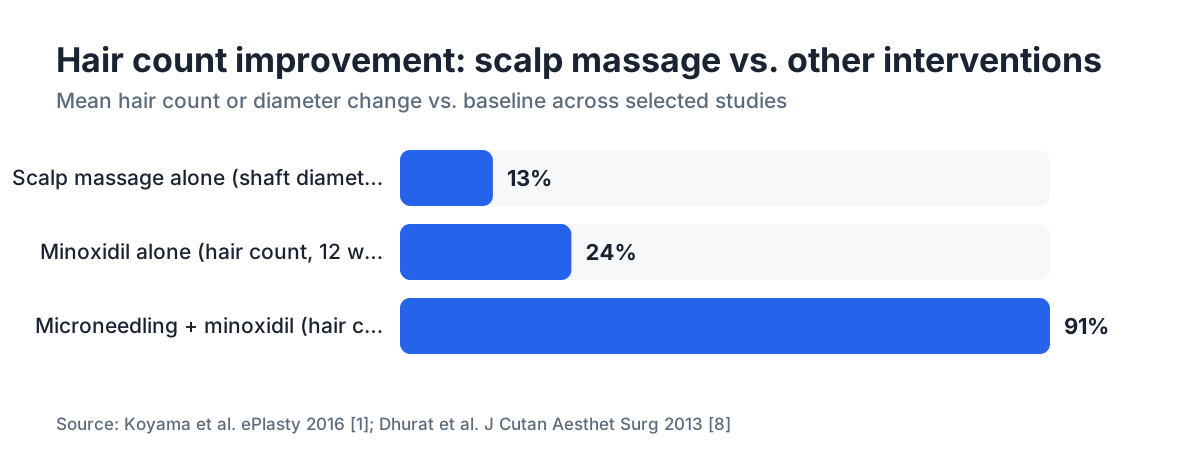
A 2016 study published in ePlasty had 9 healthy Japanese men perform standardized scalp massage for 4 minutes daily using a scalp massage device. After 24 weeks the researchers measured no significant change in hair count, but after 48 weeks (roughly 9 months) they found a statistically significant increase in hair shaft diameter of approximately 13%. [1] They attributed this partly to direct mechanical stimulation of the dermal papilla cells at the base of the follicle.
Separate work on dermal papilla cells grown in vitro found that stretching forces applied to those cells switched on genes tied to hair growth, including those linked to the Wnt signaling pathway. [1] That gives a plausible mechanism beyond just blood flow: the mechanical stretch itself may signal the follicle to stay in the growth (anagen) phase longer.
Blood flow is real but contextual. Any local massage bumps up perfusion for a while. Whether that temporary increase is enough to shift follicle behavior in a way you'd actually notice over months of daily practice is the open question. The honest answer is that the 2016 data suggest it can, at least for shaft thickness, but the sample was tiny (9 men), had no control group, and focused on healthy men without androgenetic alopecia. Nobody has run a large randomized controlled trial on scalp massage alone for pattern hair loss.
What does the research actually show? The key studies explained
The evidence base is thin but not empty.
2016 ePlasty study: 9 men, 4 minutes of daily standardized scalp massage, 48 weeks. Result: 13% increase in hair shaft diameter. No control group. [1]
2019 survey study (ePlasty, Koyama et al.): A survey of 340 men who self-reported performing scalp massage for hair loss. Those who massaged for more minutes per day and for longer total duration reported more perceived improvement. The average time in the group that reported hair regrowth or stabilization was around 11 to 20 minutes per day over several months. This is self-reported, so the bias is enormous, but it lines up with the earlier finding directionally. [2]
Dermal papilla mechanotransduction research: Lab work (not clinical trials) shows that mechanical stretch of dermal papilla cells activates pathways connected to hair cycle regulation. This is published in peer-reviewed journals but does not directly translate to a clinical outcome.
What the evidence does not show: that scalp massage alone stops androgenetic alopecia, regrows hair in bald areas, or competes with minoxidil or finasteride on efficacy. The American Academy of Dermatology does not list scalp massage as a first-line or second-line treatment for pattern hair loss. [3] That gap between the lab signal and the clinical guideline matters.
| Study | N | Duration | Key finding | Quality |
|---|---|---|---|---|
| Koyama et al. 2016 (ePlasty) | 9 | 48 weeks | +13% hair shaft diameter | Low (no control) |
| Koyama et al. 2019 (ePlasty) | 340 | Variable | More massage time correlated with self-reported improvement | Very low (survey) |
| Dermal papilla stretch studies | Cell cultures | N/A | Wnt pathway upregulation | Mechanistic only |
How does scalp massage compare to proven hair loss treatments?
This is where honest expectations matter most.
Minoxidil for men is FDA-approved and has decades of randomized trial data. Topical 5% minoxidil produces measurable hair regrowth in roughly 40 to 60% of men in clinical trials. [4] Finasteride (1 mg daily) is FDA-approved and in a two-year registration trial, 83% of men saw no further hair loss and 66% had visible regrowth. [5]
Scalp massage has one small uncontrolled study showing a change in shaft diameter. That is not a comparison you can make with a straight face. The effect sizes are orders of magnitude apart.
Where massage might genuinely add value is as an adjunct. A couple of small studies have looked at scalp massage combined with minoxidil versus minoxidil alone. The results were mixed but leaned toward slightly better outcomes with massage added. The proposed reason is that massage may improve minoxidil absorption by increasing blood flow to the dermis. That is plausible and worth the three minutes of effort, even if the effect is modest.
If you are early in pattern hair loss and trying to decide where to put your effort, scalp massage is not a substitute for evidence-based treatment. It is a reasonable, free add-on. Check out what causes hair loss first so you know what you're actually dealing with, because massage does nothing for, say, telogen effluvium, where the mechanism is completely different.
How do you actually do scalp massage correctly?
The technique used in the 2016 trial involved a standardized device that applied a defined pressure and movement. For home use, fingers work fine based on the available evidence.
Basic finger massage: Place the pads (not the nails) of your fingers across your scalp. Apply moderate, firm pressure. Move the skin slowly over the skull in small circular motions, about 1 cm of movement. Work across the entire scalp over the session, more than just the thinning areas.
The key is moving the skin, more than rubbing it. You want the scalp tissue to stretch slightly. Most people who do it wrong are basically just scratching their head.
Duration and frequency: The 2016 study used 4 minutes daily. The 2019 survey found stronger self-reported effects at 11 to 20 minutes per day. Practically, 5 to 10 minutes once or twice a day is a reasonable target. Splitting it into two sessions (morning and evening) is how many of the positive responders in the survey study operated.
Tools: A silicone scalp massager adds more surface contact and some people find it easier to hold consistent pressure. Boar bristle brushes do something different (surface exfoliation and oil distribution) and should not be confused with deep massage.
When to do it: If you use topical minoxidil, massaging right after application may help with penetration. The scalp should be clean and dry or lightly damp. Skip aggressive massage on a very irritated or broken scalp.
One thing that is genuinely a waste of money: expensive scalp massage devices that vibrate at proprietary frequencies, sold with dramatic before-and-after photos. There is no evidence that vibration adds anything beyond what a firm finger massage achieves.
Is the scalp tension theory real? Does a tight scalp cause hair loss?
This is where the internet gets ahead of the science.
The theory goes like this: the galea aponeurotica, the fibrous layer on the skull, becomes chronically tight in people with androgenetic alopecia. That tension restricts blood flow and makes the follicle microenvironment hypoxic (low in oxygen), which worsens DHT-related damage and speeds up miniaturization. Releasing that tension through specific stretching exercises or massage therefore slows or reverses patterned loss.
There is a sliver of observational support. The pattern of androgenetic alopecia does follow the distribution of the galea fairly well, and blood flow has been measured as slightly lower in balding scalp regions compared to non-balding ones. [6] Some researchers have noted that scalp biopsy specimens from balding areas show more fibrosis around follicles.
But there are serious problems with the theory as a standalone explanation. DHT-mediated follicle miniaturization has very strong genetic and hormonal evidence behind it. [7] Plenty of people with tight scalps never go bald. The directionality is unclear: does tension cause the balding pattern, or does the balding process (which does involve tissue changes) create secondary tension? Nobody has run a trial that relaxes scalp tension and independently measures what happens to DHT levels or follicle miniaturization rates.
My honest read: the tension theory is interesting and not implausible, but it is far from proven. If you want to address DHT blocker mechanisms, finasteride is the evidence-based choice. Scalp massage may help marginally, but treating the full galea-tension theory as your primary plan means ignoring the much stronger evidence behind hormonal therapies.
Can scalp exercises help with female hair loss too?
The research is even thinner for women, but the basic physiology is the same. Mechanical stimulation should increase local blood flow regardless of sex. The 2019 survey study included some female respondents, though results were not broken out clearly by sex.
For women, the more common pattern is diffuse thinning rather than the vertex or frontal recession that dominates in men. The mechanism often involves different hormone dynamics, nutritional factors, or telogen effluvium from physical stress, crash dieting, or thyroid issues. Scalp massage does nothing to fix iron deficiency, thyroid dysfunction, or post-partum hormonal shifts.
For women with androgenetic alopecia (female pattern hair loss), the same logic as men applies: massage is a reasonable low-risk add-on to whatever treatment plan your dermatologist has laid out, not a primary intervention.
What other scalp-stimulation techniques are worth considering?
Scalp massage is the best-studied mechanical approach by a wide margin, but it is not the only one.
Microneedling (dermaroller): Uses a roller with tiny needles (0.5 to 1.5 mm) to create micro-injuries in the scalp. The wound-healing response increases growth factors. A 2013 randomized controlled trial in the Journal of Cutaneous and Aesthetic Surgery found that microneedling plus minoxidil outperformed minoxidil alone in men with androgenetic alopecia (mean hair count increase of 91.4 in the combination group vs. 22.2 in the minoxidil-only group over 12 weeks). [8] That is much stronger evidence than the massage studies.
Low-level laser therapy (LLLT): FDA-cleared devices (not treatments, cleared devices) like laser combs and caps have some trial data supporting modest increases in hair count. The FDA clearance is for a device, not a stamp of proven efficacy in the same sense as drug approval. [10]
Inversion method: Hanging your head upside down briefly to rush blood to the scalp. No clinical evidence. Plausible mechanism for a few seconds but no sustained effect. Not worth pursuing seriously.
If you are spending money, microneedling with minoxidil has more evidence behind it than massage alone. The minoxidil side effects profile is worth reading before you start that combination, though for most people topical minoxidil is well-tolerated.
If you want to know where you land on the loss spectrum before picking a strategy, tools like the free AI scan at MyHairline can give you a baseline read on your hairline and loss pattern.
Are scalp exercises safe? Any risks worth knowing about?
For most people, scalp massage is extremely safe. The risks are minor.
Overly aggressive massage on a scalp with active seborrheic dermatitis, psoriasis, or open wounds can irritate or spread infection. If your scalp is inflamed, itchy, or flaking heavily, sort that out before adding daily massage.
Nail-based scratching instead of finger-pad massage can cause small abrasions, which is an infection risk.
There is an anecdotal report in some online communities of temporary increased shedding in the first few weeks of scalp massage, similar to the initial shed some people get with minoxidil. The proposed explanation is that massage pushes some hairs in the late telogen (resting) phase out faster. If it happens, it likely settles within a few weeks and does not mean you are making things worse long-term. But nobody has studied this in a controlled way, so that caveat stands.
If you take blood thinners or have a clotting disorder, vigorous massage is worth running past a doctor first, though the force in a typical scalp massage is far below what would cause bruising in healthy people.
What is the most realistic outcome from doing scalp massage consistently?
Here is what I would tell a friend who asked.
Do 5 to 10 minutes of firm scalp massage daily for 6 to 12 months and the most realistic outcome is a modest bump in hair shaft thickness, plus maybe some improvement in scalp health and density in areas where follicles are still active. You will not regrow hair where follicles have been permanently miniaturized or lost. The 13% shaft diameter improvement from the 2016 study is real but visually subtle.
Where massage makes the most sense: early thinning, where follicles are still alive and shrunken rather than gone. At Norwood Stage 1 or 2, you have a lot of potentially rescuable follicles and time is on your side. Pairing massage with finasteride or minoxidil at that stage is a reasonable approach backed by more evidence than massage alone.
Where it will not help: significantly advanced pattern loss, scarring alopecia, or any condition that has already destroyed the follicle.
Honestly, if you are not yet on a clinically proven treatment and you are watching your hair thin, spending three months doing only scalp massage is a poor use of that time. It is a good habit. It is not a treatment plan.
If you are unsure about the pattern or stage of your loss, getting a clear picture first is useful before you commit to anything. A free AI hair analysis can map your current pattern against the Norwood scale, which gives you a starting point for a real conversation with a dermatologist. You can do that at MyHairline's free AI scan.
If you are weighing more aggressive options, read up on finasteride and minoxidil in combination, or longer-term routes like a hair transplant, before you decide.
Sources
- Koyama T et al., ePlasty 2016, 'Standardized Scalp Massage Results in Increased Hair Thickness by Inducing Stretching Forces to Dermal Papilla Cells in the Subcutaneous Tissue'
- Koyama T et al., ePlasty 2019, 'The Effects of Scalp Massage on Hair Growth and Satisfaction'
- American Academy of Dermatology, Hair Loss: Diagnosis and Treatment
- NIH MedlinePlus, Minoxidil Topical
- Kaufman KD et al., Journal of the American Academy of Dermatology 1998, 'Finasteride in the treatment of men with androgenetic alopecia'
- Klemp P et al., British Journal of Dermatology 1989, 'Subcutaneous blood flow in early male pattern alopecia'
- Sinclair R, Dermatologic Clinics 1998, 'Male pattern androgenetic alopecia'
- Dhurat R et al., Journal of Cutaneous and Aesthetic Surgery 2013, 'A Randomized Evaluator Blinded Study of Effect of Microneedling in Androgenetic Alopecia'
- NIH MedlinePlus, Androgenetic Alopecia
- Avci P et al., Seminars in Cutaneous Medicine and Surgery 2013, low-level laser therapy for hair loss review