

TL;DR: Spironolactone is an oral drug that blocks androgen receptors in hair follicles, slowing the DHT-driven shrinking behind female pattern hair loss. Studies show 44 to 74% of women improve on 100 to 200 mg daily. It needs a prescription, takes 6 to 12 months to show results, and carries real side effects: menstrual changes, low blood pressure, and raised potassium.
What is spironolactone and why do doctors prescribe it for hair loss?
Spironolactone started life as a blood pressure drug. The FDA approved it in 1960 as a diuretic and aldosterone antagonist, so its original job was blocking a hormone that tells your kidneys to hold onto sodium and water [1]. Then came the surprise. It also blocks androgen receptors throughout the body, scalp included.
Androgens, dihydrotestosterone (DHT) most of all, drive androgenetic alopecia, the clinical name for pattern hair loss. In women it usually looks like diffuse thinning across the top and crown rather than a receding hairline. DHT binds to receptors in genetically vulnerable follicles, shortens the growth phase, and shrinks those follicles a little more each cycle until they stop making visible hair. Our guide on DHT blockers walks through that mechanism.
Because spironolactone competes with DHT at the androgen receptor, it can slow or halt that shrinking. Dermatologists have prescribed it off-label for female hair loss for decades. The American Academy of Dermatology lists it among the primary treatment options for women with androgenetic alopecia [2].
Off-label means the FDA never formally approved it for hair loss. But the reason it works is well understood, and the clinical evidence is solid enough that it appears in every major dermatology guideline for women.
How exactly does spironolactone block hair loss at the follicle level?
Hair follicles carry androgen receptors. When DHT locks onto them, it switches on genetic programs that shrink the follicle over successive cycles. Each cycle grows a thinner, shorter hair until the follicle goes quiet.
Spironolactone works two ways at once. It competes with DHT for the receptor, so DHT can't dock and send its signal. It also partly blocks enzymes involved in androgen production, which leaves less DHT circulating in the first place [3].
Follicles under androgen attack get less of the shrinking message. Miniaturized follicles can partly recover. The growth phase lengthens again. None of this brings back follicles that have already scarred over, so starting earlier tends to mean better results.
One thing worth understanding: spironolactone does not shut down DHT as hard as finasteride does. Finasteride blocks the 5-alpha reductase enzyme that turns testosterone into DHT, cutting scalp DHT by around 70% [4]. Spironolactone attacks a different point, the receptor rather than the factory. Some dermatologists use both in women who don't respond to one alone. Our finasteride breakdown compares the two.
What does the evidence say about how well spironolactone works?
The evidence is genuinely encouraging, but it isn't airtight. Most of it comes from retrospective chart reviews and smaller prospective trials, not the large double-blind randomized controlled trials that count as the gold standard. Here's the honest read: the base is strong enough for confident use, weaker than minoxidil's.
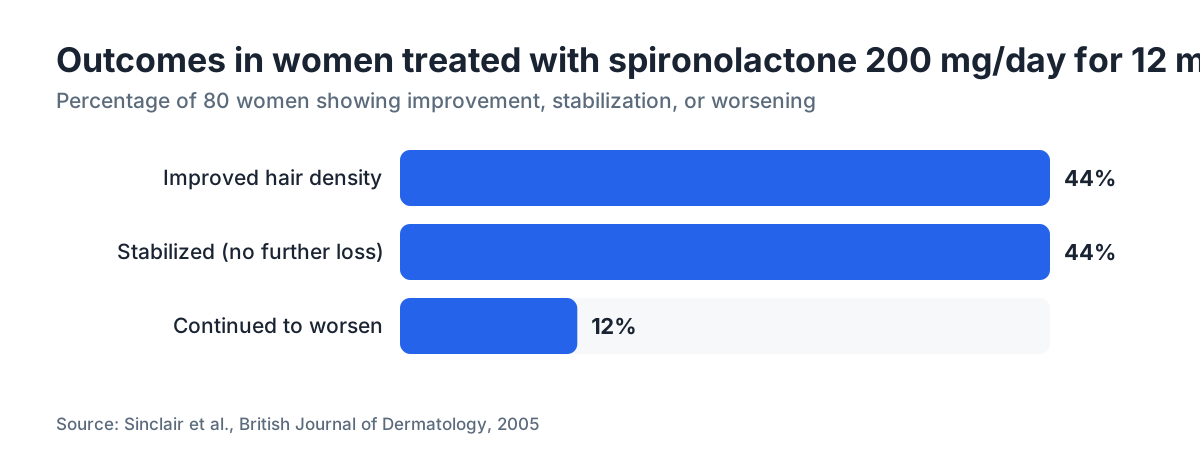
The study dermatologists cite most is Sinclair et al., published in the British Journal of Dermatology, which followed 80 women with female pattern hair loss on 200 mg/day. After 12 months, 44% showed improved hair density and 44% held steady, so 88% got some benefit [5].
A 2017 systematic review and meta-analysis in the Journal of the American Academy of Dermatology pooled trials across hair loss treatments and found spironolactone beat placebo for hair count and patient-reported outcomes in women [6].
Some older work reports response rates as high as 74% when patients are chosen carefully. Women with clinical or laboratory signs of high androgens tend to respond better than women whose levels test normal [3]. Women with normal androgens still respond sometimes, which suggests the receptor blocking matters even when circulating DHT isn't high.
Reality check. Spironolactone slows loss and can lift density, but it rarely delivers the dramatic before-and-after regrowth people see from transplants. This is a long game.
What dose of spironolactone is typically used for hair loss?
Typical starting doses run 50 to 100 mg per day, taken once daily or split in two. Dermatologists often begin low and move up based on response and tolerance.
The most studied dose for hair is 100 to 200 mg per day. A 2019 review in the Journal of Drugs in Dermatology noted that doses under 100 mg show weaker hair outcomes, while doses above 200 mg add no meaningful benefit and pile on side effects [3].
The table below shows how dose usually maps to outcomes and risk in published data.
| Dose | Hair response | Key risks |
|---|---|---|
| 25 to 50 mg/day | Weak, mostly used for acne | Minimal |
| 100 mg/day | Moderate improvement in ~50 to 60% | Menstrual changes, mild diuresis |
| 200 mg/day | Best studied dose for hair; 44 to 74% respond | Higher risk of menstrual irregularity, hypotension |
| >200 mg/day | No added hair benefit; more side effects | Hyperkalemia risk rises |
Your dermatologist or gynecologist adjusts around your blood pressure, kidney function, and potassium. Some start women at 25 mg and step up every 4 to 8 weeks. There's no single right dose, and tolerance varies a lot from woman to woman.
How long does spironolactone take to work for hair loss?
Slow. That's the honest answer.
Most women see nothing visible in the first three months. Hair cycles are long (the growth phase alone averages two to six years), and spironolactone has to interrupt a process already in motion rather than flip a switch. Less shedding is usually the first sign it's working, typically around months two to four.
Actual density gains take longer. Most dermatologists ask patients to commit to a 6 to 12 month trial before judging whether it's working [2]. Some women hit their best results after 18 to 24 months of steady use.
Watch your daily shed count early. If you were losing 150 to 200 hairs a day (heavy effluvium-level loss), drifting back toward the normal 50 to 100 is a real early signal. To sort out androgenetic shedding from the acute shedding some women get, the telogen effluvium article covers that split.
One warning: stopping spironolactone usually reverses the benefit within months. For most women who respond, this is a long-term medication, not a short course.
What are the most common side effects of spironolactone?
Spironolactone has a real side effect profile. Going in with accurate expectations matters, because some of these show up often enough to change your decision.
Menstrual irregularity is the complaint dermatologists hear most from women of reproductive age, hitting somewhere between 50 and 75% at the 100 to 200 mg range [5]. That can mean heavier periods, spotting, or irregular cycles. Many doctors manage it by adding an oral contraceptive pill, which also helps androgen-driven hair loss on its own.
Blood pressure effects deserve attention, since this drug was built as an antihypertensive. At hair-loss doses, big drops are less common than at cardiac doses, but light-headedness, dizziness on standing (orthostatic hypotension), and fatigue happen. Women who already run low should talk it through with their doctor before starting.
Hyperkalemia (raised potassium) is the most serious risk. Spironolactone makes you retain potassium. In healthy young women with normal kidneys eating a normal diet, dangerous levels are uncommon at hair-loss doses, but the risk is real. A study in JAMA Dermatology by Plovanich et al. found that routine potassium monitoring in healthy young women on low doses may be unnecessary, though most practitioners still check labs at baseline [7].
Other reported side effects:
- Breast tenderness or mild enlargement (roughly 10 to 15% of women at 100 mg)
- More frequent urination (it's a diuretic)
- Fatigue
- Headache, mostly in the first weeks
- Lower libido in some women, though others report the opposite from reduced androgens
Then there's the big one. Spironolactone is teratogenic. It feminizes male fetuses in animal studies, which is why the FDA label carries a strong warning against use in pregnancy [1]. If pregnancy is possible, reliable contraception is not optional.
Is spironolactone safe to take long-term?
For most healthy women, yes. Decades of clinical use back that up.
Spironolactone has run continuously in cardiac and hypertensive patients for more than 30 years, often at doses well above what hair loss requires. That track record gives real-world safety data no clinical trial could match.
The concern that surfaces now and then is a theoretical cancer risk from old rat studies showing more tumors at very high doses. The FDA label notes it [1]. But those tumors showed up at 500 mg/kg/day in rodents, far past clinical use, and decades of human use have produced no epidemiologic signal of cancer risk at therapeutic doses [3].
Kidney monitoring matters more in older women or anyone with baseline kidney trouble, because potassium retention gets worse as renal function drops. Standard practice is a baseline metabolic panel and a recheck around 3 months, then annual labs if everything holds steady.
If you want an objective baseline of your hair before starting, free tools like the MyHairline AI scan can log initial density and thickness, giving you a real comparison point a year later when you're trying to judge response.
Who is a good candidate for spironolactone for hair loss?
The best candidates are women with androgenetic alopecia who either show elevated androgens on blood work or clear clinical signs of androgen-driven loss (thinning at the top and crown, sometimes with acne or excess facial hair alongside).
Women with polycystic ovary syndrome (PCOS), congenital adrenal hyperplasia, or other hyperandrogenism disorders often respond especially well [2].
Who is not a good candidate:
- Women who are pregnant or trying to conceive (absolute contraindication)
- Women with impaired kidney function (higher hyperkalemia risk)
- Women with markedly low blood pressure
- Women on other potassium-raising drugs such as ACE inhibitors, ARBs, or potassium-sparing diuretics in combination
- Women with the rare condition Addison's disease
Hair loss has many causes beyond androgens. Thyroid disorders, iron deficiency, nutritional gaps, and acute stress all cause heavy shedding that spironolactone won't touch. Getting bloodwork to rule those out first is worth the time. Our broader article on what causes hair loss covers the diagnostic picture.
Age is nuanced. Post-menopausal women can use spironolactone, and the contraception issue drops away, but blood pressure effects may hit harder with age.
How does spironolactone compare to other hair loss treatments for women?
Dermatologists reach for four main things in female hair loss: minoxidil (topical or oral), spironolactone, finasteride (off-label, with restrictions), and low-level laser therapy.
Minoxidil is the only FDA-approved topical treatment for female pattern hair loss. It works differently from spironolactone, prodding follicles to grow rather than blocking androgens. Many women run both because they hit different parts of the problem. Our oral minoxidil guide covers that route if you're comparing.
Finasteride is FDA-approved for male hair loss only. Some countries and practices use it off-label in post-menopausal women, but it demands the same strict pregnancy avoidance as spironolactone, and the evidence in women is thinner [4]. See how finasteride and minoxidil work as a combination if that interests you.
Here's a rough comparison of the main options for women.
| Treatment | FDA approval in women | Mechanism | Time to see result | Key limitation |
|---|---|---|---|---|
| Topical minoxidil 2% | Yes (female pattern hair loss) | Follicle stimulant | 4 to 6 months | Daily application; shedding on start |
| Oral minoxidil (low dose) | Off-label | Follicle stimulant | 3 to 6 months | Hypertrichosis, fluid retention |
| Spironolactone | Off-label | Androgen receptor blocker | 6 to 12 months | Menstrual effects; no pregnancy |
| Finasteride | Off-label (post-menopausal only in most guidelines) | DHT synthesis inhibitor | 6 to 12 months | Teratogenic; weaker evidence in women |
| Hair transplant | Procedural | Surgical redistribution | 9 to 18 months for result | Cost; requires stable donor area |
For most women starting out, topical minoxidil plus spironolactone is the first combination dermatologists reach for. If you're further along and weighing surgery, the hair transplant guide covers what makes a woman a good surgical candidate.
Do you need a prescription for spironolactone, and what do doctors check before prescribing?
Yes. Spironolactone is prescription-only in the United States, though it isn't a controlled substance. You can't buy it over the counter or as a supplement.
Before prescribing, most dermatologists or gynecologists will:
- Take a history covering menstrual irregularity, acne, and any known kidney or adrenal conditions
- Check baseline blood pressure
- Order a basic metabolic panel for kidney function (creatinine, BUN) and baseline potassium
- Often order hormone labs: testosterone (free and total), DHEA-S, and sometimes a TSH to rule out thyroid causes
- Confirm reliable contraception if the patient can become pregnant
Telehealth dermatology has made access easier than it used to be, but the labs still need to happen. Be skeptical of anyone who prescribes spironolactone for hair loss without checking kidney function first.
Cost varies. Generic spironolactone is cheap, often under $20 for a month at common pharmacy chains with discount programs like GoodRx [8]. The visit and labs are where most of the out-of-pocket cost sits. Insurance coverage for the drug itself is usually good because it has cardiac indications, though coverage tied to the hair-loss use specifically may vary.
Can spironolactone cause hair loss or make shedding worse at first?
This worry comes up constantly in patient forums, and here's the honest answer: a brief bump in shedding during the first 4 to 8 weeks is possible, though it's less documented for spironolactone than for minoxidil, where it's common enough to have a name (minoxidil shedding). The minoxidil side effects article covers that in detail.
For spironolactone, the proposed reason for an early shed is that the anti-androgen effect can nudge follicles stuck in a long telogen (resting) phase back into growth, and those old hairs have to fall out first. That's speculative, but it fits what some women describe.
If shedding spikes after you start and hasn't settled by week 8 to 12, flag it to the prescribing doctor, because it could mean something other than a transition effect is going on. Ongoing worsening isn't expected and shouldn't get pinned on the drug without a fresh look.
What happens if you stop taking spironolactone?
The benefits aren't permanent. Spironolactone doesn't fix the underlying genetic sensitivity of your follicles to DHT. It manages the condition while you take it.
Most women who stop after a good run report shedding climbing again within three to six months, with density sliding back toward pre-treatment levels over the following six to twelve months [5]. It's the same pattern seen with other anti-androgen and minoxidil treatments.
That's not a reason to skip treatment. Holding hair loss at bay for years is worth a lot. Some women do well on a lower maintenance dose (50 mg/day) after reaching a strong response at 100 to 200 mg, which trims the side effect burden for the long haul.
If you're weighing years of daily medication against something more permanent, read up on whether a hair transplant is realistic for your pattern and stage. For women, the answer leans heavily on donor density and whether the shedding has stabilized.
Sources
- FDA, Spironolactone (Aldactone) prescribing information
- American Academy of Dermatology, hair loss treatment guidance
- Kaufman KD et al., Finasteride in the treatment of men with androgenetic alopecia. Journal of the American Academy of Dermatology 1998
- Sinclair R et al., Treatment of female pattern hair loss with oral antiandrogens. British Journal of Dermatology 2005
- Adil A, Godwin M. The effectiveness of treatments for androgenetic alopecia: A systematic review and meta-analysis. Journal of the American Academy of Dermatology 2017
- Plovanich M et al., Low usefulness of potassium monitoring among healthy young women taking spironolactone for acne. JAMA Dermatology 2015
- GoodRx, Generic spironolactone pricing
- Camacho-Martinez FM. Hair loss in women. Seminars in Cutaneous Medicine and Surgery 2009
- van Zuuren EJ et al., Interventions for female pattern hair loss. Cochrane Database of Systematic Reviews 2016