TL;DR: Yes, increased shedding around months 2 to 4 of finasteride is a recognised and usually temporary phenomenon often called a 'finasteride shed.' It happens because DHT suppression disrupts the hair cycle, pushing resting follicles into a shed phase at once. Most men see shedding peak by month 3 and regrowth begin by months 6 to 12. Quitting now is the most common mistake.
What is actually happening in your scalp at month 3 of finasteride?
Finasteride blocks 5-alpha reductase, the enzyme that turns testosterone into dihydrotestosterone (DHT). DHT is the hormone that miniaturises hair follicles in men with androgenetic alopecia. Start the drug and serum DHT drops by roughly 70% within weeks [1]. Your follicles have been marinating in high DHT for years. Now that changes overnight.
The problem is that follicles do not all respond on the same schedule. Some that were stuck in a long telogen (resting) phase get a biological restart signal. Others that were limping along in a weakened, miniaturised anagen (growth) phase get shed as the follicle resets for a healthier cycle. Across months 2 through 4, more hairs than usual hit the shedding phase at the same time.
People describe this as a telogen effluvium-like event set off by a sudden shift in the scalp's hormonal environment. It is not identical to classic telogen effluvium, which is usually driven by physical or nutritional stress, but the synchronised-shedding mechanism is comparable.
Shedding a hair does not mean losing a follicle. The follicle is still there. If finasteride is doing its job, that follicle now sits in a less hostile hormonal environment and, for many men, will grow a thicker, longer hair in its next cycle.
How common is this shedding, and does the evidence back it up?
Honest answer: the trial data on this specific shed is thinner than most articles admit. The two large trials that led to FDA approval of finasteride 1 mg (Propecia), published in the Journal of the American Academy of Dermatology in 1998, measured hair count and weight, not a discrete early-shedding event [2]. No randomised controlled trial says '35% of men shed at month 3.' Anyone who quotes a clean number like that is making it up.
What does exist is a consistent pattern across observational data, dermatologist clinical experience, and smaller prospective studies. A 2001 paper in the Journal of Investigative Dermatology Symposium Proceedings documented the hair cycle disruption that follows rapid DHT reduction and noted that a transient jump in telogen hairs is an expected biological consequence [3]. The American Academy of Dermatology's patient guidance on hair loss acknowledges that people starting treatment may notice increased shedding in the early months before they see benefit [4].
Among men who stay on finasteride long enough to benefit, early shedding is common enough that many dermatologists warn patients about it up front. The absence of a shed does not mean the drug is failing. Its presence does not mean the drug is working. Both groups can go on to respond well.
When does the finasteride shed typically peak and stop?
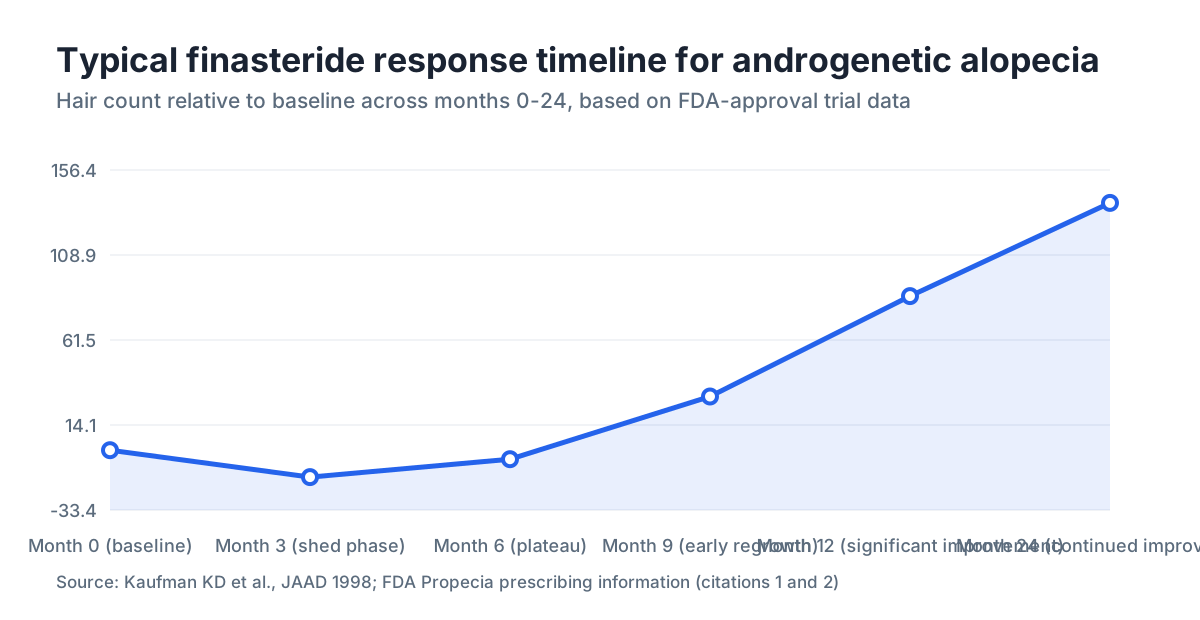
Most accounts place peak shedding between weeks 8 and 16, which lands squarely in the month 2 to month 4 window [3]. For most men who get it, the shed winds down on its own by month 4 to 6 with no change in treatment.
The chart below maps the rough timeline clinicians use when counselling patients. These figures come from hair cycle biology and the timelines documented in the finasteride approval trials, not a single study, so treat them as ranges, not precise cutoffs.
After the shed resolves, many men hit a frustrating plateau: hair is no longer falling dramatically, but nothing is visibly growing back yet either. That plateau, roughly months 4 through 9, is normal. Visible regrowth, when it comes, usually shows up around months 9 to 12. The FDA-approval trials showed statistically significant improvement in hair count over placebo at 12 months, with further improvement at 24 months [2].
Still shedding heavily and getting worse past month 6? That warrants a dermatologist visit. That pattern is less typical and could point to something else, from an iron deficiency to a separate scalp condition.
Is your shedding a finasteride shed or something else entirely?
This is the question worth real time, because not all month-3 shedding comes from finasteride.
Classic telogen effluvium from a separate trigger (illness, crash diet, major surgery, extreme stress) lags the trigger by about 2 to 3 months [5]. If you started finasteride around the same time you had a big stressor, you may be blaming the drug for two events at once. The what causes hair loss article breaks down the triggers worth ruling out.
Androgenetic alopecia itself, the condition finasteride treats, keeps progressing in the early months before the drug has had time to work. Some of what you see at month 3 may just be ongoing baseline loss, not a finasteride-induced shed.
Nutritional deficiencies, iron and ferritin especially, are another common confound. Ferritin below about 40 ng/mL has been linked to diffuse hair loss in some studies, though the threshold is debated [5]. No bloodwork in the past year? Get it.
One useful, if imprecise, distinction: a finasteride shed tends to be diffuse across the scalp and brief. Ongoing androgenetic alopecia concentrates at the temples, crown, and hairline. If your receding hairline is visibly worse and the temples are your main concern, that reads more like progression than a temporary shed.
Using minoxidil at the same time? That drug causes its own well-documented early shed as it pushes hairs from telogen into anagen [6]. Start both together, which many dermatologists recommend, and it gets very hard to tell which shed is which. The minoxidil for men page covers its own early shedding pattern.
Should you stop finasteride because of the shedding at month 3?
No. Stopping at month 3 is almost certainly the wrong call, and it is the single most common reason men never get the benefit finasteride could have delivered.
Here is the practical reality. If the shed is finasteride-induced, quitting removes the one agent that had started resetting your hair cycle. The follicles that had just begun a new cycle under lower DHT get slammed back into full DHT levels. Shedding may slow or stop after you quit, which feels like proof the drug was the problem. Then the androgenetic progression resumes, usually within months.
Finasteride's approval trials showed no benefit at 3 months. The 12-month data was where the statistically significant difference appeared [2]. You are judging the drug at the worst possible moment in its timeline.
Side effects are a separate and real question. Finasteride carries FDA label warnings for sexual side effects, including decreased libido, erectile dysfunction, and ejaculation disorders, reported in roughly 3.8% of men in trials versus 2.1% on placebo [1]. If you are stopping over those side effects rather than the shedding, that is a legitimate conversation to have with your prescriber. Do not stop over hair shedding alone.
What does finasteride's FDA label actually say about early shedding?
The FDA-approved prescribing information for finasteride 1 mg (Propecia) does not list 'initial shedding' as a labelled adverse event. The adverse reaction section focuses on sexual function side effects [1].
The label does state, under clinical studies, that in men with vertex baldness finasteride increased hair count by 86 hairs from baseline at 12 months versus a loss of 50 hairs in the placebo group, and that hair regrowth was seen by year 2 in men who continued. It also notes that in men who discontinued, the hair count advantage was lost within 12 months of stopping [1].
No shedding warning in the label does not mean shedding does not happen. It means the trials were not built to track it as a primary endpoint. Read the full label on the FDA's drug database [1], not the folded-up summary in a pharmacy insert.
The dht blocker article covers the mechanism in more depth if you want to understand why DHT suppression pays off over a longer timeframe even when early results look discouraging.
Can adding minoxidil reduce or offset the finasteride shed?
Reasonable question. The answer is: possibly, at the cost of some extra initial shedding from the minoxidil itself.
Minoxidil shortens the telogen phase and pushes hairs into anagen. In theory, adding it alongside finasteride could nudge follicles toward active growth sooner. In practice, minoxidil causes its own shed in the first 4 to 8 weeks as it clears out resting hairs to make room for new ones [6].
The combination beats either drug alone, and the evidence backs that up. A 2021 randomised controlled trial in the Journal of the American Academy of Dermatology found that 5% minoxidil foam plus finasteride 1 mg produced significantly greater hair density improvement at 24 weeks than either monotherapy [7]. If you are going to use both, starting them together rather than one after the other is often recommended, so you ride out the shed phase once instead of twice.
The finasteride and minoxidil article covers the combination protocol, including dosing and realistic timelines. If you are on oral rather than topical minoxidil, the shedding dynamics differ slightly; oral minoxidil has its own page on that.
Run our free AI hair scan at MyHairline if you want a baseline read on your hair density and pattern before you change anything. A documented starting point makes it far easier to judge whether a treatment is actually working three to six months from now.
How do you know if finasteride is actually working despite the shedding?
You probably cannot know for certain at month 3. That is the honest answer most articles skip.
The hair cycle means hairs shed today started their journey weeks ago. Hairs in early anagen right now will not clear the scalp surface for weeks or months. Month 3 is a genuinely noisy data point.
Two things actually help. Take standardised photos (same lighting, same camera distance, same wet or dry state) at baseline and every 3 months. This beats mirror-checking every morning by a mile. Then ask your dermatologist for a pull test and possibly a trichoscopy, which shows whether shed hairs have telogen (club-shaped) roots or anagen roots. A mostly-telogen pull test during a shed is actually reassuring: it means the follicles are cycling, not dying.
By month 9 to 12 you should have a meaningful signal. If hair count and coverage are stable or better against your baseline photos, finasteride is likely working. If coverage is clearly worse and you have been consistent, that is the moment for a deeper conversation about whether you are a non-responder or whether something else is driving the loss.
Men who see nothing at 12 to 18 months despite consistent use are sometimes non-responders (estimated at roughly 10 to 20% of users, though good epidemiological data is limited) or may have a condition other than androgenetic alopecia behind the loss.
Are there any ways to manage or reduce the shedding while staying on finasteride?
There is no proven treatment for the finasteride shed itself. Waiting it out is the main recommendation.
Still, a few practical moves make you feel less helpless than watching hairs fall.
Check your nutrition. Iron deficiency and low ferritin are common and fixable causes of extra shedding that can stack on top of whatever finasteride is doing. A basic panel with complete blood count, ferritin, and thyroid function (TSH) rules out the usual nutritional and endocrine confounds. Vitamin D deficiency has also been linked to hair cycling problems in some studies [8].
Ease up on mechanical stress. Tight hairstyles, heavy heat styling, and aggressive brushing pull hairs from follicles that are already vulnerable. This does not change the underlying biology, but it keeps your shed count from getting inflated by avoidable damage.
Scalp health matters more than people think. A 2019 study in Dermatology and Therapy found that seborrheic dermatitis, which is very common, can amplify shedding independent of androgenetic alopecia [9]. Flaky, itchy, or oily scalp? Treating it with a zinc pyrithione or ketoconazole shampoo is cheap and sensible. Ketoconazole has some evidence for a mild anti-androgenic effect at the scalp [10].
Supplements get marketed hard for exactly this situation. The evidence for most is weak; hair loss supplements covers what actually has data behind it. Biotin in particular is wildly oversold for anyone who is not biotin-deficient.
When should you see a dermatologist about month-3 shedding on finasteride?
See a dermatologist if any of these apply.
The shedding shows no sign of slowing by month 5 or 6. Heavy, accelerating loss past the typical window does not fit a simple drug adjustment and needs evaluation.
You are losing hair in patches rather than diffusely. Patchy loss points toward alopecia areata, an autoimmune condition that is a separate diagnosis from androgenetic alopecia and does not respond to finasteride [4].
You have scalp symptoms: real itching, flaking, pain, or visible inflammation. Those suggest a primary scalp condition that needs its own treatment.
You are a woman prescribed finasteride off-label. Finasteride is not FDA-approved for women, and the safety and efficacy picture differs. Shedding dynamics may differ too, and the risks (including teratogenicity in pregnant women) mean this needs close supervision.
You have systemic symptoms alongside the shedding: fatigue, weight changes, temperature sensitivity. Those could point to thyroid dysfunction, anaemia, or other systemic causes a blood panel will catch fast.
A dermatologist, especially one who specialises in hair, can run a scalp dermoscopy, a standardised pull test, and the right labs in one visit. That information is worth far more than another month of anxious mirror-checking.
For how far hair loss can go untreated and what your realistic options are at each stage, the finasteride overview covers the full evidence base and what non-responders usually consider next, including hair transplant as a downstream option.
Sources
- FDA-approved prescribing information for Propecia (finasteride 1 mg), DailyMed / FDA drug database
- Kaufman KD et al., Journal of the American Academy of Dermatology, 1998
- Whiting DA, Journal of Investigative Dermatology Symposium Proceedings, 2001
- American Academy of Dermatology, patient guidance on hair loss
- Trost LB et al., Journal of the American Academy of Dermatology, 2006
- Olsen EA et al., Journal of the American Academy of Dermatology, 2002
- Hu R et al., Journal of the American Academy of Dermatology, 2021
- Rasheed H et al., Dermatology and Therapy, 2013 (PMC)
- Borda LJ et al., Dermatology and Therapy, 2019
- National Library of Medicine, MedlinePlus drug information (ketoconazole)