
TL;DR: Topical finasteride cuts scalp DHT hard while putting far less drug into your blood than the 1 mg pill. Clinical trials report sexual side effects in roughly 1 to 2% of users, versus 3 to 15% with oral finasteride. Scalp irritation is the most common complaint. No formulation is risk-free, and safety data past 24 months barely exists.
What is topical finasteride and how does it differ from the pill?
Topical finasteride is a solution, gel, or spray you rub into your scalp. Same active molecule as the oral 1 mg tablet (Propecia). The delivery route changes almost everything about how much of it reaches your bloodstream.
Oral finasteride goes through your gut, gets processed by your liver, and spreads through your whole body before any of it works on your scalp. Topical finasteride is built to do most of its job locally. Some drug still crosses the skin, which is why "zero systemic absorption" is a marketing line, not a fact. But the numbers are a lot lower.
A 2021 pharmacokinetic study in the Journal of the European Academy of Dermatology and Venereology measured serum finasteride in men using a 0.25% topical solution daily. Plasma levels averaged about 0.39 ng/mL, against roughly 9.2 ng/mL after a 1 mg oral dose [1]. That is close to a 20-fold gap in blood levels.
Here is what that means in practice. The scalp's 5-alpha-reductase enzyme still gets blocked well, scalp DHT drops 60 to 70% in most trials, and the hormonal disruption everywhere else in your body is much smaller. That gap is the whole reason topical finasteride got serious clinical attention, especially for men who had side effects on the pill or who never wanted to swallow one. Our overview of finasteride covers how the drug works from the ground up.
What are the most common side effects of topical finasteride?
Skin reactions where you apply it top the list. Itching, dryness, scaling, mild redness of the scalp. Across published trials, application-site reactions hit somewhere between 4 and 10% of users, depending on the vehicle. Alcohol-based solutions sting more than liposomal gels [2].
Past the local irritation, the side effect list looks like the oral pill's, just far less common.
| Side effect | Oral finasteride 1 mg (reported rate) | Topical finasteride 0.25%, 1% (reported rate) |
|---|---|---|
| Decreased libido | 1.8 to 15% | 0.6 to 2.1% |
| Erectile dysfunction | 1.3 to 3.8% | 0.3 to 1.5% |
| Ejaculatory disorder | 1.2% | <1% |
| Application-site irritation | N/A | 4 to 10% |
| Post-finasteride syndrome (self-reported) | Rare, disputed | Not well characterized |
Those oral figures span a wide range on purpose. The low end comes from the original Merck placebo-controlled trials. The high end comes from self-report surveys and real-world registry data. Both camps have critics, and both are right about something [3].
For topical, the two biggest head-to-head efforts are the Caserini series and a 2022 randomized controlled trial pitting topical finasteride 0.25% once daily against oral finasteride 1 mg daily. The topical group logged fewer sexual adverse events and matched the pill on hair count at 24 weeks [2].
Two things I'll say flat out. A 1 to 2% rate of sexual side effects is not zero. And tolerability in trials usually beats real life, because trial subjects get screened and watched closely in ways you won't be.
Does topical finasteride cause sexual side effects?
Yes, it can. Less often than the pill, but the honest answer is that these side effects are quieter with topical, not gone.
The mechanism is simple. Finasteride blocks 5-alpha-reductase type II, the enzyme that turns testosterone into DHT. DHT matters for sexual function in tissue outside the scalp. If enough drug reaches your bloodstream, you get body-wide DHT suppression, and that is where most sexual side effects start. Topical finasteride keeps blood levels low, so the risk drops. It does not vanish.
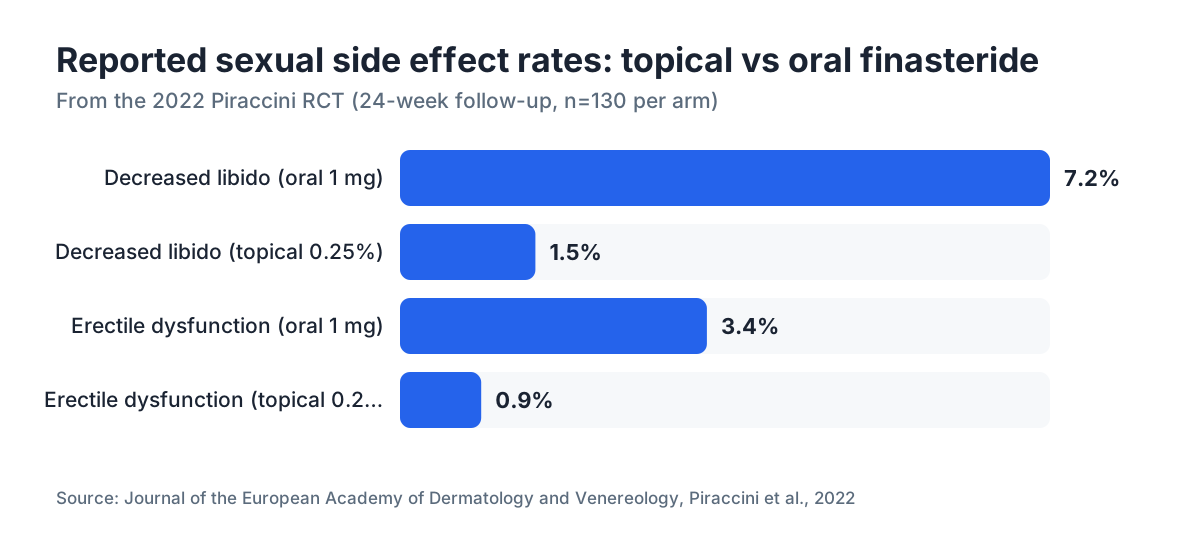
The 2022 RCT by Piraccini and colleagues reported decreased libido in 1.5% of topical users versus 7.2% of the oral group over 24 weeks [2]. Erectile dysfunction showed up in 0.9% topically versus 3.4% orally. Both differences were statistically significant.
What no trial can tell you is what happens to you specifically. Your genetics, your baseline DHT, other medications, and even your anxiety about the drug all interact with exposure in ways a population average can't predict. That last one is real: a documented nocebo effect produces genuine symptoms in 10 to 15% of subjects handed a placebo in finasteride trials [4].
If you had sexual side effects on the oral pill and quit, switching to topical is not a guaranteed clean slate. A small number of men in case series report symptoms even at the low exposures topical produces. They are a minority. They exist.
What is post-finasteride syndrome, and can topical finasteride cause it?
Post-finasteride syndrome (PFS) is the name for a cluster of sexual, neurological, and psychological symptoms that some men report continuing long after they stop finasteride. Persistent erectile dysfunction, reduced genital sensation, depression, cognitive trouble, fatigue.
The Post-Finasteride Syndrome Foundation and self-reporting registries have logged hundreds of cases. The condition is real in the sense that real people are suffering. Whether the symptoms come from finasteride's pharmacology, from epigenetic or neurosteroid changes, or from a nocebo component is an open research question with no settled answer [5].
As of mid-2025, the FDA label for finasteride (both 1 mg and 5 mg) carries a warning about reports of persistent sexual side effects after stopping [6].
For topical finasteride specifically, there is no published case series or registry documenting PFS after topical use. Part of that is timing: topical has been widely available for a shorter stretch, and most PFS reports predate today's formulations. Assuming topical is immune would be unscientific, because it does put measurable drug in your blood. Assuming it carries the same risk as the pill would be equally unscientific, given how much lower those serum levels run.
This is an honest gap. Nobody has good data on PFS rates in topical finasteride users. If PFS already worries you, that worry is medically legitimate, and it's worth a real conversation with a dermatologist before you start any finasteride at all.
Does topical finasteride have side effects in women?
This is one of the more medically loaded questions here, and the evidence is genuinely thin.
Finasteride in any form is off-limits for women who are pregnant or who may become pregnant. It's a category X teratogen. The FDA label states that "women who are or may potentially be pregnant must not use finasteride," because even skin contact with crushed or broken tablets has been linked to a risk of ambiguous genitalia in male fetuses [6]. The same logic covers topical solutions. Skin absorption is real. No pregnant woman should handle these products, full stop.
For postmenopausal women with androgenetic alopecia, topical finasteride is under study as an off-label option. Small trials show hair count gains at 0.5 to 1% applied twice daily, with fairly mild side effects. The main concerns are menstrual irregularity and a theoretical risk of feminizing effects in a male partner through skin transfer, though no published data confirms that transfer matters clinically at normal use [7].
Side effects in premenopausal women are less studied than in men. Endocrine disruption is theoretically possible, and because women metabolize the drug somewhat differently, borrowing conclusions from male trials is rough. Most dermatologists won't prescribe topical finasteride to a woman of reproductive potential without careful counseling and confirmed contraception.
If you're a woman weighing topical finasteride for hair loss, the evidence base is smaller than it is for men. That doesn't mean it won't work or that side effects are worse. It means informed consent carries more weight here than usual.
How does the systemic absorption of topical finasteride compare to oral?
This is where the pharmacology earns its keep, and where topical finasteride's real edge lives.
The 2021 pharmacokinetic study above found the area under the curve (AUC) for serum finasteride after topical 0.25% daily application ran about 5% of the AUC from a 1 mg oral dose [1]. Scalp DHT suppression in that same study still reached roughly 64%, not far under the 70% you see with the oral pill.
That pairing is the argument for topical in one line. Big local effect, small systemic footprint. The drug doesn't need to flood your bloodstream to reach your follicles, because the follicles sit right under the skin where you put it.
Different formulations absorb differently. Alcohol-based solutions push more drug into circulation than liposomal or nanoparticle vehicles, which are designed to trap the drug in the skin instead of letting it pass through. A 2019 study in the British Journal of Dermatology found nanostructured lipid carriers cut systemic finasteride AUC by roughly 40% versus an ethanolic solution at the same concentration [8]. This formulation chemistry keeps changing, and not every compounded topical finasteride on the market uses the same vehicle.
Most topical finasteride in the U.S. comes from compounding pharmacies, since the FDA hasn't approved a specific topical product as of mid-2025. Formulation quality varies. That variation hits both how well it works and how safe it is.
Is topical finasteride safer than oral finasteride overall?
Short answer: probably yes for most men, based on what we have now. But the safety profile isn't mapped as well as oral finasteride's, which has 30 years of data behind it.
Oral finasteride 1 mg (Propecia) got FDA approval in 1997. Decades of prescribing data, multiple meta-analyses, long-term registry studies. Topical finasteride has been in widespread use, even in more permissive markets, only since roughly 2015 to 2018. The longest published RCT runs 24 months.
Head to head, topical finasteride looks like this:
- Comparable hair growth at studied doses (0.25%, 1%)
- Lower reported rates of sexual side effects
- More application-site reactions (itching, dryness)
- Lower but non-zero systemic DHT suppression
What you trade away is certainty. With the pill, you know what you're getting because the data is deep. With topical, you swap a better short-term side effect profile for less long-term information. Plenty of men reasonably make that trade. It should be a choice you make with your eyes open.
Men who already tolerate oral finasteride well have little reason to switch. Men new to finasteride, worried about sexual side effects, or coming off the oral pill because of them have a legitimate and increasingly well-supported option in topical. Weighing it against something like minoxidil helps you see the full board.
What are the side effects specific to the scalp and skin?
Scalp irritation is the tax you pay for lower systemic effects. The common reports:
Itching and dryness. The alcohol or propylene glycol carriers in most solutions strip some of the scalp's moisture barrier. This usually eases after two to four weeks as the scalp adapts. A light moisturizer on untreated areas helps.
Flaking. Often mistaken for dandruff. It's usually a vehicle reaction, not a drug reaction. Switching formulations often clears it.
Folliculitis. A small number of users get follicular inflammation, small pimples around the hair follicles. This tends to come from clogged pores, especially if you apply the solution and cover your scalp right away.
Contact dermatitis. True allergy to finasteride itself is rare. Reactions to excipients (propylene glycol, benzyl alcohol, preservatives) are more common and can show up as a spreading red rash past the application site. If you see that, stop and see a dermatologist.
Hair shedding in the first 8 to 12 weeks. This isn't unique to topical finasteride. DHT suppression pushes follicles from telogen (resting) back into anagen (growing), which briefly bumps up shedding of old hairs. It's temporary and usually a sign the drug is working. Our page on telogen effluvium shows what normal shedding looks like versus something that needs a doctor.
How long do topical finasteride side effects last?
Application-site reactions (itching, dryness, flaking) usually clear within two to four weeks as the scalp adjusts, or within days of stopping.
Sexual side effects, if they show up, tend to appear in the first one to three months. In the controlled trial data, most users who got them saw resolution within weeks of stopping. The persistent sexual symptoms tied to the PFS description are the exception, not the rule. They're real enough to take seriously.
The initial shedding phase usually peaks around week eight to twelve and settles on its own. By month six, most users who respond see net gain.
One practical note. Because topical finasteride's systemic exposure is lower, its washout after stopping may run shorter than the pill's, though no comparative washout trial has tested that directly. Finasteride's half-life is 6 to 8 hours regardless of route [6]. But drug stored in skin and follicular tissue may clear on a different timeline with topical than with oral use.
Who should avoid topical finasteride?
The contraindications track oral finasteride's, with a few specific to topical use:
Pregnant women or women who may become pregnant. Non-negotiable. This covers every finasteride formulation [6].
Men with a history of severe post-finasteride syndrome on the oral pill. If you had persistent side effects after stopping oral finasteride, there's no evidence topical is safe for you. A lower dose is not a guarantee.
Men with known hypersensitivity to finasteride or excipients. Allergic contact dermatitis to vehicle components can get significant.
Men on drugs that interact with 5-alpha-reductase inhibitors. Finasteride can interact with certain alpha-blockers. If you take these for prostate or blood pressure issues, talk to your physician first.
Men with untreated scalp conditions. Open wounds, active psoriasis, or severe seborrheic dermatitis can raise systemic absorption sharply by breaking the skin barrier. Get the scalp reasonably healthy before you start.
If you're trying to size up your hair loss before committing to anything, the free AI hair loss scan at MyHairline gives you a Norwood stage estimate and a baseline to track against.
How do topical finasteride side effects compare to minoxidil side effects?
These two drugs often ride together, and their side effect profiles are nothing alike. Comparing them straight:
Minoxidil's common side effects are scalp irritation (similar to topical finasteride), initial shedding, and unwanted facial hair from systemic absorption, which matters most with oral minoxidil. Oral minoxidil can also cause fluid retention and low blood pressure in a small share of users. Our breakdown of minoxidil side effects goes deeper.
Topical finasteride's main risks are sexual side effects and the theoretical PFS concern. Minoxidil has no meaningful sexual side effects because it works through a different mechanism entirely: it widens blood vessels, it doesn't touch your hormones.
For men most worried about sexual function, minoxidil on its own is a reasonable starting point. For men chasing maximum efficacy who can accept the low but real sexual side effect risk, the topical finasteride plus topical minoxidil combination is increasingly backed by trial data. The 2022 Piraccini trial used a combined finasteride 0.25% / minoxidil 2.5% topical solution and posted strong hair count results, with the side effect profile mostly reflecting each drug on its own [2].
Neither drug cures androgenetic alopecia. Both need ongoing use. Stop either one and the gains fade within 6 to 12 months.
What do real clinical trials show about topical finasteride efficacy and side effects?
The trials that carry the most weight:
Caserini et al. (2014 and 2016). The Italian group that did the foundational work on a once-daily topical finasteride solution. Their 2016 study in 323 men over 12 months showed significant hair count improvement, with sexual adverse events in under 2% of users [9].
Piraccini et al. (2022). A randomized controlled trial comparing topical finasteride 0.25% + minoxidil 2.5% once daily against oral finasteride 1 mg + minoxidil 5% oral. The topical group showed non-inferior hair count improvement with far fewer sexual side effects (1.5% vs. 7.2% reporting decreased libido) [2].
Eun et al. A Korean RCT using 0.1% topical finasteride solution that also showed meaningful hair density gains at 16 weeks with low systemic exposure [10].
Every one of these tops out at 12 to 24 months. What happens at year three, five, or ten with topical finasteride is not known. Oral finasteride has 5-year and 10-year data showing continued efficacy and stable side effect rates. Topical doesn't have that yet.
The other limitation: most trials use proprietary or controlled formulations. The compounded topical finasteride you actually buy from a U.S. pharmacy may run a different vehicle, concentration, and absorption profile than what got studied. Not a reason to avoid it. A reason to know what you're buying.
Sources
- FDA Drug Safety Communication - finasteride label updates
- JAMA, Mondaini et al. 2007 - nocebo effect in finasteride users
- Journal of Sexual Medicine, Traish et al. 2015 - post-finasteride syndrome review
- FDA - Propecia (finasteride 1 mg) prescribing information
- International Journal of Dermatology - topical finasteride in female androgenetic alopecia review
- British Journal of Dermatology, nanostructured lipid carrier finasteride formulation study, 2019
- Drug Delivery, Caserini et al. 2016 - 12-month topical finasteride trial in 323 men
- Journal of Dermatology, Eun et al. - Korean RCT 0.1% topical finasteride