

TL;DR: Oral finasteride (1 mg/day for hair loss) causes sexual side effects in roughly 2-4% of men in controlled trials, with most resolving after stopping the drug. Rare cases of persistent symptoms after discontinuation have been reported. Serious effects like depression and breast cancer are tracked but uncommon. Women of childbearing age must not handle crushed tablets due to fetal risk.
What are the most common side effects of oral finasteride?
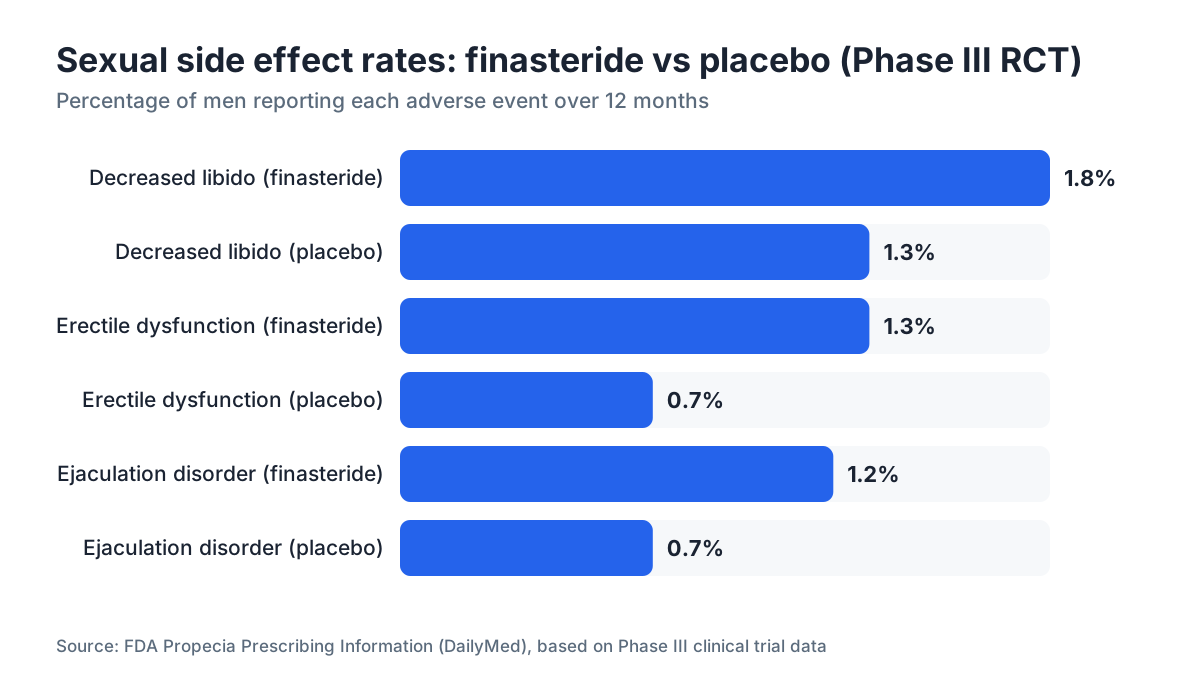
The FDA-approved label for Propecia (finasteride 1 mg) lists three sexual adverse reactions from the main Phase III trial: decreased libido (1.8% finasteride vs 1.3% placebo), erectile dysfunction (1.3% vs 0.7%), and ejaculation disorder (1.2% vs 0.7%) [1]. Those numbers are small. But the gap over placebo is the part that matters: roughly 1 in 50 to 1 in 100 men on finasteride get one of these symptoms who wouldn't have on a sugar pill.
Non-sexual side effects reported in trials include breast tenderness or enlargement (gynecomastia), rash, and testicular pain, each in fewer than 1% of participants [1]. Most side effects reported in trials resolved when the drug was stopped, and in some cases resolved even while men kept taking it.
Here's the honest framing. The drug works well for male pattern hair loss. The finasteride overview covers efficacy in detail. Anyone considering it still deserves the full picture first.
How common are sexual side effects really?
The 2-4% figure comes from pooled randomized controlled trials, the most reliable source because they include a placebo group. The 2002 five-year study by Kaufman et al. in the Journal of the American Academy of Dermatology followed 1,879 men and found sexual dysfunction rates around 1.3-1.8% on finasteride versus 0.6-1.3% on placebo, a difference that narrowed over time [2].
Post-market data from voluntary reports and observational studies tend to run higher, partly because men with problems are the ones who report. A 2019 analysis in JAMA Dermatology reviewed FDA Adverse Event Reporting System data and found sexual dysfunction and depression were reported disproportionately compared with other oral dermatology drugs [3]. That doesn't give you an absolute rate. It confirms the signal is real.
One number worth knowing changes how you should read everything else. A 2007 study in the Journal of Sexual Medicine gave men finasteride with or without a warning about sexual side effects. The group told to expect problems reported far more erectile dysfunction [4]. That is the nocebo effect: symptoms partly driven by expectation. It doesn't mean the side effects are imaginary. It means the 2-4% trial rate is probably closer to the truth than the scary numbers from non-blinded surveys.
| Source type | Sexual side effect rate (finasteride arm) | Comparison rate (placebo/baseline) |
|---|---|---|
| RCT (Kaufman 2002, 5-year) | ~1.3-1.8% | ~0.6-1.3% |
| FDA label (Phase III, 1 year) | ~3.8% any sexual AE | ~2.1% |
| FAERS voluntary reports | Not a rate; signal elevated | Not comparable |
| Nocebo RCT (J Sex Med 2007) | 43.6% (warned arm) | 15.3% (unwarned arm) |
What is post-finasteride syndrome and is it real?
Post-finasteride syndrome (PFS) is the name for a cluster of symptoms, mostly sexual dysfunction, depression, and cognitive trouble, that persist after a man stops finasteride. Patient advocacy groups have collected thousands of reports. The FDA updated the Propecia label in 2012 to include persistent sexual dysfunction after discontinuation [1].
Is it real? The honest answer: the persistent symptoms are real for the people living with them, and the FDA took them seriously enough to change the label. What stays poorly understood is the mechanism, the true prevalence, and why some men are hit and others aren't. No large prospective study has cleanly established a causal pathway or a reliable prevalence figure for PFS specifically.
A 2020 review in Dermatology and Therapy concluded that PFS lacks a clear biological mechanism and that the evidence rests mostly on case reports and patient surveys with heavy selection bias [5]. That's not a dismissal. It's an honest description of where the science sits. Men with persistent symptoms after stopping deserve real clinical evaluation, not an eye-roll. They also shouldn't assume the drug is the cause without ruling out other contributors like depression, anxiety, or an underlying hormonal problem.
If this worries you before you start, read the full dht blocker explainer, which covers how finasteride works and what we know about how long DHT stays suppressed.
Can finasteride cause depression or affect mental health?
Yes, and it's on the FDA label. The Propecia prescribing information was updated to include depression and suicidal ideation as reported adverse events [1]. These are rare but serious.
The evidence is mixed. A 2020 retrospective cohort study in JAMA Dermatology matched more than 93,000 men who took finasteride for hair loss against controls and found a statistically significant rise in depression diagnosis (hazard ratio around 1.79 in the first 90 days) [6]. That's a real signal. But hair loss itself causes plenty of psychological distress, and separating drug-induced depression from distress over going bald is genuinely hard in observational data.
If you have a personal or family history of depression, that's a conversation to have with your prescriber before you start. It doesn't take the drug off the table. It changes the risk-benefit math.
Does finasteride cause breast cancer in men?
The FDA label lists male breast cancer in its post-marketing adverse reaction section [1]. Male breast cancer is very rare to begin with, about 1 in 100,000 men per year in the US [7], which makes it hard to pin a cause on spontaneous reports. The label language is careful: it asks patients to report breast lumps, pain, nipple discharge, or breast enlargement promptly.
No large randomized trial has shown a statistically significant rise in male breast cancer with 1 mg finasteride. The five-year Kaufman data reported no breast cancer signal [2]. The concern is flagged on biological plausibility (finasteride shifts the estrogen-to-androgen ratio), not because a clear excess risk has been proven.
Gynecomastia (breast tissue enlargement) is a separate thing and more common, though still under 1% in trials [1]. Breast changes are a reason to see a doctor. Not a reason to panic.
Is finasteride safe for women to take or handle?
Finasteride 1 mg is not FDA-approved for women. Finasteride 5 mg (Proscar, for enlarged prostate) isn't either. The label warns that finasteride is contraindicated in women who are or may become pregnant, because it blocks conversion of testosterone to DHT in a developing male fetus and can cause external genital abnormalities [1].
Women of childbearing potential must not handle crushed or broken finasteride tablets, because the active ingredient can be absorbed through skin. Intact coated tablets are considered safe to handle briefly [1].
Some dermatologists prescribe finasteride off-label to postmenopausal women with female pattern hair loss, and small studies suggest modest benefit. For the broader picture in women, what causes hair loss covers female pattern loss in more depth. The side effect profile in women looks different from men (sexual dysfunction isn't the main worry; teratogenicity and liver considerations dominate), but controlled data in women is thin.
How do finasteride side effects compare to other hair loss treatments?
Context helps here. Minoxidil side effects are mostly topical (scalp irritation, contact dermatitis, unwanted facial hair) with rare systemic effects. Oral minoxidil at low doses (0.25-2.5 mg/day) carries risks of fluid retention, low blood pressure, and hypertrichosis (unwanted body hair) that finasteride does not. Hair transplant surgery brings surgical risks like scarring, infection, and graft failure that finasteride does not.
Here's a direct comparison:
| Treatment | Main risks | Affects fertility/fetus? | Reversible on stopping? |
|---|---|---|---|
| Oral finasteride 1 mg | Sexual dysfunction, depression (rare), gynecomastia | Yes (male fetus) | Usually yes; PFS rare |
| Topical minoxidil | Scalp irritation, facial hair | Avoid in pregnancy (less clear) | Yes |
| Oral minoxidil (low dose) | Fluid retention, low BP, hypertrichosis | Avoid in pregnancy | Yes |
| Hair transplant | Surgical: infection, scarring, graft failure | No | N/A (surgical) |
The risk profiles are different in kind, more than in severity. A man who can't accept the sexual side effect risk of finasteride might do well on finasteride and minoxidil at lower doses, or on minoxidil alone. That's a call to make with a doctor who knows your health history.
Do finasteride side effects go away if you stop taking it?
For most men in trials, sexual side effects resolve after stopping finasteride. The FDA label states that in clinical studies, symptoms resolved in men who reported them after they discontinued the drug [1].
The qualifier is post-finasteride syndrome. A subset of men report symptoms that don't resolve. Estimates of that subset swing wildly depending on the source (clinical trial vs patient advocacy survey), and there's no agreed prevalence. A conservative reading of the evidence: true persistent PFS is uncommon but real.
One practical note. If you develop sexual side effects on finasteride, stopping and waiting 2-4 weeks before deciding they're permanent is reasonable. If they hang on past that, get evaluated. Diagnosing yourself with PFS after one week of symptoms and one Google search is not a strategy.
Does finasteride affect PSA levels and prostate cancer risk?
Yes, and it matters clinically. Finasteride lowers PSA (prostate-specific antigen) by roughly 50% after six or more months of use [1]. PSA is a screening marker for prostate cancer. A doctor who doesn't know you're on finasteride might read a suppressed PSA as genuinely normal. The standard fix is to double the measured value to approximate the true baseline.
The Prostate Cancer Prevention Trial, a large randomized study of finasteride 5 mg (not 1 mg, but the same mechanism), found finasteride cut overall prostate cancer incidence but was linked to a higher proportion of high-grade tumors detected [8]. The 5 mg label carries a warning about this. The 1 mg label notes the PSA effect and recommends adjustment [1].
If you're a man over 50 on finasteride getting routine PSA screening, make sure your doctor knows you take it. That part is not optional.
What should you tell your doctor before starting finasteride?
The short list: any history of depression or anxiety, any sexual dysfunction before starting, your current medications (especially other 5-alpha reductase inhibitors or drugs that stress the liver), whether your partner is pregnant or trying to conceive, and any personal or family history of prostate or male breast cancer.
Finasteride is metabolized by the liver. Severe hepatic impairment changes drug exposure, and the label says caution is warranted, though dose adjustments haven't been formally studied for the 1 mg dose [1].
Some clinicians order a baseline PSA before you start so future changes read accurately. That's reasonable practice, especially for men over 40.
To see how your current hair loss pattern fits the range of options, a free AI scan at MyHairline gives you a starting point for that conversation. It's not a substitute for medical advice.
Are the side effects different at lower doses of finasteride?
This is an active area of interest. Some dermatologists have tried doses below 1 mg (0.2 mg, 0.5 mg) on the theory that most DHT suppression happens at low doses and the side effect rate might drop with it. A 2018 dose-response study in the Journal of Dermatological Science found 0.2 mg finasteride suppressed scalp DHT by about 70% and serum DHT by about 40%, versus roughly 60% serum suppression at 1 mg [9].
Whether lower doses mean fewer sexual side effects hasn't been proven in a large, adequately powered trial. The pharmacokinetic argument is plausible. The clinical evidence is thin. Off-label compounding to hit sub-milligram doses exists in some markets but adds quality control variables.
Topical finasteride is a related option, covered in more detail in the finasteride article, with some evidence of lower systemic DHT suppression and possibly a friendlier side effect profile. The American Academy of Dermatology's hair loss guidelines note that topical formulations are still being studied and the evidence base is smaller than for oral finasteride [10].
What does the FDA label actually say about finasteride side effects?
The FDA-approved Propecia (finasteride 1 mg) prescribing information, revised in 2012 after a label update, lists this in its adverse reactions section: sexual dysfunction including decreased libido, erectile dysfunction, and ejaculation disorder; breast disorders including gynecomastia and breast tenderness; hypersensitivity reactions including rash, pruritus, urticaria, and angioedema; and testicular pain [1].
The post-marketing section added sexual dysfunction that continued after stopping treatment, depression, and male breast cancer. The label states directly: "There are reports of sexual dysfunction that continued after stopping finasteride. These events may be related to use of finasteride" [1].
The contraindications section says finasteride is contraindicated in women who are or may become pregnant, with the mechanism spelled out: blocking 5-alpha reductase during fetal development can cause abnormalities of the external genitalia in male fetuses. That's the scientific basis for the "do not handle crushed tablets" warning.
Read the actual label before you start any prescription drug. The FDA publishes prescribing information through DailyMed [1]. To track how your hair responds over time, MyHairline offers a free AI scan. Any medical decision still belongs with your doctor.
Sources
- FDA DailyMed, Propecia (finasteride 1 mg) prescribing information
- Kaufman KD et al., Journal of the American Academy of Dermatology, 2002; 47(3):377-385 - 5-year finasteride efficacy and safety study
- Nguyen DD et al., JAMA Dermatology, 2019; 155(1):35-42 - FDA FAERS analysis of finasteride adverse events
- Mondaini N et al., Journal of Sexual Medicine, 2007; 4(6):1708-1712 - Nocebo effect of finasteride
- Irwig MS, Dermatology and Therapy, 2020 - Post-finasteride syndrome review
- Dyson TE et al., JAMA Dermatology, 2020 - Finasteride and depression retrospective cohort
- National Cancer Institute SEER data, male breast cancer incidence
- Thompson IM et al., New England Journal of Medicine, 2003; 349:215-224 - Prostate Cancer Prevention Trial
- Mella JM et al., Journal of Dermatological Science, 2018 - Finasteride dose-response study
- American Academy of Dermatology, Guidelines of Care for Androgenetic Alopecia
- Caserini M et al., JAMA Dermatology, 2020 - Topical finasteride serum DHT suppression