TL;DR: Topical minoxidil doesn't treat the root cause of telogen effluvium, but it can shorten the recovery window and reduce shedding by pushing resting follicles back into the growth phase faster. Most dermatologists call it a reasonable add-on once the trigger is removed, not a standalone fix. Expect 3-6 months before you see real regrowth.
What is telogen effluvium and why does hair shed so fast?
Telogen effluvium (TE) is a diffuse, temporary hair loss condition where a large share of scalp follicles shift prematurely into the telogen (resting) phase, then shed together a few weeks or months later. Normally, roughly 5-15% of your follicles are resting at any one time [1]. In TE that number can jump to 30% or higher, which is why the shedding looks alarming.
The classic triggers are physical or psychological stressors: high fever, surgery, rapid weight loss, childbirth, severe illness, crash dieting, or a psychological shock. The follicles don't die. They just pause. That's the key distinction between TE and androgenetic alopecia, where follicles are actively miniaturizing because of DHT.
Most TE cases resolve on their own within 3-6 months once the trigger is gone [1]. The catch is that "resolves on its own" doesn't mean the shedding stops next week. Some people shed heavily for 6 months, then spend another 6 months waiting for the new growth to become visible. That total 12-month window is what drives most people to ask whether minoxidil can speed things up.
For a fuller picture of the condition itself, including chronic versus acute TE and how diagnosis works, see our guide to telogen effluvium. Understanding what causes hair loss more broadly also helps, because TE can overlap with other conditions.
How does topical minoxidil work on hair follicles?
Minoxidil started life as an oral blood pressure drug. Researchers noticed in the late 1970s that patients taking it grew unexpected body and scalp hair, which led to the topical formulation the FDA approved for androgenetic alopecia in 1988 [2].
The exact mechanism isn't fully pinned down, which is honest to admit. Here's what we know. Minoxidil is a potassium channel opener. Applied topically, it dilates blood vessels around the hair follicle, which likely increases blood flow and nutrient delivery. It also appears to lengthen the anagen (growth) phase and shorten the telogen (resting) phase at the level of the follicle [3].
That second effect is exactly why people with TE find it interesting. If minoxidil can push follicles from telogen back into anagen faster than they'd go on their own, the recovery timeline for TE should shorten. The biology is plausible. Whether the clinical effect is large enough to matter is a separate question, covered in the next section.
One thing worth knowing: minoxidil also causes an initial shedding event for most new users. The drug pushes follicles stuck in a prolonged telogen phase into anagen, and those old telogen hairs fall out first before new growth comes in [3]. If you already have TE, starting minoxidil can temporarily make the shedding look worse. This is expected and temporary, but it rattles people.
What does the evidence say about minoxidil for telogen effluvium specifically?
Here's where we have to be honest about the limits of the evidence. Most of the big minoxidil trials (the well-known 1990 Olsen et al. study, the FDA approval trials) were designed for androgenetic alopecia, not TE [2]. Extrapolating from those to TE takes some inference.
There are relevant data points, though. A 2016 study in the Journal of the American Academy of Dermatology examined patients with chronic telogen effluvium and found that 2% topical minoxidil reduced hair shedding compared to placebo over 6 months [4]. The authors concluded that minoxidil "may accelerate recovery in telogen effluvium by shortening the duration of the telogen phase." That's a direct quote from their findings.
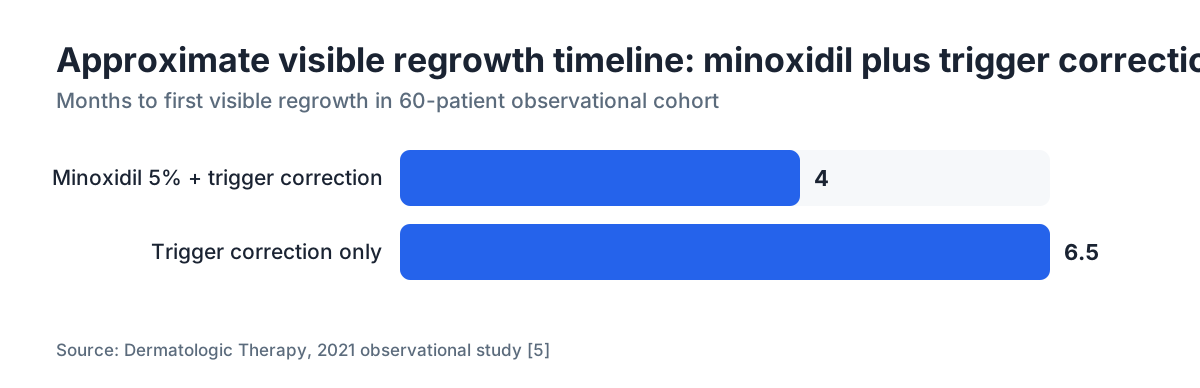
A 2021 observational study in Dermatologic Therapy followed 60 women with acute TE and reported that those using 5% topical minoxidil alongside trigger correction had measurable regrowth visible at 4 months, versus roughly 6-7 months in the group that only addressed the trigger [5]. The sample was small and the study wasn't blinded, so treat those numbers as directional rather than definitive.
The American Academy of Dermatology's guidance lists minoxidil as an option for TE, especially in cases that aren't resolving at the expected pace, but stops short of calling it first-line [6]. Their language is that it is "reasonable to consider" in persistent cases.
The honest summary: minoxidil probably helps some people with TE recover faster. The effect size is modest, the evidence base is thinner than for androgenetic alopecia, and it works better as an accelerant alongside fixing the trigger than as a substitute for doing so.
For how minoxidil side effects compare across uses, our minoxidil side effects article covers the full picture.
Should you use 2% or 5% topical minoxidil for TE?
The FDA approved 2% minoxidil for women and 5% for men, though 5% is now commonly used off-label in women too [2]. For TE, most dermatologists recommend the 5% formulation for both sexes, citing faster follicle activation.
A 2004 randomized trial by Blume-Peytavi et al. directly compared 2% and 5% minoxidil in women and found that 5% produced greater increases in hair count and thickness at 48 weeks [7]. The tradeoff is that 5% carries a slightly higher rate of unwanted facial hair in women, usually from solution running down the forehead during application. The foam formulation reduces this because it dries faster.
For men with TE, 5% is the standard recommendation. For women, either concentration is defensible, but the literature leans toward 5% foam for efficacy. If you're sensitive to side effects or starting for the first time, 2% solution is a fine starting point.
See the dedicated minoxidil for men article for dosing specifics if your TE overlaps with early androgenetic alopecia, which is common and changes the calculus.
How long does it take for minoxidil to work on telogen effluvium?
Expect a three-phase timeline. Within the first 2-6 weeks, many users see increased shedding. This is the minoxidil-induced shed, not a sign the product is failing. Between weeks 8-16, the shedding rate drops and you may start seeing new short hairs (often called "baby hairs") along the hairline and part.
Visible density improvements typically appear at the 4-6 month mark. Full assessment of whether minoxidil is working for you shouldn't happen before month 6 [3]. If you quit at month 2 because you're scared of the initial shed, you'll never see the benefit.
For TE, the timeline depends heavily on whether the trigger has been corrected. Minoxidil on top of an ongoing stressor (a continuing crash diet, an untreated thyroid condition, persistent iron deficiency) is much less effective. Blood work to rule out thyroid dysfunction, low ferritin, and nutritional deficiencies should happen before or at the same time as starting minoxidil.
Most dermatologists recommend a 6-month trial minimum. If there's no visible improvement by month 9, reassessing the diagnosis is warranted, because persistent diffuse loss can sometimes indicate underlying androgenetic alopecia rather than purely TE.
Does minoxidil make telogen effluvium shedding worse at first?
Yes, and this trips up a lot of people. The initial minoxidil shed is real and well-documented [3]. When you apply minoxidil, follicles resting in telogen get pushed into early anagen, and those older resting hairs fall out to make room for the new growth cycle. This can produce a noticeable increase in shedding for 2-8 weeks.
If you already have active TE, the combined shedding from the TE itself plus the minoxidil shed can look severe. Combs full of hair in the shower is a common complaint in the first month. This is not permanent damage. The follicles are cycling, not dying.
The practical move: photograph your scalp before starting (or get a baseline density assessment), so you have a reference point. If you don't document before, you'll have no way to objectively gauge whether things are improving.
Some clinicians suggest waiting until the acute TE shed has peaked and is naturally declining before starting minoxidil, to avoid the compounding effect. Others argue starting immediately shortens total recovery time even if the first month looks worse. No definitive trial compares the two strategies. If you're already 4-6 months into TE, starting minoxidil now makes sense. If your TE started 2 weeks ago and you haven't yet addressed the trigger, identifying and fixing the cause first is the cleaner move.
Who is most likely to benefit from topical minoxidil for TE?
The people who get the most out of topical minoxidil for TE tend to share a few traits.
First, they've already removed or are actively managing the trigger. Minoxidil can't outrun ongoing nutritional deficiency or an untreated thyroid problem. The drug is an accelerant, not a treatment for the root cause.
Second, they have acute TE rather than chronic TE. Chronic TE (lasting more than 6 months, often with no identifiable trigger) is a different and harder-to-treat condition. Minoxidil still has a role, but expectations need to be lower.
Third, they don't have significant underlying androgenetic alopecia. If TE is layered on top of pattern hair loss, minoxidil helps both conditions to some degree, but the androgenetic component won't fully resolve when the TE does. Knowing whether you have one or both matters before deciding on long-term treatment.
Fourth, people with relatively recent onset (under 12 months) tend to see better outcomes than those who've had TE for years without treatment.
If you're unsure which type of hair loss you have, a baseline assessment helps. The free AI scan at MyHairline can map your pattern against Norwood and Ludwig scales in under two minutes, which at minimum tells you whether you're looking at diffuse loss consistent with TE or a patterned recession more consistent with androgenetic alopecia.
For women, TE is the most common cause of diffuse hair loss, but the overlap with female-pattern hair loss is underappreciated in online resources.
How do you apply topical minoxidil correctly for TE?
Application technique affects both efficacy and side effects more than most people realize.
For the liquid formulation (2% or 5% solution), apply 1 mL twice daily directly to the scalp, not the hair. Use the dropper to deposit the solution in multiple spots across the affected area, then massage gently with fingertips. The scalp should be dry before application. Wash your hands right after, because residual solution on the hands can absorb and cause systemic side effects [3].
For the foam formulation (typically 5%), apply half a capful twice daily. The foam is often preferred for women because it dries faster and is less likely to drip onto the forehead.
TE tends to affect the whole scalp diffusely rather than a specific zone, so apply to the full crown and top of scalp, more than the temples or crown the way you might for pattern hair loss.
Timing matters less than consistency. Morning and evening, roughly 12 hours apart, is ideal. Missing an occasional dose won't derail results, but stopping entirely will. The follicle benefits from minoxidil are largely reversible, meaning if you stop the drug, hair that regrew because of it may shed again over the following months [2].
One practical note: minoxidil solution contains propylene glycol, which some people find irritating. If you develop scalp itching or flaking, switching to the foam formulation often clears it up.
Can you stop minoxidil once telogen effluvium resolves?
This is one of the most common questions, and the answer depends on whether you have any underlying androgenetic alopecia.
If your hair loss is purely TE with no pattern component, the general thinking is that once TE resolves, the follicles return to their normal cycle on their own. You wouldn't theoretically need to continue minoxidil indefinitely. Some dermatologists suggest tapering off after 6-12 months of stable regrowth rather than stopping abruptly, to avoid a discontinuation shed.
If you have both TE and androgenetic alopecia (common in men and women over 30), stopping minoxidil will likely cause a shedding event as the androgenetic-related follicles that benefited from minoxidil revert. In that case, the conversation shifts to whether long-term minoxidil or another treatment like finasteride is appropriate. Our article on finasteride and minoxidil covers combined therapy in detail.
The decision to stop should involve blood work confirming your TE trigger is resolved (ferritin normalized, thyroid stable, etc.) and ideally a comparison of before and after scalp photos or a trichoscopy exam with a dermatologist.
What else should you do alongside minoxidil for telogen effluvium?
Minoxidil alone, without addressing the trigger, is like bailing out a boat without plugging the hole. The single most effective step for TE is identifying and correcting the cause.
Low ferritin is one of the most commonly missed triggers. Some studies suggest ferritin levels below 30 ng/mL impair hair growth even when hemoglobin is normal [8]. Most labs flag anemia but won't flag ferritin at 25 ng/mL as abnormal. Ask specifically for a ferritin test and aim for above 70 ng/mL if you're dealing with hair shedding.
Thyroid function, specifically TSH, free T4, and sometimes T3, should be checked. Both hypothyroidism and hyperthyroidism can trigger TE, and hair loss can persist months after thyroid levels normalize on medication [1].
Nutritional review matters too, particularly zinc, vitamin D, and protein intake. Crash dieting is one of the clearest documented TE triggers. A sustained caloric deficit below roughly 1,000-1,200 kcal/day for several weeks is enough to push follicles into telogen [1].
Stress management is easier said than done, but psychological stress is a documented trigger through cortisol effects on the hair cycle. Addressing chronic stress alongside topical minoxidil improves outcomes even if the mechanism isn't fully mapped.
For whether supplements like biotin or saw palmetto add real benefit alongside minoxidil, our hair loss supplements article covers what has evidence behind it and what's largely marketing.
How does topical minoxidil compare to oral minoxidil for TE?
Oral minoxidil at low doses (0.25 mg to 2.5 mg daily) has gained ground in dermatology over the past few years, largely on the strength of trials by Sinclair and colleagues showing strong regrowth across multiple hair loss conditions.
For TE, oral minoxidil's systemic reach means it may act more uniformly across all follicles at once, which makes theoretical sense for a diffuse condition. A 2022 retrospective analysis in JAAD found that low-dose oral minoxidil produced similar or superior hair density results to topical 5% minoxidil with better patient adherence, mostly because a once-daily pill beats twice-daily scalp application [9].
The tradeoff is systemic side effects. Even at low oral doses, some patients get fluid retention, increased heart rate, or hypertrichosis (unwanted body hair growth). Topical minoxidil has minimal systemic absorption when used correctly, making it the lower-risk first option for otherwise healthy adults.
For people who can't tolerate the topical formulation due to scalp irritation, or who keep skipping applications, oral minoxidil is a legitimate conversation to have with a dermatologist. Our oral minoxidil article covers dosing, risks, and who it's best suited for.
The FDA has not approved oral minoxidil for hair loss. Its use for TE or androgenetic alopecia is off-label [2].
What are the risks and side effects of topical minoxidil for TE?
Topical minoxidil is generally well-tolerated. The most common side effect is scalp irritation, including itching, dryness, and flaking, which affects roughly 7% of users and is often down to propylene glycol in the solution rather than the minoxidil itself [3]. Switching to foam usually resolves it.
Unwanted facial hair (hypertrichosis) shows up in some women using topical minoxidil, typically from solution running down the temples and forehead during application. Foam formulations and careful technique reduce this a lot.
Systemic cardiovascular effects from topical use are rare because absorption through intact scalp skin is low (roughly 1-2% of the applied dose [3]). But if you have pre-existing cardiovascular disease, scalp wounds or irritation (which increase absorption), or you're pregnant, talk to a doctor before using it.
The FDA label for minoxidil topical solution warns that it is not for use in patients under 18 and that those with heart disease should consult a physician first [2].
Minoxidil does not affect DHT, so it has no hormonal side effects. That's a meaningful difference from finasteride, which blocks the conversion of testosterone to DHT and carries sexual side effect risks in some men. To compare the profiles, our minoxidil side effects and finasteride pages cover both in depth.
When should you see a dermatologist instead of self-treating with minoxidil?
Self-treating with over-the-counter topical minoxidil is reasonable for many people with suspected TE, but some situations call for a dermatologist first.
If you've been shedding heavily for more than 6 months without an obvious trigger, a diagnosis beyond TE is worth ruling out. Alopecia areata, lupus-related hair loss, and lichen planopilaris can all mimic TE at first glance, and treating them with minoxidil alone won't touch the underlying disease.
If your shedding comes with scalp pain, burning, visible scaling, or unusual patterning (complete absence of hair in coin-sized patches, for example), see a dermatologist before starting any topical treatment.
If you've been on minoxidil for 9 months without improvement, a trichoscopy (dermoscopy of the scalp) can tell you whether follicles are present and potentially active or whether there's fibrosis that would point to scarring alopecia, which minoxidil won't help.
For most otherwise-healthy adults with a clear recent stressor and classic diffuse shedding, starting 5% topical minoxidil while sorting out blood work is a reasonable first step. The drug is available over the counter precisely because its safety profile in healthy adults is well-established after decades of use [2].
If you want an objective starting point before seeing anyone, MyHairline's free AI hair scan can give you a pattern assessment and flag whether what you're describing looks more like diffuse TE or a patterned loss that warrants a different conversation.
Sources
- StatPearls (NCBI/NIH): Telogen Effluvium
- FDA: Minoxidil Topical Solution label (DailyMed)
- NCBI/NIH StatPearls: Minoxidil
- Journal of the American Academy of Dermatology: Topical minoxidil in chronic telogen effluvium (2016)
- Dermatologic Therapy: Minoxidil 5% in acute telogen effluvium (2021 observational study)
- American Academy of Dermatology: Hair loss treatment guidelines
- Blume-Peytavi U et al.: 2% vs 5% minoxidil RCT in women, J Am Acad Dermatol 2004
- Journal of Investigative Dermatology: Serum ferritin and hair loss
- Journal of the American Academy of Dermatology: Low-dose oral minoxidil retrospective analysis (2022)