

TL;DR: There is no single hair loss gene. The androgen receptor gene (AR) on the X chromosome has the strongest effect, but a 2017 genome-wide study identified 287 independent genetic signals for male pattern baldness. Consumer DNA tests can estimate your risk. They cannot tell you whether you'll go bald or which treatment will work.
Is there really one 'hair loss gene,' or is that a myth?
Mostly a myth. People say "I got the baldness gene from my mom's dad" and there's truth buried in that, but it flattens what's actually going on.
The androgen receptor gene, called AR, sits on the X chromosome and has the biggest single-gene effect on male pattern hair loss [1]. Men get their X chromosome from their mother, so the maternal grandfather connection is real. AR alone doesn't decide your fate, though.
A 2017 genome-wide association study in PLOS Genetics analyzed data from more than 52,000 men and found 287 independent genetic signals tied to male pattern baldness. The authors wrote that "the heritability of male-pattern baldness could be better explained by considering a much larger number of common variants than previously thought" [2]. Translated: hundreds of small variants, scattered across nearly every chromosome, stack up into your risk.
So the honest answer is that AR is the loudest voice. It's still one voice in a very large choir.
How does the AR gene actually cause hair loss?
The AR gene builds the androgen receptor protein. That protein sits inside hair follicle cells and binds androgens, mainly dihydrotestosterone (DHT). When DHT docks onto the receptor, it fires a signaling cascade that gradually shrinks follicles in androgen-sensitive scalp zones. Dermatologists call that shrinkage miniaturization [1].
Some AR variants make the receptor more sensitive to DHT. You can have perfectly normal DHT levels and still lose hair faster than a guy with twice your DHT but a duller receptor. That's why DHT blockers like finasteride help many people and do almost nothing for others.
The gene also carries a stretch called the CAG repeat. Shorter CAG repeats line up with higher androgen receptor activity and a stronger balding signal. The relationship isn't perfectly linear, and it shouldn't be used on its own to make clinical calls [3].
Female pattern hair loss involves AR too. The hormonal backdrop is messier. Estrogen and other factors change how androgen receptors behave on the female scalp, which is part of why women's hair loss looks different and responds differently to the same drugs.
Which other genes are linked to hair loss?
Past AR, researchers have tied hair loss to genes that run follicle cycling, immune regulation, and cell signaling. A few worth knowing:
WNT signaling genes. The WNT pathway steers hair follicle development and cycling. Variants in genes like WNT10A and SFRP2 have shown up across multiple GWAS datasets [2].
HDAC9. This histone deacetylase gene came up as a significant locus in the 2017 PLOS Genetics study and appears to affect follicle cycling.
PAX1 and 2q35. A region near chromosome 2q35 holds variants tied to baldness risk, though the exact causal gene isn't nailed down.
EDA2R. This gene sits near AR on the X chromosome and seems to work alongside it to amplify the hair-loss signal.
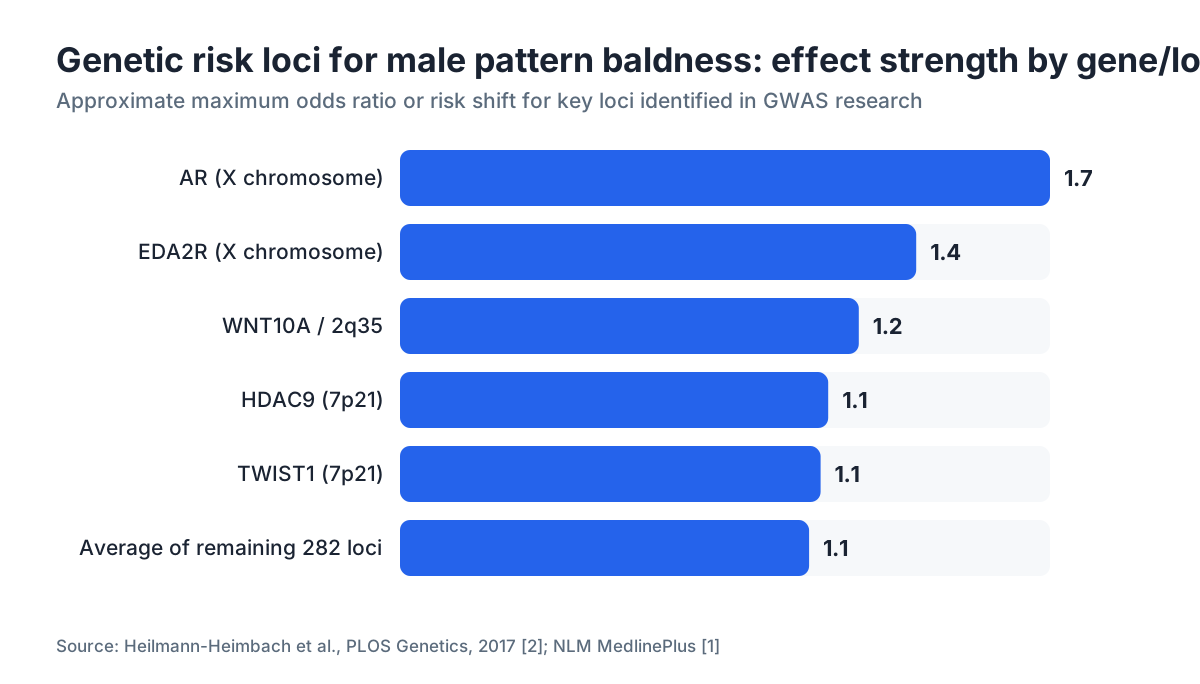
None of these hits like AR does. Most carry odds ratios between 1.05 and 1.30, meaning they nudge your risk by 5 to 30 percent. AR variants can move risk by 70 percent or more depending on the specific variant and the population studied [2].
For women, the GWAS data is thinner. A 2021 study in Nature Communications found 40 loci for female pattern hair loss. Several overlap with male loci but carry different effect sizes [4].
| Gene / Locus | Chromosome | Primary role | Effect on risk |
|---|---|---|---|
| AR | X | Androgen receptor sensitivity | Strongest single locus (~70%+ in some variants) |
| EDA2R | X | Follicle signaling near AR | Moderate, often linked with AR |
| WNT10A | 2q35 | Follicle development | Small to moderate |
| HDAC9 | 7p21 | Follicle cycle regulation | Small |
| TWIST1 | 7p21 | Transcription factor | Small |
| Multiple 2q35 loci | 2 | Mixed | Small |
Is hair loss inherited from your mother or your father?
Both. This is one of the stickiest myths in every barbershop.
The AR gene is on the X chromosome, and men get their X from their mother, so your maternal grandfather's hair is a genuinely useful clue. It's not the whole story even for AR alone. The variant has to sit on the specific X chromosome your mother passed to you, and she has two to choose from.
The other 286-plus signals from the 2017 study live on autosomes, the non-sex chromosomes you inherit equally from both parents [2]. A large twin study put the heritability of male pattern baldness at roughly 79 to 81 percent, with real contributions from both the maternal and paternal sides [5].
Father bald early and maternal grandfather bald early? Your risk is a lot higher than if only one side shows it. Neither side cancels the other out.
Can you get a genetic test for hair loss risk?
Yes. Just know what you're buying before you pay for it.
Several companies sell hair loss genetic panels. 23andMe folds a polygenic score for male pattern baldness into its health reports. HairDX sells a test built around AR gene variants, especially a variant it calls the GG genotype, which the company says is tied to a higher likelihood of progressive hair loss [6]. Dedicated hair genetic tests run roughly $100 to $250 as of mid-2025.
These tests can tell you whether you carry high-risk variants at the loci they cover. Here's what they can't do:
- Predict with certainty that you'll go bald
- Tell you how fast the loss will move
- Identify which treatment you'll respond to
- Account for the hundreds of loci they don't test
A polygenic score built from many variants tells you more than a single-gene test. Even a high polygenic score isn't a promise you'll lose your hair. Stress, nutrition, and conditions like thyroid disease or telogen effluvium stack on top of genetics and can speed up loss or, sometimes, reverse the apparent shedding.
The American Academy of Dermatology does not recommend routine genetic testing as part of a standard hair loss workup [7].
How accurate are consumer DNA tests for predicting baldness?
Better than a coin flip. Worse than a sure thing.
A 2020 study in Scientific Reports tested whether a 200-locus polygenic score could sort bald from non-bald men in the UK Biobank. The model hit an area under the ROC curve (AUC) of about 0.78, meaning it classified men correctly roughly 78 percent of the time [8]. A random guess sits at 0.50.
That sounds strong until you ask what it means for one person. A high-risk score flags a group of men more likely to go bald. Inside that group, some will still have full hair at 60. These tests predict populations well and individuals poorly.
Single-locus tests like HairDX, which look mainly at one or two AR variants, predict worse because they miss most of the genetic signal. The company says its test flags a "significantly higher likelihood" of hair loss for men with the high-risk GG variant, but independent peer-reviewed validation of that specific commercial panel is limited [6].
A polygenic score with hundreds of loci is worth something if you want a read on your baseline risk. An AR-only test gives you a fragment. Neither beats looking at your family tree and watching your own hairline over time.
Can knowing your genetics change your treatment plan?
In theory, yes. In practice, not much yet.
The most talked-about use is predicting finasteride response. Finasteride blocks 5-alpha reductase type 2, the enzyme that turns testosterone into DHT. A 2014 study in JAMA Dermatology found that men with certain 5-alpha reductase gene (SRD5A2) variants had lower baseline DHT and different response patterns to finasteride. The clinical picture wasn't clear enough to guide dosing [9].
Most dermatologists start everyone on the same proven treatments regardless of genotype: minoxidil for men (FDA-approved for androgenetic alopecia), finasteride (FDA-approved for men), or finasteride and minoxidil together. Genetic data might one day sort who gets which drug first, but that pharmacogenomics work is early for hair loss specifically.
What genetics can do right now is set urgency. If you carry several high-risk alleles and you're 22 with a hairline that's just starting to creep back, that's a strong argument for starting treatment now, since earlier intervention consistently produces better outcomes in the clinical literature [7].
Not sure where your hairline actually stands? A baseline photo helps. The free AI scan at MyHairline maps your hairline against Norwood stages so you have a documented starting point before or after any genetic test.
Does the hair loss gene affect women differently?
Yes, a lot.
Women carry two X chromosomes, so they have two copies of the AR gene. The more active copy usually wins out, but the second copy buffers. Women also run higher estrogen, and estrogen tends to push back against DHT's shrinking effect on follicles.
The result: female pattern hair loss (androgenetic alopecia in women) usually shows up as diffuse thinning across the crown rather than the receding hairline men get. It tends to move slower and rarely ends in complete baldness [7].
The 2021 Nature Communications study of female pattern hair loss found 40 significant loci, 11 of them shared with known male loci. New female-specific signals turned up near genes tied to steroid hormone metabolism, a sign that the biology splits off once you account for the different hormonal environment [4].
Risk scores calibrated on male hair loss don't transfer cleanly to women. If you're a woman looking at genetic risk, find panels built on female GWAS data or see a board-certified dermatologist who focuses on hair disorders.
What does 'high risk' in a hair loss gene test actually mean for your odds?
This is where people misread their results.
Genetic risk scores are population statistics. If a test says you're in the 90th percentile for genetic hair loss risk, it means 90 percent of the tested population has a lower polygenic score than you. It does not mean a 90 percent chance you'll be bald by 40.
To turn a score into something useful, you need a base rate. Male pattern baldness reaches roughly 50 percent of men by age 50 and 70 percent by age 70, per dermatology epidemiology data [10]. If the background prevalence at your age is 30 percent and your genetics roughly double it, you're looking at around 60 percent by that age. Not certainty.
High genetic risk plus early signs of loss (a hairline edging up, temples pulling back, thinner density at the crown) is a far stronger signal than genetics alone. A hairline that's already moving is more than a prediction. It's evidence. For more on reading those early signs, see our piece on receding hairlines.
Genetic risk also compounds with things you can change. Chronic stress, very low protein intake, iron deficiency, and certain medications can speed up loss on top of a predisposition. What causes hair loss beyond genetics is worth reading on its own at what causes hair loss.
Are there genetic tests your doctor can order versus buying direct-to-consumer?
Yes, and the two are different animals.
Direct-to-consumer (DTC) tests like 23andMe or HairDX ship without a prescription. They report polygenic risk scores or specific variant calls and are regulated in most cases as consumer wellness products, not medical devices. The FDA authorized 23andMe's personal genome service through a De Novo pathway [11], but that authorization covers the process, not a clinical claim that the score should steer your treatment.
Clinician-ordered tests show up in narrower situations: ruling out rare monogenic causes of hair loss (like loose anagen syndrome or certain ectodermal dysplasias), or in research. If your hair loss looks unusual, starts very early (before age 15), or comes with other symptoms, a dermatologist may order targeted gene panels through clinical labs like GeneDx or Invitae.
For most men with ordinary androgenetic alopecia, a clinical exam, possibly a scalp biopsy, and bloodwork (thyroid, ferritin, androgens) beat a genetic test. Genetics tells you about predisposition. Bloodwork and a physical exam tell you what's happening right now.
Spending money? Put a dermatology consult ahead of a consumer genetic panel unless curiosity is the whole point.
Can gene therapy or genetic editing eventually cure hair loss?
Maybe. Not soon, and not for most people.
Researchers are chasing a few directions. One targets the Wnt/beta-catenin pathway to wake dormant follicles. Another uses RNA interference to dial down androgen receptor expression in scalp follicles. A 2022 paper in Science Advances showed that lipid nanoparticles could carry mRNA into hair follicle cells in mice, a possible delivery route for follicle-targeted gene therapy [12].
None of these has reached human clinical trials for pattern baldness as of early 2026. The regulatory road for somatic gene therapy is long, the safety bar is high, and hair loss, real as its toll on quality of life is, doesn't carry the priority that cancer or rare genetic disease does with regulators.
The likelier near-term win is smarter pharmacogenomics: using your genetic profile to choose among existing drugs (finasteride, dutasteride, oral minoxidil) instead of editing the genome. That work is running now.
Today, the treatments proven to slow or partly reverse androgenetic alopecia are minoxidil, finasteride, low-level laser devices, and for advanced loss, hair transplant surgery. Genetics can frame your risk. These are still the tools you'd actually reach for.
Should you bother getting a hair loss genetic test?
My honest take: for most people it's an optional piece, not a first step.
If you're losing hair and want to act, you don't need a genetic test to start. You need a diagnosis (is this androgenetic alopecia, or something like telogen effluvium or a nutritional shortfall?) and then a treatment plan. A dermatologist gives you both without ever sequencing your DNA.
Here's where a test earns its keep: you're young, your hairline looks fine, but your father and maternal grandfather both went bald by 30 and you want your own odds before deciding whether to start preventive treatment. A high polygenic risk score is a fair nudge toward earlier intervention in that spot.
Skip the test if you're already clearly losing hair (you don't need DNA to confirm what the mirror shows), if you'd use the result to talk yourself out of treatment despite obvious progression, or if you're hoping it'll pick your treatment for you. That evidence isn't there yet.
Spend the $150 on one good dermatology consult instead. If you do want a record of where your hairline is right now, the free AI scan at MyHairline gives you a fast Norwood stage estimate before any appointment.
Sources
- National Library of Medicine, MedlinePlus Genetics: AR gene
- Heilmann-Heimbach S et al., PLOS Genetics 2017: Meta-analysis identifies novel risk loci and yields systematic insights into the biology of male-pattern baldness
- Randall VA, Clinical Endocrinology 2008: Androgens and hair growth
- Guo Y et al., Nature Communications 2021: Genome-wide association study of female pattern hair loss
- Nyholt DR et al., American Journal of Human Genetics 2003: Genetic basis of male pattern baldness
- HairDX: Hair loss genetic test information
- American Academy of Dermatology: Hair loss diagnosis and treatment
- Pirastu N et al., Scientific Reports 2020: Genome-wide association study of hair loss in UK Biobank
- Hirayama Y et al., JAMA Dermatology 2014: SRD5A2 variants and finasteride response
- Norwood OT, Journal of the American Academy of Dermatology 2001: Male pattern baldness classification and incidence
- U.S. Food and Drug Administration: De Novo authorization of 23andMe Personal Genome Service
- Cui Z et al., Science Advances 2022: Lipid nanoparticle delivery of mRNA to hair follicle cells