

TL;DR: The pull test is a fast clinical check: grab about 40-60 hairs, apply gentle traction, and count what releases. More than 6 hairs (roughly 10% of the bundle) is a positive result and points to active shedding, often from telogen effluvium or androgenetic alopecia. You can run a rough version at home in under a minute, but it signals a trend, not a diagnosis.
What exactly is the pull test?
The pull test (also called the hair pull test or traction test) is a physical exam dermatologists use to check whether hair shedding is active right now. It takes about 30 seconds. The doctor grasps a small bunch of hairs, applies steady outward tension, and counts how many slide free.
The logic is simple. Hair sitting in the telogen (resting) phase, or hair pushed early out of anagen (active growth), is only loosely held in the follicle. Healthy anagen hair grips hard. So a bundle that gives up several strands under light traction tells you something real about that scalp today.
It does not tell you why. A positive result could mean telogen effluvium, androgenetic alopecia in an active phase, alopecia areata, or a handful of other causes. The test is a signal, not a diagnosis. Dermatologists nearly always pair it with a patient history and, often, dermoscopy or blood work.
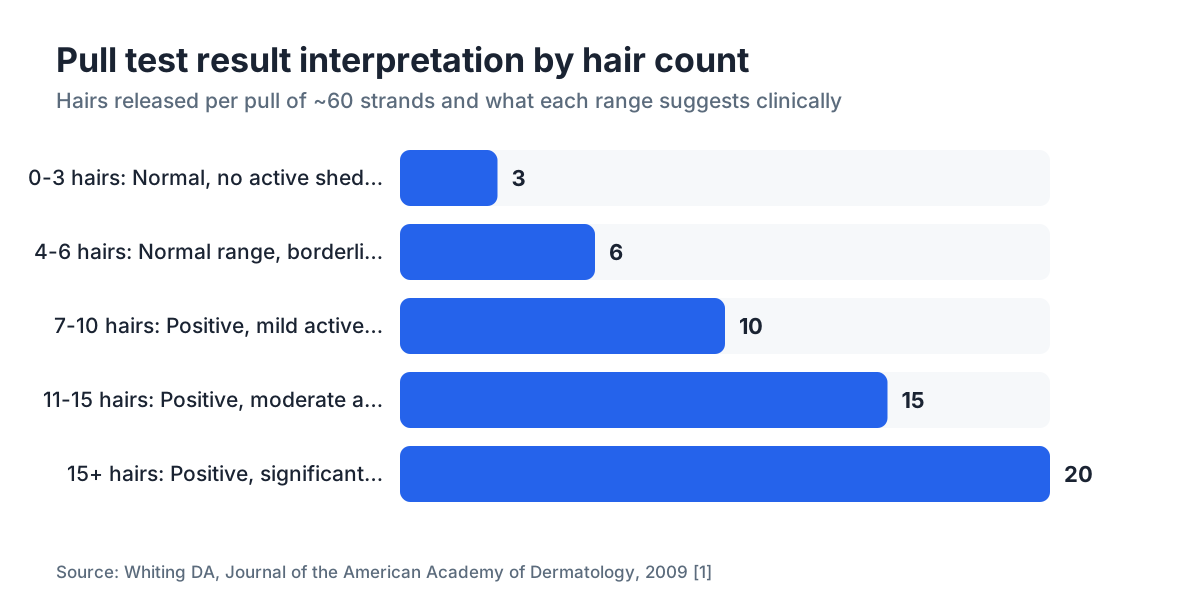
Clinicians have used this test for decades. A 2009 paper in the Journal of the American Academy of Dermatology set the positive threshold at more than 6 hairs out of 60 pulled, roughly 10%, which is still the most cited cutoff [1].
What do the results of a pull test actually mean?
The raw count matters. Where you pull matters just as much.
A positive result (more than 6 hairs per 60 grabbed, or above 10%) means active shedding is happening in that zone at that moment. In androgenetic alopecia, positive results cluster at the crown and frontal scalp but stay negative at the sides and back, because occipital hair is not androgen-sensitive. In diffuse telogen effluvium, the whole scalp tends to test positive [1].
A negative result (6 or fewer hairs) means shedding in that zone is normal at the time you tested. It does not clear you of a hair loss condition. Someone in early androgenetic alopecia can test negative for years before the thinning becomes visible.
Good clinicians also look at what came out. Telogen hairs have a small white club-shaped root bulb and no sheath. Anagen hairs carry a pigmented, gel-like sheath. Mostly telogen clubs fits an effluvium picture. Dystrophic anagen hairs (broken, no root) point to something more disruptive at the follicle level, like alopecia areata or a toxic process [1].
One caveat changes everything: the test is unreliable if the hair was washed in the past day or two. Washing strips the loosest hairs first. Clinicians ask patients not to wash for 24 to 48 hours beforehand.
| Pull test zone | Positive result suggests | Negative result suggests |
|---|---|---|
| Crown + frontal, negative at occiput | Androgenetic alopecia (active) | Pattern loss not currently active |
| Positive across all zones | Telogen effluvium or diffuse loss | Shedding resolved or never diffuse |
| Positive in patchy areas only | Alopecia areata at patch margins | Inactive alopecia areata |
| Positive everywhere, dystrophic anagen hairs | Toxic/chemotherapy-related loss | Normal follicle retention |
How do you do the pull test on yourself at home?
You can run a decent version yourself. It won't match a clinical exam, and you can't inspect root shape under magnification, but it gives you a real signal.
Start here: don't wash your hair for at least 24 hours before you try it. Freshly washed hair releases fewer strands because the shower already took them.
Here is the method, step by step.
Grab a section near the crown, roughly the width of two fingers side by side. Aim for 40 to 60 strands. Don't try to count them before pulling.
Hold the bundle close to the scalp with your thumb and two fingers, then slide firmly and smoothly outward along the shaft to the tips. Steady, moderate traction. Not a yank, not a tickle. Think of the force you'd use to slide a snug ring off your finger.
Count the hairs left in your fingers. Add any that landed on your shoulder or lap. Anything that clearly snapped off mid-shaft (rather than sliding out from the root) doesn't count.
Repeat in at least three zones: the crown, the frontal hairline, and the side or back near the ear. Write down each count.
More than 6 hairs from a zone, showing up again and again, is worth attention. Two or three is likely normal.
The honest limit: without knowing exactly how many hairs you grabbed, the percentage is rough. Dermatologists use a fixed 60-hair grab because it gives a steady denominator. At home, your best move is consistency across sessions so you can track change over time.
A tool like the MyHairline AI scan gives you a structured visual baseline next to this kind of at-home testing, since one pull test snapshot can't capture cumulative change.
How many hairs is normal to lose per day?
Most people shed 50 to 100 hairs a day under normal conditions [2]. Sounds like a flood, but the average scalp carries roughly 100,000 hairs, so 100 lost is 0.1%.
At any moment, about 80 to 90% of hairs are in anagen (growing), 1 to 2% in catagen (transition), and 8 to 15% in telogen (resting, ready to shed). The pull test is basically sampling how many follicles in one area have shifted into telogen or a dystrophic state.
After a big stressor (illness, surgery, childbirth, rapid weight loss), that telogen fraction can spike. The Cleveland Clinic Journal of Medicine notes that telogen effluvium usually shows up 2 to 4 months after the trigger, when the shed count can triple or more [3].
Seasonal variation is real but small. Some research suggests slightly higher shedding in late summer and fall. The swing is minor enough that it rarely tips a pull test into positive territory [2].
Is the pull test accurate? What does the research say?
It's a useful screen, not a high-precision test. Its biggest weakness is poor inter-rater reliability: two examiners doing the test on the same patient don't always land on the same count.
Whiting's 2009 review in the Journal of the American Academy of Dermatology is still one of the few focused looks at pull test methodology. It found the test is most informative when done serially over time and read alongside clinical context rather than as a standalone number [1]. Its sensitivity and specificity aren't well-characterized in large controlled trials, and that's an honest gap in the literature.
Trichoscopy (dermoscopy) has grown as a companion to the pull test because it lets the clinician see the ratio of miniaturized to normal hairs and other features a pull test can't catch [4]. If you're at a dermatology office and they only run the pull test with no optical magnification, ask about trichoscopy.
At-home versions are rougher still. They're good for tracking a trend week over week, not for producing a number you build treatment decisions on. Repeated positives at home are a reason to book an appointment. They are not a reason to start medication on your own.
What conditions does a positive pull test point to?
A positive pull test only says shedding is active. The pattern narrows things down.
Diffuse positive (all zones): telogen effluvium is the usual cause. It's a temporary, often reversible shed triggered by metabolic stress, crash dieting, illness, thyroid dysfunction, iron deficiency, or hormonal shifts. It can also flag a nutritional deficiency, and blood work usually tells you more than the pull test does here. There's more on triggers in what causes hair loss.
Crown and frontal positive, occiput negative: this pattern fits androgenetic alopecia (AGA), the most common form of progressive hair loss. AGA runs on dihydrotestosterone (DHT) sensitivity in predisposed follicles. Occipital follicles lack the androgen receptor density to be affected, so they hold firm even while the frontal and crown zones shed actively [6]. If that's your pattern, treatments like minoxidil for men, finasteride, or DHT blockers are worth raising with a dermatologist.
Patchy margins positive: alopecia areata typically tests positive at the active edge of a bald patch, where an autoimmune process is attacking hair.
Anagen hairs pulling out (not telogen clubs): less common, and often a sign of something disruptive, like loose anagen syndrome in children, anagen effluvium from chemotherapy, or a severe nutritional deficiency.
A receding hairline with a positive pull test at the temples suggests active androgenetic progression. Act on that sooner rather than later, because follicle miniaturization gets harder to reverse once it's advanced.
What does the hair look like when it comes out in the pull test?
This is information you can read yourself, no equipment required.
Telogen hairs: the root end has a small, dry, white or pale club. Think tiny matchstick head. No pigment, no gel-like sheath. This hair was already done growing. Seeing a few is expected.
Anagen hairs: the root end is pigmented and wrapped in a glistening, translucent inner root sheath. Pulling anagen hairs out in numbers means the follicle is being disrupted from outside, not finishing a normal cycle.
Dystrophic anagen hairs: the shaft is irregular or broken, the root malformed. These point to something actively damaging the follicle, like an autoimmune attack or a toxin.
Broken mid-shaft hairs: not true pull test positives. Mid-shaft breakage means hair fragility from chemical damage, heat styling, or traction, not follicle disease. Note them, but keep them out of your pull test count.
Without a microscope, telling anagen from telogen by eye is tricky on fine or light hair. A magnifying glass helps. Dermatologists use microscopy or trichoscopy at 10 to 70x for reliable classification [4].
When should you see a doctor instead of relying on the home pull test?
The home pull test is a starting point, not an endpoint.
See a dermatologist if you get consistently positive results (more than 6 hairs per pull) across multiple sessions in a week. Or if the shedding has run more than 3 months. Or if you notice bald patches, scalp scaling or inflammation, eyebrow or lash loss, or diffuse thinning coming on fast.
Lab work often matters more than the pull test. Thyroid function (TSH), ferritin (more telling than hemoglobin here), zinc, vitamin D, and a complete blood count can reveal reversible causes no scalp test will find [5]. The American Academy of Dermatology recommends a full history and physical before pinning hair loss on any single cause [5].
If your pattern points to androgenetic alopecia, earlier is genuinely better. Finasteride and minoxidil carry the most evidence and work better while follicles are alive and miniaturizing rather than gone [7][8]. The combination of finasteride and minoxidil has more evidence behind it than either drug alone.
For severe or treatment-resistant cases, a hair transplant becomes an option, but only once shedding is stable. That's one more reason to nail down a clear timeline with a qualified dermatologist.
Can you do the pull test too often? Are there risks?
Done right, no. The pull test doesn't cause meaningful harm. You're applying the same force used in normal grooming. A single session won't trigger a shed cycle or damage follicles.
The real risk is anxiety from overchecking. Pulling your hair every morning to count strands burns mental bandwidth, and the daily variance in a home test is high enough to hand you misleading readings. Once a week, on a consistent protocol (same zones, same hours since last wash), is a reasonable tracking pace.
Don't let obsessive self-testing stand in for medical evaluation. If you're worried enough to test daily, you're worried enough to book an appointment.
One edge case: people with alopecia areata at the margins of a patch should know that manipulating the marginal zone can sometimes provoke a Koebner-like phenomenon, though this is poorly documented for simple traction at pull-test force. It's a theoretical concern worth raising with your dermatologist if you have active alopecia areata.
How do dermatologists use the pull test alongside other tests?
No good dermatologist stops at the pull test. It sits inside a broader workflow.
Trichoscopy (video dermoscopy): a handheld or video device magnifies the scalp 10 to 70 times. The clinician sees the ratio of miniaturized (thin, pale) to terminal hairs, yellow dots, black dots, and other markers that separate AGA from alopecia areata from scarring alopecias [4]. A positive pull test plus a high miniaturization ratio makes a much stronger case than either alone.
Wash test: saving all hairs shed during a standardized shampoo gives a more precise shed count over one session. Some researchers argue it's more reproducible than the pull test, but it's harder to standardize outside a clinic.
Scalp biopsy: the gold standard for ambiguous cases. A 4mm punch biopsy from an affected area shows follicle miniaturization ratios, inflammation patterns, and fibrosis that no surface test can. Rarely the first step, often needed for scarring alopecia diagnoses.
Blood work: ferritin below 30 ng/mL is associated with telogen effluvium in women, though the causal threshold is debated [10]. Thyroid-stimulating hormone outside the normal range is a common reversible cause. Testing is not optional when the picture is unclear.
Track your own pull test results over time and bring the notes plus photos to your appointment. You'll give the clinician a better read on trajectory. The MyHairline AI scan is one way to build a visual baseline you can share.
What treatments make sense if the pull test is positive?
It depends on the pattern the positive test shows and the cause underneath it.
Diffuse pattern with iron deficiency or thyroid dysfunction on blood work: treat that cause and the shedding usually settles within a few months. No hair-specific drug needed.
Pattern pointing to androgenetic alopecia: the evidence hierarchy is fairly clear. Minoxidil (topical or oral) is FDA-approved for men and women and raises the share of follicles in anagen [7]. Finasteride is FDA-approved for men and blocks the conversion of testosterone to DHT, the hormone that miniaturizes genetically susceptible follicles [8]. Read minoxidil side effects if that's on your mind. Hair loss supplements have a much thinner evidence base and aren't first-line.
Telogen effluvium: the main move is fixing the trigger and waiting. Most cases resolve within 6 to 9 months of the trigger clearing [3]. Minoxidil may speed the return to anagen but isn't required.
Alopecia areata is a different conversation, involving intralesional corticosteroids, topical immunotherapy, or newer JAK inhibitors for severe cases, and it belongs with a dermatologist.
If someone raises supplements like creatine, there's a small signal worth knowing about: does creatine cause hair loss is a real question with nuance behind it.
Sources
- Whiting DA. Journal of the American Academy of Dermatology, 2009. Pull test methodology and thresholds.
- American Academy of Dermatology (AAD). Hair loss: Overview.
- Harrison S, Bergfeld W. Cleveland Clinic Journal of Medicine, 2009. Diffuse hair loss.
- Rudnicka L, Olszewska M, Rakowska A. Trichoscopy: dermoscopy of the hair and scalp, Journal of Dermatological Case Reports, 2011.
- American Academy of Dermatology (AAD). Hair loss: Diagnosis and treatment.
- Tosti A, Piraccini BM. Androgenetic alopecia and telogen effluvium: clinical diagnosis, Dermatology, 2001.
- FDA. Minoxidil topical solution drug information.
- FDA. Finasteride (Propecia) drug information.
- Sinclair R. Male pattern androgenetic alopecia, BMJ, 1998.
- Olsen EA et al. Evaluation of hair loss in women, Journal of the American Academy of Dermatology, 2005.
- NIH MedlinePlus. Hair loss.