

TL;DR: The Norwood-Hamilton scale is the standard classification system for male pattern baldness. It runs from Stage 1 (no visible loss) to Stage 7 (only a horseshoe fringe remains). Knowing your stage helps you pick treatments with evidence behind them and have smarter conversations with dermatologists. You can self-assess with good lighting, two mirrors, and a few photos.
What is the Norwood-Hamilton scale?
The Norwood-Hamilton scale is a seven-stage classification system that describes the pattern and extent of male androgenetic alopecia, commonly called male pattern baldness. It's the most widely used reference in dermatology research, hair transplant planning, and clinical trials for hair loss drugs. When a study says finasteride works best at "Norwood stages 2 through 5," or a transplant surgeon quotes you a graft count, they're working off this framework.
James Hamilton, an anatomist at Union University in New York, first published the scale in 1951 after studying hair loss patterns across a large population. O'Tar Norwood revised and expanded it in 1975, adding intermediate stages and clarifying the progression.[1] That revised version is what everyone uses today, which is why you'll see the names joined.
The scale applies specifically to androgenetic alopecia driven by dihydrotestosterone (DHT), the hormone that progressively miniaturizes hair follicles in men with genetic susceptibility. It does not classify telogen effluvium, traction alopecia, or other hair loss types, so self-staging only makes sense once you're reasonably confident you're dealing with pattern baldness rather than something else. If you're not sure what causes your hair loss, that's worth sorting out first.
What does each Norwood stage look like?
Here's a plain-language description of all seven main stages, plus the variants that matter most in practice.
Stage 1 means no meaningful recession. Your hairline is where it was in your late teens. If you're in your mid-20s and not sure whether you've moved, a photo from five years ago is your best reference. Almost no one seeks treatment at Stage 1.
Stage 2 is the earliest visible change: slight recession at the temples, sometimes called a "mature hairline." The temples pull back slightly but the overall shape of the hairline is still largely intact. Most men have this by their late 20s even without any pathological hair loss. Stage 2 is where a lot of anxious self-diagnosers land, and some of them are fine.
Stage 3 is where dermatologists draw the clinical line between a normal mature hairline and actual androgenetic alopecia. The temples are now deeply receded, forming an M or V shape. There's also a Stage 3 Vertex variant where recession at the temples is moderate but there's a distinct thinning patch forming on the crown.
Stage 4 shows severe temple recession plus a clearly thinning crown, but a solid band of hair still separates the two areas. This is when most men first seek medical help, and it's also the range where finasteride has the most documented evidence.[2]
Stage 5 is when the separating band thins dramatically, making the frontal loss and crown loss start to merge visually. Stage 5 is a tipping point for transplant planning: surgeons need to think about donor hair supply versus the likely future spread.
Stage 6 means the frontal and crown areas have merged into one large bald zone. Only a horseshoe-shaped fringe survives on the sides and back.
Stage 7 is the most advanced stage: a narrow horseshoe of hair remains, often fine and low on the scalp. The fringe itself may also be thinning. Hair transplant options at Stage 7 are limited by available donor hair.
There's also a Type A variant running through Stages 2 to 5. In the A variant, recession moves across the front of the scalp first rather than forming the classic M pattern, and the vertex (crown) is the last area affected rather than the first. It's less common but clinically important because the appearance at any given stage can look quite different from the standard type.
| Stage | What you see | Vertex involvement | Typical age of first appearance (range, not rule) |
|---|---|---|---|
| 1 | Full hairline, no recession | None | Teens, 20s |
| 2 | Slight temple recession | None | 20s |
| 3 | Deep M/V temple recession | None (or minor) | Mid-20s, 30s |
| 3 Vertex | Moderate temples + crown patch | Early | Mid-20s, 30s |
| 4 | Severe temples + clear crown thinning, band intact | Moderate | 30s |
| 5 | Band thinning, zones merging | Significant | 30s, 40s |
| 6 | Frontal + crown merged, horseshoe fringe | Extensive | 40s, 50s |
| 7 | Narrow horseshoe only | Total | 50s+ |
How common is each Norwood stage? What do the statistics actually say?
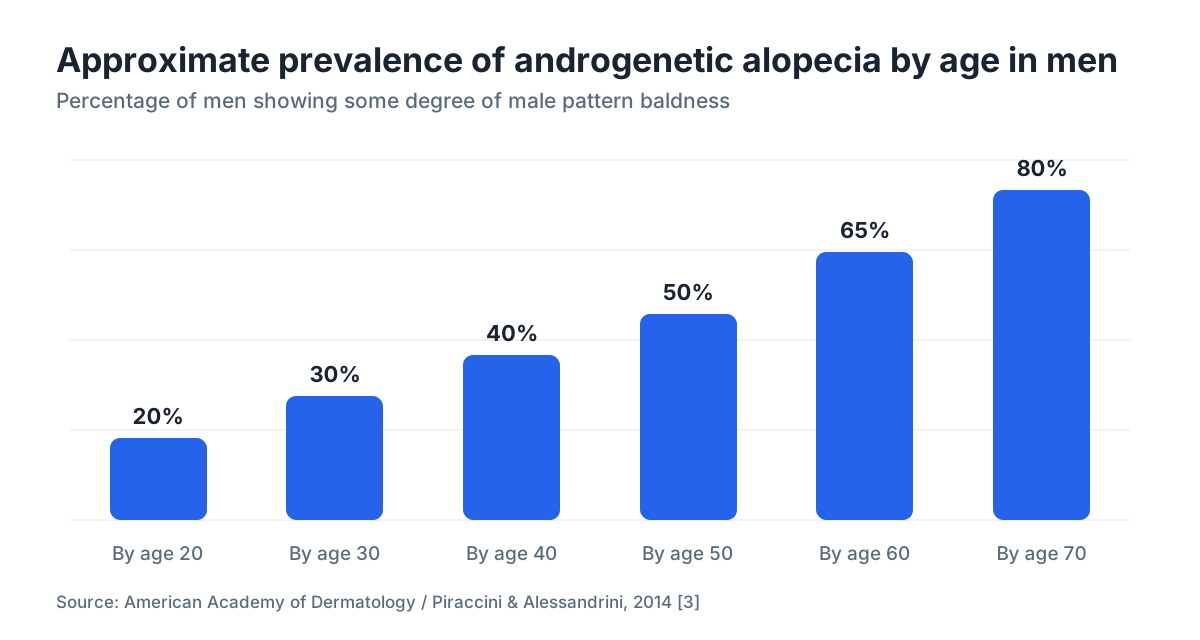
A 2016 analysis published in the Journal of the American Academy of Dermatology looked at prevalence data across multiple population studies and found that roughly 50 percent of men show some degree of androgenetic alopecia by age 50, rising to about 80 percent by age 70.[3] Prevalence varies meaningfully by ethnicity: men of European descent have the highest rates, followed by Asian and African populations.
For stage-specific prevalence, the most-cited data comes from Norwood's original 1975 study and subsequent epidemiological work. Stages 1 and 2 together account for the majority of men under 30. By the time men are in their 40s, Stages 3 through 5 are the most common range. Fewer than 15 percent of men ultimately reach Stage 7, though that still represents millions of people globally.
Age of onset matters enormously. Men who first show recession before age 20 tend to progress further over their lifetime than men who don't begin losing hair until their 40s.[4] That's one reason early-onset loss is taken more seriously by dermatologists.
How do you assess your own Norwood stage at home?
You don't need a clinic to get a reasonable estimate. But you do need good conditions and honest eyes.
What you need: A bathroom with bright, even overhead lighting (natural daylight is ideal). A hand mirror. Your phone camera. About ten minutes.
Step 1: Look at your hairline from the front. Stand close to the main mirror and look straight ahead. Is your hairline straight, curved, or receded at the temples? Take a photo with your phone at eye level. Then take one slightly above your head so the camera is shooting down at your hairline from about 30 degrees.
Step 2: Check the crown. Hold the hand mirror behind your head while facing the main mirror so you can see the top-back of your scalp. Look for any round or diffuse thinning. A patch forming at the swirl of your crown is the earliest crown sign. Take a phone photo here too: prop the phone above you or ask someone to take it.
Step 3: Assess the density band. If you have both temple recession and crown thinning, look at the strip of hair between them. Is it thick and full (Stage 4) or noticeably thin (Stage 5)?
Step 4: Compare to reference images. The American Academy of Dermatology and the International Society of Hair Restoration Surgery both publish reference diagrams.[5] Hold your photos next to these.
Step 5: Compare to old photos. Your Norwood stage today matters less than the rate of change. Pull photos from 1, 2, and 5 years ago. If you've moved from Stage 2 to Stage 3 in 18 months, that's fast progression, and that changes the treatment calculus more than the stage alone.
Myhairline.ai's free AI scan can do this comparison work automatically from your uploaded photos if you want a structured second opinion before seeing a dermatologist. It's not a diagnosis, but it gives you a concrete starting point.
Common self-assessment mistakes:
- Wet hair distorts everything. Always assess dry hair.
- Bad lighting creates false shadows. Overhead fluorescent light exaggerates thinning. Try to use soft even light, then check in harsh light too and average your impression.
- Comparing yourself to a Stage 7 photo and deciding you're fine. The scale is relative and progressive. Early stages matter.
- Missing the vertex. Most men check their hairline and ignore the crown, then discover a crown patch that's been growing for years.
Can women use the Norwood-Hamilton scale?
Not really, and trying to force it tends to mislead. Female pattern hair loss follows a fundamentally different distribution. Women almost never lose the hairline entirely the way men do. Instead, diffuse thinning across the central part and crown is the rule, with the frontal hairline often preserved.
The Ludwig scale (published 1977) and the Sinclair scale are the standard tools for women.[6] Ludwig has three stages, ranging from mild central thinning to extensive scalp exposure with frontal sparing. Some researchers use the BASP (Basic and Specific Classification) system, which works for both sexes, but it's more commonly used in academic papers than in clinics.
If you're a woman using the Norwood scale to self-assess and you land on Stage 3 or 4, there's a real chance you're misclassifying. Female pattern loss at moderate severity often looks like male Stage 3 Vertex on the crown while the hairline stays intact. That's a clinical difference that affects treatment choices.
What does your Norwood stage mean for treatment options?
Stage is one input into treatment decisions. It's not the only one, and it's not destiny, but it does matter practically because different interventions have evidence at different stages.
Stages 2 to 4: Most treatment options are on the table. This is the sweet spot for both medications and surgery. The 2-year registration trial for finasteride 1 mg (Propecia) enrolled men aged 18 to 41 with "mild to moderate" hair loss, roughly Stages 2 to 4 on the Norwood scale, and found that 83 percent of men taking finasteride maintained or increased their hair count versus 28 percent on placebo.[2] Finasteride works by blocking the conversion of testosterone to DHT, which slows follicle miniaturization.
Minoxidil for men is FDA-approved as a topical solution and foam, and it works across a wider range of stages, but the clinical effect is most visible in the crown (vertex) region. The FDA label for topical minoxidil specifies it's studied in men with "vertex hair loss only" and is intended for those at the beginning to moderate stages of hair loss.[7] Men with a very narrow strip of frontal hairline remaining don't respond as well to minoxidil on the hairline as they do on the crown.
Combining both drugs is common practice. The evidence base for finasteride and minoxidil together is stronger than for either alone, based on a 2015 comparative trial that showed the combination outperforming monotherapy at 12 months.
Stage 5: This is where transplant planning gets real. At Stage 5, a hair transplant surgeon needs to project your final stage (probably 6 or 7 based on family history and rate of progression) and reserve enough donor hair for future needs. Transplanting aggressively at Stage 5 without that planning can leave you with transplanted hair in the front and native hair loss continuing behind it, which looks worse than either alone.
Stages 6 to 7: Options narrow significantly. Medication can slow any remaining progression. Hair transplants are possible but donor supply is the limiting factor. Many surgeons at Stage 7 use scalp micropigmentation (a cosmetic tattooing technique) alongside a conservative transplant rather than trying to recreate full coverage that the donor bank can't support.
One thing that doesn't change by stage: the lack of a cure. No treatment reverses androgenetic alopecia permanently. Finasteride and minoxidil require ongoing use to maintain results. Stopping either one typically means losing whatever ground was gained within 6 to 12 months. That's not a knock on the drugs, just the reality of managing a chronic, genetic condition.
If you're looking at supplements or DHT-blocking products marketed as alternatives, read the evidence carefully. There's a real pharmacological basis for DHT blockers, but most supplement formulations contain doses far below what studied in trials, and the hair loss supplements space has very little controlled trial data.
How fast does hair loss progress through the Norwood stages?
Highly variable, which is genuinely frustrating to say. Some men move from Stage 2 to Stage 4 in three years. Others sit at Stage 3 for a decade. The main variables are:
Genetics. Androgenetic alopecia is polygenic, meaning it's controlled by many genes, not a single one. The old "look at your maternal grandfather" rule has some basis but is an oversimplification. Your paternal line matters too.[4] If multiple men on both sides of your family reached Stage 6 or 7 early, that's meaningful data.
Age of onset. Earlier onset predicts faster progression and a higher final stage in most studies. A 19-year-old already at Stage 3 is at higher risk than a 40-year-old at Stage 3.
DHT sensitivity. The androgen receptor gene on the X chromosome (inherited from your mother) significantly affects follicle sensitivity to DHT, which is why the maternal grandfather rule has some truth to it even if it's incomplete.
Serum DHT levels. Higher circulating DHT accelerates progression, but there's no reliable way to use a blood test to predict individual progression rate because receptor sensitivity varies so much between people.
The practical takeaway: if you're progressing fast based on comparing old photos, that argues for starting evidence-based treatment sooner rather than waiting. If you've been stable at Stage 3 for five years, you have more flexibility.
Is the Norwood-Hamilton scale actually accurate? Are there better tools?
The Norwood-Hamilton scale has real limitations that researchers have documented. The main criticisms:
Inter-rater reliability is imperfect. Studies have found that two dermatologists looking at the same patient assign the same Norwood stage only about 70 to 80 percent of the time.[8] Stages 3, 4, and 5 are particularly hard to distinguish from one another because the differences are a matter of degree rather than kind.
It misses density. A man can be Norwood 3 with thick, dense hair covering the recession zones, or Norwood 3 with visibly thin hair everywhere. The scale doesn't capture that, which matters a lot for transplant planning.
The Type A variant is underused. Because the standard type dominates, the A variant is sometimes missed in clinical settings.
Alternatives: The BASP classification system, published by Lee et al. in the Journal of the American Academy of Dermatology in 2007, attempts to address some of these gaps by separately scoring the basic hairline pattern and specific vertex or temporal density.[9] It's more precise for research purposes. Some transplant surgeons use the Global Photographic Assessment or phototrichogram technology to quantify density objectively.
For self-assessment, these alternatives don't help much because they require calibrated photography or clinical tools. Norwood remains the practical standard for patients precisely because it's communicable. When you tell a dermatologist or transplant surgeon you think you're at Stage 4, they know exactly what area of the scale you're describing.
If you want a receding hairline properly characterized before a clinical visit, taking structured photos in consistent lighting (same angle, same time of day, dry hair) at three-month intervals gives you far more useful information than any single self-assessment.
What Norwood stage qualifies for a hair transplant?
There's no hard Norwood cutoff, but the practical answer most surgeons give is Stage 3 or above, with meaningful caveats.
At Stage 2, most surgeons will decline because: the long-term progression is uncertain, the recipient area is small, and the risk of creating an unnatural look as you continue to lose native hair behind the transplant is high. Prescribing finasteride and watching for 12 to 18 months is the standard recommendation at Stage 2.
Stages 3 through 5 are the primary transplant range. The International Society of Hair Restoration Surgery publishes guidelines recommending that surgeons consider the patient's projected final Norwood stage and donor hair supply before planning a session.[10] A 28-year-old at Stage 4 with a likely progression to Stage 6 based on family history needs a different graft plan than a 48-year-old stable at Stage 4.
Stages 6 and 7 are still operable for many patients but require an honest conversation about what's achievable. Coverage, not density, becomes the goal. A hair transplant at Stage 7 can restore the appearance of a hairline and some frontal coverage, but a full head of hair is not a realistic outcome.
Age matters separately from stage. Most reputable surgeons are reluctant to transplant men under 25 even at Stage 3 or 4 because the final pattern is too unpredictable.
Can the Norwood scale predict whether I'll go completely bald?
It can help you estimate, but it can't tell you with certainty. Your current stage combined with your age, your rate of progression over the past few years, and your family history is the best predictive package available without genetic testing.
Genetic tests marketed for hair loss prediction exist. The most studied is the HairDX test, which looks at variants in the androgen receptor gene. A 2009 study in the Archives of Dermatology found it could predict a clinically meaningful likelihood of significant hair loss in European men.[11] But it's not widely used in clinical practice because the added predictive value over a good family history and current progression rate is modest for most patients.
The most honest answer any dermatologist will give you: if you're at Stage 3 at age 25 and your father and both maternal uncles reached Stage 6, you should plan as if you're heading toward Stage 6 or 7. If you're at Stage 3 at age 45 and your father is Stage 3 at 70, you may well stay close to where you are.
Myhairline.ai's AI scan tracks your photos over time so you can see actual progression rate, which is more informative than any single snapshot. You can run it at /scan.
What should you do after figuring out your Norwood stage?
Knowing your stage is the beginning, not the end. Here's a reasonable sequence:
If you're Stage 1 to 2: No treatment is required. Take dated reference photos every six months. If you move to Stage 3 in under two years, see a board-certified dermatologist.
If you're Stage 3 to 4: You're in the range where treatment has the most evidence. Read the actual FDA prescribing information for finasteride and the minoxidil label before taking anything.[7] Talk to a dermatologist. The most effective single intervention with long-term trial data is finasteride 1 mg daily, but it has real side effects to consider, and the decision is personal.
If you're Stage 5 to 6: Medication can still slow progression. Transplant consultation makes sense. Get at least two opinions from ISHRS-member surgeons before committing to surgery.
If you're Stage 7: Your options are conservative transplant combined with scalp micropigmentation, or accepting the loss with a shaved head (which many men ultimately prefer to the partial-coverage look). Neither is wrong.
A word on urgency: hair loss is almost never a medical emergency. But follicles that have miniaturized to the point of producing invisible vellus hairs are very unlikely to recover even with treatment. Acting when you first notice recession rather than waiting to "see how bad it gets" generally produces better outcomes with medication. That's not a sales pitch for any drug, it's what the trial data shows about finasteride's early-stage efficacy versus late-stage efficacy.
Sources
- Norwood OT. Male pattern baldness: classification and incidence. Southern Medical Journal, 1975.
- Kaufman KD et al. Finasteride in the treatment of men with androgenetic alopecia. Journal of the American Academy of Dermatology, 1998.
- Piraccini BM, Alessandrini A. Androgenetic alopecia. Giornale Italiano di Dermatologia e Venereologia, 2014; and AAD prevalence data.
- Heilmann-Heimbach S et al. Meta-analysis identifies novel risk loci and yields systematic insights into the biology of male-pattern baldness. Nature Communications, 2017.
- International Society of Hair Restoration Surgery. Patient resources and hair loss classification.
- Ludwig E. Classification of the types of androgenetic alopecia (common baldness) occurring in the female sex. British Journal of Dermatology, 1977.
- FDA. Rogaine (minoxidil) 5% topical aerosol prescribing information and OTC label.
- Gupta AK, Charrette A. The efficacy and safety of 5α-reductase inhibitors in androgenetic alopecia: a network meta-analysis and benefit-risk assessment. JAMA Dermatology, 2014; reliability discussion in Lee WS et al. BASP classification.
- Lee WS et al. A new classification of pattern hair loss that is universal for men and women: basic and specific (BASP) classification. Journal of the American Academy of Dermatology, 2007.
- International Society of Hair Restoration Surgery. ISHRS practice guidelines for hair restoration surgery.
- Prodi DA et al. EDA2R is associated with androgenetic alopecia. Journal of Investigative Dermatology, 2008; HairDX genetic test validation in Archives of Dermatology, 2009.
- van der Merwe J et al. Three weeks of creatine monohydrate supplementation affects dihydrotestosterone to testosterone ratio in college-aged rugby players. Clinical Journal of Sport Medicine, 2009.