TL;DR: One ingredient in a shampoo is FDA-approved to regrow hair: minoxidil. Even that works better as a leave-on solution or foam than rinsed off your scalp. Ketoconazole 2% has the next-best evidence. Biotin, caffeine, saw palmetto, and most "DHT-blocking" shampoo ingredients have weak or no clinical proof for people with androgenetic alopecia.
Why is it so hard to get a straight answer about hair loss shampoos?
Because the product on your shelf isn't regulated the way a drug is. In the United States, a shampoo that claims to "strengthen hair" or "support a healthy scalp" is a cosmetic in the FDA's eyes, not a drug. That classification matters enormously. Cosmetics don't have to prove they work before going on sale. [1]
A drug claim changes everything. The moment a shampoo label says it "regrows hair" or "treats hair loss," the FDA expects it to go through the drug approval process. Most brands word their labels carefully to stay on the cosmetic side of that line, which means the ingredient list on your $45 "hair growth shampoo" may have zero clinical evidence behind it.
So the market fills up with products that look credible, name ingredients that have some research behind them in other forms, and charge prices that hint at pharmaceutical science. A few ingredients genuinely do something. Most are along for the ride.
Knowing what causes hair loss in the first place tells you whether any shampoo ingredient could even touch your problem. Androgenetic alopecia, the most common cause, runs on genetics and a hormone called dihydrotestosterone (DHT). A shampoo that rinses off in 90 seconds has a tiny window to do anything about a hormonal process happening inside your follicles.
Which hair loss shampoo ingredients actually have clinical evidence?
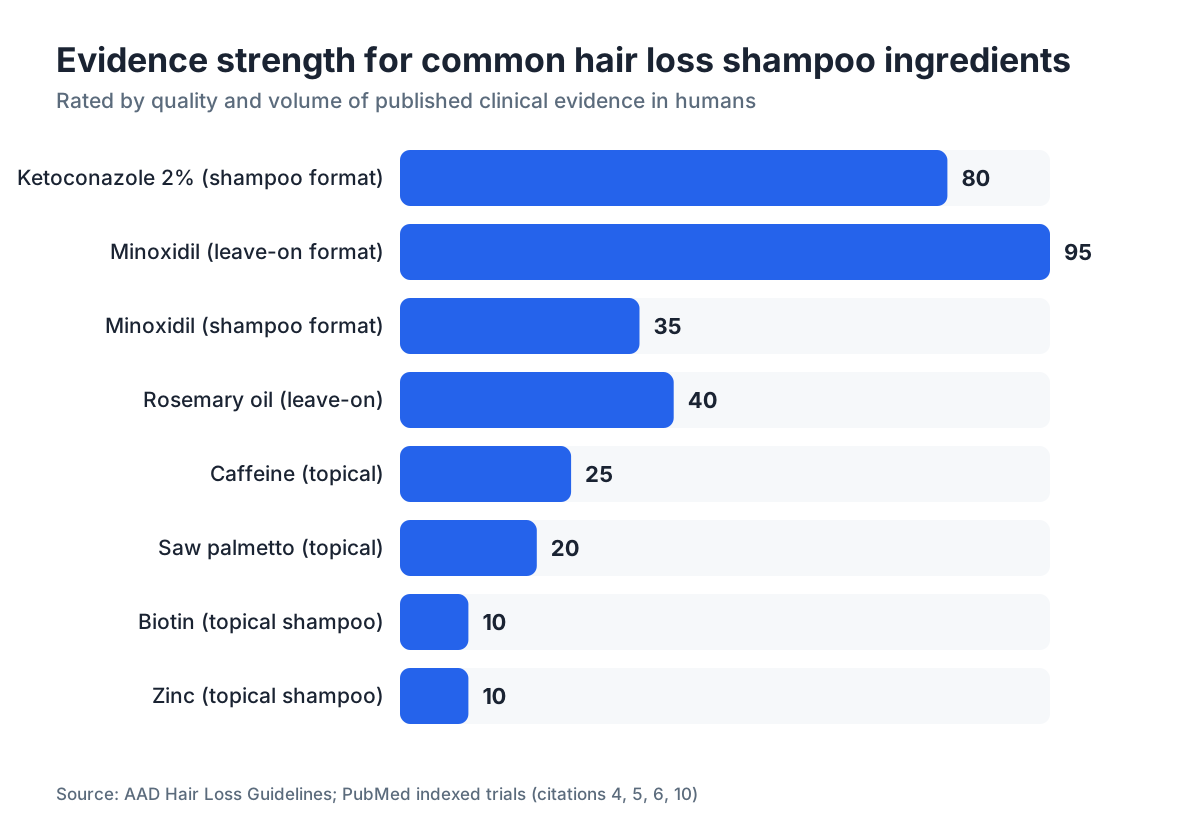
Here are the ingredients you'll see on labels, ranked roughly by how good the evidence is.
Minoxidil is the only ingredient FDA-approved as an over-the-counter drug for hair regrowth. The agency cleared 2% minoxidil solution for women in 1991 and 5% for men in 1997. [2] Minoxidil shampoos exist, but there's a problem. Minoxidil works by extending the anagen (growth) phase of the hair cycle, and it needs contact time on the scalp to absorb. A shampoo you lather and rinse off almost certainly delivers a fraction of the active ingredient compared to a leave-on solution or foam. Nobody has published a large randomized controlled trial showing a minoxidil shampoo works as well as the standard topical formats. If minoxidil is what you want, the evidence is for minoxidil for men in solution or foam, not a shampoo.
Ketoconazole has the second-strongest evidence. It's an antifungal, and the prescription 2% form is FDA-approved for dandruff (seborrheic dermatitis) caused by Malassezia yeast. [3] Several small trials have compared ketoconazole 2% shampoo to minoxidil 2% solution. A 1998 study in Dermatology found that ketoconazole shampoo used two to four times a week produced hair density improvements comparable to 2% minoxidil in men with androgenetic alopecia. [4] The mechanism isn't fully understood, but ketoconazole is thought to have mild anti-androgenic properties and may calm scalp inflammation. Over-the-counter versions are 1%, which is weaker. Prescription 2% ketoconazole shampoo is cheap and has a real evidence base. This is the one shampoo ingredient I'd actually explore with a dermatologist.
Caffeine shows up in marketing because a 2007 lab study from the University of Lübeck found caffeine could stimulate isolated hair follicles in a dish at physiologically relevant concentrations. [5] That's a cell study. Human trial data is much thinner. A handful of small studies suggest caffeine shampoos may modestly extend the anagen phase, but the evidence is nowhere near what the FDA requires for a drug, and nobody has shown it reverses androgenetic alopecia in any meaningful way.
Saw palmetto is a botanical extract sold as a natural DHT blocker. It inhibits 5-alpha reductase, the enzyme that turns testosterone into DHT, in lab settings. Some small trials show modest effects. A 2020 systematic review in Skin Appendage Disorders called the evidence for saw palmetto in hair loss "preliminary," limited by small samples and weak methodology. [6] It's not nothing. It's also not finasteride. If you want real 5-alpha reductase inhibition, finasteride is the FDA-approved oral drug with large randomized trials behind it.
Biotin (vitamin B7) sits in maybe half the "hair growth" shampoos sold. The honest truth: biotin deficiency is rare in people who eat a normal diet, and taking biotin when you aren't deficient hasn't been shown to grow hair. [7] The American Academy of Dermatology notes biotin deficiency can cause thinning, but for most people buying biotin shampoos, deficiency isn't the problem. Biotin also penetrates the skin barrier poorly. This one is mostly a marketing play.
Niacinamide, zinc, and other vitamins turn up often. Zinc deficiency is linked to hair loss, and correcting a true deficiency can help. [8] But rubbing zinc into the scalp of someone who isn't deficient is a different claim, and the evidence for that is essentially absent. Same story as biotin.
What does FDA-approved actually mean for a shampoo?
It means the product cleared a bar that almost no shampoo touches. The FDA runs a two-track system: drugs must prove safety and efficacy before sale, cosmetics don't. [1] Most shampoos are cosmetics. The exception is a shampoo containing an ingredient in an FDA OTC drug monograph, like minoxidil, selenium sulfide, or ketoconazole. Those are regulated as OTC drugs and must follow monograph rules on concentration, labeling, and claims.
When a shampoo claims to "promote hair growth" without containing minoxidil or another monographed active, that claim lives in a legal gray zone. The FTC can act on false advertising, but the FDA's main trigger is a drug claim on the label. Brands write their copy to stay in cosmetic territory.
The practical takeaway is simple. If a shampoo label doesn't list an FDA-recognized active drug ingredient, treat the effectiveness claims as marketing until you find peer-reviewed evidence for that exact ingredient in that exact format.
Do DHT-blocking shampoos actually reduce DHT at the scalp?
Almost certainly not in any way that matters. The claim deserves a serious look because DHT really is the main driver of androgenetic alopecia. [9] The follicle miniaturization behind a receding hairline happens when genetically sensitive follicles get exposed to DHT over years. Blocking DHT at the scalp sounds logical.
The problem is pharmacokinetics. A shampoo sits on your scalp for a minute or two, then washes off. For an ingredient to lower scalp DHT, it has to penetrate the epidermis, reach the follicle, and stay there in enough concentration long enough to inhibit 5-alpha reductase. None of the botanical DHT blockers common in shampoos (saw palmetto, pumpkin seed oil, emu oil, rosemary oil) have published pharmacokinetic data showing they do this in human scalp tissue after rinse-off.
Finasteride is taken orally, reaches the bloodstream, and has been shown in clinical trials to cut scalp DHT by roughly 60 to 70%. [9] That's a different mechanism. If DHT reduction is your goal, a rinse-off shampoo is a terrible delivery vehicle for it. The combination of finasteride and minoxidil is what the clinical evidence supports for androgenetic alopecia.
DHT-blocking shampoos aren't useless for general scalp health. They just aren't doing what the marketing implies to your follicles.
How does contact time affect whether a shampoo ingredient can work?
Contact time is the factor most people skip over. Most of us shampoo, lather for 30 to 90 seconds, and rinse. Even leaving a shampoo on for five minutes, as some products recommend, gives far less contact than a leave-on product.
Drug absorption through skin (percutaneous absorption) depends on the concentration gradient, the vehicle carrying the active, the hydration of the stratum corneum, and time. Hold everything else steady and more time means more absorption. A leave-on 5% minoxidil foam applied once or twice daily delivers far more cumulative active per week than a 5% minoxidil shampoo rinsed off daily.
The exception is any ingredient whose main job is on the scalp surface, not inside the follicle. Ketoconazole knocking back Malassezia on the skin surface needs less penetration than, say, lowering DHT inside a follicle. That's part of why ketoconazole shampoo has credible evidence. Its target (fungal organisms on the scalp, surface inflammation) is actually reachable in a rinse-off format.
When you see a shampoo with minoxidil, ask three things: what's the concentration, does the formula include penetration enhancers, and what do the leave-on instructions say. Without those answers, you can't tell whether the product delivers a therapeutic dose.
Is rosemary oil in shampoo actually effective for hair loss?
Rosemary oil earned real attention from a 2015 randomized controlled trial in SKINmed that compared rosemary oil applied twice daily to 2% minoxidil in 100 people with androgenetic alopecia over six months. [10] Both groups showed statistically similar gains in hair count, and rosemary caused less scalp itching. That's a legitimate result from a real trial.
But notice the details. The study used rosemary oil applied directly to the scalp, not rinsed off in a shampoo. The concentration was specific. The comparison was 2% minoxidil, the weaker formulation, not 5%. And it was one trial with 100 people, far smaller than the trials behind minoxidil's approval.
Rosemary oil in a shampoo is a different product than rosemary oil applied and left on. If you want to try it based on that evidence, buy a carrier-diluted rosemary scalp oil and use it as a leave-on. The shampoo version won't replicate the study.
Still, rosemary has a better evidence base than most botanicals in the hair loss aisle. I wouldn't dismiss it. I'd just be honest that one RCT with 100 people is the ceiling of what we know.
Which shampoo ingredients are mostly a waste of money?
Straight opinion, because that's more useful than hedging: biotin shampoos are almost certainly a waste of money for most people with androgenetic alopecia or stress-related shedding. The ingredient doesn't penetrate well topically, deficiency is rare in healthy adults, and the marketing quietly swaps "biotin deficiency causes hair loss" for "biotin shampoo prevents hair loss." [7]
Keratin shampoos coat and strengthen the hair shaft temporarily and can cut breakage, which makes existing hair look thicker and feel less brittle. That's a cosmetic benefit and a real one. It does nothing to the follicle. If you're losing hair from the root, keratin shampoo is beside the point.
Any shampoo touting "stem cell activation" or "exosome technology" is selling language with essentially no clinical evidence in a rinse-off format for hair loss. The stem cell and exosome treatments being researched involve injection or direct scalp application under medical supervision. A shampoo is not that.
Sulfate-free shampoos are gentler and cut dryness and breakage, which is a fine reason to pick them. But sulfates don't cause androgenetic alopecia, and going sulfate-free won't slow or stop genetic hair loss. It's a gentler wash. Good as a preference, not as a treatment.
For people whose hair loss might tie to nutrition, hair loss supplements taken orally have a better shot at reaching the follicle than topical shampoo ingredients, though the evidence is still thin for most of them.
Can a shampoo cause hair loss or make it worse?
Yes, some shampoos can contribute to hair loss, though not through the same mechanism as androgenetic alopecia.
Sulfates (sodium lauryl sulfate, sodium laureth sulfate) strip the scalp of natural oils and can cause dryness and irritation. Chronic scalp inflammation doesn't directly cause genetic hair loss, but an irritated, inflamed scalp isn't good for follicle health, and scratching from irritation can cause mechanical breakage.
Some people develop contact dermatitis from fragrance or preservatives in shampoos. Repeated inflammation can play into a condition called frontal fibrosing alopecia (FFA), a scarring alopecia that a small body of research has linked to certain cosmetic products, though the causal link is still being investigated. [11]
Over-washing dries out the scalp and shaft too, making hair prone to breakage that looks like shedding. That's different from follicular hair loss, but worth knowing.
If you notice more shedding after starting a new product, stop it and see whether shedding settles over a few weeks. Shedding from telogen effluvium has many triggers, and a new product is sometimes the one.
One thing shampoo cannot do: cause androgenetic alopecia. That's genetic and hormonal. No shampoo ingredient, not even the harsh ones, causes follicle miniaturization.
What's the honest comparison of the main hair loss shampoo ingredients?
Here's a plain look at the evidence level for each major ingredient you'll run into.
| Ingredient | Evidence level | Mechanism | Best format | FDA status |
|---|---|---|---|---|
| Minoxidil | Strong (in leave-on form) | Prolongs anagen phase, vasodilator | Leave-on solution or foam | FDA-approved OTC drug |
| Ketoconazole 2% | Moderate | Antifungal, possible anti-androgen | Shampoo (rinse-off works here) | FDA-approved as OTC antifungal drug |
| Rosemary oil | Early/limited (1 RCT) | Possible 5-AR inhibition, circulation | Leave-on oil (not shampoo) | Not FDA-approved for hair loss |
| Caffeine | Early/weak | May extend anagen in vitro | Leave-on probably better | Not FDA-approved |
| Saw palmetto | Weak, preliminary | 5-alpha reductase inhibition | Oral may be more effective | Not FDA-approved |
| Biotin | Deficiency-related only | Keratin synthesis support | Oral if deficient | Not FDA-approved for growth |
| Zinc | Deficiency-related only | Enzyme function | Oral if deficient | Not FDA-approved for growth |
| Keratin | Cosmetic only | Shaft coating | Shampoo or treatment | Cosmetic |
The picture is clear. Only ketoconazole and (in one specific format) minoxidil have clinical evidence strong enough to call them "active" for hair loss. Everything else is some degree of preliminary.
If you're unsure what type of hair loss you have, a clearer read on your scalp and hairline pattern tells you which interventions even apply. The free AI scan at MyHairline can give you a baseline on your hairline and pattern before you spend money on products.
What should someone actually look for on a hair loss shampoo label?
Read the Drug Facts box first. A shampoo with an FDA-recognized drug claim must carry a Drug Facts panel listing the active ingredient, its concentration, directions, and warnings. No Drug Facts panel means you're buying a cosmetic, and any effectiveness claim on the front of the bottle is marketing.
For ketoconazole, look for 1% (OTC) or 2% (prescription). Concentration matters here. The 2% has better clinical evidence, and you'll need a prescription for it in most US states.
For minoxidil shampoos, check the concentration and whether the directions tell you to leave it on the scalp for a set time before rinsing. If it's a standard lather-and-rinse product, the evidence is much weaker than for leave-on formats.
Ignore most "clinically tested" or "dermatologist recommended" phrases on the front of the label. They're largely unregulated and tell you almost nothing about evidence quality.
If you're dealing with real hair loss rather than maintenance, a shampoo alone almost certainly won't be enough. The treatments with real evidence (minoxidil in leave-on form, finasteride for men with androgenetic alopecia, and hair transplant for advanced cases) are more intensive than a daily wash. Shampoos can support those treatments. They rarely carry a plan on their own.
For people with stress-related or nutritional shedding rather than genetic loss, the math shifts a bit. Understanding what causes hair loss in your specific case comes before buying anything.
Are prescription shampoos meaningfully different from OTC options?
In some cases, yes. The main prescription shampoo with genuine evidence is ketoconazole 2%. The OTC version (Nizoral and its generics) is 1%. Both target Malassezia and have anti-inflammatory properties, but the 2% has stronger evidence in the hair loss literature. [4]
Clobetasol propionate shampoo is a prescription corticosteroid used for certain inflammatory scalp conditions like lichen planopilaris and seborrheic dermatitis that can worsen hair loss. It's not a regrowth treatment. It's a way to reduce the inflammation feeding the loss. A dermatologist makes that call.
For most people with androgenetic alopecia, no prescription shampoo replaces the evidence base for finasteride (for men) or topical minoxidil. Prescription shampoos address specific underlying conditions, not the core genetic and hormonal process of common baldness.
If you're seeing a dermatologist, ask directly whether a prescription shampoo fits into a broader protocol. Most of the time, the answer involves more than a shampoo.
What do dermatologists actually recommend for hair loss in practice?
They anchor on minoxidil and finasteride, not shampoo. The AAD's clinical guidance for androgenetic alopecia centers on topical minoxidil and finasteride (for men), with a note that combining them may beat either alone. [12] Shampoos come up occasionally as adjuncts for scalp health, ketoconazole in particular for patients who also have seborrheic dermatitis, but no major guideline treats them as a primary therapy.
For women with pattern hair loss, topical minoxidil 2% or 5% is the primary recommended OTC treatment. The AAD also recommends ruling out underlying causes (iron deficiency, thyroid disorders, hormonal changes) before assuming the problem is androgenetic alopecia. [12]
Dermatologists who specialize in hair loss tend to be skeptical of shampoo-first approaches for anything past scalp maintenance. The word that keeps coming up in the literature is "adjunctive." Shampoos can be part of a routine built around proven treatments. They don't anchor the plan.
If your hair loss is significant and progressing, a shampoo is no substitute for a proper evaluation. A dermatologist can look at your scalp, run a pull test, order bloodwork if warranted, and tell you whether you're dealing with androgenetic alopecia, telogen effluvium, or something else. That distinction changes everything about what treatment makes sense.
Here's the honest bottom line after reading through the evidence. Ketoconazole shampoo is worth using if you have scalp inflammation or dandruff alongside your hair loss. Minoxidil shampoo is a weaker version of a proven treatment. Everything else is mostly marketing until the evidence catches up.
Sources
- FDA, Is It a Cosmetic, a Drug, or Both?
- FDA, Minoxidil OTC Drug Information
- FDA, Ketoconazole OTC Drug Monograph
- Pierard-Franchimont C et al., Dermatology, 1998; 196(4):474-7
- Fischer TW et al., International Journal of Dermatology, 2007; 46(1):27-35
- Evron E et al., Skin Appendage Disorders, 2020; 6(1):1-9
- NIH Office of Dietary Supplements, Biotin Fact Sheet for Health Professionals
- Almohanna HM et al., Dermatology and Therapy, 2019; 9(1):51-70
- Kaufman KD et al., Journal of the American Academy of Dermatology, 1998; Finasteride 1mg clinical trial
- Panahi Y et al., SKINmed, 2015; 13(1):15-21
- Vano-Galvan S et al., British Journal of Dermatology, frontal fibrosing alopecia cosmetic exposure study
- American Academy of Dermatology, Hair Loss: Diagnosis and Treatment guidelines