

TL;DR: The American Academy of Dermatology recognizes iron deficiency as a common, correctable trigger for telogen effluvium, a shedding pattern where 30-50% of hairs shift into the resting phase at once. Restoring ferritin above 70 ng/mL is the typical clinical target. Shedding usually peaks 3-6 months after the trigger and resolves within 6-12 months once the deficiency is corrected.
What does the AAD say about iron deficiency and hair loss?
The American Academy of Dermatology names iron deficiency as one of the most common nutritional reasons women shed hair, and it appears in the AAD's public guidance on telogen effluvium specifically. Hair loss from a nutritional gap is almost always the diffuse, all-over shedding type. It is not the patterned recession you see with androgenetic alopecia. [1]
Why does iron matter this much? Iron feeds ribonucleotide reductase, the enzyme that drives cell division inside the hair matrix. Starve the follicle of iron and those fast-dividing cells slow down. The anagen (growth) phase shortens. Hairs get pushed early into telogen (rest), sit there for roughly 100 days, then fall. That lag is the reason people often shed heavily 3-6 months after a blood draw showed low ferritin, not the day of. [2]
Seeing strands on your pillow, in the shower, in your brush, and not sure whether iron, stress, hormones, or something else is behind it? A broader explainer on what causes hair loss can help you map your situation before you talk to a doctor.
What is telogen effluvium and how does iron deficiency cause it?
Telogen effluvium is reactive hair loss. Something disrupts the normal hair cycle, a large batch of follicles synchronizes into the telogen (resting) phase, and a few months later you get a wave of shedding. It is the second most common cause of hair loss dermatologists see. [3]
Normally about 10-15% of your scalp hairs sit in telogen at any moment, so losing 50-100 hairs a day is expected. In telogen effluvium, that share jumps to 30-50%, and daily loss can climb to 300-500 hairs. Triggers include physical trauma, major surgery, childbirth, crash dieting, thyroid disease, and iron deficiency.
Iron drives the condition through a specific mechanism. Ferritin, the stored form of iron, appears to act as a growth cofactor for hair follicles, separate from its oxygen-carrying job. Published analyses, including a frequently cited paper by Rushton in the Journal of Investigative Dermatology, found that women with telogen effluvium and ferritin below 40 ng/mL shed worse than women with higher stores. [2] The follicle seems to have a threshold. Once ferritin drops low enough, the growth signal falters.
You can read a full breakdown of the condition, its stages, and its typical timeline in our telogen effluvium article.
What ferritin level is considered too low for hair growth?
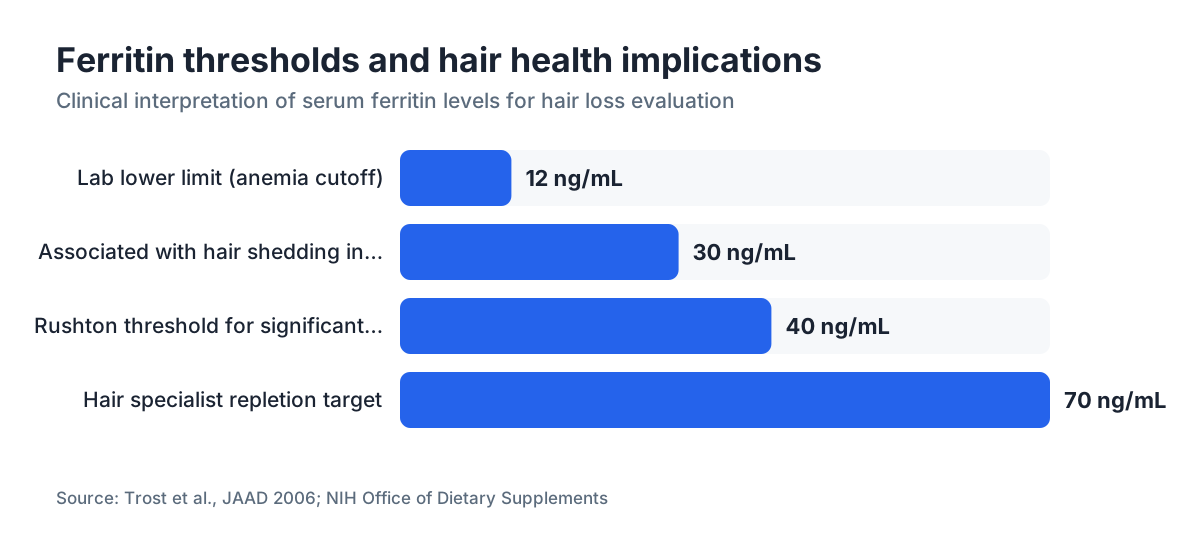
Here the clinical picture gets messy, and honest practitioners will admit it. Standard lab reference ranges for ferritin often bottom out at 12-15 ng/mL for women, the cutoff for outright iron deficiency anemia. That floor is not the right target for hair.
The dermatology literature clusters much higher. A widely referenced 2006 review in the Journal of the American Academy of Dermatology concluded that ferritin below 30 ng/mL is associated with hair loss, yet many hair specialists in practice aim for 70 ng/mL because that is roughly where follicular iron stores appear to saturate. [4] Rushton's work put the shedding threshold near 40 ng/mL. [2]
Here is the practical problem. You could carry a ferritin of 18, hear from a general physician that you are "within normal range," and still shed heavily from iron insufficiency. That gap between the lab's normal and the hair's normal is a real source of missed diagnoses.
| Ferritin range (ng/mL) | Clinical interpretation for hair | Common clinical action |
|---|---|---|
| Less than 12-15 | Iron deficiency anemia | Medical treatment, investigate cause |
| 15-30 | Low-normal, associated with hair shedding in literature | Supplementation often started |
| 30-70 | Suboptimal for hair by most hair specialist standards | Supplementation may continue |
| Above 70 | Generally adequate for hair follicle needs | Maintain through diet |
If your ferritin sits in the low-normal band and you are shedding, bring the exact number to a dermatologist instead of trusting a general "normal" interpretation.
What blood tests do dermatologists order to evaluate this?
A ferritin level alone is not the full picture. Iron can misbehave in several ways, and some conditions (chronic inflammation, liver disease) falsely raise ferritin while true stores run empty. The AAD-aligned workup for diffuse hair loss usually includes ferritin, serum iron, total iron-binding capacity (TIBC), transferrin saturation, a complete blood count (CBC), and thyroid-stimulating hormone (TSH). [1]
Transferrin saturation below 20% paired with a high TIBC points to functional iron deficiency even when ferritin reads technically normal. The CBC catches anemia (low hemoglobin, low MCV). TSH rules thyroid disease in or out, which can cause nearly identical shedding and often rides alongside iron problems, especially in women postpartum.
For women, the AAD also suggests checking sex hormones, and where androgenetic alopecia is suspected on top of telogen effluvium, a DHEA-S and free testosterone. The two conditions can stack: a woman can have hereditary thinning at the crown and an iron-driven shedding episode layered over it.
Some clinicians add 25-hydroxyvitamin D, zinc, and B12 because low levels of those can produce overlapping shedding. Correct iron while a B12 deficiency sits untreated and you may never see full recovery. The panel is cheap and the information earns its keep. [5]
How long does it take for hair to grow back after fixing iron deficiency?
Longer than most people want to hear. Hair follicles have memory. Once an iron deficit pushes them into telogen, they have to re-enter anagen, grow a full shaft, and do it across thousands of follicles somewhat out of sync. The honest timeline is 6-12 months of steady iron repletion before you see meaningful regrowth. Some people notice shedding settle down at 3-4 months, then visible thickening at 6-9 months.
The shedding often gets briefly worse when new anagen hairs shove out the old telogen ones. People panic and assume the treatment is backfiring. It isn't. That's the cycle restarting.
A real caveat: if an iron deficiency went undiagnosed for years, the hair may not fully return to its prior density even after ferritin normalizes. Chronic follicle stress isn't always reversible. That is a reason to catch it early, not a reason to skip treatment.
Nobody has clean randomized trial data on exact recovery timelines for iron-corrected telogen effluvium. The closest evidence comes from observational studies and case series. The general dermatology view, reflected in AAD educational materials, is that full or near-full recovery happens in most people within a year once you replenish iron and remove the trigger. [1]
Does stress also cause telogen effluvium, and how do you tell the causes apart?
Yes. The American Academy of Dermatology names emotional stress as a trigger for telogen effluvium, right alongside physical illness, surgery, and nutritional deficiency. [8] Stress raises cortisol, and elevated cortisol can signal follicles into premature telogen, producing the same diffuse shedding 2-4 months after the event.
Telling stress-driven from iron-driven telogen effluvium takes blood work. The shed pattern alone won't tell you. Both cause diffuse loss across the scalp. Both produce a positive pull test (more than a few hairs come out with a gentle tug). Both resolve when you remove the trigger.
In real life, both causes often run at once. Someone goes through a stressful stretch, stops eating well, their iron drops, and two months later they are shedding from two compounding triggers. Treat one and leave the other, and you get partial recovery. That is why some people stall halfway.
The clinical key is a careful timeline. A dermatologist asks: what happened 2-6 months before the shedding started? Childbirth, a serious illness, a death in the family, a crash diet, a new restrictive eating pattern, periods that got heavier. That history plus blood work usually names the culprit, or culprits.
If sustained stress has you worried about other patterns beyond effluvium, including a shifting hairline, the receding hairline article covers what to look for.
How do you treat iron deficiency to stop the hair shedding?
The treatment is iron repletion, which sounds simple and carries real nuance. Oral iron is first-line. Ferrous sulfate 325 mg (65 mg of elemental iron) on an alternate-day schedule has reasonable evidence for better absorption than daily dosing. A 2017 study in Blood showed hepcidin, the hormone that blocks iron uptake, spikes the day after a dose and suppresses the next one, so spacing doses out captures more iron. [6] [10]
Taking iron with 250 mg of vitamin C helps by keeping iron in its ferrous (soluble) form in the gut. Keep it away from coffee, tea, calcium supplements, and certain antacids, all of which cut absorption. Empty stomach absorbs better but is rougher on the gut. With food is gentler but you absorb less.
IV iron makes sense when oral absorption fails (Crohn's disease, celiac disease, post-bariatric surgery) or when levels need to climb fast. It isn't a hair treatment as such. It treats iron deficiency that happens to help hair. The IV route lifts ferritin quicker, which matters when someone is severely deficient and symptomatic beyond the hair.
One warning: do not start high-dose iron without a confirmed low ferritin on a blood test. Iron overload causes serious problems of its own, including liver damage. Self-diagnosing off hair loss symptoms is the wrong move. Get the ferritin number first.
Beyond iron, if stress is a confirmed or suspected co-trigger, the only evidence-based fix is reducing the stressor. No supplement is proven to block stress-induced telogen effluvium. Minoxidil gets used off-label sometimes to speed follicles back into anagen during recovery. If you are weighing that, the minoxidil for men article covers dosing and expectations, and the minoxidil side effects article covers what to watch for.
What foods are highest in iron, and can diet alone fix this?
Dietary iron comes in two forms: heme iron (animal sources, 15-35% absorbed) and non-heme iron (plants and fortified foods, 2-20% absorbed). For rebuilding depleted ferritin, heme iron works harder. [11]
Top heme sources (per 3 oz cooked serving): oysters about 8 mg, beef liver about 5 mg, beef chuck about 3 mg, dark turkey meat about 2 mg. Non-heme sources: cooked lentils about 3.3 mg per half-cup, cooked spinach about 3.2 mg per half-cup, tofu about 3.4 mg per half-cup, fortified cereals up to 18 mg per serving depending on the brand. [7]
The U.S. recommended dietary allowance for iron is 18 mg/day for premenopausal women and 8 mg/day for men and postmenopausal women. [7] Women with heavy periods or a plant-based diet can struggle to hit 18 mg through food alone, which is how deficiencies build quietly over years.
Can diet alone fix an established deficiency? In mild cases, ferritin in the 20-30 range, dietary changes plus absorption tricks (vitamin C with iron-rich meals, no tea with meals) can raise ferritin over several months. In moderate to severe deficiency, you usually need supplements, because food shifts work too slowly to move ferritin in a clinical timeframe.
Researching whether supplements beyond iron might help? The hair loss supplements article weighs the evidence on biotin, zinc, and the usual options.
Is telogen effluvium from iron deficiency different in men vs. women?
Iron-deficiency telogen effluvium is far more common in women. The reasons are physiological: menstruation, pregnancy, and postpartum blood loss create recurring iron demands most men never face. Postpartum telogen effluvium is the single most common trigger of the condition, driven by the hormonal drop after delivery plus iron lost during childbirth.
In men, iron deficiency severe enough to shed hair is less common but not rare. It shows up in men with gastrointestinal blood loss (ulcers, polyps, inflammatory bowel disease), frequent blood donors, or endurance athletes with hemolysis (red cells breaking down from repetitive foot strike). A man with telogen effluvium and no obvious trigger deserves a GI evaluation.
The bigger diagnostic question in men is separating effluvium from androgenetic alopecia (male pattern hair loss), which is far more common and has nothing to do with iron. Effluvium sheds diffusely from all over. Androgenetic alopecia thins at the temples and crown in a set pattern. A dermatologist can tell them apart with a physical exam and the pull test, and trichoscopy (dermoscopy of the scalp) makes it clearer still. For men where androgenetic alopecia sits in the mix alongside effluvium, understanding options like finasteride and DHT blockers is the natural next step once the effluvium is handled.
When should you see a dermatologist, and what will the appointment look like?
See a dermatologist if shedding has run past 3 months, if you can see scalp showing through, if the pull test (gently tugging 40-60 hairs between your fingers) keeps yielding 6 or more, or if over-the-counter changes haven't helped after 3 months of effort. If the shedding is severe and sudden, go sooner.
The AAD recommends a structured evaluation for diffuse hair loss: a detailed history, a physical exam of the scalp and hair shafts, a pull test, and targeted blood work. [1] Expect questions about when the shedding started, what happened 2-6 months before, your menstrual history, recent weight changes, medications, family history of hair loss, and diet.
Trichoscopy (a dermatoscope exam of the scalp) lets the dermatologist see whether follicles are miniaturizing (pointing to androgenetic alopecia) or look normal in size but sit empty (pointing to effluvium). That single distinction changes the treatment plan.
A scalp biopsy comes up occasionally when the diagnosis stays unclear after history and blood work, especially if scarring alopecia is on the table. For straightforward iron-deficiency telogen effluvium, a biopsy is rarely needed.
Want to track your shedding and hairline before the appointment? The free AI hair analysis at MyHairline gives you a baseline scan to bring in. It doesn't replace a dermatologist's evaluation, but it's a useful starting reference.
Can telogen effluvium become permanent?
Acute telogen effluvium, the kind set off by a single identifiable event like childbirth or a crash diet, is almost always temporary. Fix the trigger, give it time, and most people recover their pre-event density.
Chronic telogen effluvium is a different animal. It's defined as diffuse shedding lasting more than 6 months. It tends to hit women in their 30s to 50s, and the trigger often never gets pinned down. Ferritin is frequently low in this group but may not be the whole story. Thyroid swings, subtle hormonal shifts, and grinding stress can all keep it going.
Permanent loss from telogen effluvium itself is uncommon. The follicles usually stay intact. But two scenarios can leave lasting thinning. First, a severe effluvium left alone for years can set off persistent follicle miniaturization. Second, and more often, what looks like permanent effluvium is actually androgenetic alopecia that the episode unmasked or sped up. The hereditary thinning was already starting. The effluvium just made it visible faster.
So: don't assume the loss is permanent before you've corrected the cause and waited a full year. And don't assume it's all effluvium if regrowth comes back patchy at the temples and crown specifically, because that pattern points toward androgenetic alopecia that needs its own treatment.
Sources
- American Academy of Dermatology, Hair Loss: Diagnosis and Treatment
- Rushton DH, Clinical and Experimental Dermatology 2002; nutritional factors and hair loss review
- Malkud S, Journal of Clinical and Diagnostic Research 2015; telogen effluvium review
- Trost LB et al., Journal of the American Academy of Dermatology 2006; iron and hair loss review
- Almohanna HM et al., Dermatology and Therapy 2019; role of vitamins and minerals in hair loss
- Stoffel NU et al., Blood 2017; alternate-day iron dosing and hepcidin
- National Institutes of Health Office of Dietary Supplements, Iron Fact Sheet for Health Professionals
- American Academy of Dermatology, Hair Loss Types and Causes
- National Heart, Lung, and Blood Institute, Iron-Deficiency Anemia
- FDA Drugs at FDA database, ferrous sulfate label information
- Guo EL, Katta R, Dermatology Practical and Conceptual 2017; diet and hair loss review