

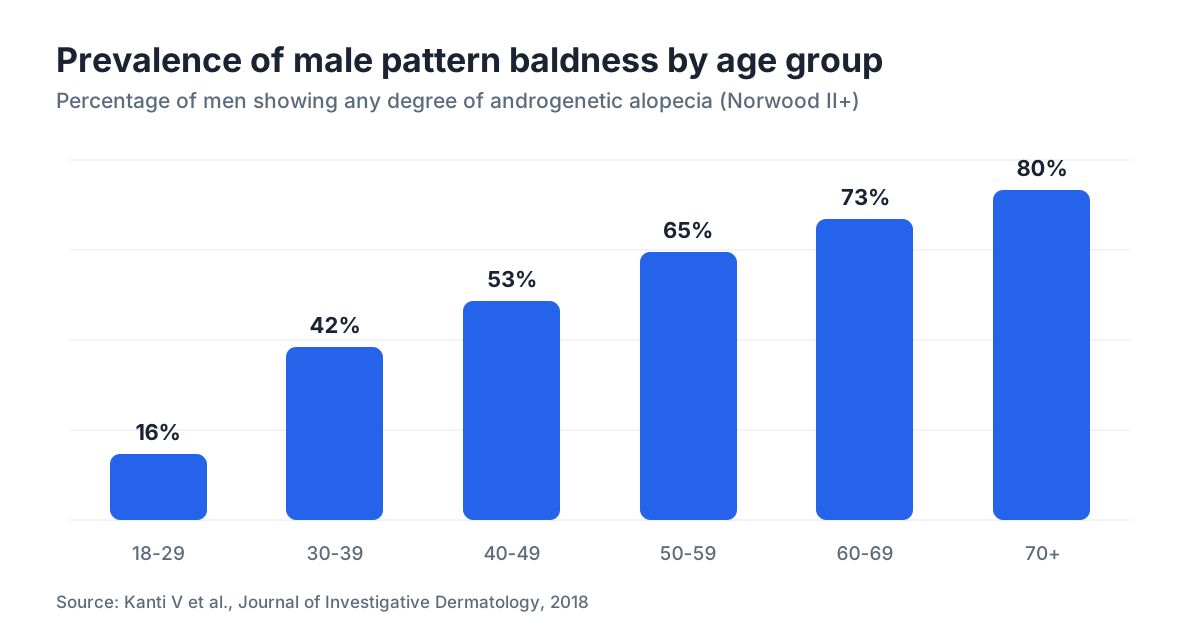
TL;DR: Male pattern baldness affects roughly 16% of men aged 18-29, climbs to about 53% by ages 40-49, and passes 80% by the 70s. Most men first notice temple recession between their late teens and mid-20s, though miniaturization starts years before the mirror shows it. Genetics sets the timing more than anything else, and early onset usually means faster progression.
What is the Norwood scale and how does it map hair loss progression?
The Norwood-Hamilton scale is the standard system doctors use to describe male pattern baldness (androgenetic alopecia). It runs from Type I through Type VII. Type I is a full head of hair with no meaningful recession. Type VII is the far end: a horseshoe band of hair around the sides and back, nothing on top. The stages between track the hairline retreating at the temples, the crown thinning, and eventually those two zones merging into one bald area.
James Hamilton first described the scale in 1951. O'Tar Norwood revised and extended it in 1975, and his version is the one still used in clinical research and practice today [1]. It has real limits. It describes loss in discrete steps, but actual thinning is continuous, and men can plateau at any stage for years or for life. No better system has replaced it for communicating severity fast and consistently.
Staging matters to a dermatologist because treatment decisions, transplant candidacy, and prognosis all shift hard between a Norwood II and a Norwood VI. The scale is also the backbone of nearly every study on baldness prevalence and age of onset, so you need to understand it before any statistic on timing means anything.
What is the average age male pattern baldness starts?
It varies more than most people expect, but the most common window for first noticing it is 18 to 29. A cross-sectional study in the Journal of Investigative Dermatology found that roughly 16% of men aged 18-29 already showed some degree of male pattern baldness, and that figure reached about 53% in the 40-49 group [2]. By the 70s, more than 80% of men show significant androgenetic alopecia. Those are the closest thing we have to population-level benchmarks.
"Starting" and "noticing" are different events. Follicle miniaturization, the biological process underneath, often begins years before the hairline visibly moves. Men who later reach Norwood VI or VII frequently had subtle thinning visible under magnification in their early 20s that they wrote off as normal variation. The biological clock runs ahead of the mirror.
Ethnicity shifts the curve. The same Journal of Investigative Dermatology data and later reviews suggest white men of European ancestry have the highest rate of early-onset androgenetic alopecia, while men of East Asian and African descent tend to see onset later, though severe baldness still develops at similar rates across groups by older ages [2][3].
Genetics is the dominant driver. If your father and maternal grandfather both lost hair early, your own early onset gets a lot more likely. The androgen receptor gene on the X chromosome, inherited from your mother, is the best-established single risk factor, but dozens of other loci contribute, which is why baldness never follows a clean inheritance pattern [4].
How common is each Norwood stage by age group?
The table below draws on prevalence data from Norwood's own 1975 survey of over 1,000 men and the Hamilton-Norwood estimates that have been cited consistently in dermatology literature since [1][2].
| Age range | No significant loss (NW I-II) | Moderate loss (NW III-IV) | Advanced loss (NW V-VII) |
|---|---|---|---|
| 18-29 | ~84% | ~13% | ~3% |
| 30-39 | ~58% | ~31% | ~11% |
| 40-49 | ~47% | ~32% | ~21% |
| 50-59 | ~35% | ~35% | ~30% |
| 60+ | ~20% | ~35% | ~45% |
Read these as approximations. Studies define the stage cut-offs a little differently and sample men differently. What holds across all of them is the shape of the curve: most men in their late teens and 20s have limited recession, a meaningful minority are already at Norwood III or beyond, and advanced loss climbs steeply after 40.
Norwood III is the tipping point where most men start taking treatment seriously. At that stage the hairline has clearly pulled back past the mature hairline (a slight, symmetrical recession from the juvenile line that is normal and stops moving) into territory that looks thin in photos and under direct light [5].
Can male pattern baldness start in your teens?
Yes. Uncommon, but not rare. Case series in dermatology journals document androgenetic alopecia starting at 15 or 16 in genetically loaded individuals, and many men who hit Norwood VI or VII by their 40s say their hairline first moved between 17 and 20. The biology allows it. Scalp follicles can start reacting to dihydrotestosterone (DHT) as soon as puberty raises androgen levels.
Teenage-onset loss gets dismissed as a "mature hairline" all the time, so let me draw the line. A mature hairline is the normal, slight recession away from the dead-straight juvenile hairline that most men develop in their late teens. It settles about one finger-width above the upper forehead crease and stays there for good. If the hairline keeps marching backward past that point, especially unevenly or with temple recession, that is androgenetic alopecia, not maturation [5].
If you are a teenager watching your hairline change, the receding hairline guide walks through how to tell a mature hairline from true androgenetic recession. For what is driving the loss at the follicle, see what causes hair loss.
Early onset is also, annoyingly, a predictor of worse outcomes. Men who reach Norwood III before 21 are more likely to progress to Norwood V or higher than men who reach that same stage in their 30s, though the data are observational and tangled up with genetics [2].
How fast does hair loss progress through Norwood stages?
Progression speed is the single most unpredictable variable in androgenetic alopecia. Some men go Norwood II to Norwood IV in three years. Others sit at Norwood III for a decade. There is no reliable individual predictor, and that is an honest limit worth stating up front.
The best data come from the placebo arms of finasteride and minoxidil trials. The 1998 finasteride trial in the Journal of the American Academy of Dermatology found placebo-treated men with Norwood III-IV vertex thinning lost an average of 9.6 hairs per square centimeter per year in a measured scalp area [6]. That sounds abstract until you realize it turns into thinning most men can see in the hairline or crown within two to three years without treatment.
Population studies put the average man at roughly one Norwood stage every 5 to 10 years, but the spread around that number is enormous. Stress, illness, nutritional gaps, and hormonal shifts can briefly speed up shedding (a separate process from androgenetic alopecia, covered in the telogen effluvium article). Once the trigger clears, that kind of shedding usually settles.
Here is the practical move. Photograph your hairline every three months under the same lighting. If you can see movement between shots taken six months apart, you are an active progressor, and that fact matters more than your current stage when you decide whether to treat now.
What actually causes the timing of onset, genetically and hormonally?
Androgenetic alopecia is driven by DHT, a potent androgen the enzyme 5-alpha-reductase makes from testosterone. Genetically sensitive follicles react to DHT by shrinking, producing thinner and shorter hairs each cycle until they stop making terminal hair at all. When this starts depends mostly on how sensitive your follicles are, which is written in your genes [4].
The androgen receptor gene (AR) on the X chromosome is the most consistently flagged gene in genome-wide studies. Because men inherit their X from their mother, the maternal grandfather's pattern gets cited as a predictor. But a 2017 meta-analysis in Nature Communications identified 63 genetic loci tied to early-onset male pattern baldness, most of them autosomal, meaning both parents contribute [4]. That is why inheritance is messy and why one side of the family tells you only part of the story.
Beyond genes, total androgen levels matter at the margins. Men with complete androgen insensitivity never develop male pattern baldness, whatever their other genetics. But among typical men, total testosterone correlates only weakly with severity. The bigger lever is how sensitive the follicles are to whatever DHT is present, not how much is circulating. That is exactly why DHT blockers work not by wiping out DHT but by dropping it below the follicle's damage threshold.
Age-related change in scalp 5-alpha-reductase activity plays in too. Type II 5-alpha-reductase, the dominant form in scalp tissue, tends to get more active as men age, which partly explains why prevalence keeps rising even in men whose genetics looked safe at 25.
What is the difference between a receding hairline and a mature hairline?
A mature hairline recedes once and stops with no drop in density. Androgenetic recession keeps moving and thins the hair as it goes. That single distinction settles most of the anxiety men in their late teens and early 20s carry about their hairline, and the confusion is fair because both involve the line moving back.
A mature hairline develops in most men between 17 and 29. It is the natural, symmetric recession of the slightly convex juvenile hairline to a spot roughly 1 to 1.5 cm above the upper forehead crease. It settles there. It does not noticeably thin density and it does not carve out the temple recession that makes a classic "M" shape. Once set, a mature hairline is just the adult version of your hairline [5].
Androgenetic recession keeps going. The temples pull back further, often unevenly. Density at the hairline drops, so hairs get finer and shorter even before the line itself moves. The crown may thin at the same time. If you part your hair and see scalp through the part where you didn't two years ago, that is more than maturation.
If you are calling it yourself, the receding hairline article goes cue by cue. Short version: moved once and stopped with steady density, probably mature. Still moving, or density clearly dropping, probably androgenetic alopecia.
At what Norwood stage should you start treatment?
There is no single right answer, but there is a logical framework. Both FDA-approved treatments, oral finasteride (1 mg) and topical minoxidil (2% and 5%), slow or halt progression rather than reversing significant established loss. The earlier you start, the more hair you are defending instead of chasing regrowth [6][7].
The FDA approved finasteride for men with mild to moderate hair loss, which maps roughly to Norwood II through IV with vertex involvement [6]. Trials showed it maintained or increased hair count in about 83-90% of men over two years in that range. For Norwood V-VII the evidence gets weaker, not because the drug stops working but because there is less viable follicle left to save.
Minoxidil was FDA-approved first as a topical solution and later as a foam, for vertex thinning. It grows some new hair in about 40% of users in trials, but its main job is also preservation and slowing loss [7]. The minoxidil for men article covers dosing and realistic expectations.
Here is the answer most dermatologists give. Norwood II or III and actively progressing is the best moment to start. You have the most to protect and the most runway for the drugs to pay off. Norwood V or VI and stable for years is a different calculation, and a hair transplant may give you more visible benefit than medication alone. For men between those extremes, finasteride and minoxidil together has better evidence than either drug by itself.
Want an objective read on where you sit? MyHairline's free AI scan (/scan) classifies your stage from photos, a reasonable starting point before a dermatology appointment.
Does starting hair loss young mean you'll go fully bald?
Not necessarily, but early onset is a real warning sign. The research is observational, so the link runs through shared genetics: men carrying the heaviest load of androgenetic alopecia risk alleles tend to start earlier and progress further. Early onset is correlated with advanced eventual loss, not the cause of it.
A man who spots his first temple recession at 19 is statistically likelier to reach Norwood VI than a man who spots the same recession at 38, because the first man is probably expressing a heavier genetic burden. But plenty of men started receding at 20 and have held at Norwood III for 25 years without a single treatment. The plateau is real and common.
What you should not do is treat early onset as a guaranteed sentence and either panic or give up. The useful move is to watch it systematically and decide within 6 to 12 months whether it is progressing. If it is, treatment at Norwood II or early III is well supported. If it plateaus on its own, that is good news and you may not need treatment at all.
Are there any non-genetic factors that affect the age hair loss starts?
Genetics explains most of the variance in onset age, but it is not the whole story.
Chronic stress does not cause androgenetic alopecia. It can trigger telogen effluvium, a temporary shedding phase, which can expose underlying androgenetic thinning that normal density had been hiding. Men often think stress "started" their hair loss when stress actually shed enough hair to make existing miniaturization obvious.
Nutritional deficiencies, especially iron and ferritin, vitamin D, and zinc, can drag on the hair growth cycle and worsen shedding. They do not cause androgenetic alopecia in the genetic sense, but they can speed up apparent thinning in men who are already predisposed. Blood work to rule these out is cheap and worth doing before you pin everything on genetics. The hair loss supplements article covers which deficiencies actually have evidence behind them.
Weight and metabolic health have a more tangled relationship with the condition. Research links metabolic syndrome and insulin resistance to earlier or more severe androgenetic alopecia, possibly through raised androgens in men with obesity, though the effect size is modest [12].
The creatine question comes up constantly. A 2009 study in a rugby population found raised DHT-to-testosterone ratios after creatine supplementation, which has fed years of speculation. The evidence is thin and has not been replicated in the way you would need to draw a firm conclusion. Full breakdown in the does creatine cause hair loss article.
How do you accurately self-assess your Norwood stage?
Self-staging is imprecise but useful for tracking change over time. The method that works: take three photos in the same lighting every 2 to 3 months. One overhead shot, one from the front at eye level, one of the crown from behind with the camera held above your head. Natural daylight reveals more than warm indoor light. Wet hair shows the scalp more clearly and is useful but unflattering, which is why most people skip it, which is also why most people underestimate their stage.
Compare those photos against published Norwood diagrams. The staging questions that matter: has the hairline moved noticeably since the photos six months back? Is scalp visible through the crown or the part? Are the temples starting to curve inward toward an "M"?
The main trap is confirmation bias. Worried men over-stage themselves. Men in denial blame lighting or a bad hair day. A dermatologist can stage you in person in about two minutes. Some use dermoscopy, a tool that magnifies the scalp and catches miniaturized follicles before thinning shows up to the naked eye.
MyHairline's free AI scan (/scan) gives you a middle option if you want an objective read before booking a medical appointment. It classifies Norwood stage from photos and works as a reference point, though it does not replace a clinical exam.
What do dermatologists actually recommend based on age and Norwood stage?
Most practicing dermatologists work from a framework anchored in the American Academy of Dermatology's guidance on androgenetic alopecia, which backs topical minoxidil and oral finasteride as first-line treatments for men [8].
Men in their late teens and early 20s at Norwood II-III: the AAD supports both options, but finasteride needs a specific conversation about side effects, including the roughly 2-4% incidence of sexual side effects reported in trials, plus the reality that stopping loses the benefit within 6 to 12 months [8][9]. Some dermatologists start younger patients on minoxidil first given its milder side effect profile, holding finasteride for cases where minoxidil alone clearly falls short.
Men in their 30s and 40s at Norwood III-V: the evidence is strongest and most dermatologists are comfortable recommending either or both. Combination therapy has the best data for preservation plus modest regrowth. See finasteride and minoxidil for the combination trial data.
Men at Norwood V-VII: medication can still slow loss in the remaining areas and may preserve or mildly thicken residual crown hair, but keep expectations grounded. At these stages the hair transplant conversation moves to the center, with medication used to stabilize the donor area and protect remaining native hair.
Finasteride's FDA label flags a discussion about persistent sexual side effects, and any man considering it should read the prescribing information and talk it through with a physician. The finasteride article covers what the label actually says and what the trials showed on safety.
Sources
- Norwood OT. Male pattern baldness: classification and incidence. Southern Medical Journal, 1975
- Kanti V et al. Prevalence and risk factors of male pattern baldness. Journal of Investigative Dermatology, 2018
- Blume-Peytavi U et al. Androgenetic alopecia: a review. Journal of the European Academy of Dermatology and Venereology, 2011
- Heilmann-Heimbach S et al. Meta-analysis identifies novel risk loci and yields systematic insights into the biology of male-pattern baldness. Nature Communications, 2017
- American Academy of Dermatology Association. Hair loss overview
- Kaufman KD et al. Finasteride in the treatment of men with androgenetic alopecia. Journal of the American Academy of Dermatology, 1998
- FDA. Drugs at FDA and approved labeling
- American Academy of Dermatology Association. Hair loss diagnosis and treatment
- Rossi A et al. Finasteride 1 mg is effective and well tolerated in the treatment of male androgenetic alopecia: a multicentre review. International Journal of Dermatology, 2004
- van der Donk J et al. Psychosocial aspects of hair loss among men in the Netherlands. Psychological Reports, 1994
- Wambier CG et al. Androgenetic alopecia and metabolic syndrome: a systematic review. Journal of the American Academy of Dermatology, 2021