

TL;DR: Most reputable surgeons won't operate on patients under 25, and many stay cautious through age 30. The surgery itself isn't the problem. Unpredictable future loss is: a transplant placed today can look patchy in 10 years as your native hair keeps thinning behind it. For men in their mid-twenties, the standard advice is medication first, surgery later.
Is 25 too young to get a hair transplant?
For most men, yes. Not because the surgery can't physically be done at 25, but because the result you get today can look wrong within a decade.
Hair loss in your twenties is almost always still moving. Androgenetic alopecia, the genetic pattern loss behind the vast majority of male baldness, doesn't announce when it will stop. A surgeon operating at 25 is working from half a picture. They're designing a hairline around a donor supply that has to last another 50 or 60 years, and they're placing grafts in zones where native hair still grows now but may be gone by 35.
The International Society of Hair Restoration Surgery (ISHRS) tells surgeons to assess patient age and pattern stability carefully before proceeding, and most experienced surgeons set an informal floor around 25 to 28 years old. Full pattern maturity often isn't reached until the early thirties [1].
There are exceptions. Trauma-related scarring, medical conditions causing localized loss, or a patient stable on finasteride for several years can justify earlier surgery. But for a 25-year-old with a Norwood 2 or 3 receding hairline who isn't on medication, most ethical surgeons say the same thing: not yet.
Why does age matter so much for hair transplant timing?
Donor hair is finite, and that single fact drives everything. You have a fixed number of follicles in the back and sides of your scalp that are genetically resistant to DHT, the hormone that drives androgenetic alopecia. A transplant moves those follicles to thinning areas. Once they're used, they're used.
At 25 a surgeon can't know how much scalp will eventually need coverage. A man who looks like a Norwood 3 at 25 might be a Norwood 6 by 45 if his genetics are aggressive. Put 2,000 grafts in his frontal zone at 25 and he may exhaust enough donor supply that at 45 there aren't enough grafts left to cover the crown and mid-scalp that have since gone bare. The result is a visible hairline sitting above a bald back, the classic disconnected look.
Men who start losing hair before age 20 face a much higher lifetime risk of advanced baldness (Norwood 5 to 7) than men who start in their thirties [2]. Onset age is one of the better predictors of ultimate severity. And early-onset patients are exactly the ones most likely to be pushing for early surgery.
Design is the second trap. Surgeons have to guess where a young patient's hairline will naturally recede to, then build around it. At 25, without years of stability data, that guess is speculative. A low, dense hairline looks great at 25 and can look artificial and stranded at 50 once the surrounding hair vanishes.
If you want to understand what's actually thinning your hair before making any surgical call, our guide on what causes hair loss covers the mechanisms in plain terms.
What do surgeons actually look for before operating on a young patient?
A serious surgeon runs a specific checklist before agreeing to operate on anyone under 30. Age alone isn't a hard cutoff, but it triggers extra scrutiny.
Pattern stability comes first. Have you been losing hair for at least two to three years with measurable progression? Do you have photos showing the rate of change? Is your pattern heading toward a predictable endpoint, or are there signs it could turn aggressive?
Donor density matters enormously. The back and sides of your scalp have to supply enough grafts to cover today's thinning plus tomorrow's. Surgeons measure your donor density (hairs per cm2) and estimate total extractable grafts. Average donor density runs roughly 70 to 80 follicular units per cm2, though usable area and hair shaft caliber vary a lot from person to person [3].
Family history gives useful, not definitive, clues about your likely endpoint. If your father and maternal grandfather are both Norwood 7, that matters.
Current medical therapy is a big one. A 25-year-old who has been on finasteride for two years with documented stabilization is a completely different candidate than one who has tried nothing. Most experienced surgeons want at least 12 months of stability on medication before they'll operate on someone this young.
ISHRS practice guidance treats candidate selection, including age and pattern analysis, as the single most important factor in long-term transplant outcomes [1].
Some surgeons also use trichoscopy (scalp video microscopy) to spot miniaturization in areas that still look hair-bearing but are already compromised by DHT. That reveals how much "invisible" loss is already underway.
What are the real risks of getting a transplant too early?
The cost of transplanting too early isn't just cosmetic regret. It's surgical and financial.
The clearest risk is an unnatural result as native hair keeps receding behind or around the transplanted zone. You end up with a fixed hairline and progressive thinning everywhere else, which forces additional procedures to fix. Each repair is harder than the first, because donor supply has shrunk and scar tissue from prior surgery complicates extraction.
Donor depletion is permanent. Every follicle pulled from the donor zone is gone for good. Spend 2,500 grafts at 25 on a problem that ultimately needs 5,000, and you've burned half your budget on a partial fix.
The money is real. A primary FUT or FUE session in the US runs roughly $4,000 to $15,000 depending on graft count and clinic [4]. Repair procedures usually cost more per graft because they're more demanding technically. Patients who transplanted in their twenties without adequate planning are among the most common repair cases at experienced clinics.
There's a psychological trap too. Some patients who operate at 25 feel driven to repeat the procedure every few years as loss continues, which speeds up donor depletion and locks them into an expensive cycle.
Like any surgery, transplants carry procedural risks: infection (reported in roughly 1% of cases), folliculitis, shock loss (temporary shedding of existing hair around the site), and scarring, especially with FUT strip surgery [5].
Should you try medication before considering a transplant at 25?
Almost certainly yes. For most 25-year-olds with androgenetic alopecia, the evidence-based first move is medical therapy, not surgery.
Finasteride (1 mg daily) is the only FDA-approved oral medication for male pattern hair loss. It blocks the conversion of testosterone to DHT, the androgen that miniaturizes follicles. Clinical trials show it slows or halts progression in roughly 83% of men and produces visible regrowth in about 66% over two years [6]. That's a real result from a pill that costs as little as $10 to $30 a month as a generic.
Topical minoxidil (2% or 5% solution or foam) is the other FDA-approved option. It works differently, acting on the follicle itself to extend the growth phase [7]. Running both together tends to beat either alone [8]. There's a deeper breakdown in our article on finasteride and minoxidil.
For a 25-year-old, two years on finasteride can do several things at once: slow or stop the progression driving your anxiety, generate real regrowth in some cases, and hand a surgeon far better data about where your pattern is going before anyone cuts.
The counter-argument is side effects. Sexual side effects were reported in about 1.4% to 3.8% of users in clinical trials, and in some men they persist [6]. That's real and not dismissible, and it's a conversation to have with a physician. But for most young men with early-pattern loss, the risk-benefit math still favors a trial of medication first.
How do surgeons decide on the right hairline for a young patient?
Hairline design is where age creates the most friction between what a patient wants and what a surgeon should do.
A 25-year-old often walks in wanting the hairline he had at 18: low, full, square or slightly rounded, with a temporal peak. The trouble is that design looks age-appropriate at 25 and entirely unnatural at 50 on someone who has kept losing hair behind it.
Experienced surgeons push for a slightly higher, more mature hairline, one that reads as natural across a range of ages and accounts for likely future recession. It's a hard conversation, because the patient often feels like the surgeon is refusing to hand over what he's paying for.
The American Academy of Dermatology (AAD) advises that transplant design account for future loss patterns and age-appropriate aesthetics so the result still looks natural decades out [9].
A few practical design principles good surgeons use for younger patients: they leave a buffer zone of native hair ahead of the transplanted area, so if that native hair thins later it doesn't create an abrupt density wall; they place grafts with irregular, natural spacing at the hairline instead of a dense straight line; and they avoid putting grafts in any zone showing even early miniaturization unless they're confident medication has locked the pattern down.
If you have a receding hairline specifically and are trying to work out whether surgery or medication makes sense for your stage, that article goes deeper on Norwood staging and what each stage means for your options.
What does androgenetic alopecia progression look like in your twenties?
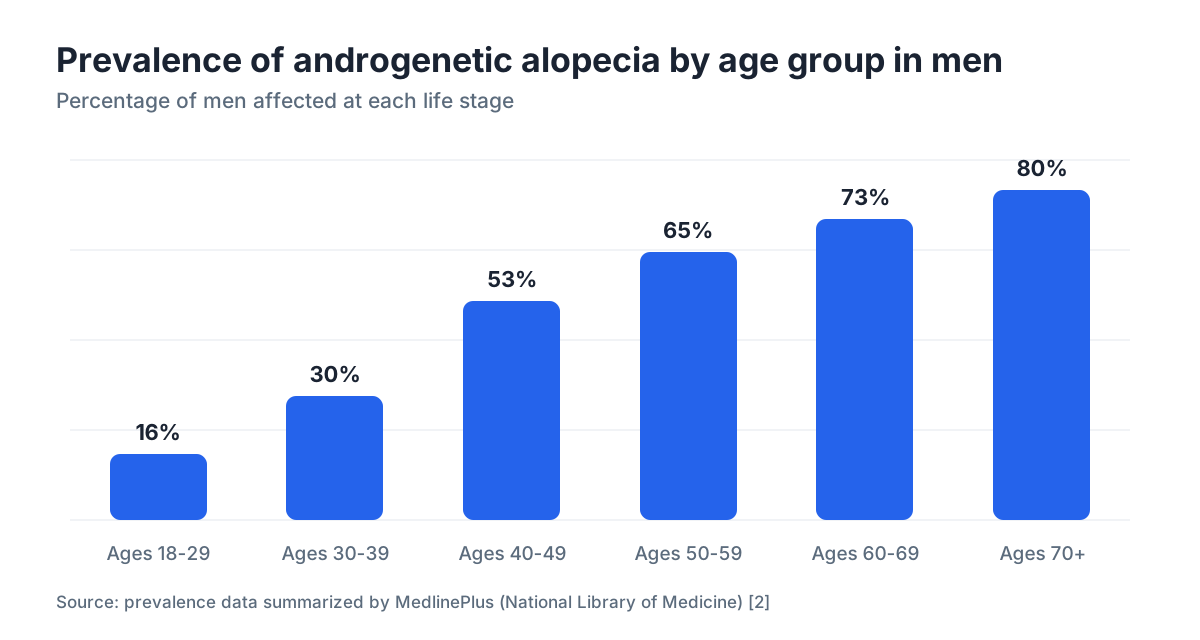
Androgenetic alopecia affects an estimated 16% of men aged 18 to 29, climbing to about 53% by age 45 [2]. It doesn't follow one path.
Some men race from Norwood 2 to Norwood 4 within five years of onset. Others sit at Norwood 3 for decades. There's no reliable blood test or genetic test that tells you definitively where you'll land. The best proxies are onset age (earlier usually means more aggressive), rate of progression in the first two to three years, family history on both sides, and scalp miniaturization patterns visible under trichoscopy.
DHT is the driver. If you want to understand why some follicles are vulnerable and some aren't, it comes down to follicle sensitivity to dihydrotestosterone. There's a full explanation in our article on DHT blockers.
One thing the literature makes clear: the Hamilton-Norwood scale, which maps pattern loss from Type 1 (no loss) to Type 7 (most extensive), came out of studying large populations over time. Men who start at Norwood 2 or 3 in their twenties aren't guaranteed to reach Norwood 6 or 7, but their lifetime risk of extensive loss runs higher than someone who first notices thinning at 40.
That uncertainty is exactly why the surgical community urges caution with young patients. You're making a lifelong decision off a temporary snapshot.
Are there situations where a hair transplant at 25 actually makes sense?
Yes, a few.
Scarring alopecia from trauma, burns, or certain medical conditions creates areas of permanent loss that won't spread the way androgenetic alopecia does. Transplanting into a stable scar at 25 is medically and aesthetically defensible, and most of the progression worries don't apply the same way.
Traction alopecia, which comes from years of tight hairstyles and is more common in women, sometimes leaves localized permanent loss in otherwise stable areas. Same logic: if the cause is removed and the area holds steady, age is less of a barrier.
For androgenetic alopecia itself, the case for surgery at 25 gets stronger when several things line up: documented multi-year stability, a clear family history pointing to a limited endpoint (say, Norwood 3 across all male relatives), ongoing finasteride use for at least a year, and excellent donor density. The key words are conservative and limited. A plan that uses a small number of grafts on one specific area, leaving donor supply largely intact for the future, is a different animal than a full frontal restoration at 25.
Some women with androgenetic alopecia also present in their twenties. Female pattern hair loss usually follows a diffuse thinning distribution rather than a receding hairline, and the same principles hold: stability, medical therapy first, conservative approach.
The honest answer is that it depends on your specific situation. Any surgeon who says "yes, let's do it" after a 15-minute consultation without reviewing years of progression photos and your medical history should give you pause.
How do FUE and FUT compare for younger patients specifically?
Both main transplant techniques carry implications for young patients worth understanding.
FUE (Follicular Unit Extraction) removes individual follicular units one at a time from the donor area. The main draw for a young patient is no linear scar, which matters if you might wear your hair short. The downside: it can use donor area less efficiently and tends to cost more per graft, typically $6 to $10 per graft versus $3 to $7 for FUT [4].
FUT (Follicular Unit Transplantation, also called strip surgery) removes a strip of scalp from the donor area, dissects it into individual grafts, and closes the wound with sutures, leaving a linear scar. It can yield more grafts per session from a smaller area and often shows higher graft survival rates in expert hands. The scar is permanent, though usually hidden under hair of moderate length.
For a 25-year-old who needs to protect as much donor capacity as possible for future procedures, surgeons sometimes lean toward FUT because it's more graft-efficient. But that's surgeon- and patient-specific, not a universal rule.
The practical answer: technique matters less than the surgeon's experience and, more than that, whether you should be having surgery at all right now.
For a broader introduction to what the procedure involves, our overview of hair transplants covers both methods, costs, and recovery.
| FUE | FUT | |
|---|---|---|
| Scarring | Tiny dot scars, dispersed | Single linear scar |
| Grafts per session | Typically 1,000-3,000 | Up to 3,000-4,500 |
| Cost per graft (US) | $6-$10 | $3-$7 |
| Recovery | 7-10 days | 10-14 days |
| Best for | Short-hair wearers, smaller sessions | Larger sessions, graft efficiency |
What questions should you ask a surgeon before agreeing to a transplant at 25?
The consultation tells you a lot. A surgeon who asks most of these questions is worth trusting. One who skips them isn't.
Ask them: What do you think my likely Norwood endpoint is, and how are you arriving at that estimate? How many grafts are you planning to use, and how many do I likely have available in total? What's your plan if I lose significantly more hair in the next 10 years? Are you recommending I stay on finasteride after surgery, and for how long? Can you show me patients you operated on at my age and what they look like 10 years later?
Then ask yourself some honest questions. Are you seeking surgery because you've hit a genuine plateau after years of treatment, or because you're anxious about early loss and want a fast fix? Are you ready for the reality that surgery does nothing to stop future loss?
If a surgeon doesn't raise future progression or donor supply limits given your age, raise it yourself. If they're dismissive, leave.
Still sorting out whether your hair loss is actually androgenetic alopecia or something else? The free AI analysis at MyHairline can give you a baseline read on your pattern before you start booking consultations. It's not a substitute for a medical evaluation, but it helps you walk into that conversation with a clearer picture of what you're dealing with.
Worth knowing: surgeons who are ISHRS members have agreed to ethical standards that include appropriate candidate selection. That's not a guarantee, but it's a useful filter when researching clinics [1].
What is the realistic cost of a hair transplant, and does it change at 25?
Cost is driven by graft count, clinic location, and surgeon experience, not by patient age. But young patients often rack up more total lifetime spend, because they're more likely to need additional procedures as loss continues.
In the US, a typical FUE session of 1,500 to 2,500 grafts runs $6,000 to $16,000 [4]. FUT tends to cost 20% to 40% less per graft for the same volume. Clinics in Turkey and Eastern Europe charge far less, sometimes $2,000 to $5,000 for the same graft count, though the quality range is extreme and vetting is on you.
Hair transplants aren't covered by US insurance when the loss is cosmetic. They may be partially covered for medical necessity, like post-surgical scalp reconstruction, but that's rare.
The hidden cost is the lifetime cost. A 25-year-old who spends $10,000 on a procedure, then needs a second at 34 ($10,000 to $15,000), and possibly a third at 45 for crown loss ($8,000 to $12,000), has spent $28,000 to $37,000. Start finasteride at 25, stabilize the loss, and do one well-timed procedure at 32 or 33, and you might get a better result for $10,000 to $14,000 total.
This isn't a knock on surgery. It's an argument for sequencing it right.
What should a 25-year-old with hair loss actually do right now?
Here's a straightforward sequence based on what the evidence supports.
First, see a dermatologist or hair loss specialist, not a hair transplant clinic. You want an objective read from someone whose income isn't tied to selling you a procedure. They can confirm the cause (androgenetic alopecia, telogen effluvium, something else), assess your Norwood stage, check scalp health, and lay out medical options.
Second, try medication if you're a candidate and comfortable with the risk profile. Finasteride and minoxidil together carry the strongest medical evidence. Two years of documented use gives you and any future surgeon real data on your trajectory and your response to treatment.
Third, take regular photos. Every three months, same lighting, same angle. After two years you'll have an actual record of your progression rate, which beats any guess made at a consultation.
Fourth, revisit the surgery question at 27 or 28 if you're still interested. By then you'll have documented stability or progression data, a medical therapy history, a clearer sense of your pattern, and a more mature donor supply assessment.
If things move fast and your surgeon believes early intervention is genuinely indicated, you can make that call from a far better-informed position.
The MyHairline AI scan is a reasonable first step if you want a handle on your current pattern and hairline before a clinical consultation. It's free and takes a few minutes.
One more thing: if you've been reading about hair loss supplements or heard that creatine causes hair loss, those are worth understanding too. The supplement evidence is thin, and the creatine question is more nuanced than most headlines suggest. Don't let an unverified claim drive a major decision.
Sources
- International Society of Hair Restoration Surgery (ISHRS), Practice Standards
- National Library of Medicine (MedlinePlus), Androgenetic alopecia genetics and prevalence
- National Center for Biotechnology Information (NCBI), StatPearls: Hair Transplantation
- American Society of Plastic Surgeons, Procedural Statistics and Cost Data
- American Academy of Dermatology (AAD), Hair transplant surgery patient information
- FDA, Propecia (finasteride 1 mg) approved labeling
- FDA, Rogaine (minoxidil 5%) approved labeling
- Hu R et al., Combined use of finasteride and minoxidil in early androgenetic alopecia, Dermatologic Therapy, 2015
- American Academy of Dermatology (AAD), Hair loss treatment guidance
- ISHRS, Practice Census and World Survey of Hair Restoration Surgery