
TL;DR: Yes, you can apply minoxidil to your beard. It's off-label, because the FDA only approved it for scalp hair loss. A 2016 randomized controlled trial found 3% topical minoxidil raised beard hair count well past placebo after 16 weeks. Expect visible change at 3 to 6 months. Side effects are real but manageable. Stop using it and the new hair falls out.
What does minoxidil actually do to beard hair?
Minoxidil opens potassium channels in cells, and on any hair-bearing skin that translates to longer growth phases and more blood flow to the follicle. It started life as an oral blood pressure drug in the 1970s. Then patients started sprouting hair where they didn't want it, a side effect called hypertrichosis, and that accident became the topical products sold today for scalp hair loss. [1]
On the beard it does the same thing it does on the scalp. It stretches out the anagen (active growth) phase of the hair cycle and probably increases blood supply to the follicle, delivering more oxygen and nutrients. Follicles you already have push out thicker, longer, darker hairs. And the fine, near-invisible hairs called vellus hairs can flip into terminal hairs, the coarse dark ones that actually read as a beard. [6]
What it can't do is build follicles from nothing. If a patch of skin has no follicles, minoxidil won't summon any. That's the hard ceiling on results, and it's why one man fills in dramatically while his friend barely changes.
The conversion of vellus to terminal hair is the mechanism that matters most for beards. How many vellus follicles sit dormant in your sparse patches is mostly genetic. That's the real reason results swing so widely between people.
Is using minoxidil on your beard FDA-approved?
No. The FDA approved topical minoxidil for androgenetic alopecia on the scalp only: the 2% and 5% solutions and the 5% foam. [2] Beard application is off-label.
Off-label isn't illegal or reckless. Doctors recommend off-label treatments all the time when evidence backs them up. It does mean the manufacturer never ran the large trials on beard skin that an official beard indication would require, and the label says nothing about your face.
Use it on your beard and you own that decision. The clean move is to ask a dermatologist first, especially if you have any heart history, because even topical minoxidil gets into your bloodstream.
What does the research actually say about beard growth?
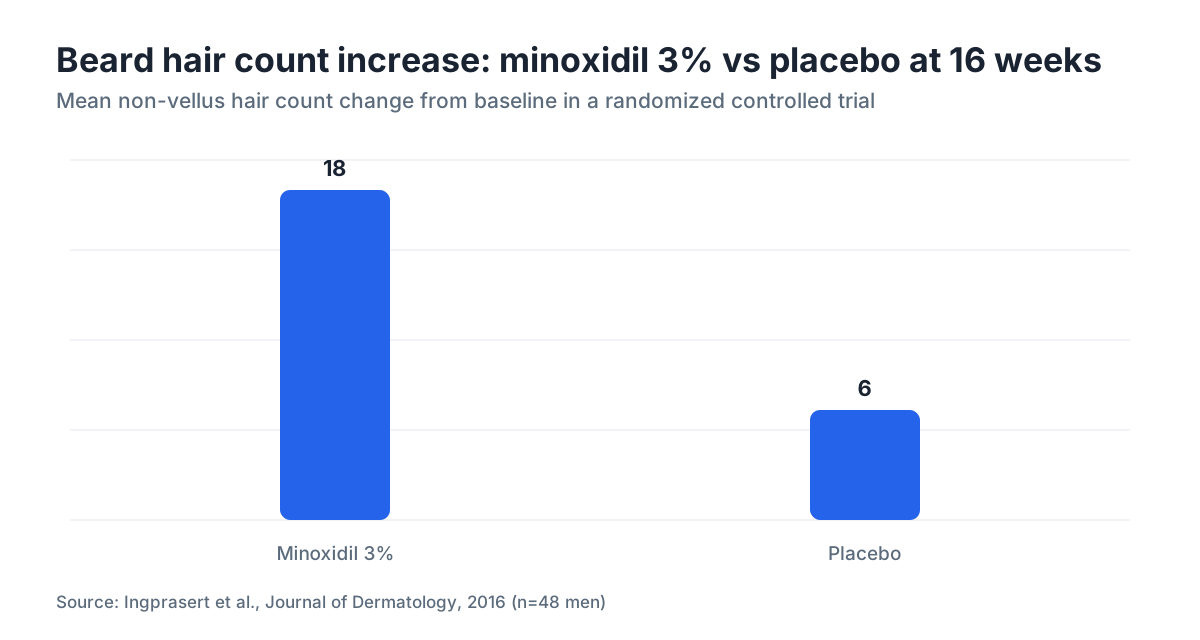
One good trial anchors everything: a 2016 randomized, double-blind, placebo-controlled study in the Journal of Dermatology. [3] Researchers split 48 men with sparse beards into a 3% topical minoxidil group and a placebo group, twice daily for 16 weeks. The minoxidil group gained significantly more non-vellus hairs than placebo, and the photo assessments agreed. The authors wrote that "3% topical minoxidil lotion was significantly more effective than placebo in increasing beard hair."
Note the concentration. That trial used 3%, not the 5% that dominates Western shelves. Nobody has run a head-to-head of 3% versus 5% on beards, so whether the higher strength does more than add irritation is an open question.
A handful of case reports and observational studies exist. No second large RCT does, as of this writing. The beard evidence is thin next to scalp hair loss, which has decades of trials behind it. The honest read: one solid RCT is enough to say it works for a lot of men, and not enough to pin down the best concentration, dose, or what happens over years.
The American Academy of Dermatology doesn't mention beard growth in its minoxidil guidance at all. That guidance is about scalp androgenetic alopecia. [4]
How long does it take minoxidil to grow a beard?
Plan on 3 to 6 months before you judge it. The 2016 RCT ran 16 weeks and measured real results at that mark. [3] Most people who recommend this off-label suggest waiting at least that long before calling it a success or a failure.
The timeline is slow because the hair cycle is slow. Minoxidil pushes follicles into anagen, but anagen itself needs months to grow hair you can see. Faint new growth often shows up around weeks 8 to 12. The obvious stuff arrives at months 4 to 6.
Here's what trips people up: shedding. In the first 4 to 8 weeks, some men shed beard hairs. Same telogen effluvium effect you see with scalp minoxidil, where old hairs get pushed out so new anagen hairs can move in. It passes. Quitting over early shedding is the most common mistake there is. Read more on that in our piece on telogen effluvium.
Six full months of consistent twice-daily use and zero change? At that point it's fair to call yourself a non-responder for this.
How do you apply minoxidil to your beard?
The steps are simple. A few details are not optional.
Pick a formulation first. The 5% liquid solution is the easiest to find. The 5% foam spreads well over large areas but wastes product on something as small as a beard. The 2% solution works if you want to start gentle. Lower strengths like 3% come from compounding pharmacies and are harder to get over the counter.
Apply 1 mL (the standard scalp dose) to the sparse areas, once or twice daily. Twice daily is what the RCT used and what most protocols call for. [3] Drop it on, spread it with clean fingertips.
Let it dry all the way before you touch your face or hit the pillow. The liquid needs 30 to 60 minutes. Residue on a pillowcase transfers to a partner's skin and can grow hair on their face. That isn't a scare story. It's a documented problem with scalp use, and your face is no different. [8]
Wash your hands the second you finish. Your palms absorb minoxidil too.
Never put it on broken, irritated, or sunburned skin. The barrier is down, absorption spikes, and systemic effects get more likely. [8]
Growing a beard over the treated skin is fine. Push the hair aside and hit the skin underneath.
What are the side effects of minoxidil on the beard?
Same side effects as scalp use, with the risk tilted up a bit because facial skin is more vascular and can absorb more.
The local ones are skin irritation, dryness, itching, and contact dermatitis. A lot of that comes from the propylene glycol in the liquid. The foam skips propylene glycol, and plenty of people react to it far less.
Unwanted hair growth is the annoying one. Minoxidil doesn't know the difference between the skin you want treated and the skin next to it. Let it drift onto your cheekbones, neck, or forehead and hair can show up there. Precise application and full drying before bed keep the spread down.
Systemic absorption is the serious one. Topical minoxidil does reach the bloodstream. On the scalp, plasma levels usually stay low. Facial skin, especially around the mouth and under the chin, can pull in more. Enough systemic minoxidil lowers blood pressure, holds fluid, and in rare cases sets off a racing heart. [2] Lightheaded, pounding heart, or swollen ankles: stop and see a doctor.
Our minoxidil side effects breakdown runs through the full list.
Anyone with cardiovascular disease, low blood pressure, or kidney problems should get a doctor's explicit go-ahead before putting minoxidil on the face.
Which minoxidil concentration works best for beards?
The only beard RCT used 3%. [3] The scalp trials that proved minoxidil works used 2% and 5%. [5] No one has run a clean head-to-head on beards.
In the real world, most men reach for 5% because it's cheap and everywhere. Anecdotally, and weight anecdote for what it is, plenty of them report results. Whether 5% beats 3% on the beard or just piles on side effects, nobody actually knows.
Starting at 2% or 3% is the cautious play and cuts irritation risk. If results look weak after 3 to 4 months, stepping up to 5% is reasonable.
Oral minoxidil is its own path. Some dermatologists prescribe it at low doses (0.625 mg to 2.5 mg per day) for hair growth. [7] It sidesteps the skin irritation completely and trades it for a different systemic risk profile. Read our oral minoxidil guide. This one is prescription only.
Do you have to use minoxidil forever to keep your beard?
Almost certainly yes. Most articles glide right past this.
Minoxidil doesn't touch your genetics or your hormone sensitivity. It holds follicles in an active growth phase for as long as you keep applying it. Stop, and over a few months those follicles slide back to where they started. The hairs minoxidil grew fall out, and your sparse patches return to roughly baseline.
That's exactly the scalp story. The FDA label for scalp minoxidil says continued use is required to keep the regrowth. [2] There's no reason beard follicles play by different rules.
A small share of users say they kept some gains after quitting, maybe because those follicles were about to mature on their own anyway. Betting on that is optimistic. Start with a plan to continue indefinitely, or accept the gains are on loan.
Work this out before you buy your first bottle. Twice-daily application to your face for years is a genuine commitment, and it costs money. Generic 5% minoxidil solution runs about $5 to $20 a month depending on brand and quantity.
Does minoxidil work the same for everyone's beard?
No. This is the caveat nobody wants to hear.
Your result hinges on how many dormant vellus follicles sit in your sparse areas, how much your skin absorbs, how faithfully you apply it, and genetic factors nobody has fully mapped.
Age plays in. Men in their late teens to early twenties may keep filling in naturally, so it's hard to tell minoxidil's work from ordinary maturation at that age.
Ethnicity and genetics set your baseline density, which sets how much room minoxidil has to work with. A man who's sparse because he simply has few follicles will change less than a man whose follicles are all there but sleeping.
The 2016 RCT showed a group-level win. Inside that group, individuals bounced around. Some men converted a lot of terminal hair, others got modest gains. There's no reliable way to predict which one you'll be before you try.
Want a clearer read on your own pattern before spending anything? A structured assessment helps. MyHairline's free AI scan (/scan) reads your photos and hands you a baseline, useful whether you're treating your scalp or eyeing beard use.
Can women use minoxidil on facial hair?
This question runs two directions, and they're different problems.
Women worried about unwanted facial hair face the first one: minoxidil used on the scalp can migrate to the face and grow hair there. It's a documented side effect and a real reason to apply carefully and mind how you sleep. [2]
Women who actually want more beard or sideburn coverage face the second. This goal is rare, and no published RCT touches it. The same off-label logic applies, but there's basically no evidence to lean on for this use in women.
For women dealing with scalp hair loss, the 2% solution is FDA-approved for female pattern hair loss, and the 5% foam is approved for women too. [2] Facial application in women falls under no approved indication.
How does minoxidil compare to other beard growth options?
Here's the honest comparison.
| Option | Evidence for beard | Approx. cost | Notes |
|---|---|---|---|
| Topical minoxidil 3-5% | 1 RCT, positive result [3] | $5-20/month | Off-label; requires ongoing use |
| Oral minoxidil (low-dose) | Scalp RCTs; no beard-specific RCTs | Rx only, varies | Less local irritation; systemic effects |
| Beard transplant | Case series; no RCTs | $3,000-$7,000+ | Permanent; surgical; uses donor scalp or body hair |
| Finasteride | Scalp DHT blocker, no beard benefit data | $10-60/month | Not relevant for beard growth; different mechanism |
| Biotin / supplements | No good trial data for beard | $10-30/month | Not recommended for this purpose |
| Derma rolling (microneedling) | Emerging evidence for scalp; no beard RCTs | $20-80 (device) | Sometimes combined with minoxidil |
A beard transplant is the only permanent option if minoxidil stalls or falls short. See our hair transplant guide. The cost and downtime are real, but the result needs no daily upkeep. Finasteride is not a beard treatment. It blocks DHT, which drives scalp hair loss, but beard follicles answer to androgens differently. Details in our finasteride breakdown.
No supplement has clinical trial evidence for beard growth. Our hair loss supplements piece explains why.
What should you watch for in the first few months?
Weeks 1 to 4: probably nothing you can see. Some men get mild dryness or a slight tingle at the application sites. Real burning, redness, or swelling means stop and let the skin settle. You may be reacting to propylene glycol in the liquid, and the foam often fixes that.
Weeks 4 to 8: possible shedding of existing beard hairs. It's unnerving and usually temporary. Old hairs in late telogen get pushed out as follicles shift into anagen. Hold the line here unless the shedding is extreme.
Weeks 8 to 16: fine vellus hairs may appear in patches that were bare. They come in thin and pale before they toughen up. This is the window the RCT measured. [3]
Months 4 to 6: terminal hair conversion gets obvious. Most people form a real verdict here.
The whole time: watch for systemic signs. Lightheadedness, especially standing up fast, hints your blood pressure is moving. Anything persistent means stop and check in with a doctor. [2]
Photograph your beard in the same light every two weeks. Progress is slow enough that your memory lies. The photos don't.
Sources
- FDA Drug Approval History: Minoxidil (Rogaine), National Library of Medicine DailyMed
- FDA, DailyMed: Minoxidil 5% topical solution prescribing information
- Ingprasert S et al., Journal of Dermatology 2016: Efficacy and safety of minoxidil 3% lotion for beard enhancement
- American Academy of Dermatology, Hair Loss Treatment Overview
- Olsen EA et al., Journal of the American Academy of Dermatology 2002: A randomized clinical trial of 5% topical minoxidil vs 2% and placebo for androgenetic alopecia
- Suchonwanit P et al., Drug Design Development and Therapy 2019: Minoxidil and its use in hair disorders
- Randolph M, Tosti A, Journal of the American Academy of Dermatology 2021: Oral minoxidil treatment for hair loss
- FDA MedWatch, Minoxidil topical product safety information
- Dhurat R et al., International Journal of Trichology 2013: A randomized evaluator blinded study of effect of microneedling in androgenetic alopecia
- American Hair Loss Association, Overview of FDA-Approved Treatments
- NIH National Institute of Arthritis and Musculoskeletal and Skin Diseases: Hair Loss