
TL;DR: Topical minoxidil, applied twice daily to the face, can increase beard density in men with patchy growth. A randomized controlled trial published in the Journal of Dermatology found 3% minoxidil beat placebo at 16 weeks. Results reverse if you stop. Expect 3 to 6 months before visible changes, plus skin irritation and some systemic absorption risk.
Does minoxidil actually grow beard hair?
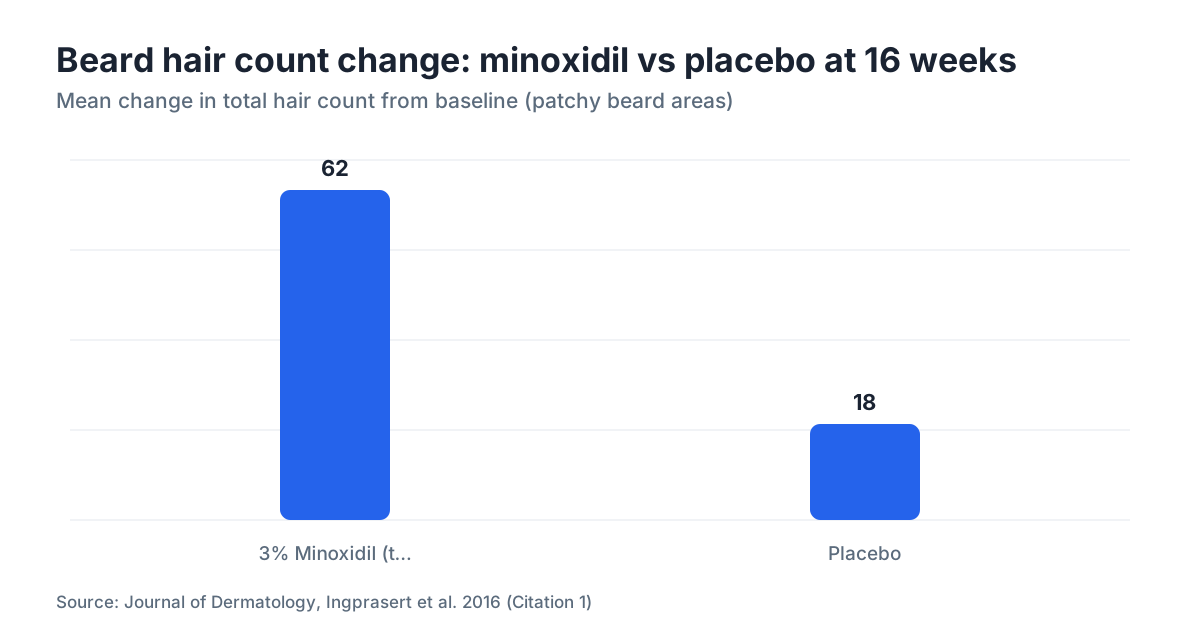
Yes, and there's real evidence behind it. A 2016 randomized, double-blind, placebo-controlled trial published in the Journal of Dermatology assigned 48 men with thin beards to either 3% topical minoxidil lotion or placebo, applied twice daily to the face for 16 weeks. The minoxidil group ended up with significantly higher hair counts than placebo, and the authors concluded that "3% minoxidil lotion was more effective than placebo in increasing beard hair" [1]. That's about as clean a study design as you get for a cosmetic use case.
The mechanism is the same as on your scalp. Minoxidil is a vasodilator first developed as a blood pressure drug. Applied topically, it gets converted by sulfotransferase enzymes in hair follicles to minoxidil sulfate, the active metabolite. That compound stretches out the anagen (active growth) phase of the follicle cycle and increases follicle size, so finer vellus hairs give way to thicker, darker terminal hairs [2].
Beard follicles respond for the same reason scalp follicles do: they run the same basic cycle. The catch is that beard growth is heavily androgen-driven, so men with low testosterone or low DHT sensitivity may see less response. Minoxidil doesn't touch your androgen levels. It just pushes the follicles you already have to work harder.
The honest caveat: one 48-person trial is not a mountain of evidence. The effect is real, but the size of it swings a lot between individuals. Some men grow a noticeably fuller beard. Others get modest improvement. A small group sees little change. Nobody has good population-level data on what percentage of men end up satisfied.
How does minoxidil work on facial hair specifically?
Facial hair follicles run the same anagen-catagen-telogen cycle as scalp follicles, just on a different clock. Beard anagen lasts roughly one to six years, shorter and more variable than scalp hair. Minoxidil extends that phase, giving existing follicles more time to grow and thicken [2].
There's a follicle density angle too. Most men with patchy beards do have follicles in the sparse spots. Those follicles just make vellus (peach fuzz) hairs instead of terminal hairs. Minoxidil enlarges them. Over months, the vellus hairs get replaced by pigmented, coarser terminal hairs. That's why the visual result is slow: you're waiting for a full follicle cycle to play out.
Sulfotransferase enzyme activity matters here more than most sources admit. Men with lower enzyme activity in facial skin convert less minoxidil to the active sulfate form and tend to respond less. There's no widely available clinical test for facial sulfotransferase activity. The closest proxy is your scalp: if topical minoxidil worked well on your scalp, your enzyme activity is probably decent.
One thing minoxidil does not do is create new follicles where none exist. If a stretch of your face has essentially no follicles, minoxidil won't grow hair there. It amplifies what's already present.
What concentration of minoxidil should you use on your beard?
The only RCT specifically on beard growth used 3% topical minoxidil [1]. Most scalp studies use 2% or 5%. In practice, most men trying this off-label reach for 2% or 5% liquid or foam, because those are what's on the shelf over the counter in the United States.
Here's the trade-off:
| Concentration | Evidence for beard | Irritation risk | Cost (approx. per month) |
|---|---|---|---|
| 2% liquid | Indirect (scalp data) | Lower | $8-15 |
| 3% liquid | Direct RCT data [1] | Moderate | Less available OTC |
| 5% liquid | Off-label, common use | Higher | $10-20 |
| 5% foam | Off-label, common use | Moderate (no propylene glycol) | $20-35 |
The 5% liquid contains propylene glycol, which is the main driver of contact dermatitis on the face. Facial skin is thinner and more reactive than scalp skin. Plenty of men who try 5% liquid on their beard report redness, flaking, or a burning feeling they never get on their scalp. Switching to the foam, which drops the propylene glycol, usually fixes that.
Oral minoxidil is a different conversation. Some dermatologists prescribe low-dose oral minoxidil (0.625 mg to 2.5 mg daily) off-label for hair growth, and that would reach facial follicles systemically. The side effect profile is wider. If you want to understand that option, the oral minoxidil article covers it in depth.
If you can get a 3% formulation from a compounding pharmacy, that's closest to the evidence. If not, 5% foam applied once daily (instead of twice) is a reasonable compromise that many men land on.
How do you apply minoxidil to your beard correctly?
The application routine matters more on the face than the scalp, because systemic absorption climbs with larger surface areas or occlusion. Keep it targeted.
For liquid minoxidil: Use the dropper to apply about 0.5 to 1 mL to the patchy areas specifically, not the whole face. Spread it with a finger, rub it in gently, and let it dry fully (10 to 15 minutes) before touching your face or going to bed. Wash your hands right after.
For foam: Dispense a small amount (roughly half a capful), rub it between your fingers to melt it, then work it into the target spots. Foam absorbs faster, usually 5 to 10 minutes to dry.
Frequency: Twice daily is what the evidence uses [1]. Some men do once daily to cut irritation and systemic exposure. Once daily probably works somewhat less well, but there's no head-to-head beard data on it.
Timing rules matter. Don't apply right after a hot shower when pores are open and absorption spikes. Wait 30 minutes after washing your face. Don't press your treated beard into your partner's face or your pillowcase right after application, since minoxidil can transfer and affect whoever it touches. The FDA label for topical minoxidil notes that accidental exposure should be avoided by others in the household, particularly women of childbearing age [2].
Shaving: You can still shave while using minoxidil. Just don't apply it to freshly shaved or irritated skin. Wait a few hours after shaving.
How long does it take to see beard results from minoxidil?
Slow. That's the honest summary.
The 2016 RCT hit statistically significant differences at 16 weeks, which is four months of twice-daily application [1]. But 16 weeks is the floor, the minimum point where measurable results showed up in a controlled setting. Most men who document their progress anecdotally report that visible, meaningful improvement takes 6 to 12 months, because the follicle cycle on the face runs longer than the study window.
Here's the rough timeline most users report:
Weeks 1 to 4: No visible change. Maybe some redness or flaking if your skin is sensitive.
Weeks 4 to 12: Possible shedding of fine vellus hairs (this is normal and means follicles are cycling). Some men misread it as the product failing.
Months 3 to 6: Fine hairs start converting to slightly thicker, darker hairs in the target areas. This is the phase where you squint in the mirror and can't quite tell if it's working.
Months 6 to 12: Terminal hair growth becomes clearly visible in most responsive men. Density climbs.
Beyond 12 months: Continued slow improvement is possible. Some men report gains up to two years in.
The shedding phase around weeks 4 to 12 trips people up. It's the same telogen effluvium pattern seen on the scalp: minoxidil kicks resting follicles into a new growth cycle, and the old hair sheds first before the new growth comes in. Don't quit during this window.
Is minoxidil for beard growth FDA-approved?
No. This is an off-label use.
The FDA has approved topical minoxidil specifically for androgenetic alopecia (pattern hair loss) on the scalp, in both men and women [2]. Beard growth is not an approved indication. Physicians and patients are legally allowed to use approved drugs off-label, but it means the FDA has not reviewed evidence for this specific use.
What that means practically: you won't find a beard minoxidil product with FDA approval. You're buying a scalp product and putting it on your face. Same active ingredient, different location. Doctors who recommend it are working from the published trial data and clinical experience, not an approved label.
Oral minoxidil is FDA-approved only for hypertension (high blood pressure), not for any hair use, scalp or beard [3]. Dermatologists who prescribe it for hair are doing so entirely off-label.
Off-label doesn't mean unsafe or ineffective. Minoxidil's safety profile is well-documented from decades of scalp use. But it does mean you should have a realistic conversation with a doctor before starting, especially about cardiovascular history. See the minoxidil side effects overview for the full picture.
What are the risks and side effects of putting minoxidil on your face?
Facial skin is more permeable than scalp skin in spots, so systemic absorption runs slightly higher per unit area applied. That's the main reason face use deserves its own risk discussion.
Common local side effects:
Contact dermatitis: Redness, itching, flaking, or burning at the application site. Mostly driven by propylene glycol in liquid formulations. Switching to foam often clears it.
Dryness and peeling: Minoxidil is drying. A fragrance-free moisturizer after it dries helps.
Hypertrichosis (unwanted hair in nearby areas): If minoxidil migrates, you can grow hair where you don't want it, on your cheeks, near your eyes, or elsewhere. Apply precisely.
Systemic side effects (less common but real):
Fluid retention and weight gain, low blood pressure, dizziness, and heart palpitations are all documented with systemic minoxidil exposure [3]. They're more likely with oral use but can show up with heavy topical use over a large area. If you have cardiovascular disease or take blood pressure medication, talk to a doctor first.
Allergic reaction: True allergy to minoxidil itself is rare but exists. Symptoms include swelling, hives, or trouble breathing. Stop immediately and get medical attention.
Transfer to others: The FDA label warns about this specifically. Minoxidil transferred to a pregnant woman's skin has the potential to affect fetal development [2]. Use with care.
For a broader breakdown of everything minoxidil can do to your body, see minoxidil side effects.
What happens if you stop using minoxidil on your beard?
The beard goes back to baseline. This is the part most beard-minoxidil content skips over.
Minoxidil doesn't permanently change follicles. It holds an extended anagen phase while you use it. Stop, and follicles slide back to their natural cycle. Hair grown during treatment sheds over the following 3 to 6 months, and you land roughly where you started [2].
It's the same pattern seen on the scalp: the drug has to continue indefinitely to keep the results. Some men reach a point where their beard is thick enough that even shedding a few minoxidil-maintained hairs leaves a baseline noticeably better than before (because natural testosterone-driven follicle maturation kept going in parallel). But that's not a guaranteed outcome, and there's no good data on how often it happens.
A few options exist if you want to eventually stop. Some men taper instead of quitting cold. Some switch to oral minoxidil for systemic maintenance. None of these have controlled trial support for the beard specifically.
The honest position: if you grow a beard you love with minoxidil, plan to use it long-term.
Can minoxidil fix a patchy beard permanently?
Not permanently on its own. There's a more useful answer underneath that, though.
Patchiness has more than one cause. Some men have patchy beards because of follicle distribution genetics: the follicles in certain areas are sparse or missing. Minoxidil can't create follicles. It can enlarge and activate existing ones, so if the patchy area holds some dormant or vellus follicles, minoxidil can bring them in. If there are genuinely few follicles there, results will be minimal.
Other men have patchy beards because of alopecia areata, an autoimmune condition that causes hair loss in defined patches on the scalp, beard, or body. Minoxidil is not a treatment for alopecia areata. It may offer some supportive benefit, but the autoimmune driver needs separate management, usually corticosteroid injections, topical immunotherapy, or JAK inhibitors. If your patches appeared suddenly and have well-defined edges, see a dermatologist before starting minoxidil.
For men who want a permanent fix for thin beard density, beard hair transplant procedures have grown a lot and now routinely use follicular unit extraction (FUE) to move scalp grafts to the face. That's a permanent structural fix with real recovery time and real cost (typically $3,000 to $10,000 depending on graft count and clinic). Minoxidil and transplant aren't mutually exclusive: some men use minoxidil to thicken what they have while saving for a procedure, or use it post-transplant to support graft survival.
If you're trying to figure out whether a hair-loss component is driving the patchiness, the what causes hair loss article covers the diagnostic picture.
How does minoxidil compare to other beard growth options?
There aren't many evidence-backed alternatives, which is part of why minoxidil has become the default.
| Option | Evidence level | Effect | Cost | Permanent? |
|---|---|---|---|---|
| Topical minoxidil (3-5%) | RCT [1] | Moderate improvement | $10-35/month | No |
| Oral minoxidil (off-label) | Multiple trials for scalp | Potentially stronger | $20-50/month | No |
| Beard transplant (FUE) | Case series + clinical practice | High for coverage | $3,000-10,000 | Yes |
| Biotin supplements | No RCT for beard | Minimal/none unless deficient | $10-20/month | N/A |
| Derma roller + minoxidil | Small scalp RCT, extrapolated | May enhance absorption | $20-50 one-time | No |
| Peppermint oil | One animal study, one scalp RCT | Weak/uncertain | $5-15/month | No |
Finasteride and DHT blockers come up in the beard context sometimes. The logic goes: reduce DHT to prevent androgen-related follicle suppression. But beard growth is stimulated by DHT, not suppressed by it (unlike scalp hair in androgenetically predisposed men). Taking finasteride while trying to grow a beard is theoretically counterproductive, though the clinical reality is messier and varies by person. If you're already on finasteride for scalp hair loss, don't assume it'll help your beard.
For minoxidil for men more broadly, including scalp use and full dosing guidance, that's a separate deep read worth bookmarking.
Derma rolling (microneedling) with a 0.5 to 1.0 mm roller before applying minoxidil is popular in beard-growing communities online. The idea is that microchannels in the skin let more minoxidil penetrate. There's one RCT backing microneedling plus minoxidil for scalp hair loss over minoxidil alone, but no equivalent beard-specific trial. It's plausible. Whether the absorption benefit beats the risk of irritation and infection from rolling a non-sterile device over facial skin is a judgment call.
Who is a good candidate for beard minoxidil?
The best candidates share a few traits.
You have a patchy or thin beard with existing vellus hair in the sparse areas. Run your finger against the grain in a patchy spot: if you can feel very fine, nearly invisible hairs, those follicles are there and potentially activatable. If the skin feels smooth and follicle-free, keep your expectations low.
You're in good cardiovascular health. Minoxidil's main systemic risks are cardiovascular. Men with hypertension, arrhythmia, or heart failure should talk to a doctor before applying anything to a large facial surface daily.
You're patient. If you can't commit to at least 6 months of consistent daily application before judging results, this will frustrate you.
You're not using it as a workaround for alopecia areata or another diagnosed condition. Those need proper dermatological management.
You're a man. There's essentially no data on women using minoxidil for facial hair growth, and there are reasons to think the androgen-driven dynamics are quite different. This article addresses male beard growth specifically.
If you're not sure what's behind your hair patterns, facial or scalp, and want a data-informed starting point, the free AI analysis at MyHairline can flag patterns worth discussing with a dermatologist before you start any treatment.
Age matters too. Beard growth keeps developing naturally through the mid-to-late twenties for many men. If you're 19 and disappointed by your beard, give it more time before reaching for minoxidil. If you're 30 and your beard is what it is, that's your natural baseline, and minoxidil becomes a more reasonable next step.
Are there any tips that actually improve results?
A few things have real logic behind them. A few popular tips are noise.
Consistency beats everything. Skipping doses regularly is the fastest way to undermine the treatment. Set a twice-daily alarm until it's automatic.
Start with the foam if you're worried about irritation. Less propylene glycol, similar delivery, gentler on facial skin. Yes, it costs more.
Give it a full 6 months before deciding it's a dud. The 16-week RCT is the minimum signal point. Plenty of men are still early in the curve at 16 weeks.
Consider a derma roller (0.5 mm) once a week before a minoxidil application. Biologically plausible absorption boost, based on extrapolation from scalp data. Clean it properly between uses.
Don't crank the dose thinking more is better. More minoxidil means more systemic absorption and more irritation without proportional benefit. 1 mL twice daily (or roughly half a capful of foam twice daily) is the studied dose range.
Watch for systemic symptoms: dizziness, swelling in hands or feet, unexpected weight gain. Those are signals to stop and consult a doctor.
Take monthly photos in consistent lighting from the same angles. Memory is useless for slow changes. Photos let you make a real call at 3, 6, and 12 months.
Manage expectations from day one. Minoxidil won't turn a beard with very sparse follicle coverage into a full Viking beard. It improves what you have. Men who start knowing that end up satisfied far more often than men expecting a transformation.
Sources
- Journal of Dermatology (2016) - Ingprasert et al., RCT of 3% minoxidil vs placebo for beard growth
- FDA - Minoxidil Topical Solution label (DailyMed / NLM)
- FDA - Oral minoxidil (Loniten) prescribing information (DailyMed / NLM)
- National Institutes of Health (NIH) - StatPearls: Minoxidil mechanism of action
- Journal of the American Academy of Dermatology - Microneedling plus minoxidil vs minoxidil alone RCT (Dhurat et al., 2013)
- International Journal of Dermatology - Low-dose oral minoxidil review
- Dermatology and Therapy - Alopecia areata treatment review
- NIH National Library of Medicine - Hair follicle cycle biology review
- FDA - Drug off-label use guidance (general)