TL;DR: Minoxidil is FDA-approved only for the crown (vertex) in men, but dermatologists routinely use it off-label for temples and receding hairlines. The evidence for off-label use is real but thinner. It can regrow hair at the temples in some people, though results are generally more modest than at the crown. Applying it to the forehead skin does nothing useful.
What does the FDA actually approve minoxidil for?
The FDA approved topical minoxidil for men specifically for "hereditary hair loss at the vertex of the scalp," meaning the crown. The 5% foam and 2% and 5% solution labels all say vertex. That's it. The agency has never formally reviewed minoxidil for frontal or temple hair loss because the original clinical trials run by Upjohn in the 1980s focused on crown thinning, which is easier to photograph and measure.[1]
This doesn't mean temple use is unsafe or experimental in some alarming sense. Off-label prescribing is legal and common in dermatology. What it does mean is that the FDA hasn't independently verified efficacy claims for the hairline. Any doctor recommending it for your temples is working from clinical experience and smaller studies rather than the large registration trials behind the crown approval.
For women, the label says "generalized thinning of hair on the top of the scalp." That's a bit broader than the male label and doesn't restrict use to the crown, but it still doesn't specifically mention the temples or hairline.
On-label equals crown. Off-label equals everywhere else. Both uses are legal.
Does minoxidil work on a receding hairline and temples?
Yes, for many people, though the results are more variable than at the crown. A 2022 study published in the Journal of the American Academy of Dermatology looked at topical minoxidil used on the frontal scalp and found statistically significant hair count improvements compared to placebo at 24 weeks.[2] Regrowth was slower and less dense than typical crown response, but it was real and measurable.
Why the difference? The crown holds a higher density of miniaturized follicles that are still alive and just waiting for a stimulus. Temple follicles in a significantly receded hairline may be further along in the DHT-driven miniaturization process, which means fewer viable follicles to reactivate. Minoxidil can't revive a follicle that's been completely destroyed. If the skin at your temple is smooth and shiny with no fine vellus hairs visible, the odds of meaningful regrowth drop sharply.
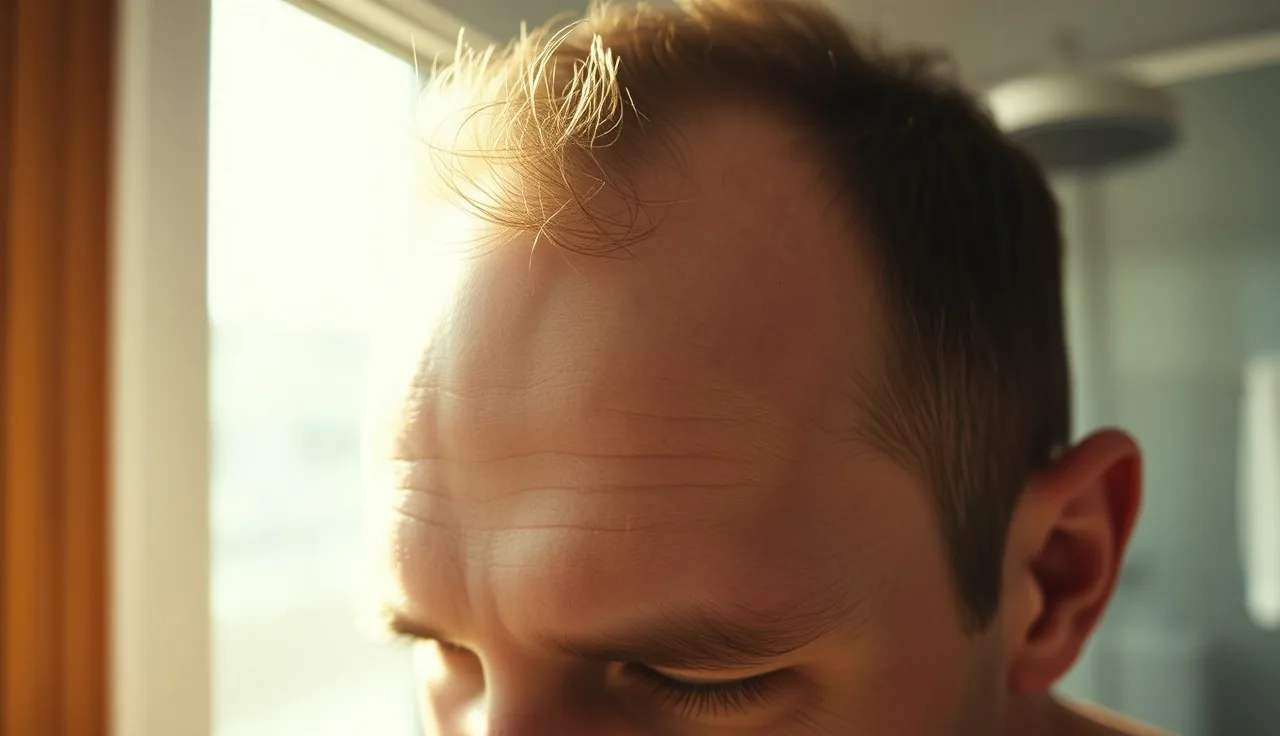
If you can see fine, wispy hair at your temples, those follicles are still alive. That's where minoxidil has a genuine shot. Thin coverage responds better than outright baldness.
For a broader look at why the hairline recedes in the first place, receding hairline covers the DHT mechanism and staging in detail.
How does minoxidil actually regrow hair?
Minoxidil is a potassium channel opener. It started as an oral blood pressure drug, and doctors noticed patients taking it grew hair. The topical version came out of that observation.
At the follicle level, it widens blood vessels and increases blood flow, which delivers more oxygen and nutrients to hair follicle cells. It also extends the anagen (growth) phase of the hair cycle and shortens the telogen (resting) phase. Some research suggests it upregulates vascular endothelial growth factor in the dermal papilla, which may directly stimulate follicle activity.[3]
None of this mechanism is location-specific. The drug doesn't know it's at the crown versus the temple. If viable follicles exist anywhere on the scalp, minoxidil can potentially stimulate them. Location matters because of follicle biology, not because of anything special about how minoxidil behaves.
That said, minoxidil does nothing about DHT, which is the hormone actually causing the miniaturization in androgenetic alopecia. It's a workaround, not a root-cause treatment. That's why many dermatologists pair it with finasteride or another DHT blocker, especially for frontal recession, where DHT sensitivity tends to run high.[4]
Is the temple area harder to treat than the crown?
Generally, yes. Here's why that matters in practice.
The frontal hairline and temples hold follicles that, in men with androgenetic alopecia, are among the first to miniaturize. By the time someone notices recession, those follicles have often been shrinking for years. Crown follicles miniaturize later in the process, so when someone first spots crown thinning, there's usually more salvageable follicle mass.
Studies comparing response rates across scalp zones consistently show better regrowth at the vertex. A Cochrane review of minoxidil trials noted that the evidence base for crown use was substantially larger and more consistent than for frontal thinning.[5] That's not proof frontal use doesn't work. It's just honest about where the data is stronger.
Age matters too. A 22-year-old with early temple recession has better odds than a 45-year-old with the same pattern, because the follicles have had less time to fully miniaturize. Starting earlier gives the drug more to work with.
If you want a realistic picture of where you fall on the hair loss spectrum, tools like the free AI hair scan at MyHairline can map your thinning zones and give you a Norwood staging, which helps set expectations before you commit to a treatment routine.
How should you apply minoxidil to the temples and hairline?
Apply to the scalp, not the hair. This sounds obvious but it's the most common mistake. Rubbing minoxidil into your hair length wastes product and doesn't reach the follicles.
For liquid solution: use the dropper to place the liquid directly on the thinning area, then massage it in gently with your fingertips for about a minute. For the temples, apply just inside the hairline edge onto the thinning scalp skin, not onto forehead skin below where hair once grew. Minoxidil applied to the forehead does nothing for hair regrowth and can cause unwanted facial hair if it drips down.[6]
For foam: dispense roughly half a capful, let it melt in your palm, and dab it onto the target area. Foam is less likely to drip than solution, which makes it a little easier for hairline application.
Dosing is typically twice daily for solution (1 mL each time) and once daily for 5% foam. Some people split the solution dose to once daily off-label, but the twice-daily schedule produced better outcomes in the clinical trials.[1]
Wash your hands immediately after. Seriously. Touching other parts of your body after applying minoxidil can cause hair growth in those spots.
Wait at least four hours, ideally longer, before washing your hair after application. Getting the scalp wet too soon rinses the drug away before it absorbs.
For a full breakdown of formulations and dosing schedules, minoxidil for men goes into more detail.
What minoxidil concentration works best for the hairline?
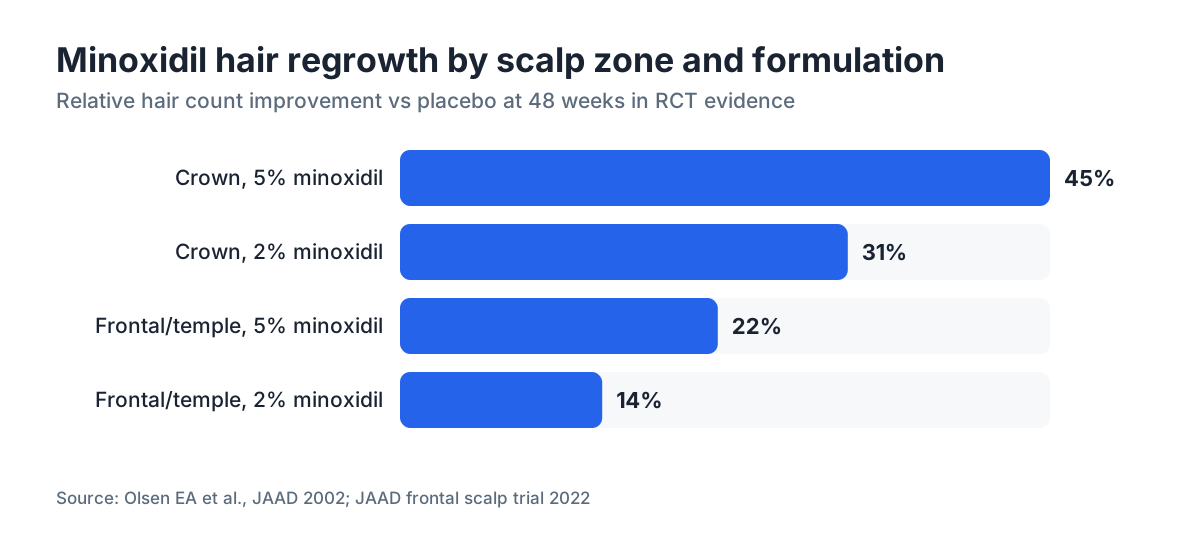
The evidence slightly favors 5% over 2% for both men and women, though the gap is wider in men. A head-to-head trial published in the Journal of the American Academy of Dermatology found that 5% minoxidil produced 45% more hair regrowth than 2% in men at 48 weeks.[7] Both concentrations produced regrowth, but 5% was meaningfully better.
For women, the FDA approved 2% for years, then approved 5% foam with a once-daily dosing recommendation. The 5% works in women too, but the once-daily label exists partly because of concerns about unwanted facial hair from the higher concentration.
For temple use specifically, there's no controlled data comparing concentrations at that zone. The general logic that more is more probably applies, but dermatologists sometimes start women on 2% at the temples precisely because the hairline sits close to the forehead and facial hair growth is an annoyance people want to avoid.
Oral minoxidil is a separate option worth knowing about. At low doses (0.625 mg to 2.5 mg per day for women, 2.5 mg to 5 mg for men), it reaches follicles systemically and doesn't care whether your problem is crown or temple. A growing body of evidence supports its use for frontal thinning. Oral minoxidil covers that option in full.
How long does minoxidil take to work on the temples?
Longer than most people expect. And the first thing that happens is usually shedding.
Minoxidil causes telogen effluvium in roughly a third of users in the first four to eight weeks. Old hairs in the resting phase get pushed out to make room for new growth. This is normal and temporary, but it's genuinely alarming if you don't know it's coming. If your temple area suddenly looks worse after starting minoxidil, that's probably why. Telogen effluvium explains the shedding phase in more detail.
After that initial shed, new hair growth typically starts appearing around the three to four month mark. At six months you can make a fair assessment of whether it's working. Full evaluation takes 12 months, because hair cycles are slow.
At the temples, expect results to be slower and subtler than at the crown. You might see fine regrowth, a slower rate of further loss, or modest density gains. Some people see none of those things, especially if their recession is advanced. The drug doesn't always work, and calling it at 12 months of consistent use is reasonable if there's been no change.
Can minoxidil cause hair to grow where you don't want it?
Yes. Facial hair growth is the most common unwanted effect of using minoxidil near the hairline. It usually happens when the liquid runs down onto forehead or facial skin, or when hands aren't washed after application.
The American Academy of Dermatology lists unwanted facial hair growth as a known side effect of topical minoxidil.[6] It's not permanent. If it happens, it reverses when you stop applying the drug to that area or stop using it entirely. But it can take several months to fully reverse.
Foam formulations reduce dripping and get recommended for women specifically because of this concern. Applying at bedtime, letting it fully dry before lying down, and using a pillow cover you don't mind staining all help.
Systemic effects like low blood pressure, rapid heart rate, or fluid retention are rare with topical application but are real risks, especially at higher concentrations and with oral formulations. A full review of what to watch for is at minoxidil side effects.
Should you use minoxidil alone or combine it with something else for the hairline?
For most men with androgenetic alopecia causing temple recession, combining minoxidil with finasteride outperforms either drug alone. A randomized controlled trial published in Dermatologic Therapy found that the combination produced significantly greater improvement in hair count and patient satisfaction scores than either monotherapy at 12 months.[8]
The logic holds up mechanistically. Finasteride addresses the root cause (DHT-driven miniaturization) by blocking 5-alpha reductase, the enzyme that converts testosterone to DHT. Minoxidil stimulates follicle growth through a separate pathway. They aren't redundant. They're complementary.
For women, finasteride is sometimes used off-label but isn't FDA-approved for hair loss in women, and it's contraindicated in women who are or might become pregnant. Finasteride and minoxidil covers combination therapy in detail for both sexes.
If you don't want to take a daily oral medication, some dermatologists use topical finasteride with minoxidil in a compounded formulation. The evidence for this is newer but promising.
For frontal hair loss that has progressed far despite medical therapy, a hair transplant may be the only option that delivers natural-looking density. Medical therapy is generally recommended first to stabilize ongoing loss before considering surgery.
What if minoxidil isn't working on your temples after 12 months?
Stop using it if there's been no response after a genuine 12-month trial with consistent twice-daily application. Some people are non-responders, and continuing an ineffective treatment just costs money and time.
Before calling it a failure, though, check a few things. Were you applying to the scalp surface, not the hair? Were you missing doses regularly? Did you stop and restart multiple times? Consistency matters enormously. Minoxidil's benefits reverse within three to six months of stopping, and inconsistent use prevents the steady drug concentration the follicle needs.
If you've been consistent and nothing has happened, get a dermatologist evaluation. You may have a type of hair loss that isn't androgenetic alopecia at all, in which case minoxidil might not be the right tool. Scarring alopecia, alopecia areata, and other conditions look similar but respond to different treatments. Understanding what causes hair loss in your specific case matters before doubling down on one treatment.
Oral minoxidil is worth discussing with a doctor at this point, since systemic delivery bypasses any issues with topical absorption or application technique.
For men who've been on both minoxidil and finasteride for over a year with continued progression, surgical consultation is a reasonable next step. The MyHairline free AI scan can help you document your hair loss over time, which is useful context for any dermatologist or hair restoration specialist.
Is minoxidil safe to use on the temples long-term?
The long-term safety data on topical minoxidil is genuinely reassuring. It's been in use since the 1980s, and post-market surveillance over four decades has not revealed serious organ toxicity from topical use at the labeled doses.[9]
The main long-term concern is cosmetic (facial hair) and practical (you have to keep using it indefinitely). If you stop, the hair you gained starts to reverse within a few months. That's not a safety issue, but it's a commitment issue worth thinking about before you start.
Cardiovascular monitoring is more relevant for oral minoxidil, where systemic absorption is much higher. For topical use, blood pressure effects are minimal in most people with normal cardiovascular health, though people with known heart disease should discuss it with their doctor.
There's no good evidence that long-term scalp application causes any cumulative toxicity or cancer risk. The FDA has not issued any post-approval safety communications restricting long-term use.
Sources
- FDA, Rogaine (minoxidil) 5% topical foam prescribing information
- Journal of the American Academy of Dermatology, frontal scalp minoxidil trial, 2022
- Semalty M et al., Minoxidil mechanism of action review, Drug Discovery Today, 2021
- American Academy of Dermatology, Hair Loss: Diagnosis and Treatment guidelines
- Cochrane Database of Systematic Reviews, minoxidil for androgenetic alopecia
- American Academy of Dermatology, minoxidil patient information including side effects
- Olsen EA et al., 5% vs 2% topical minoxidil in men, Journal of the American Academy of Dermatology, 2002
- Hu R et al., combination finasteride and minoxidil vs monotherapy, Dermatologic Therapy, 2015
- NIH National Library of Medicine, MedlinePlus, minoxidil topical drug information
- FDA, minoxidil OTC monograph, Code of Federal Regulations Title 21