
TL;DR: Minoxidil does grow beard hair, but it's not FDA-approved for the face. Small controlled trials show real density gains after 3 to 6 months of topical use. The gains are modest. Shedding comes first, and most men need to keep using it to hold results. On the face, DHT helps beard follicles instead of shrinking them, so the biology differs from the scalp.
What is minoxidil and how does it grow hair in the first place?
Minoxidil started as a blood pressure pill in the 1970s. Doctors kept seeing the same odd side effect: patients grew more body hair. That observation turned into Rogaine, the topical version the FDA approved for scalp hair loss in men in 1988 and women in 1991 [1].
Nobody fully understands the mechanism, which is an honest thing to admit about a drug that's been sold for over 40 years. Here's what researchers do know. Minoxidil opens potassium channels in cells around the follicle, which increases blood flow and nutrient delivery. It also prolongs the anagen (growth) phase of the hair cycle and shortens the telogen (resting) phase [2]. More follicles growing at once means more visible hair.
On the scalp, this effect is well-documented. The FDA-approved use is androgenetic alopecia, meaning pattern hair loss driven by DHT sensitivity. The beard is a different tissue with different hormonal wiring. Beard hair grows because of androgens, especially dihydrotestosterone (DHT) and testosterone. Facial follicles get stimulated by DHT rather than damaged by it, the exact opposite of what happens to scalp follicles in men with pattern baldness [3]. So the question of whether minoxidil works on the beard isn't "same drug, different location." The biology genuinely differs.
Before you point it at your face, it helps to know how minoxidil works on the scalp, including dosing and the science behind FDA approval.
Does minoxidil actually work on beard hair? What do the studies say?
Yes. There's real evidence it works. The beard literature isn't as deep as the scalp literature, but it exists and it points the same direction.
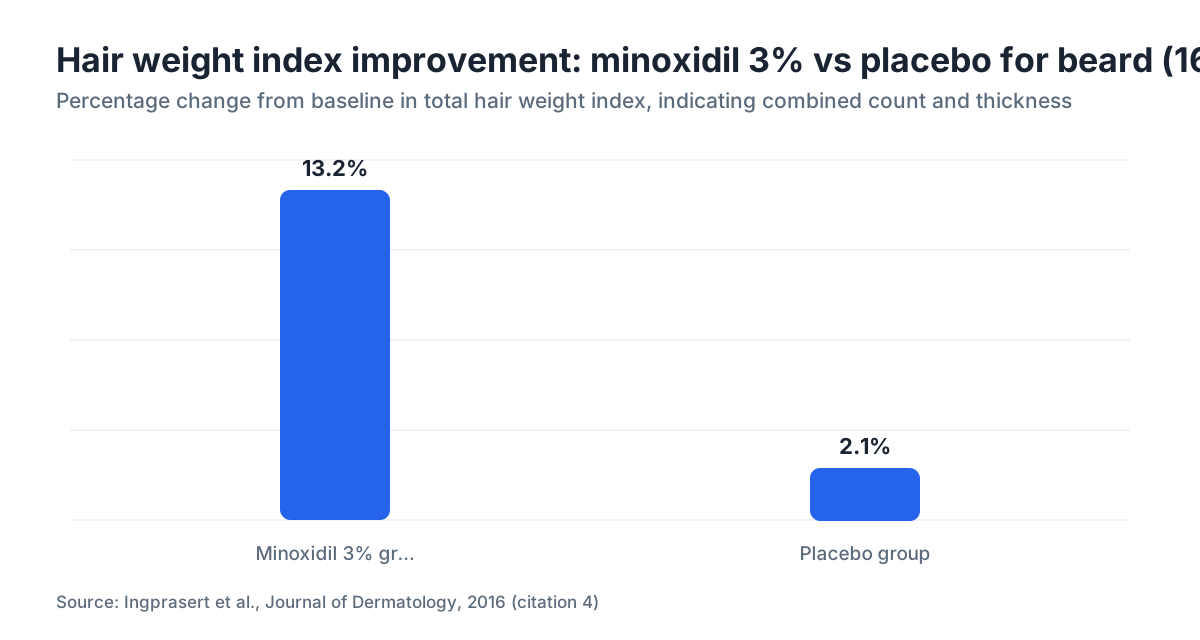
The most-cited trial is a 2016 randomized controlled study in the Journal of Dermatology. Researchers assigned 48 men with thin beards to either 3% topical minoxidil lotion or placebo, applied twice daily for 16 weeks. The minoxidil group had significantly greater total hair count and hair weight index than placebo. The authors concluded that "3% minoxidil lotion is effective and safe for beard enhancement" [4]. That's a verbatim quote from the study.
Three caveats about that trial. Sixteen weeks is short. The sample is small at 48 men. And it used 3%, not the 5% most men actually buy. A 2021 review in the Journal of Cosmetic Dermatology went through the available evidence and found consistent signals that topical minoxidil grows beard hair, while calling for larger trials to pin down the best concentration and frequency [5].
The mechanism likely mirrors the scalp: minoxidil prolongs anagen and enlarges the follicle. Beard follicles that are miniaturized or cycling too fast get pushed toward fuller, longer growth phases. Men with patchy beards from uneven cycling tend to respond better than men who simply have no follicles in a given spot.
No drug builds follicles from scratch. Minoxidil works on follicles that already exist but underperform. Set your expectations there.
How does beard minoxidil differ from scalp minoxidil?
The drug is identical. The context is not. On the scalp, minoxidil fights DHT-driven miniaturization; on the face, DHT is what makes beard hair grow in the first place.
On the scalp, follicles shrink because DHT binds androgen receptors and shortens the growth cycle over years. Minoxidil partly offsets that by extending anagen, but stop the drug and DHT resumes its work. You lose the gains. That's why scalp minoxidil gets described as a lifelong commitment.
On the face, DHT works in your favor. Beard hair is androgen-dependent in the opposite direction from scalp hair. So minoxidil on the beard isn't holding back a hormonal process that's actively killing follicles. It's more like nudging underactive follicles into a more active state.
That changes what happens when you stop. Some men keep their beard gains, as if the follicle got woken up and stayed awake. Others lose the extra density. There's no reliable way to predict which camp you land in, and nobody has good long-term data. The closest evidence is anecdotal reports in dermatology case series, not controlled discontinuation trials.
Concentration cuts differently too. The scalp literature supports 5% over 2% for men [2]. The main beard RCT used 3% [4]. Plenty of men use 5% on their beard because that's what's on the shelf, and clinical reports suggest it's usually tolerated, but formal head-to-head concentration data for facial hair is thin.
| Feature | Scalp (AGA) | Beard |
|---|---|---|
| FDA-approved indication | Yes (men and women) | No (off-label) |
| DHT role | Damages follicles | Stimulates follicles |
| Main RCT concentration | 5% | 3% |
| Gains after stopping | Lost within months | Possibly partly retained |
| Primary evidence | Extensive (decades) | Limited (a few small RCTs) |
| Typical response timeline | 4 to 6 months | 3 to 6 months |
How long does minoxidil take to work on a beard?
Expect nothing for the first month. That's not pessimism. That's the hair cycle.
When you start minoxidil, it first pushes resting (telogen) hairs into a new growth phase, which shoves the old hairs out first. On the scalp this is called telogen effluvium, and the same thing happens on the face. You may see more facial shedding in weeks 2 through 6. It's normal, and it's a sign the drug is doing something [see telogen effluvium for the full shedding pattern].
The 2016 RCT hit statistically significant differences at 16 weeks, so 4 months [4]. In practice, most men notice visible improvement between months 3 and 6. Your full response, whatever the ceiling turns out to be, usually takes 6 to 12 months of steady use.
The rough timeline:
- Weeks 1 to 6: possible shedding, no visible gain
- Months 2 to 3: fine vellus hairs may show up in bare spots
- Months 4 to 6: hairs start to thicken and pigment
- Months 6 to 12: continued gains, terminal hair conversion
Seen zero change by month 6? Pushing to month 9 or 12 is reasonable. If nothing has moved by 12 months, you're probably a non-responder for this route.
How do you apply minoxidil to your beard correctly?
Application is simple. Consistency matters far more than technique.
Most men use the standard 5% topical solution or foam. Apply 1 mL (about 20 drops of solution, or half a capful of foam) to the areas you want to treat, once or twice daily. Twice daily is what the scalp literature supports and what the beard RCT used [4]. Some men find once daily easier to keep up, and some dermatologists now argue once daily is enough given how long minoxidil sits in the follicle, but the formal once-versus-twice comparison for beards specifically doesn't exist.
Apply to dry skin. Rub it in gently. Let it dry for at least 4 hours before washing your face or hitting the pillow. This is the step most people rush, and it's the one that matters. Minoxidil absorbs over hours. Wash it off at the 30-minute mark and you cut how much reaches the follicle dramatically.
A few practical notes:
Foam irritates less than the propylene glycol solution, which counts on the face because facial skin is more sensitive than the scalp. If you get real redness or itching, switching from solution to foam usually helps.
Wash your hands right after applying. Minoxidil absorbs through skin wherever it lands. Accidental transfer to a partner's skin is a real thing to think about.
Skip broken skin, inflamed acne, and cuts. Absorption spikes through damaged skin and raises the systemic side effect risk.
For a fuller look at minoxidil side effects, including what's common versus what should make you stop, that guide covers both topical and oral forms.
What results are realistic? Who responds well and who doesn't?
Minoxidil is not a beard transplant. It won't build a full thick beard on bare skin, and it won't fix a zone with no follicles at all. It works on follicles that already exist but sit dormant or crank out thin, unpigmented vellus hair.
Men who tend to respond better:
- Patchy beards where some areas are thin rather than completely bare
- Younger men (roughly 18 to 35), where dormancy is more likely than permanent follicle loss
- A family history of full beards, which suggests the genetic potential is there
- Consistency: twice daily, no missed days
Good responders see real gains: higher hair count, thicker terminal hairs in patchy zones, better coverage. The 2016 RCT measured this as a significantly greater hair weight index versus placebo, which captures count and thickness together [4].
Poor responders and non-responders see little to nothing after 6 to 12 months. That usually means either there aren't enough dormant follicles to activate, or the person converts minoxidil poorly to its active form, minoxidil sulfate, a step handled by an enzyme called SULT1A1. Men with low SULT1A1 activity in their follicular cells respond weakly to topical minoxidil, which is one reason results swing so much between people [6].
There's a commercial test (the Minoxidil Response Test) that measures SULT1A1 activity. It's not widely used, and the evidence for its usefulness in beard applications specifically is limited.
Is minoxidil safe to use on the face?
Topical minoxidil on facial skin is generally well-tolerated, based on the trial data and years of off-label use. The 2016 RCT reported no serious adverse events [4]. The common complaints are local: dryness, itching, and redness where you apply it.
Systemic side effects are the bigger worry. Minoxidil crosses skin into the blood, and the face may absorb more than the scalp because facial skin is thinner and more vascular. Systemic minoxidil can cause fluid retention, heart palpitations, and in rare cases larger cardiovascular effects. These are well-documented from oral minoxidil's history as a hypertension drug [1].
The systemic dose from 1 mL of 5% topical minoxidil is low, roughly 1 to 2 mg per application in typical scalp absorption studies, against the 5 to 40 mg daily doses used for high blood pressure. But absorption varies, and some people take up more than others.
Be cautious, or check with a doctor first, if you have known cardiovascular disease, low blood pressure, or kidney or liver problems. Pregnant women should avoid it entirely based on animal reproductive toxicity data, and it's not approved for anyone under 18 [1].
Oral minoxidil has become a dermatologist-prescribed option for both scalp and beard growth lately, with some evidence it beats topical for certain patients, though by definition it carries higher systemic exposure.
Will you lose beard gains if you stop using minoxidil?
Everyone wants a clean answer here. The honest one: it depends, and nobody has great data.
On the scalp for androgenetic alopecia, the answer is clear. Stop minoxidil and you lose the gains within 3 to 6 months, because DHT-driven miniaturization picks right back up [2]. The beard is different, because for most men there's no active destructive process running in the background.
Some beard users keep a big chunk of their gains after stopping, which fits if those follicles were dormant rather than steadily miniaturizing. Others lose most of the extra density within a few months.
A conservative way to frame it: if your beard was thin purely from dormancy or slow cycling, minoxidil may have permanently shifted those follicles to a more active state. If it was more about follicle size and cycle length that needs ongoing support, stopping means reverting.
If the result matters to you and you can live with the routine, staying on it is the safer bet. Testing discontinuation after 12 to 18 months is a fair experiment if you want to learn your own response.
How does topical beard minoxidil compare to oral minoxidil?
Oral minoxidil for hair growth gets prescribed off-label by dermatologists at 0.625 mg to 5 mg daily, far below the 5 to 40 mg hypertension range [see oral minoxidil for the full breakdown]. It reaches follicles all over the body through the bloodstream, so it can support beard growth as a knock-on effect of scalp treatment.
For beard-specific use, oral has a theoretical edge: steady systemic delivery that doesn't hinge on your SULT1A1 activity in facial follicles. Oral minoxidil skips the need for local sulfation because it converts to minoxidil sulfate after absorption [9]. The trade-off is that systemic side effects, especially fluid retention and unwanted body hair, are more common and more serious with oral dosing.
Dermatologists who prescribe oral minoxidil for scalp loss routinely note that patients' beard, eyebrow, and body hair thickens too. That shows up in case reports and small series, not in RCTs aimed at beard growth [9].
For beard growth alone, most people should start topical. If topical fails after 9 to 12 months, oral minoxidil from a dermatologist is a reasonable next step rather than quitting.
Wondering how minoxidil fits alongside finasteride or combined finasteride and minoxidil for scalp hair? Those articles cover dual-drug regimens. One caveat for the beard: finasteride does nothing for it, and by lowering DHT it could in theory reduce androgen-driven beard growth in some men.
What are the alternatives to minoxidil for beard growth?
Minoxidil has the most evidence behind it. Everything else trails.
A beard transplant is the definitive option for a permanent result. A surgeon harvests follicles from the scalp (usually the occipital region) and implants them in the beard area. Results can be excellent, graft survival in the beard is generally high, and the hair grows permanently because it keeps its scalp genetics and isn't androgen-sensitive in the damaging way. Cost runs roughly $3,000 to $15,000 depending on graft count and location. For more on surgery, see hair transplant.
Derma rolling (microneedling) with a 0.5 to 0.75 mm roller gets paired with minoxidil based on scalp evidence that microneedling boosts penetration and independently triggers growth factors [10]. No dedicated RCT tests beard microneedling with minoxidil, but the scalp data is suggestive enough that some dermatologists recommend it.
PRP (platelet-rich plasma) injections have RCT support for scalp hair loss and essentially no rigorous evidence for the beard.
Supplements sold for beard growth, usually biotin, saw palmetto, or vitamin blends, have no meaningful RCT evidence for beard-specific use. Biotin deficiency is rare, and dosing above normal levels doesn't grow beard hair in men whose biotin is already fine. For a realistic take on what supplements can and can't do, hair loss supplements covers the evidence honestly.
Not sure what's actually driving your beard or hair issues? A free AI analysis at MyHairline can help you figure out the pattern before you spend money on a treatment.
Is minoxidil beard use FDA-approved, and does that matter?
No. The FDA has approved topical minoxidil only for androgenetic alopecia of the scalp, at 2% and 5% for men and 2% for women [1]. Beard use is off-label.
Off-label doesn't mean illegal or unsafe. Doctors prescribe and recommend off-label uses backed by evidence all the time. The FDA's own patient guidance states that healthcare providers "generally may prescribe the drug for an unapproved use when they judge that it is medically appropriate for their patient" [7]. In practice, that means manufacturers don't market minoxidil for beards and most labels won't mention it, but dermatologists can recommend it and you can use it.
Here's what off-label status does mean. There's no FDA-reviewed efficacy data specifically for beards. The risk profile on the face hasn't been systematically reviewed by regulators. And if something goes wrong, the manufacturer carries no liability for that use.
For most healthy adult men, the risk-benefit math is reasonable given the trial evidence. Still, talk to a dermatologist first if you have any cardiovascular, kidney, or skin conditions.
Could minoxidil beard use affect your scalp hair or cause hair loss elsewhere?
Minoxidil stimulates hair follicles. It doesn't selectively target only the spot you apply it to once it's in the bloodstream. Topical use is mostly local, but some systemic absorption happens.
A few specific worries men raise:
Will it thin my scalp hair? Unlikely. If anything, systemic absorption from beard use might slightly help scalp follicles. There's no mechanism by which topical facial application would selectively damage scalp hair.
Will it grow hair somewhere I don't want it? More plausible. Systemic minoxidil is known to cause hypertrichosis, meaning excess body hair, and high-dose topical use has done it in some people [8]. The dose from 1 mL on the face is usually too low to trigger widespread hypertrichosis, but sensitivity varies.
Transfer to a partner is a real issue. Apply minoxidil, then touch or rub against someone's skin, and they can absorb it. This matters most if your partner is pregnant or breastfeeding. Letting it dry fully and washing your hands well cuts that risk a lot.
If you're also worried about a receding hairline or scalp loss alongside a patchy beard, it helps to understand what causes hair loss, so you know whether your scalp and beard share a root cause or run on separate tracks.
Sources
- FDA, Rogaine (minoxidil) drug label and approval history
- American Academy of Dermatology, minoxidil for hair loss guidance
- Randall VA. Androgenic alopecia versus beard: different responses to the same hormone. Clin Exp Dermatol. 2008
- Ingprasert S et al. Efficacy and safety of topical minoxidil 3% for beard enhancement. J Dermatol. 2016
- Ito T et al. Review of topical minoxidil for beard and facial hair. J Cosmet Dermatol. 2021
- Gupta AK et al. Minoxidil: a review of use in hair disorders. Skin Appendage Disord. 2020
- FDA, Off-label drug use guidance for patients
- Westgate GE et al. Minoxidil-induced hypertrichosis and hair cycle effects. Br J Dermatol. 1993
- Sinclair R et al. Low-dose oral minoxidil for hair loss: a review. J Am Acad Dermatol. 2021
- Dhurat R et al. Microneedling with minoxidil vs minoxidil alone for alopecia. Int J Trichology. 2013