
TL;DR: DHI (Direct Hair Implantation) runs about $4,000 to $8,000 in Turkey, $10,000 to $20,000 or more in the US and UK, and somewhere in between across Eastern Europe. Price tracks three things: graft count, surgeon experience, and geography. Most Western clinics charge $3 to $10 per graft. Packages abroad often fold in flights and hotel nights.
What is DHI and why does it cost more than standard FUE?
DHI (Direct Hair Implantation) is a version of FUE (Follicular Unit Extraction) where extracted grafts go straight into the scalp through a Choi implanter pen, skipping the separate channel-creation step classic FUE needs. The pen sets depth, angle, and direction in one motion, which is why supporters argue it packs denser and heals faster.
The reason for the higher price is plain. Choi pens are expensive and disposable, and the technique needs more hands. A typical DHI session runs several trained technicians loading and placing pens at once, sometimes 2 to 4 pens in parallel. That labor is real overhead, and it lands on your invoice.
The gap between DHI and standard FUE at the same clinic usually sits at 10 to 30 percent. Some clinics charge the identical rate and simply stamp DHI on it as premium branding. Ask exactly what protocol they use and whether the head surgeon holds the pen or supervises technicians. That answer tells you more than the DHI label ever will.
DHI gets used most for crown and hairline work, where density and natural direction show the most. It also suits patients who want to add hair among existing follicles without shaving the recipient area, because the pen slides between standing hairs more easily than a pre-cut slit.
What does a DHI hair transplant cost in the US?
In the United States, a DHI transplant runs $8,000 to $20,000 for a session of 1,500 to 3,500 grafts [1]. Most clinics price per graft, not per session. The going rate at established US practices is $5 to $10 per graft, with boutique and celebrity-facing clinics at the top.
A 2,000-graft session at $7 per graft comes to $14,000. Add pre-op bloodwork, post-op medication, and travel, and you land at $15,000 to $16,000 all-in. That is a lot. What US pricing buys you is real, though: easy follow-up if something goes sideways, malpractice coverage, and board-certified oversight.
Health insurance almost never pays for hair transplants because they count as cosmetic [2]. A few exceptions exist for documented medical causes like scarring alopecia, burns, or chemotherapy-related loss, but you would have to win a coverage determination letter before surgery, not after.
Financing through CareCredit or similar medical credit lines is easy to find, and most mid-to-large US clinics offer it. Promotional interest can jump to around 26 percent if you miss the payoff window, so read the terms. Cash or a zero-fee rewards card usually costs you less.
How much does DHI cost in Turkey, the UK, and other countries?
Turkey dominates the global hair transplant market, DHI included. Istanbul clinics quote all-inclusive packages (surgery, hotel, airport transfers, post-op kit) from around $1,500 to $2,000 for small sessions and $3,500 to $8,000 for larger ones covering 3,000 to 5,000 grafts [3]. That spread is wide because quality is wide. The rock-bottom end often runs high-volume, technician-led operations where the surgeon shows up briefly, if at all.
Eugenix, an Indian clinic with a strong name in the transplant community, prices DHI at $2,500 to $6,000 depending on graft count, with its own surgeons doing the bulk of the work rather than handing it all to technicians. Eugenix hair transplant cost keeps coming up in forums because the clinic sits in an interesting middle: tighter oversight than budget Turkish shops, far cheaper than US or UK prices.
The UK runs $7,000 to $15,000 for a mid-range DHI session, London at the top. Canada tracks the US. Spain and Poland have grown into popular European alternatives at $3,500 to $7,000.
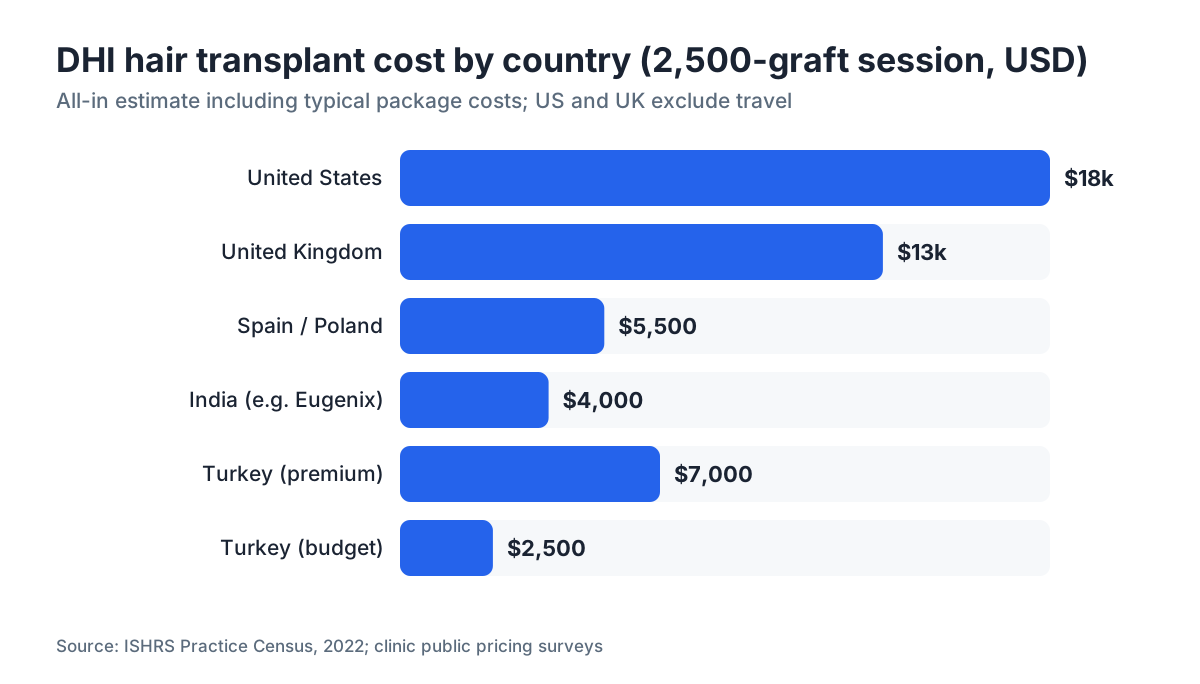
The table below shows rough per-graft and session costs across major destinations.
| Country / Region | Per-graft cost (USD) | Typical 2,500-graft session (USD) | All-inclusive? |
|---|---|---|---|
| United States | $5, $10 | $12,500, $25,000 | Rarely |
| United Kingdom | $4, $8 | $10,000, $20,000 | Rarely |
| Turkey (budget) | $0.60, $1.50 | $1,500, $3,750 | Usually |
| Turkey (premium) | $2, $4 | $5,000, $10,000 | Usually |
| India (e.g. Eugenix) | $1, $2.50 | $2,500, $6,000 | Partially |
| Spain / Poland | $1.50, $3 | $3,750, $7,500 | Sometimes |
These figures reflect publicly quoted clinic pricing across 2024 to 2025 and shift with graft count, surgeon seniority, and case complexity [3][4].
What factors drive the total price of a DHI transplant?
Graft count is the biggest lever. Most DHI sessions run 1,000 to 4,000 grafts, and adding grafts adds cost close to linearly. Some clinics shave the per-graft rate above 3,000 grafts. Many do not.
Surgeon experience and who owns the clinic matter a lot. A practice run by a hair restoration surgeon who personally does extractions and implantations charges more than a tourism factory where a general practitioner signs off on someone else's work. The International Society of Hair Restoration Surgery (ISHRS) has reported that unlicensed or poorly trained practitioners doing transplants is a growing global problem [4].
Geography sets the baseline. Rent, malpractice premiums, and staff wages differ by an order of magnitude. A surgeon paying Manhattan real estate and New York liability rates cannot touch Istanbul pricing.
Case complexity adds cost too. Scalp scarring, tightly coiled hair, or thin donor density relative to the coverage you want all demand more planning and technique. Some clinics charge a flat complexity premium. Others fold it into a higher per-graft rate.
Then there is PRP (platelet-rich plasma), which some clinics bundle and others bill separately at $500 to $1,500 per session. The evidence on PRP as a transplant adjunct is mixed: some trials show a modest bump in graft survival, others show no significant effect [5].
How many grafts do you need and what will it cost at your Norwood stage?
The Norwood scale runs from stage 1 (no visible recession) to stage 7 (only a horseshoe of donor hair left). Any honest DHI cost estimate starts with your Norwood stage, because that sets your graft count.
Norwood 2 to 3 (early hairline recession): 1,000 to 2,000 grafts. At $7 per graft in the US, $7,000 to $14,000. At a reputable Turkish clinic, $3,000 to $5,500.
Norwood 3 to 4 (hairline plus early mid-scalp loss): 2,000 to 3,000 grafts. US range $14,000 to $21,000. Turkey premium range $5,500 to $8,000.
Norwood 4 to 5 (significant crown involvement): 3,000 to 4,500 grafts, often across two sessions. US two-session cost: $20,000 to $35,000.
Norwood 6 to 7: here donor supply, not money, is the ceiling. Many surgeons at this stage pair a transplant with medical therapy like finasteride or minoxidil for men to protect the remaining native hair and get the most from the grafts. Skip that, and a transplant can look great for three years, then lose ground as the surrounding untransplanted hair keeps thinning.
Not sure of your stage? A trichologist or dermatologist can grade it in person. The MyHairline AI scan (/scan) also gives you a free read on your pattern before you pay a consultation fee.
Is DHI worth the extra cost compared to standard FUE?
Honest answer: for most patients, the outcomes match when an experienced surgeon does either one. The published evidence does not show a large, consistent DHI advantage in graft survival or final density [6]. What the literature does support is that DHI can shorten the time grafts spend outside the body, which in theory helps viability. A skilled FUE surgeon narrows that gap anyway.
Where DHI earns its premium: patients who want to keep existing hair in the recipient area without shaving, and patients focused on the hairline, where angle precision shows most. The Choi pen gives finer directional control than a pre-slit blade in less experienced hands.
The trap is overpaying for the label. Some clinics tack on a 20 to 30 percent premium purely for marketing while their technique and team are no different from their FUE. Ask to see before-and-after photos of patients at your exact Norwood stage, and ask how many years post-op those photos are. One-year results flatter the clinic. Two-year results tell the truth.
If budget is tight, a well-run FUE by an experienced surgeon beats a sloppy DHI every time. The method matters less than the hands holding the instruments.
What are the hidden costs of a DHI hair transplant?
The quoted session price is rarely the number you actually spend. Here is what stacks up on top.
Post-op medications: most surgeons prescribe a short antibiotic course, a corticosteroid for swelling, and minoxidil to support early graft survival. US pharmacy costs run $100 to $300 depending on insurance. Abroad you often pay out of pocket, but prices tend to be lower.
Travel and lodging for medical tourism: a round-trip flight to Istanbul runs $600 to $1,200 from the US East Coast across 2024 to 2025. If the package covers only two or three hotel nights when you need four or five, budget $100 to $200 per extra night.
Repair or touch-up sessions: not every transplant nails the density on the first pass. A fill-in session adds cost. Turkish clinics sometimes include a free touch-up within 12 months. Western clinics rarely do.
Long-term medical therapy: this is the cost people underestimate most. Stop finasteride or minoxidil after your transplant and the native hair around your grafts keeps thinning. Many surgeons recommend staying on one or both indefinitely. Finasteride runs $15 to $70 per month depending on generic versus brand Propecia. Topical minoxidil runs about $10 to $30 per month. That is $300 to $1,200 per year, every year, potentially for decades.
Time off work: swelling and scabbing peak at days 3 to 5. Most patients want 5 to 10 days before facing a professional or social setting. Count the lost income or paid leave.
How do you spot a legitimate DHI clinic versus a risky one?
In a 2019 report, the ISHRS estimated the black market for hair transplants harms roughly 58,000 patients per year worldwide, with about $1.7 billion in revenue flowing to illegally operating providers [4]. That is not a number to wave off. It shows up as infections, scarring, unnatural results, and money you never see again.
Green flags: the operating surgeon is named, credentialed, and you can find their real work online. The clinic shows multi-year follow-up photos (18 months and beyond), more than 12-month results. They let you talk to past patients. The quote comes with a written plan listing exact graft-count targets and a recipient zone map.
Red flags: pricing far below regional norms (sub-$1,000 DHI for any meaningful graft count). Vague answers about who actually performs the procedure. Pressure to book today. Before-and-after photos that look like the same three or four faces recycled across the site. No physical address, only a WhatsApp number.
Check credentials through the ISHRS member directory (ishrs.org) or, for US surgeons, the American Board of Hair Restoration Surgery. Membership and certification do not guarantee a good outcome, but their absence in an established practice is a warning worth heeding.
If you are weighing a hair transplant abroad, spend time on a community like the Hair Restoration Network forum first. Real patients post real results there, including the failures.
Should you try non-surgical options before spending on DHI?
If your loss is early and still moving, operating on a shifting target is a bad bet. A transplant relocates hair permanently, but it does nothing to stop the loss of the hair you did not move. Spend $15,000 on DHI at Norwood 3, then need a second session two years later when your crown drops to Norwood 5, and you have made a poor financial call.
The FDA has approved two drug treatments for androgenetic alopecia (pattern hair loss): minoxidil (topical) and finasteride (oral, for men) [7]. Topical minoxidil is approved for both men and women. Finasteride is approved for men only and carries a label warning about sexual side effects, which is real and worth reading before you start [8].
Twelve months on finasteride plus minoxidil before surgery gives you two things. It may slow or partly reverse the loss enough that surgery matters less, and it shows whether your loss has stabilized enough for a transplant result to hold. Many surgeons recommend exactly this order for patients under 30 whose pattern is still evolving.
For a closer look at combination therapy, the evidence behind finasteride and minoxidil together is stronger than either alone. Kaufman and colleagues, writing in the Journal of the American Academy of Dermatology in 2003, found combination therapy produced better hair-count outcomes than either monotherapy in men with androgenetic alopecia [9].
Want to understand what is behind your loss before you decide anything? Start with what causes hair loss.
How do you get an accurate DHI cost estimate before your consultation?
Most clinics will not give you a real number until they see photos of your scalp or meet you in person. Fair enough, because graft count depends on donor density, recipient area size, and hair caliber. You can still narrow the estimate hard before paying a consultation fee.
Step one: photograph your scalp under good light from the top, front, and sides. Clinics that do remote consults (many tourism clinics offer this over WhatsApp or email) will hand you a preliminary graft estimate from photos. Get it in writing.
Step two: get quotes from at least three clinics across two price tiers. The comparison flags the outliers, one clinic high (maybe overcharging for the DHI label), one low (maybe cutting corners on team or aftercare).
Step three: ask every clinic the same questions. Who performs the extraction? Who performs the implantation? How many procedures does the lead surgeon personally do per week? What is in the quote and what is billed on top? What is the touch-up policy?
Step four: price in the non-surgical costs. The MyHairline AI scan (/scan) gives you a starting read on your pattern and stage without a clinic appointment, so you walk into a consultation with a clearer baseline.
Step five: pay no deposit until you have a detailed written treatment plan with the target graft count, the zone map, and the surgeon's name on it.
What results can you realistically expect and when?
Transplanted grafts follow a predictable arc after DHI. Most fall out in the first 2 to 6 weeks (shock loss). New growth starts at 3 to 4 months. By 6 months you can see the shape. By 12 months you have most of the density. By 18 months the result is mature [1].
Graft survival tracks technique and team quality. Well-run clinics report 85 to 95 percent survival [6]. Weaker operations can land at 60 to 70 percent, which means you paid for 3,000 grafts and effectively got 1,800 to 2,100. That is how a $3,000 budget session ends up costing more than a careful $8,000 one, because you need a corrective round.
DHI does not grow new follicles. It relocates existing ones. The transplanted hair keeps the genetic traits of your donor area (usually the back and sides), which is why it keeps growing after the move. The native hair around it that is still thinning will keep thinning. That is why ongoing medical management with a DHT blocker like finasteride belongs in the long-term plan for most patients with androgenetic alopecia.
Sources
- International Society of Hair Restoration Surgery (ISHRS), Practice Census Survey
- HealthCare.gov, Coverage for cosmetic procedures
- ISHRS, 2022 Practice Census Results
- ISHRS, Fight the FIGHT: Illegal Hair Transplants Report 2019
- Gentile P et al., 'Evaluation of Not-Activated and Activated PRP in Hair Loss Treatment', International Journal of Molecular Sciences, 2017
- Navarro R et al., 'Hair Transplant Outcome and Graft Survival', Dermatologic Surgery, 2020
- FDA, Approved Drug Products: minoxidil and finasteride labels
- FDA, Propecia (finasteride) prescribing information and patient label
- Kaufman KD et al., 'Finasteride in the treatment of men with androgenetic alopecia', Journal of the American Academy of Dermatology, 2003
- American Academy of Dermatology, Hair Loss: Diagnosis and Treatment