
TL;DR: ARTAS robotic FUE in India usually costs $2,000 to $6,000 depending on graft count and clinic. The same procedure runs $12,000 to $20,000 in the US or UK. The robot harvests grafts with consistent depth and angle, but a human surgeon still designs your hairline and places every graft. Outcomes track surgeon experience far more than the machine.
What is an ARTAS robotic hair transplant and how does it work?
ARTAS is an FDA-cleared robotic system made by Restoration Robotics (now owned by Venus Concept) that automates the follicular unit extraction (FUE) step of a hair transplant. [1] A camera array maps your scalp in real time, the algorithm picks out healthy follicular units, and a robotic arm punches and extracts each graft with a small circular blade. The point is consistent punch depth and angle, which cuts transection rates compared to manual extraction by a less experienced technician.
What the robot does not do matters just as much. ARTAS does not design your hairline. It does not place grafts into recipient sites. Those two steps, the ones that decide whether the result looks natural, are still done entirely by the surgeon and technicians. So "robotic hair transplant" is marketing shorthand. What you actually get is robotic extraction followed by a human hair transplant.
The system is FDA-cleared specifically for harvesting hair follicles in men with straight or slightly wavy dark brown to black hair. [1] It does measurably worse on very light, very curly, or very fine hair, which narrows who fits. Most Indian patients happen to have the hair texture ARTAS handles best, which is one reason the technology spread through Indian clinics faster than in some Western markets.
A typical ARTAS session harvests 1,500 to 3,000 grafts in a single day. Anything past 3,000 grafts is sometimes split across two days. For what your pattern might need, the Norwood scale gives a rough guide: a Norwood 3 might need 1,500 to 2,000 grafts, a Norwood 5 needs 3,000 to 4,500 or more.
How much does ARTAS robotic hair transplant cost in India?
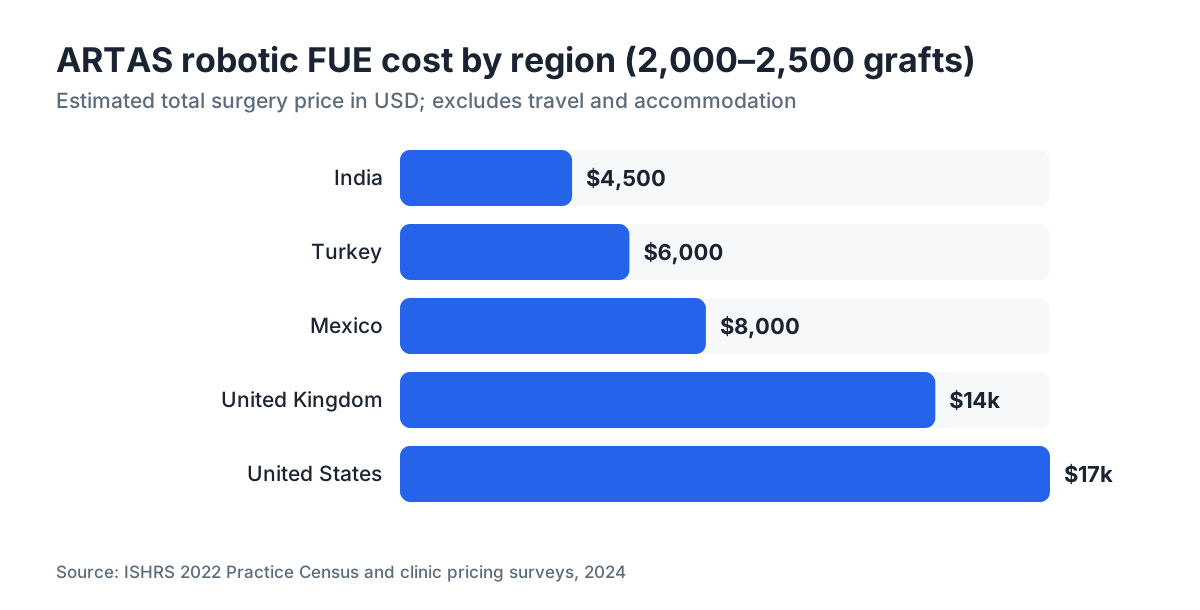
ARTAS in India runs roughly $2,000 to $6,000 for a standard session, against $12,000 to $22,000 for the same graft count in the US or UK. India has no single published price list, and costs vary enough that any one number would mislead you. Based on listed clinic pricing and market reporting through 2024 to 2025, here is a realistic range.
| Graft count | Typical India price (USD) | Typical US/UK price (USD equivalent) |
|---|---|---|
| 1,000 to 1,500 grafts | $1,500, $2,500 | $8,000, $12,000 |
| 1,500 to 2,500 grafts | $2,500, $4,000 | $12,000, $16,000 |
| 2,500 to 3,500 grafts | $4,000, $6,000 | $15,000, $22,000 |
| 3,500+ grafts | $5,500, $8,000 | $18,000, $28,000 |
The savings are real. The gap between India and the US/UK for ARTAS specifically runs about 70 to 80%, driven by lower labor costs, lower clinic overhead, and a weaker rupee against the dollar. A large ARTAS case that costs $18,000 in a major US city can legitimately cost $5,000 to $7,000 at a comparable Indian clinic running the same machine.
Pricing structures differ. Some clinics charge per graft (commonly Rs 80 to 200 per graft, roughly $0.95 to $2.40 at current exchange rates). Others charge a flat session fee. Always ask whether the quote includes the surgeon's fee, anesthesia, post-op medications, and a follow-up visit, because these get billed separately more often than not.
The ARTAS machine itself costs a clinic roughly $250,000 to $350,000 to buy, which is why clinics that own one usually charge a premium over manual FUE, even in India. [2] If a clinic quotes ARTAS pricing identical to their manual FUE pricing, confirm the machine is on-site rather than rented or outsourced.
Standard manual FUE in India (no robot) runs $1,000 to $3,500 for a similar graft count. The ARTAS premium sits around 30 to 60% above manual FUE at the same clinic. Whether that premium earns its keep depends on the benefits below.
What are the real benefits of ARTAS over manual FUE?
Honest answer: the benefits are real but narrower than the ads suggest. The clearest one is graft transection rate.
Transection means the punch cuts through the follicle and damages or kills it. A skilled manual FUE surgeon holds transection rates around 5 to 15%. Published data on ARTAS reports 7 to 12%, which is competitive with an experienced human but not dramatically better. [10] The robot's edge shows up most when the alternative is a green technician, not a seasoned surgeon.
A 2018 study in the Journal of Drugs in Dermatology evaluated ARTAS and found "no significant difference in overall graft survival or patient satisfaction compared to manual FUE when performed by an experienced surgeon," though the robot showed lower variability between grafts. [3] That last point is the actual case for robotic extraction. The machine performs the same way on hour five as on hour one. A tired human may not.
What ARTAS genuinely adds:
- Consistent punch depth and angle across thousands of grafts
- Real-time scalp mapping that adjusts for head movement
- Less fatigue-related error on large sessions
- Fewer handling steps, which can reduce follicle trauma
What ARTAS does not add:
- Better hairline design (still human)
- Better graft placement density (still human)
- Better results in lighter or curlier hair types
- Any real advantage if your surgeon is already excellent at manual FUE
Most specialists are candid that surgeon skill and clinic hygiene matter more than the machine. Given a choice between a mediocre surgeon with ARTAS and an excellent surgeon doing manual FUE, take the excellent surgeon. The robot is a tool. It does not replace experience.
How does ARTAS compare to manual FUE and FUT in India?
Indian clinics offer three main surgical approaches: FUT (strip), manual FUE, and ARTAS robotic FUE. Here is how they stack up on the things patients actually weigh.
| Factor | FUT (strip) | Manual FUE | ARTAS robotic FUE |
|---|---|---|---|
| India cost (2,500 grafts) | $1,200, $2,500 | $2,000, $3,500 | $3,500, $6,000 |
| Linear scar | Yes | No | No |
| Graft yield per session | Very high | High | High |
| Recovery time | 10 to 14 days | 5 to 10 days | 5 to 10 days |
| Works on curly/light hair | Yes | Yes | Limited |
| Surgeon dependency | High | Very high | Moderate (extraction) |
| Best for | Large sessions, tight budget | Most patients | Patients valuing consistency |
FUT is the oldest technique and still gives excellent results in high-volume cases. It leaves a linear scar at the back of the scalp, hidden under longer hair but visible with very short cuts. It is the cheapest option in India and still the pick of some of the world's most respected restoration surgeons for large Norwood 5 to 6 cases.
Manual FUE leaves no linear scar and dominates globally and in India. Quality rides entirely on the person holding the punch. An experienced surgeon doing manual FUE beats ARTAS in most real-world clinics.
ARTAS makes the most sense for patients who value the consistency argument, who worry about technician fatigue on a large session, and who have the hair type the robot handles well. It is a reasonable upgrade when the clinic's manual FUE results are already strong. It is not a patch for a weak surgical team.
For how transplants work in general, including graft survival and density expectations, see our hair transplant guide.
Which clinics in India have the ARTAS system?
ARTAS is less common in India than most people assume from reading about it online. Venus Concept (which acquired Restoration Robotics in 2019) does not publish a full clinic directory for India, and not every clinic advertising robotic FUE actually owns the ARTAS machine. [2] Some run other robotic or motorized systems (NeoGraft, HARRTS) and market them as robotic transplants.
Cities where ARTAS-equipped clinics turn up most often: Mumbai, Delhi, Bengaluru, Hyderabad, and Chennai. A handful in Pune and Ahmedabad list the system too.
Before booking, ask the clinic to confirm: Do you own the ARTAS system, not lease or rent it? How many ARTAS sessions has the lead surgeon done? Can I speak with a past patient or see verified before-and-after photos from ARTAS cases specifically, not general FUE cases?
Verified reviews on RealSelf, Google, or Trustpilot (filtered by recency and detail) beat the testimonials on clinic websites. Look for reviews that name specific surgeons, describe the process in granular detail, and lay out post-op timelines. Vague five-star reviews tell you nothing useful for this decision.
Medical tourism facilitators who focus on hair restoration (not general medical tourism agencies) can help verify credentials, but they usually earn referral fees, so weigh their recommendations with that in mind.
What does the full cost of hair transplant in India include as a medical tourist?
The surgery price is the starting line, not the finish. If you are flying to India for an ARTAS transplant, build the budget from these line items.
Flight: Round-trip from the US or UK to Mumbai, Delhi, or Bengaluru runs roughly $600 to $1,400 depending on origin and timing. From the Middle East or Southeast Asia, $150 to $500.
Accommodation: Plan for at least 7 to 10 nights. The first days post-op you want to be near the clinic. Mid-range hotels around major clinic districts cost $40 to $120 a night. Total: $300 to $1,200.
Local transport: $50 to $150 for the stay.
Post-op medications: Clinics usually supply the first week. Finasteride and minoxidil for long-term maintenance (which you should be on regardless of where you get the transplant, see finasteride and minoxidil for men) are very cheap in India and worth buying before you leave.
Follow-up care at home: Most reputable Indian clinics offer remote follow-up by video call. If you need an in-person check after you get back, budget $150 to $400 for a dermatologist or hair restoration specialist visit.
Realistic all-in cost for a medical tourist getting 2,000 to 2,500 grafts via ARTAS in India: $5,500 to $10,000. That is still 40 to 60% below the same procedure at a comparable US clinic, but well above the surgery price alone.
One cost people forget: if something goes wrong, correction procedures are on you. Get the clinic's written policy on revision cases before you sign anything.
Is an ARTAS robotic hair transplant in India safe?
Safety comes down to the clinic and surgeon, not the country or the machine.
India has a large, well-trained pool of dermatologists and plastic surgeons who specialize in hair restoration, including some genuinely world-class surgeons. It also has clinics where non-physician technicians run most of the procedure, which is a problem no matter what equipment sits in the room. The spread in quality is wider than in countries with stricter enforcement of scope-of-practice rules.
ARTAS itself has a reasonable safety profile. It is FDA-cleared for follicular unit harvesting [1], meaning the agency reviewed manufacturing and clinical data before clearance. Clearance through the 510(k) pathway is not the same as full approval based on randomized trial data. [9] The usual FUE risks apply: temporary numbness, folliculitis, shock loss (temporary shedding of existing hair, which usually resolves, see telogen effluvium), and in rare cases poor graft survival or unnatural density.
ARTAS-specific risks include the robot mistaking fine border hairs for extractable follicles, and trouble adapting to scalp laxity changes over a long session. Good pre-procedure mapping and an attentive surgical team keep these manageable.
What to verify before booking any Indian clinic:
- The operating surgeon holds an MCh, MS, or DNB in plastic surgery, or a DrNB/DNB in dermatology with formal hair transplant training. Not an MBBS with a weekend course.
- The clinic holds registration under the Clinical Establishments (Registration and Regulation) Act, 2010 if it operates in a registered state. [4]
- The procedure happens in a facility with sterile field conditions, not a converted consultation room.
- They keep an on-site protocol for anaphylaxis and other anesthesia emergencies.
How do results compare between ARTAS in India vs the US?
The machine is identical. What differs is surgeon experience, clinic standards, and patient selection.
Indian clinics with real ARTAS experience (50+ cases a year on the system) report graft survival and density outcomes on par with what top US clinics report. [3] The honest caveat: outcome data from Indian clinics is largely self-reported, and no large independent trial has compared Indian versus US ARTAS results head-to-head.
Patient outcomes track three things: the surgeon's total hair transplant experience (more than just ARTAS cases), the clinic's graft handling and storage during the procedure, and the patient's own hair characteristics (donor density, recipient area size, hair caliber). None of those are country-specific.
The steady risk in medical tourism for any elective surgery is the harder in-person follow-up if something goes wrong. A persistent infection, keloid formation, or uneven growth at 6 months is tough to manage from 8,000 miles away. That is not a reason to skip Indian clinics. It is a reason to pick one with a clear, documented remote follow-up protocol and to line up a domestic hair restoration specialist you can see locally if needed.
If you are unsure about your loss pattern or whether you are even a good transplant candidate yet, get a baseline assessment first. MyHairline's free AI hair scan at myhairline.ai/scan can characterize your pattern and flag whether your loss looks stable or still moving, which matters a lot for transplant timing.
Who is a good candidate for robotic FUE in India?
Not everyone benefits from ARTAS specifically, and not everyone benefits from any transplant right now.
ARTAS performs best on straight to moderately wavy hair, dark brown to black color, and good contrast between hair and scalp. Light blond, gray, white, and tightly coiled hair all give the camera system more trouble, and transection rates climb. [1] If your hair fits one of those types, manual FUE with an experienced surgeon is the better call regardless of cost.
Beyond hair type, good candidates share a few things: stable hair loss (not actively shedding large amounts), adequate donor density at the back and sides (a dermatologist can measure this), realistic expectations about final density (transplants improve coverage but do not bring back teenage density), and ideally already using finasteride or DHT blockers to slow ongoing loss. Transplanting into a pattern that is still charging ahead wastes grafts.
Age matters too. Most surgeons stay cautious about transplanting men under 25 because the final loss pattern is not set yet. Transplant a 22-year-old Norwood 2 who lands at Norwood 5 by 35, and the result looks less natural every year.
If you do not know what is causing your loss or whether it has stabilized, reading about what causes hair loss is a useful first step before committing to any procedure. For men with pattern loss, surgeons often recommend the combination of finasteride and minoxidil before a transplant to stabilize the field first.
What should you ask before booking an ARTAS clinic in India?
The questions that actually protect you are not the ones most people ask.
Most people ask: How much does it cost? How many grafts do I need? Do you have before-and-after photos? Fair questions. Not enough.
Ask these instead:
-
Who physically does the extraction with ARTAS, the surgeon or a technician? At some clinics the surgeon designs the session and oversees the robot, then hands off to a technician for most of the extraction. Know exactly who is in the room and what they are doing.
-
What is your transection rate on ARTAS cases? A clinic that tracks and can cite this number (ideally under 10%) takes outcomes seriously.
-
How do you store grafts during extraction? Time out of the body matters. Grafts should sit in a chilled holding solution. ATP-based solutions like HypoThermosol or Plasmalyte beat plain saline for survival. [5]
-
What happens if I am unhappy with density at 12 months? Is a touch-up included or discounted?
-
What is your protocol if I have a complication after I fly home? Do you coordinate with a local physician, or am I on my own?
-
Can I get a written breakdown of everything included in the quoted price?
A clinic that gets evasive answering any of these is telling you something. Good clinics have clear answers to all of them because they have thought through these scenarios many times.
What happens after ARTAS surgery and how long until you see results?
Recovery from ARTAS FUE is essentially the same as manual FUE, because the donor and recipient areas heal by the same process.
Days 1 to 3: Swelling around the forehead and eyes is common. Small scabs form at each punch site and recipient site. You will look noticeably different and should plan to stay indoors.
Days 4 to 10: Scabs start falling off. Do not pick them. Graft sites look pink, and the transplanted hairs may look like they are growing, but that is temporary.
Weeks 2 to 8: Shock loss. Most transplanted hairs fall out. This is expected and does not mean the procedure failed. The follicles are still alive underneath. [5] This phase panics a lot of patients. See the section on telogen effluvium for why it happens.
Months 3 to 6: New hairs start emerging, thin and fine at first.
Months 6 to 12: Hairs thicken and the result shows up. Most patients see 60 to 70% of their final result by month 9.
Months 12 to 18: Final result. A few patients keep improving out to 18 months.
Here is what decides long-term success. If you are not already on finasteride (for men with androgenetic alopecia) or another DHT-blocking approach, the native hairs around your transplant will keep thinning. Transplanted hairs resist DHT because they come from the donor zone. Your surrounding native hair does not. Without maintenance medication, many patients watch their transplant look progressively islanded over the years. That is not a surgical failure. It is the biology of pattern hair loss. Sort out your maintenance plan with a dermatologist before the procedure, not after.
Sources
- FDA Medical Devices, Device Classification and 510(k) clearance overview (ARTAS System, Restoration Robotics)
- Venus Concept, ARTAS iX robotic hair restoration system
- Journal of Drugs in Dermatology, 2018, Rose PT, robotic hair restoration evaluation
- Ministry of Health and Family Welfare, Government of India, Clinical Establishments Act 2010
- International Society of Hair Restoration Surgery (ISHRS), FUE graft handling and storage guidance
- American Academy of Dermatology (AAD), Hair loss diagnosis and treatment overview
- National Institutes of Health, National Library of Medicine, Androgenetic alopecia review (StatPearls)
- ISHRS, Practice Census Survey on global hair restoration procedures
- FDA Medical Devices, Premarket Notification 510(k) overview
- National Institutes of Health, National Library of Medicine, follicular unit extraction outcomes and transection rates review