
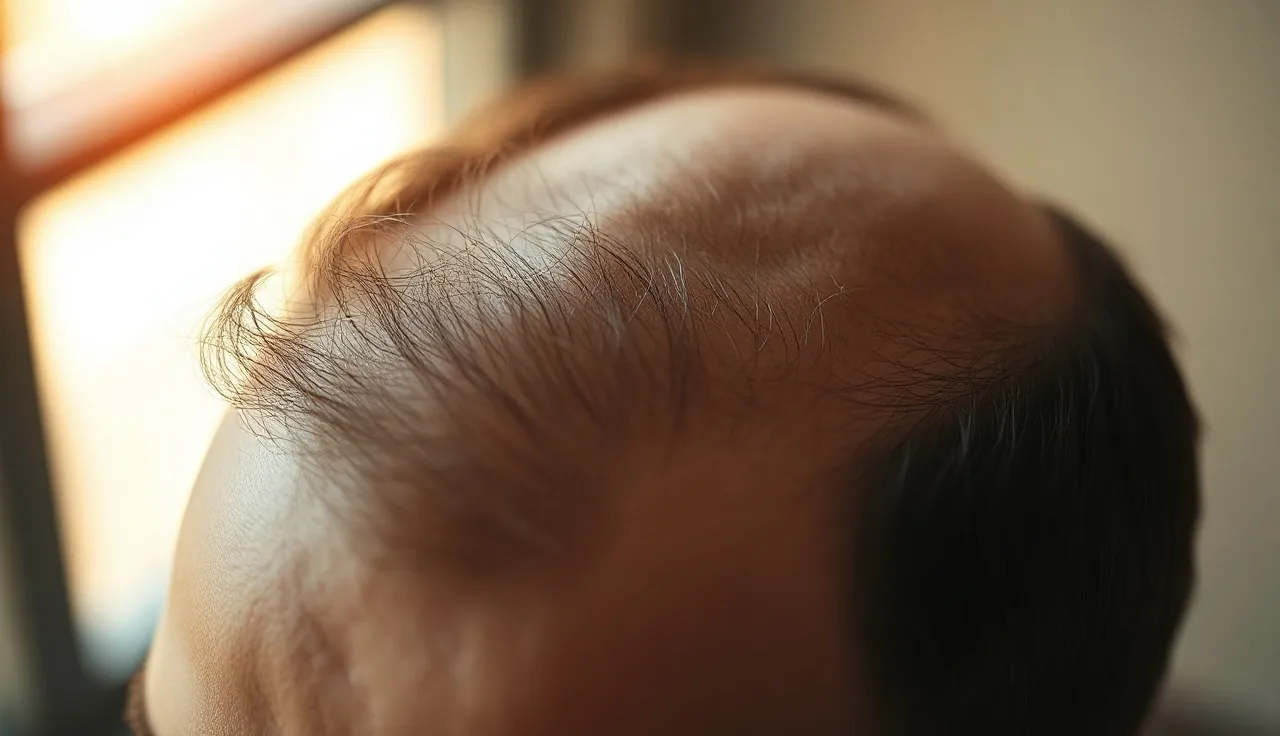
TL;DR: DHT (dihydrotestosterone) is a hormone your body makes from testosterone using an enzyme called 5-alpha reductase. In genetically sensitive follicles, DHT shortens the growth cycle and slowly shrinks the follicle until it stops making visible hair. Finasteride and minoxidil are the only FDA-approved treatments. Both work, neither cures anything, and stopping either one reverses the gains within a year.
What is DHT and where does it come from?
DHT stands for dihydrotestosterone. It's an androgen, a male-type sex hormone, and your body makes it when an enzyme called 5-alpha reductase (5-AR) converts testosterone inside your tissues. That conversion happens in the scalp, skin, liver, and prostate, among other places.
Both men and women make DHT. Men make far more, which is why androgenetic alopecia (pattern baldness) is more common and more severe in men. But women have 5-AR in their scalp tissue too, and DHT drives female hair loss at the temples and the widening central part that marks female pattern hair loss.
DHT binds to androgen receptors about five times more strongly than testosterone does [1]. That strength is the whole problem. The hormone latches onto receptors in genetically sensitive follicles, switches on genes that cut the anagen (growth) phase short, and over several cycles the follicle shrinks. A thick terminal hair becomes a fine, colorless vellus hair. Eventually the follicle may quit cycling entirely.
Here's the precise part that matters. DHT does not kill follicles outright. It suppresses them. That distinction drives everything about treatment, because suppressed follicles can often be woken back up if you act early enough.
How does DHT actually shrink hair follicles?
DHT shrinks follicles by disrupting the growth signals at the follicle's base. When it binds the androgen receptor in a dermal papilla cell (the signaling cluster at the root of the follicle), it turns up production of DKK-1, a protein that blocks Wnt signaling [2]. Wnt signaling is what keeps follicles in the anagen (growth) phase. Block it, and the follicle drops early into catagen (regression) and then telogen (rest).
Over repeated short cycles, the follicle physically shrinks. The dermal papilla loses volume. The shaft narrows. Each new hair comes in thinner and shorter than the last. Dermatologists call this follicular miniaturization, and it shows up under a trichoscope as a mix of thick and thin hairs in the same patch of scalp. That variation in shaft diameter is one of the signs they look for.
Genetics decides which follicles carry androgen receptors sensitive enough to react this way. That's why two brothers with identical testosterone and DHT levels can end up in different places: one bald at 25, the other still full at 60. The gene for the androgen receptor sits on the X chromosome, which is part of why a bald maternal grandfather is sometimes predictive. But the inheritance is polygenic (many genes at work), not a tidy single-gene rule [3].
One point most articles skip: scalp DHT levels don't track blood DHT levels. A man with perfectly normal serum DHT can still have high 5-AR activity right there in his scalp. This is why a blood test for DHT tells you almost nothing about pattern baldness.
What does DHT-related hair loss look like?
DHT-driven hair loss is slow, patterned, and follows a map. In men it tracks the Norwood scale, usually starting at the temples or the crown, sometimes both at once. The hairline pulls back while the crown thins, and over years (sometimes decades) the two zones can meet in the middle. A receding hairline that started in your early 20s and has crept along ever since is almost certainly androgenetic alopecia.
Women lose it differently. The Ludwig scale fits better. Hair thins across the top of the scalp, the part widens, and the frontal hairline usually stays put. DHT female hair loss tends to spread diffusely across the crown rather than come out in patches. Some women get temple recession too, especially after menopause when estrogen drops and androgens carry relatively more weight. The temples and frontal hairline are the areas that most closely mirror male pattern loss.
Neither pattern shows up overnight. Miniaturization is gradual. Many people don't notice until they've lost 40 to 50 percent of the density in an area, because the remaining hairs shift and the scalp's visual coverage changes slowly [4]. Photos a year apart tell you more than a daily glance in the mirror.
If your hair came out fast, over weeks or a couple of months, DHT is probably not the culprit. Sudden diffuse shedding points more toward telogen effluvium, set off by stress, illness, or a nutritional gap. DHT loss creeps.
Who is most at risk from DHT hair loss?
Men with a family history of pattern baldness on either side of the family carry the highest risk. Both sides matter, despite the old wives' tale about the mother's father. Androgenetic alopecia is the most common form of hair loss, hitting roughly 50 percent of men by age 50 and up to 70 percent by age 70, based on population data behind Hamilton and Norwood's classification work [3].
Women get it less often but are far from safe. Estimates vary, but population studies suggest about 30 percent of women will have noticeable female pattern hair loss by age 70 [5]. Postmenopausal women sit at the top of the risk list, because falling estrogen removes some of its partial blocking effect on androgens.
Women with polycystic ovary syndrome (PCOS) run high androgen levels, and thinning at the crown or temples is a common sign. If you're a woman with hair loss plus irregular periods, acne, or extra facial hair, get your androgen levels tested before you start any hair loss treatment.
Men on anabolic steroids or testosterone replacement therapy (TRT) often speed up DHT-related loss, because the extra testosterone hands 5-AR more raw material to convert. Some see rapid shedding within months of starting TRT. There's also early chatter about whether creatine raises DHT, though that rests on a single 2009 trial in rugby players and nothing solid since. If that question is on your mind, does creatine cause hair loss walks through it.
What treatments actually block DHT?
Two treatments carry FDA approval for androgenetic alopecia, they work through different mechanisms, and they're often used together.
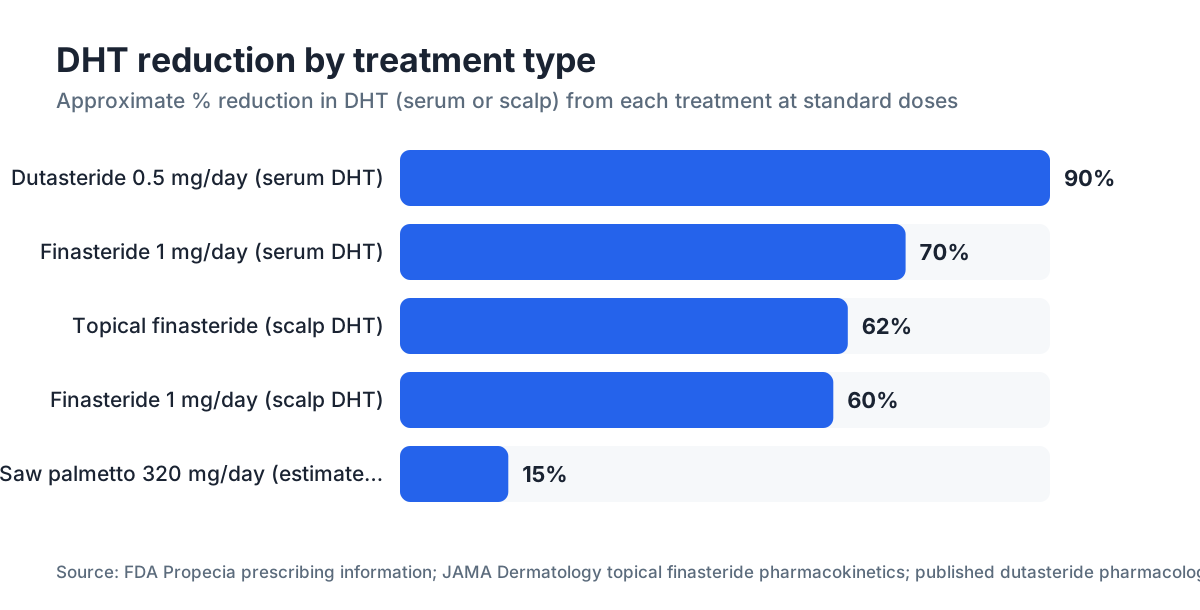
Finasteride is a 5-alpha reductase inhibitor. It blocks 5-AR type 2, the version most active in scalp tissue, cutting serum DHT by roughly 70 percent and scalp DHT by up to 60 percent at the standard 1 mg/day oral dose [6]. Randomized controlled trials show it slows hair loss in about 83 percent of men and grows visible hair back in about 66 percent over two years. The largest five-year trial found the placebo group kept losing hair while the finasteride group held its density [11]. It's prescription-only in the US.
The FDA label puts it plainly. Finasteride 1 mg was shown in clinical trials "to slow the progression of hair loss and to promote hair regrowth" in men with mild to moderate androgenetic alopecia [6]. That's a direct quote from the prescribing information, and worth remembering the next time you read a claim that it does much more or much less.
For a full breakdown of how it works and what the side effect data really shows, see our piece on finasteride.
Minoxidil doesn't block DHT at all. It works another way: it opens potassium channels in follicle cells and boosts blood flow around the follicle, which stretches out the anagen phase. Pair it with DHT blockade and you're hitting two different problems at once, which is why finasteride and minoxidil together beat either one alone in the trial data.
Dutasteride blocks both 5-AR type 1 and type 2, drops DHT harder (by about 90 percent), and is approved for hair loss in Japan, South Korea, and several other countries. In the US it's prescribed off-label. More DHT suppression may mean more effect, but it can also mean a higher chance of side effects.
Topical finasteride, rubbed into the scalp, is a newer option that reaches scalp DHT while keeping systemic exposure low. Studies show real scalp DHT reduction with much lower blood levels than the oral pill [7]. You can get it in some countries and through some US compounding pharmacies, though it has no FDA approval for this use as of 2025.
For women, finasteride isn't FDA-approved for hair loss, though doctors sometimes use it off-label in postmenopausal patients. Spironolactone, a potassium-sparing diuretic with anti-androgen effects, gets prescribed more often for women with androgen-related loss and has a decent evidence base. Minoxidil 2 percent topical is FDA-approved for women, and the 5 percent version is used off-label.
What about natural DHT blockers? Do any of them work?
Natural DHT blockers mostly promise more than the evidence delivers. Saw palmetto (Serenoa repens) is the most studied natural 5-AR inhibitor, and the evidence is mixed rather than empty. A 2021 review in the Journal of Cosmetic Dermatology found modest benefit in some trials, though the studies are small and all over the place on dose and formulation [8]. If finasteride is off the table for you and you want to try something, saw palmetto at 320 mg/day is the lowest-risk pick in this category. The effect is meaningfully smaller than finasteride's.
Pumpkin seed oil raised hair counts in a small randomized trial in men. One trial with 76 participants is thin ground to stand on.
Ketoconazole shampoo (1 percent OTC, 2 percent by prescription) has some evidence as a helper treatment. It cuts scalp DHT indirectly by calming Malassezia-related scalp inflammation, which can make miniaturization worse. It's no primary treatment, but it's reasonable to add.
Biotin, collagen supplements, and most herbal blends sold as "DHT blockers" have no credible evidence for preventing DHT-driven hair loss. The marketing leans on the word "supports" precisely so it never has to make a real efficacy claim. Our roundup of hair loss supplements breaks down what's behind each category, and what isn't.
If you're a man with genuine androgenetic alopecia, nothing natural comes close to finasteride in the trial data. That doesn't make finasteride right for everyone. Just be honest with yourself about the trade you're making.
How does DHT hair loss differ from other types of hair loss?
Not all hair loss is DHT-driven, and the treatments split hard by cause. Misdiagnosing yourself burns months of money while the loss keeps going.
Androgenetic alopecia (DHT-driven) is slow, patterned, and permanent without treatment. It follows predictable Norwood or Ludwig patterns. The scalp skin looks normal. A biopsy shows miniaturized follicles.
Telogen effluvium is diffuse shedding set off by a physiological shock: surgery, illness, childbirth, or severe stress. Hair comes out in handfuls a few months after the trigger. Scalp looks normal, follicles look normal, and hair usually grows back on its own. It has nothing to do with DHT.
Alopecia areata is autoimmune. The immune system attacks follicles, leaving round or irregular bald patches. No DHT blocker touches it [10].
Traction alopecia comes from repeated mechanical pull, common with tight hairstyles. Also not DHT-driven.
Frontal fibrosing alopecia (FFA) can look like a receding hairline but is a scarring alopecia where inflammation destroys the follicles. It hits postmenopausal women disproportionately and is showing up more often. Finasteride is sometimes used in treatment, oddly, but not for DHT blockade. Its mechanism in FFA isn't fully understood.
The short version: if your loss is diffuse, sudden, patchy, or comes with scalp redness or scarring, see a dermatologist before you buy anything. Getting the diagnosis right is the single most useful move you can make.
Can DHT hair loss be reversed, or only slowed?
Both, and it depends entirely on how far along you are. Most articles get this wrong by landing on either too much hope or too little.
Early miniaturization is partly reversible. Follicles that are shrunken but still cycling can often push out thicker hairs again once DHT stimulation drops. That's what the regrowth in finasteride trials actually is: miniaturized follicles clawing back some function.
Late-stage loss is not. Once a follicle has sat dormant for years and scar tissue has moved in, no medication brings it back. The window for medical treatment is roughly the stretch where you can still spot fine, short, thin hairs in the thinning zone. When an area goes completely smooth and follicle-free, pills and foam won't resurrect anything.
Hair transplant surgery moves follicles from the donor zone (the back and sides, which are genetically resistant to DHT) into the thinning areas. Those transplanted follicles keep their DHT resistance. But the native follicles around them keep miniaturizing unless you treat them, which is why most surgeons want you on finasteride or minoxidil after a transplant to protect what's still there. More on that at hair transplant.
Here's the honest version. DHT blockers are maintenance drugs. They work as long as you take them. Stop finasteride and most of the DHT-protected regrowth sheds out within six to twelve months. There's no finish line where you've done enough and can quit. Weigh that before you start.
How do you know if DHT is causing your hair loss?
Diagnosing androgenetic alopecia is mostly pattern recognition plus history. A board-certified dermatologist can usually spot it on sight, often with a dermatoscope to check for follicular miniaturization. Men don't need a blood test to confirm male pattern hair loss.
Women need a bigger workup, because DHT-driven loss and other causes overlap more. A dermatologist or endocrinologist may check serum DHT, total testosterone, free testosterone, DHEAS, prolactin, thyroid function (TSH), and ferritin (low iron is a separate, very common cause of thinning in women). Not every woman needs all of these. The point is that female hair loss at the temples or crown deserves more digging than the same picture in a man.
If you're not sure what you're looking at in your own scalp photos, the free AI analysis at MyHairline can give you a Norwood or Ludwig stage estimate and flag whether the pattern matches androgenetic alopecia, before you spend on a dermatology visit or start treatments that might not fit your type of loss.
Blood DHT tests in men rarely help diagnose androgenetic alopecia. Scalp DHT activity doesn't reliably track serum DHT. Plenty of men with hair loss have perfectly normal blood DHT, because the problem is receptor sensitivity, not hormone level. What causes hair loss covers the full differential if you're trying to place your own situation.
What is the DHT blocker landscape for women specifically?
DHT female hair loss is real, common after menopause, and undertreated, partly because fewer options carry FDA approval for women.
Minoxidil 2 percent topical is FDA-approved for women with androgenetic alopecia. The 5 percent version is approved only for men, though many dermatologists prescribe it off-label for women when 2 percent isn't cutting it. Low-dose oral minoxidil (0.25 to 1.25 mg/day) is also used off-label in women and has shown good results in several trials [9]. Oral minoxidil covers that evidence.
Spironolactone 100 to 200 mg/day is the most commonly prescribed anti-androgen for women with androgenetic alopecia in the US. It blocks androgen receptors and lowers ovarian androgen production. It's not FDA-approved specifically for hair loss but has a solid stack of observational and trial data [12]. It can't be used in women who are pregnant or trying to conceive.
Finasteride is sometimes used off-label in postmenopausal women. A few small trials show it can help, but the evidence is weaker than in men, and prescribers stay cautious because of teratogenicity risk (birth defects if a pregnant woman is exposed).
Ketoconazole shampoo plus topical minoxidil is a common starting point for women who want to avoid systemic medication. It's a reasonable conservative move, though the effect is smaller than systemic treatment.
If you're a woman and your temples have been thinning, that pattern (temples, frontal hairline, or a wide central part) is often the first visible sign of androgen-driven loss, and it responds to the same treatments. It's not a separate condition.
What does treatment actually cost, and is it worth it?
Generic oral finasteride runs roughly $10 to $30 a month in the US, depending on the pharmacy and dose. Brand-name Propecia is effectively irrelevant now because the generic is equivalent. That makes finasteride one of the cheapest long-term prescriptions in medicine relative to what it does.
Topical minoxidil (generic Rogaine) costs $15 to $40 a month for the 5 percent foam or solution. Oral minoxidil, prescribed off-label, is cheaper still: under $10 a month at many pharmacies. Minoxidil for men has a deeper breakdown of formulations and what the trials say about each.
Doing nothing has a cost too. Hair transplant surgery in the US typically runs $4,000 to $15,000 or more depending on graft count and clinic, and it works best once you've stabilized the underlying loss with medication first. Starting meds early and staying on them is almost always cheaper than surgery alone.
Side effects are a fair concern, especially with finasteride. Sexual side effects (lower libido, erectile dysfunction) showed up in 1.4 to 3.8 percent of men in clinical trials, per the original approval studies submitted to the FDA [6]. Post-finasteride syndrome (side effects that persist after stopping) gets reported anecdotally and is under active study, but the prevalence from rigorous data isn't established. That uncertainty is real and shouldn't be waved away. Minoxidil side effects covers the risk profile of the other option for comparison.
For women, spironolactone runs roughly $10 to $20 a month and needs annual checks for potassium and blood pressure. The cost-to-benefit math is favorable for women with confirmed androgenetic alopecia or PCOS-related loss.
Sources
- Journal of Investigative Dermatology: DKK-1 and Wnt signaling in DHT-induced follicle miniaturization
- American Academy of Dermatology, Androgenetic Alopecia overview
- British Journal of Dermatology: visible hair loss threshold and follicle density
- Journal of the American Academy of Dermatology: prevalence of female pattern hair loss
- JAMA Dermatology: topical finasteride pharmacokinetics and scalp DHT reduction
- Journal of Cosmetic Dermatology: saw palmetto review for androgenetic alopecia
- Journal of the American Academy of Dermatology: oral minoxidil for female pattern hair loss
- National Institute of Arthritis and Musculoskeletal and Skin Diseases (NIAMS): alopecia areata overview
- New England Journal of Medicine: finasteride efficacy in male androgenetic alopecia
- Journal of the American Academy of Dermatology: spironolactone for female pattern hair loss