
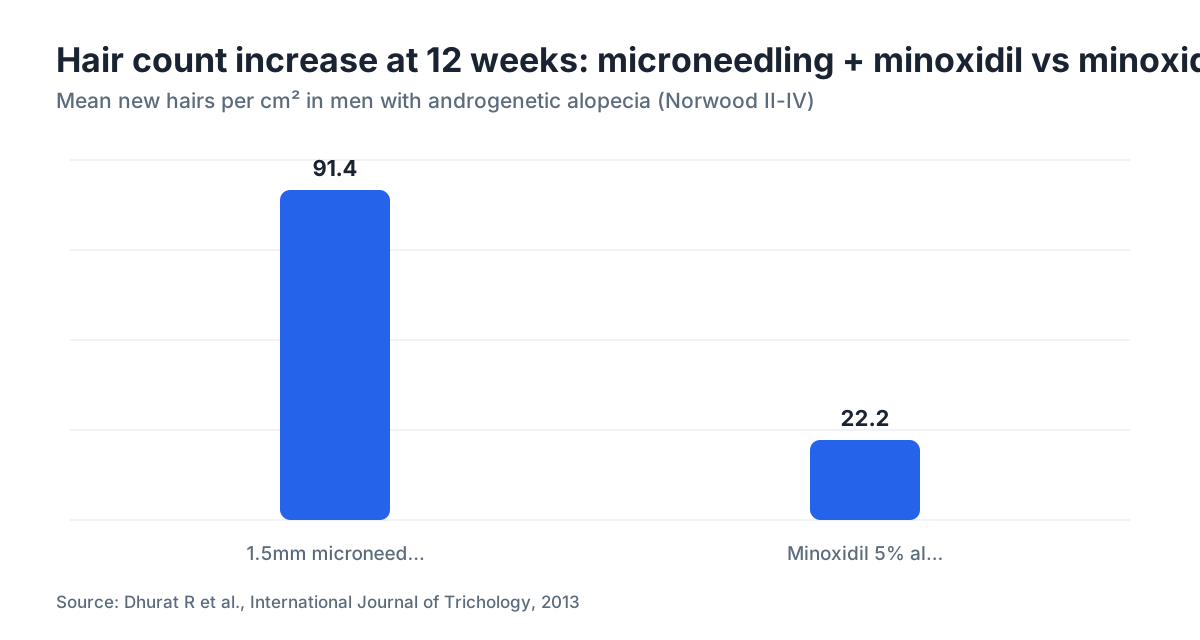
TL;DR: Depth matters a lot. Clinical trials consistently show 1.5mm microneedling produces significantly more hair regrowth than shallower depths like 0.5mm, especially alongside minoxidil. The 2013 Dhurat trial found a 1.5mm roller produced a mean increase of 91.4 hairs per cm² vs 22.2 with minoxidil alone. Shallower passes (0.5mm) are safer for beginners but show weaker evidence for androgenetic alopecia specifically.
What does microneedling actually do to a hair follicle?
Microneedling, also called percutaneous collagen induction, uses tiny needles to create controlled micro-injuries in the scalp skin. The idea is not complicated: wound the tissue just enough, and the body responds with a repair cascade that includes growth factor release, stem cell activation near the follicular bulge, and increased local blood flow.
For hair specifically, researchers believe the main mechanism involves upregulation of Wnt/beta-catenin signaling, a pathway that drives the anagen (active growth) phase of the hair cycle [1]. A 2013 randomized controlled trial by Dhurat et al. published in the International Journal of Trichology described it this way: the process leads to "overexpression of hair growth-related genes" including vascular endothelial growth factor (VEGF) and beta-catenin [1].
None of this happens at the surface. The epidermis alone is roughly 0.1mm thick. The sebaceous gland and upper follicle sit at about 0.5mm. The dermal papilla, the actual engine of hair growth, lives at 1.0 to 2.0mm depth depending on scalp location and individual anatomy [2]. So the question of which depth you use is really a question of which structures you are actually reaching.
The distinction matters more than most people using a home dermaroller realize.
How does 0.5mm microneedling compare to 1.5mm for hair regrowth?
The most-cited head-to-head data comes from the Dhurat et al. 2013 randomized controlled trial, which assigned 100 men with androgenetic alopecia to either weekly 1.5mm microneedling plus minoxidil or minoxidil alone [1]. At 12 weeks, the microneedling group gained a mean of 91.4 hairs per cm² vs 22.2 in the minoxidil-only group. That is roughly a fourfold difference in hair count.
The trial used 1.5mm, not 0.5mm. No large RCT has run a direct 0.5mm vs 1.5mm head-to-head with hair count as the primary outcome, which is an honest gap in the literature. What we have instead is mechanistic logic and a handful of smaller studies.
A 2021 review in the Journal of the American Academy of Dermatology noted that depths below 0.5mm primarily affect the epidermis and produce minimal dermal injury, while 1.0 to 1.5mm depths reliably reach the papillary and upper reticular dermis where follicular stem cells and dermal papilla cells reside [2]. A 0.5mm needle almost certainly does not reach the dermal papilla in most scalp zones.
Practically, that means 0.5mm microneedling may still help topical minoxidil absorb by disrupting the stratum corneum, which is genuinely useful [3]. But it is unlikely to trigger the same growth-factor cascade that the clinical literature attributes to deeper needling. Think of 0.5mm as a drug-delivery tool and 1.5mm as both a delivery tool and a direct biological signal to follicle-supporting cells.
| Depth | Structures reached | Primary use case | RCT evidence for hair? |
|---|---|---|---|
| 0.5mm | Epidermis, upper dermis | Topical absorption enhancement | Limited |
| 1.0mm | Mid-dermis, upper follicle | Intermediate option | Minimal |
| 1.5mm | Deep dermis, follicular bulge/papilla zone | Direct growth factor signaling | Strongest (Dhurat 2013) [1] |
| 2.0mm+ | Deep dermis, subcutaneous border | Scar/cosmetic use; risk rises | Not studied for hair specifically |
What did the best clinical trial actually find?
The Dhurat et al. 2013 trial in the International Journal of Trichology is the study everyone cites, and for good reason [1]. It was a randomized, evaluator-blinded study of 100 men aged 20 to 35 with Norwood-Hamilton grade II to IV androgenetic alopecia. The microneedling group used a 1.5mm dermaroller once weekly alongside twice-daily 5% minoxidil solution. The control group used minoxidil alone.
At week 12, the microneedling plus minoxidil group had a mean hair count increase of 91.4 hairs per cm². The minoxidil-only group gained 22.2 hairs per cm². On a seven-point patient satisfaction scale, 82% of the microneedling group rated their improvement as "greater than 50%" vs 4.5% in the control arm.
The study's limitation is that it did not test microneedling alone, so you cannot fully separate the contribution of the depth from its combined effect with minoxidil. That said, the authors concluded that microneedling was "a safe, effective and simple therapeutic option for alopecia" and pointed to Wnt pathway activation as the likely driver [1].
A 2020 systematic review in Dermatologic Surgery analyzed controlled studies on microneedling for alopecia and found consistent benefit vs controls, with 1.5mm being the most-used depth across studies showing positive results [4]. No study in that review using only 0.5mm showed results comparable to the 1.5mm literature.
Does microneedling depth also affect how well minoxidil absorbs?
Yes, and this is where shallower needles still earn their place. The stratum corneum, the outermost layer of skin, is the main barrier stopping topical minoxidil from reaching the scalp efficiently. Even 0.3 to 0.5mm needling disrupts this barrier enough to meaningfully increase drug penetration [3].
A 2019 study in the Journal of Cosmetic Dermatology showed that microneedling increased topical minoxidil permeation in ex-vivo skin models, though the effect was larger with deeper needles [3]. The clinical implication is that if your only goal is getting more minoxidil through the skin, 0.5mm may be enough. If your goal is stimulating follicular biology directly, you need to go deeper.
For men and women using minoxidil for men or topical minoxidil, combining it with 1.5mm microneedling is supported by the best available evidence. Timing matters too: applying minoxidil right after microneedling raises absorption but also raises systemic uptake and the chance of irritation. Most dermatologists currently recommend waiting 24 hours after a microneedling session before applying minoxidil, though the Dhurat protocol applied it the same day [1]. Check with your provider on timing.
If you are curious about minoxidil side effects before combining it with microneedling, that is worth reading first.
Is 1.5mm safe to use at home, or do you need a professional?
This is where many people get into trouble. A 1.5mm needle depth is clinically effective but carries real risks if technique is poor, the device is not sterile, or the person using it does not know scalp anatomy.
The scalp has a dense vascular supply. Aggressive passes at 1.5mm can cause bleeding, post-inflammatory hyperpigmentation (especially on darker skin tones), scarring if sessions are too frequent, and infection if the device is reused without proper sterilization [5]. The American Academy of Dermatology notes that microneedling performed by untrained individuals with inadequately sanitized devices carries infection risk [5].
Professional devices (electric pens with single-use needle cartridges) allow much more controlled depth, speed, and pressure than home rollers. Home rollers at 1.5mm tend to be riskier than professional pen-based devices at the same nominal depth because the actual penetration varies with pressure, angle, and scalp contour.
Practically: if you want to try 1.5mm, a dermatologist or trained aesthetician using a professional microneedling pen is the lower-risk path. If you are self-treating at home, 0.5 to 0.75mm with a clean, fresh-needle roller used no more than once a week is where most self-directed protocols land. You get some benefit, you cut the risk. The tradeoff is real.
Frequency matters as much as depth. The dermal wound-healing cycle takes about four to six weeks to complete [6]. Running 1.5mm sessions more often than every two to four weeks likely does more harm than good, disrupting healing before it finishes.
What does microneedling depth mean for women with hair loss?
Most of the controlled trial data was collected in men with androgenetic alopecia, so extrapolating to women takes some caution. Women's scalp anatomy is broadly similar, and the follicular biology is the same, but female pattern hair loss has a different hormonal driver and tends to present as diffuse thinning rather than a receding hairline [7].
A 2022 open-label study published in the Journal of Cosmetic Dermatology enrolled women with female pattern hair loss and treated them with 1.5mm microneedling plus 5% minoxidil, reporting mean hair density increases comparable in proportion to the male data, though the study was uncontrolled and smaller [11].
For women whose hair loss stems from telogen effluvium rather than pattern loss, the picture is even less clear. Telogen effluvium resolves on its own once the trigger is removed, and microneedling is not an established treatment for it. Depth recommendations in that context are essentially unsupported by any trial.
If you are unsure what is driving your shedding, understanding what causes hair loss is a genuinely useful starting point before spending money on any device.
How does microneedling compare to other hair loss treatments?
Microneedling is not a standalone replacement for proven medical treatments like minoxidil or finasteride. The evidence hierarchy matters here.
Minoxidil (topical and oral) has decades of FDA-approved use for androgenetic alopecia [8]. Finasteride has FDA approval for male pattern hair loss since 1997 [9]. Both have larger, longer, and more rigorous trial databases than microneedling. Microneedling's strongest evidence position is as an adjunct, not a monotherapy.
That said, microneedling plus minoxidil appears to outperform minoxidil alone in every controlled trial that has tested the combination [1, 4]. For people who have plateaued on minoxidil, adding 1.5mm sessions may revive response. For people considering a hair transplant, microneedling does not replace surgery for significant hair loss but may improve the density of transplanted follicles in early post-op phases (some clinics use it for this; the evidence is preliminary).
Finasteride and DHT blockers target the hormonal cause of androgenetic alopecia at the root. Microneedling does not affect DHT levels. Using them together is mechanistically logical and clinically practiced, though no large RCT has specifically compared the triple combination of finasteride, minoxidil, and microneedling against dual therapy.
Combining finasteride and minoxidil is already considered the most effective non-surgical approach for male pattern hair loss. Adding microneedling is the next layer some people try.
For a side-by-side view of treatment efficacy from the literature:
| Treatment | Trial design | Hair count increase | Notes |
|---|---|---|---|
| Minoxidil 5% alone | RCT (Dhurat 2013) [1] | +22.2 hairs/cm² at 12 wks | Active control arm |
| 1.5mm microneedling + minoxidil 5% | RCT (Dhurat 2013) [1] | +91.4 hairs/cm² at 12 wks | Best microneedling data |
| Finasteride 1mg | Multiple RCTs | ~10-15% density increase over 12 months | FDA-approved; affects DHT [9] |
| Oral minoxidil (low-dose) | Multiple RCTs | Variable; comparable to topical | Off-label; systemic [8] |
How often should you microneedle the scalp, and does frequency change by depth?
Yes, frequency should scale inversely with depth. The deeper the needle, the longer the tissue needs to recover before you go again.
For 0.5mm home sessions: once or twice a week is commonly used and unlikely to cause cumulative damage. The injury is superficial and resolves within a day or two.
For 1.5mm professional sessions: most protocols in the literature used once-weekly to once-monthly intervals [1, 4]. The Dhurat trial used once weekly. Many current clinical protocols have shifted to every two to four weeks to allow full wound healing before the next session, cutting the risk of chronic scalp inflammation.
Chronic inflammation from over-needling is a real concern. Persistent scalp inflammation can trigger or worsen shedding, potentially worsening the very problem you are trying to fix. If your scalp stays red, tender, or flaking between sessions, you are going too frequently or too deep for your skin's tolerance.
A session log helps: note depth, number of passes, any bleeding, and how the scalp looks 48 hours later. If redness or sensitivity lasts more than 72 hours, back off on either frequency or depth.
Are there people who should not use deep microneedling on their scalp?
Several conditions make 1.5mm scalp microneedling a bad idea without medical clearance.
Active scalp infection (bacterial or fungal) is an absolute contraindication: needling can spread infection into the dermis and bloodstream [5]. Active psoriasis or seborrheic dermatitis on the treated area is also a contraindication; you risk triggering a Koebner reaction, where injury induces new lesions.
People on anticoagulants (warfarin, newer blood thinners) bleed more and heal more slowly, making deep needling riskier. Isotretinoin (Accutane) within the past six to twelve months impairs wound healing and is a widely cited contraindication for any microneedling procedure [5].
For people with receding hairlines at Norwood stages IV and above, microneedling alone is very unlikely to restore a fully receded hairline. The follicles in fully miniaturized zones may be too far gone to respond. Realistic expectations matter here: microneedling helps slow ongoing loss and may improve density in zones where miniaturized follicles still exist, not create new follicles where none remain.
Pregnancy is a general contraindication for elective procedures; there is no safety data for scalp microneedling in pregnant women.
If you are on any prescription medication for hair loss or a systemic condition, check with your prescriber before adding a needling protocol. If you want a quick starting point to understand your scalp before booking any procedure, the free AI hair analysis at MyHairline can help identify what stage of loss you may be dealing with.
What should you look for in a microneedling device for the scalp?
Not all dermarollers or microneedling pens are equivalent, and the market is full of devices with inconsistent needle quality.
For home use at 0.5mm: look for medical-grade stainless steel or titanium needles, ideally in a roller with 192 to 540 needles (more needles, less pressure per needle). Replace the cartridge or roller after every five to eight uses; dull needles tear rather than puncture, causing more damage and inflammation. Disposable-cartridge pens are cleaner than fixed rollers.
For professional use at 1.5mm: electric microneedling pens (devices like the FDA-cleared SkinPen [10] are examples of cleared class II devices) use single-use cartridges and allow adjustment of speed, depth, and needle count. The FDA has cleared several microneedling devices as Class II medical devices for specific indications [10]. Hair loss is not a cleared indication for any device as of this writing; practitioners use them off-label for scalp treatment.
An important note: the FDA has not approved any microneedling device specifically for treating alopecia [10]. Devices are cleared (a different, lower bar than approval) for general dermatological use. The hair-specific application is clinician-directed off-label practice, which is entirely legal and clinically defensible given the trial data, but worth knowing.
Avoid devices marketed with extremely low prices from unverified sources. Needle gauge, material, and sterilization are the variables that actually determine safety, and cheap devices often fail on at least one.
Can microneedling work for hair loss without minoxidil or other treatments?
The honest answer is: probably yes, but with weaker results.
The Dhurat 2013 trial did not include a microneedling-alone arm, so the data cannot fully separate microneedling's independent contribution from the combination effect with minoxidil [1]. Some smaller open-label studies have used microneedling as monotherapy and reported positive hair count changes, but these lack the rigor of the randomized controlled data.
Mechanistically, the growth factor release from 1.5mm needling should have some standalone effect on follicular activity regardless of topical treatment. The question is whether that effect is clinically meaningful over months and years of use. The current answer from the published literature is: it seems to help, but the quantified evidence for monotherapy is thin.
For someone who cannot use minoxidil (due to scalp sensitivity, cardiovascular concerns with oral formulations, or personal preference) or who is not ready to start a DHT blocker like finasteride, periodic 1.5mm professional microneedling sessions are a reasonable, evidence-adjacent option to slow loss and possibly stimulate some regrowth. Just go in with appropriate expectations: you are not going to regrow a receded hairline with a dermaroller and nothing else.
Microneedling is most defensible as part of a stack, not as the whole strategy. If you want to understand hair loss supplements as another possible add-on, the evidence there is even thinner than for microneedling.
Sources
- International Journal of Trichology, Dhurat R et al., 2013
- Journal of the American Academy of Dermatology, Iriarte C et al., 2021
- Journal of Cosmetic Dermatology, Kim YS et al., 2019
- Dermatologic Surgery, systematic review of microneedling for alopecia, 2020
- American Academy of Dermatology, microneedling safety guidance
- National Institutes of Health, wound healing overview
- American Academy of Dermatology, female pattern hair loss overview
- FDA, minoxidil OTC drug information
- FDA, finasteride approval history
- FDA, 510(k) clearances for microneedling devices
- Journal of Cosmetic Dermatology, open-label study microneedling in women with FPHL, 2022