
TL;DR: Yes, minoxidil should be fully dry before you sleep or touch your scalp. Drying takes roughly 2 to 4 hours for liquid and 1 to 2 hours for foam. Go to bed wet and you blot a chunk of the dose onto your pillow instead of your skin. Wet product can also transfer to a partner and grow hair where nobody wants it.
Why does minoxidil need to dry before bed?
Minoxidil has to sit on your scalp long enough to soak into the skin and reach the follicles underneath. It starts absorbing the second it lands, but a real amount stays on the surface as a wet film for the first hour or two. Put your head on a pillow before that film dries and you're blotting up part of the dose you just applied.
Studies measuring topical minoxidil absorption found that roughly 1.4% to 1.7% of an applied dose reaches systemic circulation after full scalp exposure [1]. Even in ideal conditions, the skin takes up a small fraction. Going to bed wet shrinks that fraction further.
The second reason is easy to miss: skin-to-skin transfer. Minoxidil that rubs onto a partner's skin isn't harmless. The FDA prescribing information for topical minoxidil warns that the drug can cause unwanted facial hair growth in people who repeatedly contact treated areas [2]. That's a documented risk, not a theoretical one.
You don't have to rebuild your night around this. Apply minoxidil two to four hours before you plan to sleep and the problem mostly solves itself.
How long does minoxidil take to dry completely?
The honest answer depends on the formulation.
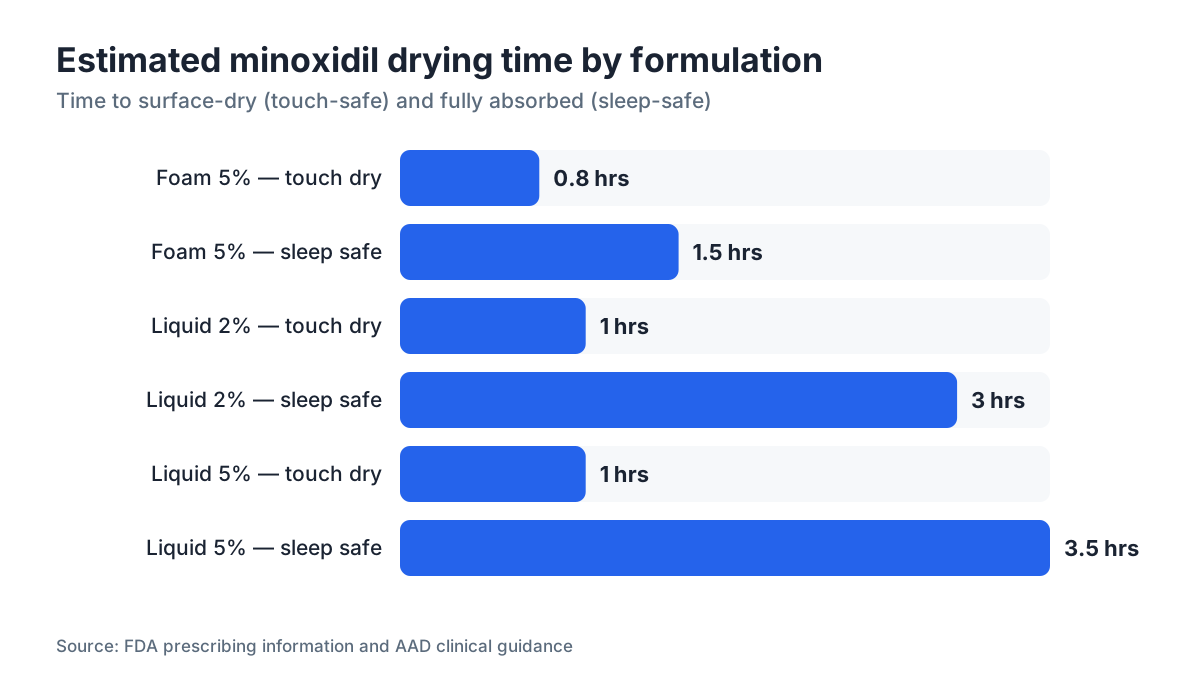
Liquid (solution) minoxidil uses alcohol and propylene glycol as carriers. The alcohol flashes off fast, but propylene glycol is a humectant that holds moisture, so the scalp feels tacky longer than people expect. Most people find the surface dry-to-touch in 30 to 60 minutes. Dermatologists still recommend waiting a full 2 to 4 hours before sleeping so deeper absorption can finish [3].
Foam minoxidil has no propylene glycol. It dries much faster, usually 1 to 2 hours, and the tacky stage is shorter or gone. That's a big reason people with sensitive scalps, or partners who mind residue, reach for foam.
A few things push drying time longer: using more product than the label says, applying to a scalp that still has a lot of hair (the hair traps the liquid), applying right after a shower when skin is warm, or living somewhere humid. In any of those cases, add 30 to 60 minutes to your buffer.
Here's the rule most dermatologists use. Run your fingers through the treated area. No stickiness, no dampness, it's dry enough. When you can't tell, wait the full four hours.
What actually happens if you go to bed before minoxidil dries?
Three things, in rough order of how much they matter.
First, you lose dose. Wet product transfers to your pillowcase and away from your scalp. Nobody has run a controlled trial measuring exactly how much moves this way, but the mechanism is plain physics: wet liquid goes to the first absorbent surface it touches. Do this every night and you're quietly under-dosing yourself.
Second, the propylene glycol and other carriers left on the pillow can irritate your face, especially around the forehead and temples where your skin presses the fabric. Some people get breakouts or a rash they can't explain. This is a real candidate.
Third, if you share a bed, the residue reaches your partner. The FDA label flags this directly [2]. Unwanted hair growth from partner transfer shows up in case reports, which is why the label tells users to keep others from contacting treated areas.
One rushed night won't ruin your treatment. Miss the drying window now and then and it costs you almost nothing. The habit of going to bed wet, night after night, is what adds up.
Does it matter if you touch your hair before minoxidil dries?
Yes, but the stakes are lower than the bed question.
Run your hands through wet-minoxidil hair and the drug moves to your palms and fingers. Touch your face after that and you can grow unwanted hair on the forehead or cheeks over time. Same transfer mechanism dermatologists warn about with pillow contact [2].
Styling wet, treated hair with your hands also drags product away from the spots you aimed for, thinning coverage where you need it most. If you applied carefully to a receding hairline or a thinning crown, that precision is the whole point.
So don't style, comb, or scratch your scalp for at least 30 to 60 minutes after application. That's not a number from a controlled trial. It's a conservative buffer hair loss clinicians use in practice. Once it feels genuinely dry, casual touching is fine.
Can you sleep with minoxidil in your hair at all?
Yes, as long as it's dry. That's the entire point of a nighttime routine: apply two to four hours before bed, let it dry fully, then sleep like normal. The drug doesn't switch off once dry. It's already into the skin and keeps diffusing toward the follicle layer.
Plenty of people prefer nights precisely because they don't have to think about how the product looks or feels during the day. Apply it, do something else for a couple of hours, check it's dry, go to sleep.
Morning application works just as well for results. Apply after your shower, head to work, and it dries on its own before you're out the door. The American Academy of Dermatology recommends applying minoxidil to a dry scalp, which fits a shower-then-wait routine [3].
If your minoxidil for men routine is once daily, timing barely matters because you have a whole day's buffer. Twice-daily regimens are where the drying question gets sharp.
Should you use a hairdryer to speed up drying?
This is a common workaround, and it can help, with one caveat. The FDA label for Rogaine-brand topical solution says to let the product air dry [2]. The worry is that heat raises blood flow to the scalp and might change absorption in ways nobody has mapped. Some clinicians also suspect high heat could degrade the minoxidil molecule before it absorbs, though published data on that exact point is thin.
A cool or low-warm setting from 8 to 12 inches away is the middle ground a lot of people use without any obvious problem. Blasting the scalp with high heat right after application is the version to skip.
If you're always racing the clock, foam minoxidil beats trying to force liquid to dry faster. Its shorter natural drying time is a genuine edge for a tight schedule.
Does minoxidil have to be applied to a dry scalp, or can you apply it to a damp scalp?
The AAD and most prescribing information say to apply minoxidil to a dry scalp [3]. Water on the scalp dilutes the product and spreads it past the area you're targeting. It can also slow absorption, because the outer skin layer is already saturated with water.
If you shower at night, towel dry and then wait 20 to 30 minutes for your scalp to fully dry before applying. Skip that and you won't destroy the treatment, but you stack another small inefficiency on top of the others.
Here's something less discussed: scalp health drives absorption. Seborrheic dermatitis or heavy dandruff can build a barrier that slows uptake. If your scalp stays irritated or flaky, treat that on its own. You want clean skin between the product and your follicles.
Will getting caught in rain or sweating wash minoxidil out?
If it's already fully dry, light rain or moderate sweat probably won't wash out much. The drug that was going to absorb has mostly done so by the time the surface is dry.
Get soaked or train hard within the first hour of applying and you've likely lost a real portion of the dose. Same logic: wet product on the surface is product that can wash away.
If you exercise in the morning, the cleanest order is workout first, shower, wait for the scalp to dry, then apply. The product goes on clean, dry skin and you're not fighting a sweat session.
How does minoxidil actually work, and does drying affect how well it works?
Minoxidil is a potassium channel opener first developed as an oral blood pressure drug. Its action at the follicle isn't fully understood, but the leading explanation is that it widens blood vessels around follicles, raises local blood flow, and may push follicle cells back into the anagen (growth) phase [4].
Topical minoxidil penetrates the skin and builds up in scalp tissue. An enzyme called sulfotransferase, present in follicle cells, then converts it to its active form, minoxidil sulfate [4]. Conversion efficiency varies person to person, which is one reason some people respond strongly and others barely at all.
Drying matters because the absorption window sits mostly in the first few hours after application. Once dry, whatever is left on the surface has done its useful work. Waiting 8 hours instead of 4 won't push more drug in. What matters is not interrupting the window by washing it off, blotting it on a pillow, or diluting it with sweat.
Curious about minoxidil side effects beyond skin-contact risks? Worth reading separately. Scalp irritation and the shed in the first few months are the questions that drag most people onto forums at midnight.
What's the best routine to fit minoxidil drying into a real schedule?
There's no single right answer, just a few patterns that fit different lives.
Night-application routine (most popular): Apply right after dinner or your evening shower. Brush teeth, read, watch TV for two hours, and it's dry by the time you wind down. The wait hides inside time you already spend.
Morning-application routine: Apply after your morning shower, before styling. Leave the house 45 to 60 minutes later and the foam version is usually dry in time. Liquid may still feel tacky, so adjust your timing.
Split routine (twice daily): One dose after dinner, one after your morning shower. Both carry natural wait times if you plan them around meals and your commute.
If you're using oral minoxidil instead of topical, none of this applies. The drying question belongs to topical formulations alone.
On finasteride or a DHT blocker too? The drying logistics don't change. It helps to know that finasteride and minoxidil are often run together and their timing needs don't collide.
Earlier stages of loss, like a receding hairline, reward getting the topical routine right from day one more than late-stage cases do. You still have more follicles worth saving.
Does it matter which minoxidil formulation you use for overnight wear?
Formulation genuinely changes overnight comfort and partner safety.
| Formulation | Dry-to-touch time | Propylene glycol | Pillow transfer risk | Scalp irritation risk |
|---|---|---|---|---|
| 2% liquid solution | 60 to 120 min surface | Yes | Moderate to high | Moderate |
| 5% liquid solution | 60 to 120 min surface | Yes | Moderate to high | Moderate to high |
| 5% foam | 30 to 60 min surface | No | Low to moderate | Lower |
| Topical spray (various brands) | Varies by carrier | Varies | Varies | Varies |
Foam is the default pick for sensitive scalps or shared beds. It dries faster and skips propylene glycol, the main irritant in the liquid [5]. The tradeoff is money: foam usually costs more per month than generic liquid.
Trying a new brand? Check the ingredient list for propylene glycol. Some newer generics dropped it from the liquid formula, which shifts the drying profile.
Still not sure hair loss is even the right diagnosis? A free AI hair scan gives you a starting point before you commit to a product and a routine.
Can minoxidil affect a partner's skin if it's not fully dry?
Yes, and this is one of the more underrated practical concerns.
The FDA label for topical minoxidil states that "unintended application" from skin contact with a treated person can cause increased facial hair in others [2]. Case reports document it in partners of topical minoxidil users, with women affected more often. Lower systemic androgen levels mean less counteracting hormone to dampen the follicle-stimulating effect.
The pathway is simple. Wet or tacky product on your scalp, contact with a partner's skin during sleep or intimacy, absorption over time. The fix is just as simple: dry the product fully before any prolonged skin contact.
If a partner has noticed unusual facial hair and you use topical minoxidil, raise that connection with a dermatologist. The effect usually reverses after exposure stops, though it can take months.
What should you do if you miss the drying window by accident?
Don't stress. One night going to bed with not-quite-dry minoxidil won't derail your progress. These treatments work over months of steady use, and a single-dose efficiency loss doesn't register in that arc [6].
What you shouldn't do is compensate by piling on extra product next time. More minoxidil doesn't buy more effect above the standard dose. Overdosing topical minoxidil raises side-effect risk without adding regrowth [2].
If the drying window genuinely can't fit your schedule, switch to foam (faster dry) or think about whether oral minoxidil suits your life better. Some people find the pill simpler for one reason: no topical drying routine at all.
For the bigger picture on why hair loss happens and whether minoxidil is even your tool, what causes hair loss walks through the main categories and where topical treatments fit each one.
Sources
- Minoxidil topical prescribing information, DailyMed (NIH/NLM)
- FDA label for Rogaine (minoxidil) 5% topical solution, via DailyMed (NIH/NLM)
- American Academy of Dermatology, hair loss treatment guidance
- Badri T, Nessel TA, Kumar DD. Minoxidil. StatPearls. NCBI Bookshelf (NIH).
- Blume-Peytavi U, et al. Efficacy and safety of minoxidil 5% foam vs. minoxidil 2% solution in female androgenetic alopecia. J Am Acad Dermatol. 2011;65(6):1126-1134.
- Olsen EA, et al. A randomized clinical trial of 5% topical minoxidil versus 2% topical minoxidil and placebo in the treatment of androgenetic alopecia in men. J Am Acad Dermatol. 2002;47(3):377-385.
- Suchonwanit P, Thammarucha S, Leerunyakul K. Minoxidil and its use in hair disorders: a review. Drug Des Devel Ther. 2019;13:2777-2786. NCBI PMC.
- National Library of Medicine MedlinePlus, Minoxidil Topical
- Rossi A, et al. Minoxidil use in dermatology, side effects and recent patents. Recent Pat Inflamm Allergy Drug Discov. 2012;6(2):130-136.
- FDA MedWatch adverse event reporting program