

TL;DR: No human study or clinical trial has found that topical minoxidil causes cancer. The FDA-approved label carries no cancer warning. An old rat study showed thyroid tumors at extreme oral doses, but topical use absorbs a tiny fraction of that. Dermatology consensus after 35-plus years of use: a cancer risk from topical minoxidil is not established.
What does the FDA label actually say about minoxidil and cancer?
The FDA-approved prescribing information for topical minoxidil carries no cancer warning. The label lists the risks that showed up in trials: scalp irritation, unwanted facial hair, fluid retention at higher doses, and the cardiovascular concern that put a boxed warning on the oral form. Cancer is not on the list. [1]
That gap matters. The FDA requires manufacturers to disclose any adverse event that showed up in trials at a rate meaningfully above placebo, plus any post-market signal that crosses a threshold of concern. Topical minoxidil has sold in the US since 1988. In nearly four decades, no cancer signal has crossed that bar.
Absence of a warning isn't proof of impossibility. It means no credible signal has surfaced from decades of heavy use, which is reassuring. The FDA's MedWatch program and the WHO's VigiBase both collect voluntary adverse event reports from around the world. Global pharmacovigilance data has not flagged a disproportionate malignancy signal for topical minoxidil. [2]
Here's the honest starting point. Across multiple decades and multiple countries, the regulatory record shows no cancer link for topical use.
What did the animal studies find, and does it apply to people?
The cancer worry almost always traces back to preclinical animal toxicology run during the drug's original development. In long-term rodent studies, male rats fed very high oral doses of minoxidil developed benign thyroid follicular adenomas more often than controls. [1] That's the source of the scare. Now here's why it doesn't map cleanly onto a person using Rogaine.
The doses were enormous. Rodent toxicology studies deliberately use multiples of the intended human dose, sometimes 10 to 100 times higher, to stress-test a compound. The tumors appeared at exposures far beyond anything a human scalp delivers.
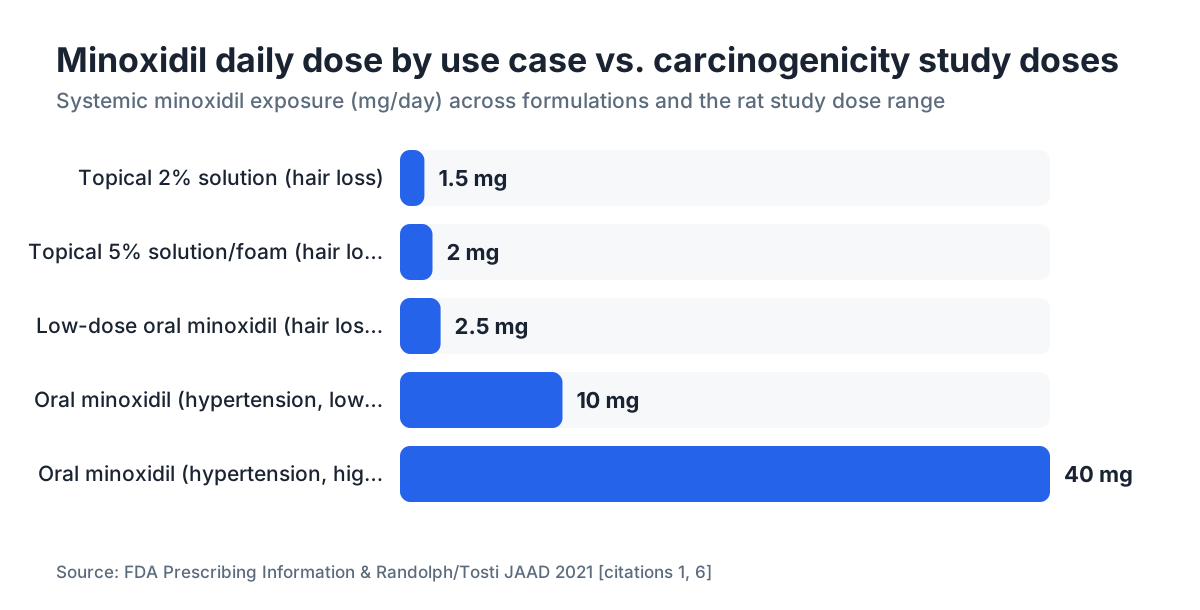
Topical absorption is low. A 2% or 5% minoxidil solution on the scalp puts roughly 1 to 2 mg into systemic circulation per day in most users, based on pharmacokinetic data in the FDA label. The oral form for hypertension runs 10 to 40 mg per day. That's a 10- to 40-fold gap in systemic exposure. [1]
Rat thyroids and human thyroids behave differently. The FDA long ago acknowledged that thyroid follicular tumors in rats often fail to predict human thyroid cancer, because the mechanism (TSH-driven hyperplasia responding to faster thyroid hormone clearance) is much weaker in humans. [3]
Nobody has good long-term human data on topical minoxidil and thyroid cancer specifically. But the biological case for worry is thin once you account for the dose and the absorption gap.
Has any human study linked minoxidil to cancer?
No published, peer-reviewed human study has found a statistically significant link between topical minoxidil and any cancer. [4]
The best human safety data comes from the original approval trials plus post-marketing pharmacovigilance. Topical minoxidil trials enrolled thousands of people and tracked adverse events for up to a year. Malignancy never registered as an adverse event of concern.
A 2019 review in Drug Design, Development and Therapy went through the safety profile of topical minoxidil across controlled trials and observational data. Cancer did not appear among the identified harms. [4] The review flagged contact dermatitis, hypertrichosis (unwanted hair elsewhere), and scalp scaling as the common issues.
Post-market surveillance is imperfect. It leans on voluntary reporting, and rare long-latency cancers are hard to pin on any single exposure. That cuts both ways. We can't rule out a very small risk with certainty, and we also have no signal to act on. Thirty-five-plus years of heavy global use with nothing surfacing does carry weight.
For context on the minoxidil side effects that do have evidence behind them, the picture stays fairly mild for a drug used this widely and this long.
What about topical minoxidil and skin cancer specifically?
There's no evidence topical minoxidil causes skin cancer. The instinct behind the question makes sense: you're rubbing a chemical into your scalp every day for years. So it's worth looking at directly.
Minoxidil is not a known human carcinogen. The International Agency for Research on Cancer (IARC), which ranks substances by carcinogenic potential, has never classified minoxidil as a carcinogen or probable carcinogen. [5]
How it works matters here. Minoxidil widens blood vessels and, most likely, stretches the anagen (growth) phase of hair follicles. It doesn't damage DNA. DNA damage is the main route by which chemical carcinogens cause cancer, so a compound that leaves DNA alone is far less likely to be genotoxic.
One in vitro study ran minoxidil through the Ames test, the standard bacterial assay for DNA-damaging activity. Minoxidil came back negative. [1] That's not a lifetime guarantee in humans, but it closes off the most direct mechanism of concern.
Scalp squamous cell and basal cell carcinomas come overwhelmingly from UV radiation, not topical drugs. Melanoma tracks with UV exposure, genetics, and mole count. None of those pathways gives minoxidil a way in.
Does the form of minoxidil matter? Topical vs oral risk comparison
Form matters a lot. Topical and oral minoxidil deliver very different systemic exposures, and that's the whole ballgame for any cancer concern rooted in the animal data.
Oral minoxidil was first approved for severe hypertension and still runs at 2.5 to 40 mg daily for that use. At those doses, systemic levels get high enough to cause fluid retention, reflex tachycardia, and pericardial effusion in some patients. That cardiovascular risk is why oral minoxidil carries a boxed warning. [1]
Low-dose oral minoxidil (0.625 to 2.5 mg daily) is now used off-label for hair loss. It does put more drug into the bloodstream than topical use, but it still sits well under the hypertension doses used in the original animal carcinogenicity work. [6]
The table lines up the doses side by side.
| Formulation | Typical daily dose for hair loss | Typical systemic absorption | Dose in rat carcinogenicity studies (human equivalent) |
|---|---|---|---|
| Topical 2% solution | 2 mL/day applied | ~1 to 2 mg | Much higher |
| Topical 5% solution or foam | 1 mL/day applied | ~1.5 to 2.5 mg | Much higher |
| Low-dose oral (off-label) | 0.625 to 2.5 mg | ~80 to 90% of dose | Higher |
| Oral (hypertension) | 10 to 40 mg | ~80 to 90% of dose | Comparable or lower |
For most people using topical minoxidil, the systemic dose stays genuinely small. The rat thyroid tumors showed up at doses that translate, by body surface area scaling, to many times the topical hair loss dose in a person.
Could minoxidil make an existing cancer worse?
This is a sharper question than whether minoxidil causes cancer, and a more interesting one. Minoxidil is a vasodilator and a potassium channel opener. Some researchers have asked whether more blood flow or those cellular effects could feed a tumor that's already there.
It's mostly theoretical. No clinical evidence shows topical minoxidil pushes tumor progression in humans. Systemic levels from topical use are low enough that any meaningful vasodilatory effect on a distant tumor would be implausible.
There's a small body of in vitro work (lab cell studies, not human trials) with mixed results across cancer cell lines. Some studies found no effect. A few found growth effects at high concentrations. At least one found the opposite, an anti-proliferative effect. Cell studies at non-physiological concentrations don't reliably predict what happens in a person.
If you're in active cancer treatment, the honest answer is simple: tell your oncologist before starting any new topical drug, minoxidil included. Not because the evidence flags danger here, but because your oncologist should know everything you're putting on or in your body while they manage your care. Chemotherapy hair loss (telogen effluvium is a related pattern) is its own conversation to have with that team.
What are minoxidil's real, documented risks?
Being honest about what the evidence doesn't show (cancer) only counts if we're equally honest about what it does show.
Contact dermatitis is the most common reaction, hitting roughly 7% of users in controlled trials. The propylene glycol in solution formulas is usually the culprit. Minoxidil foam uses a different vehicle and triggers fewer cases. [4]
Hypertrichosis, unwanted hair on the face or body, affects a meaningful minority of women on topical minoxidil, somewhere around 5 to 7% in trials. [4]
Scalp scaling, dryness, and itching are common and usually mild.
A temporary jump in shedding during the first 2 to 8 weeks is well documented and alarms a lot of new users. It's a sign the drug is cycling follicles, not a sign of damage.
Cardiovascular effects from topical use are rare. They mostly show up in people with existing heart conditions who absorb more than average. Blood pressure dips and palpitations get reported occasionally.
The minoxidil side effects article breaks each of these down further. If you're weighing other options too, read finasteride and minoxidil together before you commit.
Who is most likely to be searching this question and why?
People land on this question for a few different reasons, and they need different answers.
Some read a forum post or heard a rumor that minoxidil is dangerous. It usually traces back to that rat study, or a misread of the FDA label. The honest reply: the worry rests on a real study, but the dose extrapolation falls apart.
Some have a personal or family history of cancer and are cautious about anything that might touch that history. Fair. The evidence still doesn't support cancer risk from topical minoxidil, but talking it through with an oncologist or dermatologist before starting is the right call.
Some want the full risk picture before spending money on a treatment they'll use for years. Smart. Hair loss treatments are long commitments. Understanding what causes hair loss in the first place, and whether a treatment's risks fit your health, is how good decisions get made.
If you're not sure your pattern of loss even needs treatment yet, the free AI scan at MyHairline can show you how your hairline has shifted before you commit to anything.
What do dermatologists say about minoxidil safety overall?
The American Academy of Dermatology recommends topical minoxidil as a first-line treatment for androgenetic alopecia in both men and women. Its clinical guidance doesn't list cancer as a risk to raise with patients. [7]
Dermatologists who prescribe it regularly tend to call it one of the safer long-term drugs they hand out, mostly because systemic absorption is limited and it has a four-decade real-world record. The real patient conversation is about expectations (it works slowly, and the hair falls out again if you stop) and cosmetic annoyances like scalp dryness.
The AAD does advise checking cardiovascular history before use and mentions the risk of unwanted hair elsewhere. Not cancer. [7]
For anyone mapping out male pattern hair loss options, including finasteride, hair transplant, and DHT blockers, knowing each treatment's documented risks beats worrying about a theoretical one with no human evidence behind it.
Should you avoid minoxidil if you're worried about cancer risk?
On the current evidence, a cancer risk from topical minoxidil at recommended doses is not established. If you're healthy and thinking about topical minoxidil for hair loss, cancer is not a reason to skip it.
If you have an active diagnosis or a cancer history, the decision hinges less on minoxidil's risk profile and more on coordinating with your medical team. Tell your oncologist or dermatologist you're considering it. They may have no objection, or a specific reason tied to your treatment plan.
If your worry is broader, meaning you want the safest possible hair loss approach, topical minoxidil compares well against most alternatives on risk. Finasteride, for example, carries documented sexual side effects and a more tangled discussion around prostate cancer (it lowers PSA, which changes how screening reads). Topical minoxidil's risk story is much simpler.
For men with an early receding hairline, topical minoxidil is often the lowest-risk way into treatment. It works for a meaningful share of users and hasn't thrown a cancer signal across decades of global use. That combination is worth something.
Want to check whether your hairline is actually changing before you commit? The free AI scan at MyHairline gives you a baseline at no cost.
Sources
- FDA, Minoxidil Topical Solution Prescribing Information (label)
- WHO VigiBase / Uppsala Monitoring Centre, pharmacovigilance adverse event database
- FDA, Guidance for Industry: Statistical Aspects of the Design, Analysis, and Interpretation of Chronic Rodent Carcinogenicity Studies of Pharmaceuticals
- Suchonwanit P, Thammarucha S, Leerunyakul K. Minoxidil and its use in hair disorders: a review. Drug Design, Development and Therapy. 2019;13:2777-2786.
- IARC Monographs on the Identification of Carcinogenic Hazards to Humans
- Randolph M, Tosti A. Oral minoxidil treatment for hair loss: A review of efficacy and safety. Journal of the American Academy of Dermatology. 2021;84(3):737-746.
- American Academy of Dermatology Association, Hair Loss: Diagnosis and Treatment guidelines
- National Toxicology Program, Report on Carcinogens, 15th Edition
- FDA MedWatch Safety Reporting Program
- Olsen EA et al. A randomized clinical trial of 5% topical minoxidil versus 2% topical minoxidil and placebo in the treatment of androgenetic alopecia in men. Journal of the American Academy of Dermatology. 2002;47(3):377-385.