TL;DR: The Prostate Cancer Prevention Trial found finasteride 5 mg cut overall prostate cancer detection by about 25% versus placebo. The catch: men on finasteride who did get cancer showed more high-grade tumors on biopsy. Most researchers now read this as a detection artifact, not real added risk. The 18-year follow-up found no difference in prostate cancer deaths. For men on 1 mg for hair loss, the data is thinner but the same biology applies.
What is finasteride actually doing in the body?
Finasteride blocks 5-alpha reductase, the enzyme that converts testosterone into dihydrotestosterone (DHT). DHT is roughly five times more potent than testosterone at androgen receptors, and the prostate runs almost entirely on it. Shrink DHT and the prostate shrinks too. That's the whole mechanism behind Proscar (5 mg, approved for benign prostatic hyperplasia) and Propecia (1 mg, approved for male pattern baldness) [1].
The prostate cancer angle follows straight from that biology. Androgens drive prostate cell growth, malignant cells included. In the 1990s researchers started asking whether cutting DHT across the body might lower the chance of prostate cancer developing at all. That question became the largest prostate cancer chemoprevention trial ever run.
If you want a fuller picture of how finasteride works at the receptor level and what it does to scalp hair, the finasteride overview covers that. The short version: 1 mg reduces scalp DHT by roughly 60%, while 5 mg reduces it by about 70%. The prostate sees a bigger DHT drop at 5 mg, which matters for reading the cancer data.
What did the Prostate Cancer Prevention Trial actually find?
The Prostate Cancer Prevention Trial (PCPT) enrolled 18,882 men age 55 and older with a normal PSA and digital rectal exam, then randomized them to finasteride 5 mg or placebo for seven years. Every man who didn't develop cancer during the trial got a biopsy at the end. That end-of-study biopsy design is what makes PCPT unusual. It caught cancers that would have gone missed without systematic sampling [2].
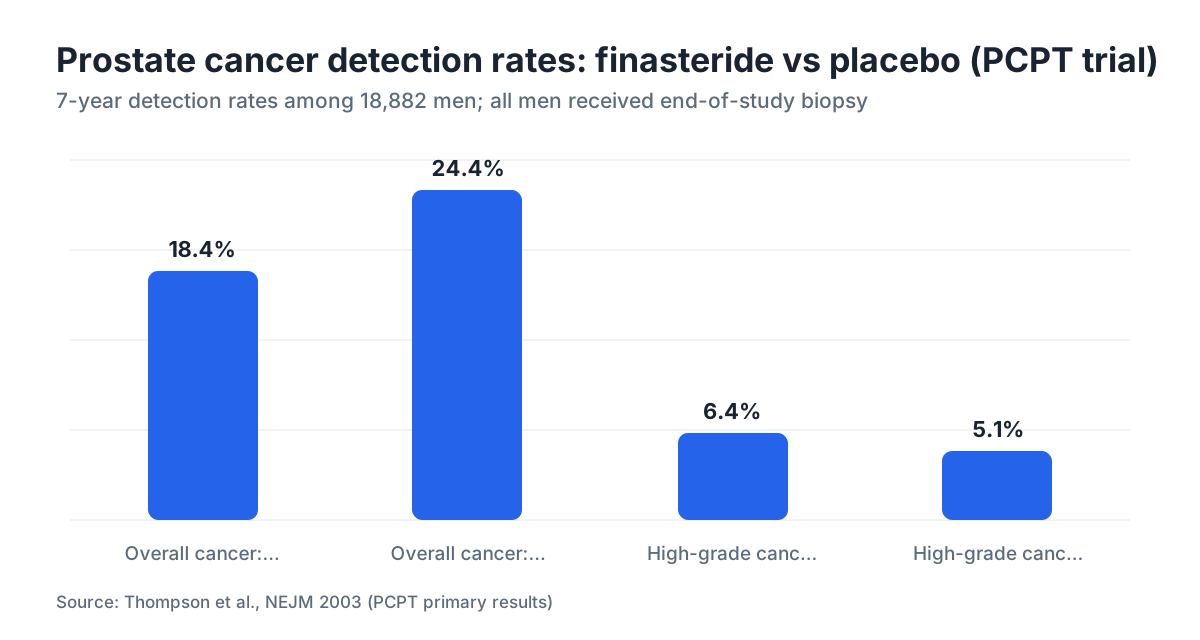
The headline result: prostate cancer turned up in 18.4% of men on finasteride versus 24.4% on placebo, a 24.8% relative risk reduction [2]. Real, statistically significant, biologically plausible. On that number alone, finasteride looked like a genuine cancer preventive.
The complication came from tumor grade. Among men who did develop cancer, the finasteride group had a higher proportion of Gleason 7 or higher tumors: 6.4% versus 5.1% in the placebo group [2]. The FDA flagged this in both drug labels. That number scared a lot of people, urologists included, and killed enthusiasm for finasteride as prevention for years.
| Outcome | Finasteride 5 mg | Placebo |
|---|---|---|
| Overall prostate cancer detection | 18.4% | 24.4% |
| High-grade cancer (Gleason ≥7) among those with cancer | 6.4% | 5.1% |
| Relative risk reduction in overall cancer | 24.8% | -- |
| Trial duration | 7 years | 7 years |
| Total enrolled | 9,423 | 9,459 |
Source: Thompson et al., NEJM 2003 [2]
Does finasteride actually cause more aggressive prostate cancers?
Most of the evidence now points to no. The leading explanation is a detection artifact called the prostate volume effect. Finasteride shrinks the prostate, sometimes by 20-25%. A smaller gland means a given biopsy needle samples a bigger fraction of it. If any cancer is present, a biopsy is more likely to find it and grade it accurately [3].
High-grade cancers tend to carry fewer androgen receptors and depend less on DHT. So they get suppressed less by finasteride and are more likely to survive and show up on biopsy in a shrunken prostate. That doesn't mean finasteride created them. It means the detection conditions changed.
The long-term follow-up backs this up. A 2013 analysis tracking participants for up to 18 years found no significant difference in prostate cancer mortality between the two groups. The paper, published in the New England Journal of Medicine, concluded: "Long-term follow-up showed no significant between-group difference in the rate of death from prostate cancer" [4]. If the high-grade cancers were truly more lethal and truly caused by the drug, that signal would show up in the death rate. It doesn't.
The REDUCE trial tested dutasteride (a related drug that blocks both isoforms of 5-alpha reductase) and saw the same shape: fewer overall cancers, a nominally higher proportion of high-grade cancers, no survival difference [3]. Two independent trials pointing the same way makes the detection artifact reading a lot more convincing.
Nobody has airtight proof, and residual uncertainty is fair to admit. But the clinical read has shifted. The American Urological Association and the American Society of Clinical Oncology issued a joint guideline stating that 5-alpha reductase inhibitors reduce the risk of low-grade prostate cancer in men who are being screened for the disease [5].
What does the FDA say about finasteride and prostate cancer risk?
The FDA updated the labels for Proscar and Propecia in 2011 to add language about the high-grade cancer finding from PCPT and REDUCE [9]. The Proscar label states that men considering finasteride for BPH should be evaluated to rule out prostate cancer before starting, and that PSA is affected by the drug (PSA roughly halves after six months on 5 mg, so physicians have to adjust their reading).
The FDA has not approved any form of finasteride for prostate cancer prevention. That matters if you've heard a claim that a doctor prescribed it specifically to prevent cancer. Off-label use happens. There's no FDA-approved chemoprevention indication.
For the 1 mg hair loss dose, the Propecia label carries a similar high-grade warning, but the PCPT data was generated entirely at 5 mg. Applying it to 1 mg is biological inference, not direct trial evidence. PSA suppression at 1 mg is real but smaller, roughly 40-50% after 24 months per the prescribing information [6].
The PSA point is where this gets practical. If you're on finasteride for a receding hairline and your doctor orders a routine PSA without knowing, an artificially low result can hand you false reassurance. Tell your doctor you're on finasteride. Standard guidance says double your on-treatment PSA to estimate the off-drug value.
Does the 1 mg dose used for hair loss carry the same cancer risks?
Honest answer: we don't know with the confidence we have for 5 mg, because no large chemoprevention trial was run at 1 mg. The biology suggests lower DHT suppression means a smaller effect in both directions, somewhat less reduction in low-grade cancer and possibly less of the detection-driven high-grade signal. But that's extrapolation.
For men taking 1 mg mainly for hair loss, prostate cancer prevention isn't the reason to take it, and cancer isn't the risk most men are asking about. The side effects that draw more attention are sexual, which the label lists at around 1.3-3.8% incidence depending on the symptom and trial [6]. The cancer question usually surfaces when a man on finasteride gets screened and his urologist notices the PSA issue, or when family history makes him wonder whether the drug is helping or hurting.
The practical answer for a hair loss patient: no evidence shows 1 mg raises prostate cancer mortality. The detection artifact argument is even stronger at lower doses. Get a baseline PSA before starting, tell your prescriber you're on finasteride at every screening, and if you have a strong family history of aggressive prostate cancer, have that specific conversation with a urologist rather than leaning on a dermatologist or GP alone.
How does finasteride affect PSA levels and prostate cancer screening?
PSA (prostate-specific antigen) is the standard blood test used to screen for prostate cancer. Finasteride suppresses PSA as a side effect of shrinking the prostate. At 5 mg, PSA typically drops about 50% within six months. At 1 mg, the drop is smaller, roughly 40-50% by 24 months, still enough to matter for screening [6].
The clinical convention is to double the on-treatment PSA for an approximate pre-treatment value. A PSA of 1.5 ng/mL on finasteride reads more like 3.0 ng/mL. A value above 4 ng/mL (or above 2.5-3 ng/mL in younger men) generally triggers further evaluation.
Here's the part people miss. If your PSA rises on finasteride, even when the absolute number stays low, that rise is a real signal. PSA should be flat or falling on the drug. Any sustained increase deserves investigation. The American Cancer Society and the PCPT investigators have both stressed that PSA velocity (rate of change) matters as much as the absolute value, maybe more, in men on 5-alpha reductase inhibitors [7].
This is one place where the 1 mg hair loss dose and the 5 mg BPH dose behave alike enough that the same caution applies.
Should men with a family history of prostate cancer avoid finasteride?
Family history is a legitimate concern. Prostate cancer has a meaningful heritable component, and men with an affected first-degree relative carry roughly double the baseline risk. The question is whether finasteride helps or hurts in that setting.
PCPT subgroup-analyzed men by family history and found the relative risk reduction from finasteride was similar regardless of family history status [2]. Reassuring, not definitive. Subgroup analyses from trials are usually underpowered and should be read carefully.
A more practical point: men with a strong family history should already be under closer prostate cancer surveillance, which means a urologist who knows you're on finasteride and reads your PSA accordingly. In that setting finasteride doesn't obviously make screening worse. It shifts the numbers, and an informed urologist can adjust.
BRCA2 is where it gets murky. Men with BRCA2 mutations have a notably higher risk of aggressive prostate cancer, meaning more of the kind that kills people rather than just more cancer overall. Those men need the prostate conversation with a urologist who specializes in hereditary cancer. The finasteride data doesn't stratify by germline mutation status, so there's no trial-level guidance to lean on.
Can finasteride be used to prevent prostate cancer?
Formally, no. The FDA has not approved finasteride for prostate cancer prevention, and the joint AUA/ASCO guideline stopped short of an unconditional recommendation for all men [5]. Their guidance targeted men already undergoing regular PSA screening who talk with their doctor about chemoprevention.
Why no blanket recommendation? Partly the lingering unease over high-grade cancer (even if the survival data suggests that unease is overblown) and partly the side effect profile. Sexual side effects hit a meaningful minority of men. For a prevention strategy to make sense across a whole population, benefit has to clearly beat harm, and that math changes with individual risk.
For a man at genuinely high risk, say a 60-year-old with several affected relatives and a PSA trending up, the chemoprevention conversation with a urologist is worth having. Finasteride's 5 mg evidence base is real. For a 30-year-old on 1 mg to keep his hairline, prostate cancer prevention isn't the calculus at all.
If you're weighing finasteride against other hair loss options, reading about finasteride and minoxidil together shows where it sits in a treatment plan.
What are the other prostate-related effects of finasteride?
Beyond cancer, finasteride has well-documented effects on prostate size and urinary symptoms. At 5 mg it's FDA-approved to treat benign prostatic hyperplasia (BPH), the non-cancerous enlargement that causes urinary trouble in older men. It cuts prostate volume by roughly 20-25% over 12 months, which shows up as measurable symptom relief [1].
For men on 1 mg for hair loss who happen to be older and developing BPH symptoms, there might be an incidental benefit. But 1 mg sits below the approved BPH dose, and using it as a BPH treatment without a urologist involved would be a mistake.
Prostatitis, inflammation or infection of the prostate, isn't reliably affected by finasteride in either direction. The drug doesn't treat infection, and there's no evidence it causes or prevents prostatitis.
One more practical note: finasteride can reduce ejaculate volume. The label lists decreased ejaculatory volume as a reported side effect, and it makes sense since the prostate contributes to semen production. It isn't dangerous. But men who don't expect it can find it unsettling.
How should men on finasteride handle prostate cancer screening?
Standard prostate cancer screening for average-risk men starts around age 50 with a baseline discussion, or 45 for men at higher risk (Black men or those with a first-degree relative diagnosed before 65), per American Cancer Society guidance [7]. If you're on finasteride when screening begins, the adjusted PSA reading matters from the first test.
Here's the practical checklist:
First, get a baseline PSA before starting finasteride if you can. Already on it? Note what your PSA has been and how long you've been taking the drug.
Second, tell every doctor who orders a PSA that you're on finasteride and at what dose. Primary care, urology, anyone ordering the test for any reason.
Third, double your on-treatment PSA when comparing to reference ranges. A lab might flag 2.0 as normal. On finasteride that's effectively 4.0, which crosses a threshold worth discussing.
Fourth, watch the trend. Any sustained upward move on finasteride is worth checking promptly, regardless of the absolute number.
Fifth, if you're having a prostate biopsy for any reason, your urologist needs to know you're on finasteride, because the drug's effect on prostate volume changes how results get read.
Tools like the free AI scan at MyHairline can help you map where you are with hair loss and whether finasteride is the right starting point. For the prostate screening piece specifically, that conversation belongs with a physician.
What do doctors actually recommend now, given all this evidence?
The pendulum has swung back toward cautious optimism about finasteride's cancer profile. The 18-year survival data from PCPT, published in 2013, was the turning point. Urologists who had been steering patients away from finasteride started revisiting that stance [4].
The 2018 joint guideline from AUA and ASCO concluded that 5-alpha reductase inhibitors can reduce the risk of low-grade prostate cancer in men being screened who want to discuss chemoprevention [5]. That's narrower than a blanket preventive recommendation, but it's a clear step away from the earlier alarm over high-grade tumors.
For dermatologists prescribing 1 mg for male pattern baldness, the standard approach is to mention the PSA effect and tell patients to inform any physician who orders a PSA. Most dermatologists don't order PSA themselves, so this is a communication issue more than a clinical one.
The cancer signal that scared people for a decade looks more like a measurement artifact than a real biological risk. That doesn't make finasteride risk-free. Sexual side effects are real, and minoxidil side effects make a reasonable comparison point when you're choosing between treatments. But for a man deciding on finasteride, prostate cancer risk is not the reason to avoid it on current evidence.
If finasteride doesn't feel right, other options are worth researching, including DHT blockers and topical alternatives. For advanced loss, a hair transplant is a surgical path with no systemic hormonal effects.
Sources
- FDA, DailyMed label for Proscar (finasteride 5 mg)
- Thompson IM et al., NEJM 2003, Prostate Cancer Prevention Trial primary results
- Andriole GL et al., NEJM 2010, REDUCE trial results
- Thompson IM et al., NEJM 2013, Long-term survival after PCPT
- American Urological Association, Clinical Guidelines section
- FDA, DailyMed label for Propecia (finasteride 1 mg)
- American Cancer Society, Prostate Cancer Early Detection
- National Cancer Institute, Prostate Cancer information
- FDA, Drug Safety and Availability section
- Theoret MR et al., NEJM 2011, FDA perspective on 5-alpha reductase inhibitors