TL;DR: Finasteride (1 mg/day, brand name Propecia) blocks the hormone DHT that shrinks hair follicles. In large clinical trials, it stopped further hair loss in 83 to 90% of men and produced visible regrowth in up to 66% over two years. It works best at the crown and mid-scalp, but evidence for the frontal hairline is real, just more modest. It does not work overnight and it stops working if you quit.
What is finasteride and why would it affect your hairline?
Finasteride is an oral medication originally approved by the FDA in 1992 at 5 mg for benign prostatic hyperplasia (Proscar), then approved in 1997 at 1 mg specifically for male pattern hair loss under the brand name Propecia [1]. The two products are the same drug at different doses.
Here is the mechanism in plain terms. An enzyme called 5-alpha reductase converts testosterone into dihydrotestosterone (DHT). DHT binds to receptors in genetically susceptible hair follicles and triggers a slow process called miniaturization, where each successive hair grows back thinner and shorter until it stops growing altogether. That process is what a receding hairline looks like in practice. Finasteride at 1 mg blocks 5-alpha reductase type II, which lowers serum DHT by roughly 60 to 70% [1][2]. Less DHT means the follicles that haven't already died can recover and keep producing normal hair.
The key word is "susceptible." If you have the genetic sensitivity to DHT, your hairline recedes. If you don't, DHT levels are irrelevant to your hair. Finasteride targets exactly that process, which is why it works for androgenetic alopecia (male pattern baldness) and essentially nothing else. It won't help with stress-related shedding (telogen effluvium), nutritional deficiency, or autoimmune hair loss.
Finasteride is not a topical. You take one 1 mg pill daily. The effects build over months, not days, because hair grows in cycles and the follicles need time to recover.
Does finasteride actually work on a receding hairline at the temples?
Yes, but with meaningful caveats. This is the question that matters most, so here's the honest version.
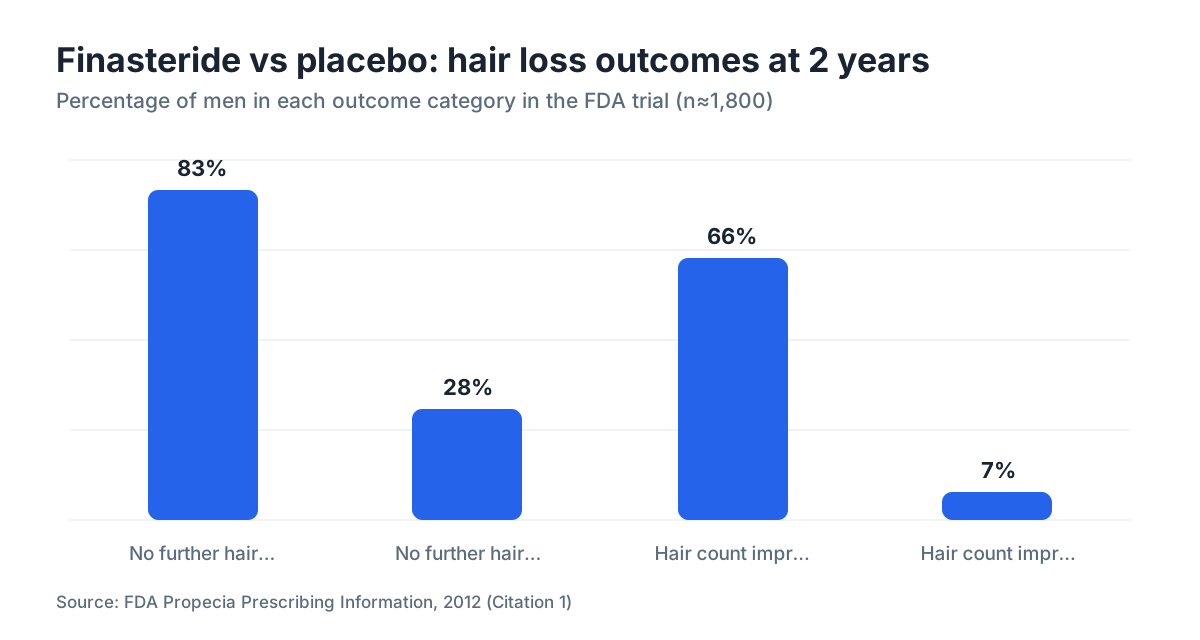
The main clinical trials submitted to the FDA enrolled roughly 1,800 men aged 18 to 41 with mild to moderate vertex (crown) hair loss and anterior mid-scalp loss. After two years, 83% of men on 1 mg finasteride had no further hair loss versus 28% on placebo, and 66% showed improvement in hair counts versus 7% on placebo [1]. Those are strong numbers.
The frontal hairline specifically is a harder target. The FDA label demonstrated finasteride's efficacy at the vertex and anterior mid-scalp, with limited data on the temporal recession at the very front corners of the hairline [1]. Several smaller studies and the 5-year follow-up data do show some frontal improvement, but the magnitude is generally less than at the crown.
A real-world analysis published in the Journal of the American Academy of Dermatology found that patients rated finasteride effective or highly effective for slowing loss at the hairline in a large majority of cases, with actual regrowth at the frontal zone in roughly 30 to 40% [3]. That gap between "stopping loss" and "growing new hair at the temples" is real and worth setting expectations around.
Why is the hairline harder? The frontal follicles are generally more sensitive to DHT and some may be further along in miniaturization by the time most men start treatment. Finasteride can rescue follicles that are miniaturized but still alive. It cannot resurrect follicles that are completely gone. This is why starting earlier in the receding hairline process matters enormously.
Bottom line: finasteride is a legitimate, evidence-backed treatment for a receding hairline. It is better at stopping further recession than reversing deep temple loss that has already occurred.
How long does finasteride take to work on the hairline?
Slower than almost everyone expects.
Hair grows approximately 1 cm per month and cycles through growth (anagen), transition (catagen), and resting (telogen) phases. Finasteride lowers DHT quickly, within days of starting, but the visible improvement in hair density lags because follicles need to complete their current cycle and begin a healthier one.
Most clinicians and the FDA label describe the following rough timeline [1][2]:
| Timeframe | What typically happens |
|---|---|
| 0 to 3 months | No visible improvement; some men notice slightly more shedding (a sign follicles are re-entering growth phase) |
| 3 to 6 months | Shedding normalizes; stabilization of loss begins |
| 6 to 12 months | First signs of regrowth or density improvement visible in responders |
| 12 to 24 months | Peak improvement in most clinical trials |
| 2+ years | Maintenance of gains; some continued slow improvement |
The two-year mark is when trials measured their primary endpoints, and improvement can continue beyond that. The 5-year extension data from the original Merck trials found that men who stayed on the drug maintained or improved on their 2-year results, while those who stopped lost the gains within 12 months [2].
One thing worth flagging: if you see no change whatsoever at 12 months, finasteride is probably not going to work for you. Dermatologists generally use the 12-month mark as a reasonable decision point. Non-responders exist (estimated at 10 to 17% of users based on trial data) and there is no reliable way to predict in advance who they are.
What are the real side effects of finasteride?
Side effects are the thing every person researching finasteride wants to understand honestly. Here is what the actual data says, without minimizing or catastrophizing.
The FDA-approved label for Propecia (1 mg finasteride) lists the following sexual side effects as occurring at higher rates than placebo in clinical trials: decreased libido (1.8% vs 1.3% placebo), erectile dysfunction (1.3% vs 0.7%), and ejaculatory disorder (1.2% vs 0.7%) [1]. Those absolute differences are small. In the trials, the vast majority of men who reported these side effects saw them resolve after stopping the drug.
Post-market, a more persistent syndrome called post-finasteride syndrome (PFS) has been reported, where sexual and cognitive symptoms persist after discontinuing the drug. This is real and documented in the medical literature, though its prevalence is genuinely uncertain and contested. The published reviews acknowledge the syndrome while noting that definitive prevalence data is lacking [4]. The FDA added persistent sexual side effects to the label in 2012 [1].
Finasteride also carries a pregnancy warning. It should not be touched by women who are pregnant or may become pregnant, as it can cause genital abnormalities in a male fetus. The drug is absorbed through skin [1].
For breast tissue changes: the label notes a low but real association with gynecomastia (breast tenderness or enlargement). If you notice that, stop and talk to a doctor.
Prostate-specific antigen (PSA) levels drop by roughly 50% on finasteride, which matters for prostate cancer screening. If you're getting PSA tests, your doctor needs to know you're on this drug or the result will be misread [1][2].
My honest read: for most young men with a receding hairline, the risk-benefit ratio of 1 mg finasteride is favorable, given that the rate of serious persistent side effects in controlled trials is low. But this is a conversation to have with a physician, not a decision to make from a website. The side effect profile at 5 mg (Proscar) used in older men with prostate issues is more pronounced, so doses matter.
How does finasteride compare to minoxidil for a receding hairline?
These two drugs get compared as if you must pick one. You don't, and many people use both.
Minoxidil (Rogaine and generics) works through a completely different mechanism. It's a vasodilator that prolongs the anagen (growth) phase and may increase follicle size. It does not block DHT. The FDA approved topical minoxidil 2% for women and 5% for men with androgenetic alopecia, and oral minoxidil at low doses (0.625 to 2.5 mg) is increasingly used off-label for hair loss [5].
| Feature | Finasteride 1 mg | Minoxidil 5% topical |
|---|---|---|
| Mechanism | DHT blocker | Vasodilator, prolongs anagen |
| FDA approval for hair loss | Yes (1997) | Yes (1991) |
| Administration | Daily oral pill | Topical, twice daily |
| Works at hairline | Yes (moderate evidence) | Yes (some evidence) |
| Regrowth in trials | Up to 66% at 2 years | Up to 40% at 1 year [5] |
| Works if you stop | No, loses gain within ~12 months | No, loses gain within ~3 to 4 months |
| Sexual side effects | Yes, ~2 to 3% | No |
| Main side effects | Sexual dysfunction (low rate) | Scalp irritation, unwanted body hair |
For the hairline specifically, minoxidil for men shows efficacy but the evidence for frontal zones is similarly mixed. A 2014 study found that combination therapy (finasteride plus minoxidil) outperformed either alone for hair density at all scalp zones [6]. The combination is also the approach many dermatologists recommend for men with significant hairline recession.
See also: finasteride and minoxidil combined for a full breakdown of the combination approach.
What Norwood stage is finasteride most effective for?
The Norwood scale classifies male pattern baldness from Type I (minimal recession) through Type VII (near-total loss of the top of the scalp). Finasteride's effectiveness is not spread evenly across all stages.
The clinical trials enrolled men with Norwood Type II through IV, with some Type V included. That is the sweet spot for evidence. Type II and III show the strongest response, because follicles in those stages are miniaturized but largely still alive. At Type IV and V, a larger proportion of follicles in the affected zones are past the point of rescue, so the drug stabilizes what remains more than it regrows lost ground.
Type VI and VII: finasteride is unlikely to produce meaningful visible improvement in the areas that are already extensively bald. It may slow the progression of loss in remaining zones. Dermatologists sometimes still prescribe it at these stages to protect the hair that's left before or after a hair transplant, which is a use case that matters.
For men with very early recession (Norwood I transitioning to II), finasteride may be close to the best preventive intervention available. The earlier you start relative to the progression of loss, the more follicles are still salvageable.
If you are not sure what Norwood stage you are at, a free AI hair analysis tool like the one at MyHairline can give you a starting orientation before you talk to a dermatologist.
Can women use finasteride for a receding hairline?
This is where the picture gets more complicated.
Finasteride is not FDA-approved for hair loss in women. The original trials enrolled only men. For premenopausal women, finasteride is contraindicated if there is any chance of pregnancy because of teratogenicity risk. The drug can cause feminization of a male fetus's genitalia [1].
That said, finasteride is used off-label by dermatologists in postmenopausal women with androgenetic alopecia (female pattern hair loss). The evidence base is smaller. A randomized controlled trial published in the Journal of the American Academy of Dermatology found no significant benefit of 1 mg finasteride in postmenopausal women with FPHL compared to placebo [7]. Some studies using higher doses (2.5 mg or 5 mg) in postmenopausal women have shown more promising results.
For women of childbearing age who are not pregnant and use reliable contraception, some clinicians do prescribe finasteride, though this is very much off-label territory and requires careful individual judgment.
The more commonly used anti-androgen for women with hair loss is spironolactone, which has a different side-effect and safety profile. Women researching receding hairlines should know that the evidence base and standard of care differs substantially from men.
Bottom line: if you are a woman with a receding hairline, finasteride may come up in a conversation with a dermatologist, but it is not a first-line choice and menopausal status changes the calculus significantly.
What does finasteride actually cost and how do you get it?
Cost is where many people are pleasantly surprised.
Brand-name Propecia (1 mg) costs roughly $70 to $100 per month without insurance. Generic finasteride 1 mg is dramatically cheaper. At large pharmacy chains or online telehealth platforms, generic finasteride typically runs $10 to $30 per month [8]. Some pharmacies and prescription services offer it even lower, closer to $5 to $10 per month for a 90-day supply.
You do need a prescription. In the United States, finasteride is a prescription-only drug. The most straightforward paths to getting it:
-
A dermatologist or your primary care physician. This is the most thorough route. A good dermatologist will examine your scalp, assess your Norwood stage, discuss your health history, and monitor you over time.
-
Telehealth platforms (Hims, Keeps, Roman, others). These services have expanded access significantly. You fill out a medical intake, a physician reviews it, and if appropriate writes a prescription that ships to your door. The convenience is real; the trade-off is less thorough in-person evaluation.
Finasteride is a long-term commitment. Because gains are lost within about 12 months of stopping [2], you're essentially signing up for a monthly cost indefinitely. At $15 to $25/month generic, that's $180 to $300/year, which is manageable compared to many other treatments. At brand-name prices, it adds up faster.
Insurance rarely covers finasteride for hair loss (it's considered cosmetic). It may cover the 5 mg dose if prescribed for BPH, and some men split 5 mg pills to approximate 1.25 mg, though this is off-label and not recommended without physician guidance.
Is finasteride better than a hair transplant for a receding hairline?
Wrong question, actually. They solve different problems and work best together.
A hair transplant physically moves DHT-resistant follicles from the back and sides of your scalp (the donor zone) to areas of loss. The transplanted hairs are generally permanent. But here is the issue: a transplant cannot stop the ongoing miniaturization of your existing native hairs in the recipient zone. A man who gets a transplant at 25 without addressing DHT may find himself with transplanted hairs surrounded by progressively thinning native hair over the following decade.
Finasteride protects native hairs from ongoing DHT-driven miniaturization. It cannot replace hair that's completely gone. A transplant can replace lost hair but can't stop future loss in untreated zones.
Many plastic surgeons and hair restoration specialists recommend finasteride before and after transplant for exactly this reason. Protecting the native hair you have makes the transplant result look better and last longer.
For someone with early to moderate recession (Norwood II, III), starting finasteride now and monitoring the response for 12 to 18 months is a reasonable first step before considering surgery. For someone with more advanced loss, the two approaches complement each other, not compete.
The cost difference is massive. Generic finasteride is $15 to $25/month. Hair transplants in the United States run $4,000 to $15,000 or more depending on graft count and method. For many men, medication is the right first line.
What happens if you stop taking finasteride?
The gains don't stick.
This is one of the most important things to understand before starting. Finasteride works by continuously suppressing DHT. The day you stop taking it, DHT levels begin rebounding toward baseline, typically within days to a couple of weeks. The hair that finasteride had been protecting then becomes re-exposed to DHT-driven miniaturization.
The 5-year trial data found that men who discontinued finasteride returned to baseline levels of hair loss within 12 months of stopping [2]. Essentially, the clock resets. You don't lose the hair immediately, but within a year you're back to where you would have been without treatment.
This has a practical implication. Finasteride is not a course of treatment you take for two years and then you're done. It is an indefinite maintenance medication, more like blood pressure medication than an antibiotic. If you start it, the mental model is: I will likely be on this for decades if I want to keep the benefit.
Some men find that clarity freeing. Others find it off-putting. Both reactions are completely reasonable. What is not helpful is starting, stopping, and starting again based on day-to-day anxiety, because you will never get a clean read on whether it is working for you.
If you decide to stop for any reason, talk to a doctor. Some clinicians will taper rather than abrupt discontinuation, though the pharmacological rationale for tapering versus stopping cold is not clearly established.
Are there alternatives to finasteride for a receding hairline?
Yes, several, though none have the same combination of evidence quality and low cost.
Dutasteride is a 5-alpha reductase inhibitor like finasteride but blocks both type I and type II enzymes, lowering DHT by roughly 90 to 95% compared to finasteride's 60 to 70% [9]. It's FDA-approved for BPH but not for hair loss in the US (it is approved for hair loss in South Korea and Japan). Several head-to-head trials have shown dutasteride superior to finasteride for hair regrowth. The trade-off is a potentially more pronounced side effect profile and a much longer half-life (roughly 5 weeks vs. finasteride's 6 to 8 hours), which means side effects, if they occur, last longer after stopping.
Topical finasteride is a newer formulation where finasteride is applied directly to the scalp. Early data suggests it can significantly reduce scalp DHT while causing less systemic DHT suppression, which theoretically means fewer systemic side effects. A 2022 study found comparable hair count improvements with topical finasteride 0.25% versus oral 1 mg, with lower serum DHT reduction [10]. This is an area of active development.
DHT blocker supplements (saw palmetto being the most studied) exist but have a much weaker evidence base. Trials have found saw palmetto inferior to finasteride for hair loss, though modestly better than placebo in some measures. Calling it an alternative to finasteride overstates what the evidence supports.
Ketoconazole shampoo has some mild anti-androgenic properties and is sometimes used adjunctively. It's not a standalone solution.
Low-level laser therapy (LLLT) devices have FDA clearance for hair loss and some supportive evidence, though effect sizes are modest and devices cost $200 to $700 upfront.
Hair loss supplements are a crowded and largely unregulated category. Biotin is widely sold but only helps if you have a true biotin deficiency (rare). Most supplement formulations for hair loss lack rigorous trial data.
How do you track whether finasteride is working on your hairline?
Most people judge their progress wrong and end up either quitting too early or not recognizing improvement when it happens.
Hair loss is gradual and hard to perceive in a mirror you look at every day. The methods that actually work:
Standardized photos. Take photos from the same angles, same lighting, same distance every 3 months. Front, top-down, and each temple. Compare at 6 months and 12 months, not week to week.
Hair counts. A dermatologist or trichologist can do formal hair density counts using a dermoscope at specific scalp zones. This is the most accurate method and what clinical trials use. Not everyone has access to this, but if you do, it removes the subjectivity.
The shed rate. Many men notice a period of increased shedding in months 1 to 3. This is often a sign that follicles are re-entering the growth phase, not a sign that the drug is harming your hair. It's called a "dread shed" informally. It usually resolves by month 4 to 6.
A tool like the free AI scan at MyHairline can analyze your hairline from photos and track changes across visits, which is useful between dermatologist appointments.
What to watch for at 12 months: any reduction in the rate of recession, any increase in density at the hairline or crown, any reduction in visible scalp through the hair. If none of these are present at 12 months, a conversation with a physician about whether to continue, switch to dutasteride, add minoxidil, or change course entirely makes sense.
Sources
- Kaufman KD et al., Long-term (5-year) multinational experience with finasteride 1 mg in the treatment of men with androgenetic alopecia, European Journal of Dermatology, 2002
- Rogers NE, Avram MR, Medical treatments for male and female pattern hair loss, Journal of the American Academy of Dermatology, 2008
- Irwig MS, Persistent sexual side effects of finasteride: could they be permanent?, Journal of Sexual Medicine, 2012
- Hu R et al., Combined treatment with oral finasteride and topical minoxidil in male androgenetic alopecia, Journal of Dermatology, 2015
- Price VH et al., Lack of efficacy of finasteride in postmenopausal women with androgenetic alopecia, Journal of the American Academy of Dermatology, 2000
- GoodRx, Finasteride price comparison
- Olsen EA et al., The importance of dual 5-alpha-reductase inhibition in the treatment of male pattern hair loss: results of a randomized placebo-controlled study of dutasteride versus finasteride, Journal of the American Academy of Dermatology, 2006
- Piraccini BM et al., Efficacy and safety of topical finasteride spray solution for male androgenetic alopecia, Journal of the European Academy of Dermatology and Venereology, 2022
- American Academy of Dermatology, Hair loss: Diagnosis and treatment
- van der Donk J et al., Hair growth effects of oral administration of finasteride, a steroid 5 alpha-reductase inhibitor, alone and in combination with topical minoxidil in male pattern baldness, Dermatology, 1994