
TL;DR: Finasteride (1 mg/day) stops further hair loss in roughly 83 to 90% of men and produces visible regrowth in about 66% within two years. You won't see much before month three, and peak results take closer to 12 to 24 months. Stopping the drug reverses its effects within 6 to 12 months. Women, side effects, and what happens if it's not working are all covered below.
What does finasteride actually do to your hair?
Finasteride blocks the enzyme 5-alpha-reductase type II, which converts testosterone into dihydrotestosterone (DHT). DHT is the androgen that shrinks genetically susceptible follicles over time. Cut serum DHT by roughly 70%, and you remove the main signal driving androgenetic alopecia (male-pattern baldness) [1].
It doesn't add something new to your scalp. It removes a damaging signal that was already there. That distinction matters because it sets realistic expectations: follicles that are already dead won't respond, but follicles that are miniaturized and still alive often can. The drug is most effective on the crown and mid-scalp. It does less for a deeply receded frontal hairline, though some men do see modest frontal improvement [2].
If you want more background on the mechanism, the full overview of finasteride explains how the drug is metabolized and what the FDA label actually says.
Understanding what causes hair loss in the first place makes it much easier to see why blocking DHT works for pattern baldness but does nothing for, say, stress-related shedding.
How quickly do finasteride results show up?
Slowly. Most men notice nothing for the first two to three months, and some see a temporary jump in shedding early on. That shedding is not the drug failing. It's miniaturized hairs cycling out to be replaced by slightly thicker ones. It's a telogen effluvium, and it usually resolves by month four. The article on telogen effluvium covers exactly what's happening at the follicle level.
Here's an honest timeline based on the clinical literature:
| Timepoint | What typically happens |
|---|---|
| Weeks 1 to 8 | No visible change; some men report increased shedding |
| Month 3 | Shedding stabilizes; early miniaturized hairs may thicken |
| Month 6 | First visible improvement for roughly 50 to 60% of men |
| Month 12 | Meaningful regrowth visible for roughly 66% of men [2] |
| Month 24 | Peak results for most users; continued slow improvement possible |
| After stopping | Reversal of gains within 6 to 12 months [3] |
The main 2-year trial published in the Journal of the American Academy of Dermatology found that men taking 1 mg finasteride daily had a mean increase of 107 hairs per 1-inch-diameter circle on the vertex scalp compared to placebo at 24 months [2]. That's a real number from a real count, not a qualitative impression.
One-year finasteride results are the most searched milestone. The honest answer: most men who are going to respond will have clear evidence of it by month 12, but they haven't hit their ceiling yet.
What do the clinical trials actually show at 1, 2, and 5 years?
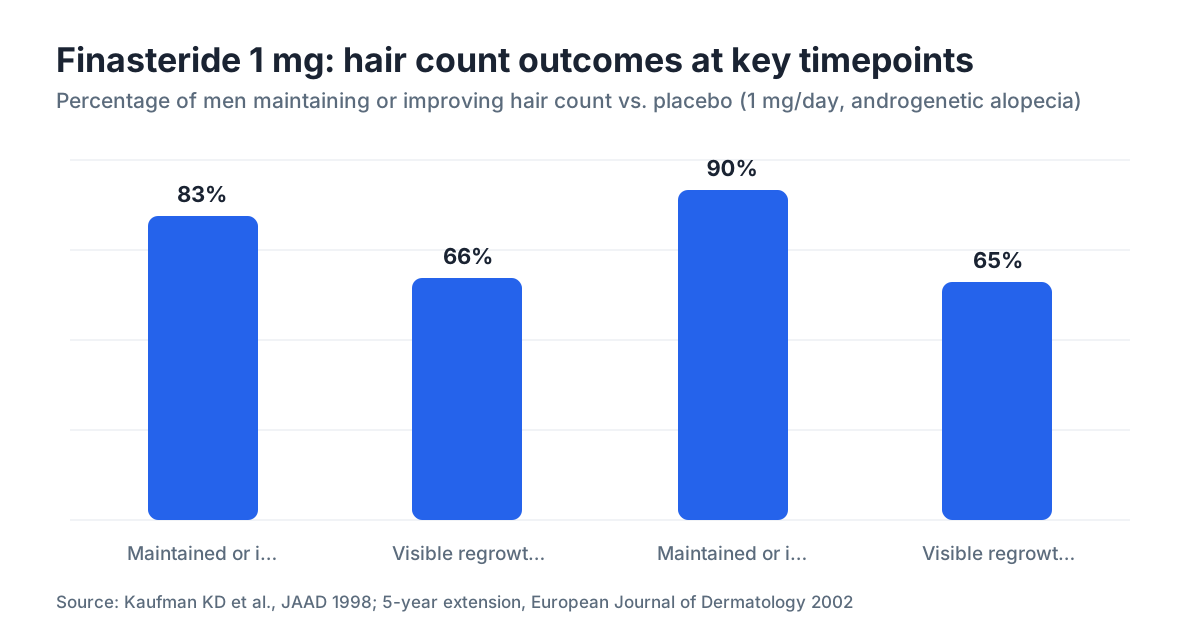
The efficacy data comes from two large randomized controlled trials published in 1998 and 1999, both sponsored by Merck but independently analyzed. At one year, 83% of men taking finasteride 1 mg maintained or increased hair count versus placebo [2]. At two years, 66% showed measurable regrowth.
A 5-year open-label extension study found that 90% of men maintained or improved their hair count, and 65% showed visible regrowth at the 5-year mark [3]. The 10% who lost ground despite taking the drug were mostly men with more advanced loss at baseline. That number, 90% maintenance at 5 years, is about as good as a pharmacological hair-loss treatment gets.
The catch: all of that applies to androgenetic alopecia in men. The drug is FDA-approved for men only. Women, especially women of childbearing age, face a different calculus entirely, which is covered below [1].
For men thinking about combining finasteride with a topical, the evidence for adding minoxidil is genuinely additive. The article on finasteride and minoxidil breaks down the combination trial data in detail.
What do before and after photos actually show?
Before-and-after photos in hair loss are notoriously unreliable as evidence. Lighting angle, hair length, styling product, and camera distance all change perceived density dramatically. The standardized global photographic assessment from the clinical trials is far more trustworthy than anything you'll find on Instagram.
In the Merck trials, blinded dermatologists rated global photographs on a 7-point scale at 2 years. Among men taking 1 mg finasteride, 48% showed visible improvement on this scale versus 7% on placebo [2]. Roughly 42% showed no change (meaning they maintained without improving), and 10% showed further loss. So the most realistic outcome for most men is hair that looks about the same two years later, which is a win given that untreated pattern baldness only moves one direction.
If you're tracking your own progress, take photos under identical conditions: same lighting, same camera distance, dry hair, no products. Month-to-month shots often look meaningless. Compare month one to month twelve and the change becomes visible.
For men with a receding hairline, photographic improvement at the temples is harder to document because frontal recession responds less reliably than vertex thinning.
Does finasteride work for women?
This is genuinely complicated. Finasteride is not FDA-approved for hair loss in women, and it carries a pregnancy category X label, meaning it's contraindicated in women who are or may become pregnant because of the risk of feminizing a male fetus [1].
Off-label use in postmenopausal women exists, and some studies support it. A randomized trial published in the Archives of Dermatology found that 1 mg finasteride daily produced no statistically significant improvement in premenopausal women with androgenetic alopecia compared to placebo [4]. Higher doses (2.5 to 5 mg) have shown more promise in some observational studies of postmenopausal women, but the evidence base is smaller and less consistent than for men.
Women with pattern hair loss who are postmenopausal and confirmed not pregnant sometimes use finasteride off-label under close dermatologist supervision. It's not a standard first-line recommendation, and any woman considering it should have a direct conversation with a physician, not a telehealth checkout screen. The honest answer: finasteride probably works better in men, and women have other options worth exploring first.
What side effects should you watch for?
The FDA label lists sexual side effects as the main concern: decreased libido, erectile dysfunction, and decreased ejaculate volume occur in roughly 1 to 2% of men in the clinical trials, and these effects resolved in most men after stopping the drug [1]. Those numbers come from placebo-controlled trials, and some researchers argue the nocebo effect (side effects driven by reading about them) inflates real-world reports.
Post-finasteride syndrome is more contested. Some men report persistent sexual and neurological symptoms after stopping the drug. The FDA added a label update in 2012 noting reports of persistent dysfunction, but the causal evidence remains debated in the medical literature. A 2020 review in JAMA Dermatology concluded the absolute risk of persistent side effects appears low but acknowledged that solid long-term data are limited [5].
A small but real point: finasteride lowers PSA (prostate-specific antigen) levels by about 50%, so PSA screening in men taking the drug needs to be read with that adjustment in mind. Tell your doctor you're taking finasteride before any prostate cancer screening.
If you're weighing DHT blockers more broadly, finasteride isn't the only option, but it's the one with the deepest long-term safety data.
What happens if finasteride stops working?
Some men see good results for several years and then notice the drug seems less effective. This isn't pharmacological tolerance in the classic sense. More often, it's because the drug was always slowing progression rather than permanently reversing it, and new follicles are reaching a stage of loss that finasteride can't rescue.
A meaningful subset of men are primary non-responders, meaning they never respond at all. There's no reliable genetic test yet to predict this before starting, though research is ongoing. If you've taken 1 mg finasteride consistently for 12 months and see continued significant loss, that's a reasonable point to re-evaluate.
Options at that stage: adding topical minoxidil for men if you're not already using it, switching to oral minoxidil (emerging evidence for cases where topical hasn't worked), increasing to 5 mg finasteride (off-label, sometimes used in non-responders), or consulting a hair transplant surgeon. A hair transplant is the most definitive option for restoring lost density, but it works best when medical therapy has stabilized the progressive loss first.
If you're not sure how much ground you've lost or whether your hairline has been moving, getting a structured baseline is genuinely useful. MyHairline's free AI scan (/scan) can document your current pattern and Norwood stage so you have something concrete to compare against as months pass.
Should you combine finasteride with minoxidil?
Yes, if you can tolerate both. The combination outperforms either drug alone. A randomized trial found that men using both finasteride and topical minoxidil had greater hair count increases than men using either therapy alone at 12 months [6]. The two drugs work through entirely different mechanisms: finasteride removes DHT, minoxidil opens potassium channels in the follicle and extends the growth phase. There's no pharmacological reason they'd interfere, and the clinical data confirm they don't.
The practical question is whether you want to manage two daily treatments. Topical minoxidil takes two applications a day and can irritate the scalp. Oral minoxidil is simpler (once-daily pill) but carries its own side effect profile including fluid retention and, rarely, unwanted body hair growth. The minoxidil side effects article covers what to watch for.
My honest take: if you're going to commit to finasteride, adding minoxidil at the start gives you the best shot at seeing results by the 12-month mark. Starting finasteride alone and adding minoxidil six months later if you want faster progress is also reasonable.
What's the cost and how do you get finasteride?
Generic finasteride 1 mg is cheap. As of 2025, a 30-day supply runs roughly $10 to 25 per month at major pharmacy chains and is often cheaper through discount programs like GoodRx. Brand-name Propecia is largely discontinued or rarely dispensed in the US. You'll almost certainly get the generic.
You need a prescription. A dermatologist or primary care doctor can prescribe it after a basic history and, ideally, an exam to confirm androgenetic alopecia. Telehealth platforms also prescribe it, often for $20 to 40 per month all-in including consultation, which is where most younger men now start. The trade-off is less rigorous baseline documentation compared to an in-person visit.
Finasteride also comes as a 5 mg tablet (used for benign prostatic hyperplasia under the brand name Proscar), and some men split those tablets into four roughly 1.25 mg doses. That's off-label and the tablets aren't scored for splitting, but it's a known cost-cutting move. The dose-response curve for finasteride is relatively flat between 0.2 mg and 5 mg, so a 1.25 mg split tablet produces a DHT reduction similar to the 1 mg dose [7].
The hair loss supplements market promises similar results for similar money. It doesn't deliver them. Finasteride at $15 a month with a 90% maintenance rate beats any supplement stack.
Is finasteride worth it long term?
That depends on what you value and what side effects you experience. For most men, the answer is yes: a drug that's 90% effective at halting progressive hair loss over five years, costs less than a streaming subscription, and has a known and manageable side effect profile is a favorable deal.
The calculus changes if you're a primary non-responder, if you have persistent sexual side effects, or if you're at an advanced enough stage that medical therapy alone won't give you satisfying density. In those cases, a realistic conversation with a dermatologist about combination therapy or surgical options is smarter than continuing indefinitely.
The American Academy of Dermatology rates oral finasteride as a Grade A recommendation for androgenetic alopecia in men, meaning the evidence quality is high and the recommendation is strong [8]. That's not a minor endorsement. It puts this among the best-evidenced treatments in all of dermatology, hair loss aside.
For long-term use, annual dermatologist check-ins are reasonable. A scalp exam and, if you're over 50, a PSA discussion with your adjusted baseline are the main things to stay on top of. Most men who respond well and tolerate the drug stay on it indefinitely, because stopping reverses results. If you stop and shed heavily six months later, restarting will likely recover most of what was lost, though re-regrowth isn't guaranteed to fully match the prior peak.
If you want a second opinion on your current hair pattern before committing to a plan, MyHairline's free AI scan (/scan) gives you a Norwood classification and a structured baseline in about two minutes.
Sources
- FDA, Propecia (finasteride) prescribing information
- Kaufman KD et al., Journal of the American Academy of Dermatology, 1998
- Kaufman KD et al., European Journal of Dermatology, 2002 (5-year extension)
- Price VH et al., Archives of Dermatology (JAMA Network), 2000
- Belknap SM et al., JAMA Dermatology, 2020
- Khandpur S et al., Journal of Dermatology, 2002
- Vermeulen A et al., Journal of Clinical Endocrinology & Metabolism, 1992 (finasteride dose-response)
- American Academy of Dermatology, guidelines for androgenetic alopecia
- FDA MedWatch, finasteride label update 2012
- National Library of Medicine, MedlinePlus: finasteride