
TL;DR: Native scalp density averages 65 to 85 follicular units per square centimeter, but you don't need to match that to look natural. Most experienced surgeons aim for 40 to 60 FU/cm² in one session. Below 25 FU/cm² looks see-through under most lighting. The number that works for you depends on your hair caliber, your skin-to-hair contrast, and how much donor supply you have left.
What is graft density and how is it measured?
Graft density is the number of follicular unit grafts placed into a defined area, usually written as follicular units per square centimeter (FU/cm²). A follicular unit is a naturally occurring bundle of one to four hairs held together by a ring of supporting tissue. When a surgeon punches or strips those units from your donor zone and places them in recipient sites, the concentration of those sites in any given square centimeter is your density.
Surgeons measure recipient density two ways. The first is the count of recipient sites drilled or cut per cm², which they control directly during the procedure. The second is yield, meaning the sites that actually grew hair, measured at the 12-month check. These two numbers rarely match, because not every graft survives. Average graft survival in experienced hands runs 85 to 95% [1], so a surgeon who places 50 sites per cm² should expect roughly 42 to 47 growing follicular units per cm² a year later.
Density is not coverage. Coverage describes how much total scalp area you're filling. A surgeon can get good coverage at low density if the patient has thick-caliber hair, or poor coverage at high density if the hair is fine and the skin-to-hair contrast is high. Density and caliber are the two levers of a natural result.
What is the natural density of a human scalp?
Unaffected human scalp averages 65 to 85 follicular units per cm², with most studies clustering around 70 to 80 FU/cm² in Caucasian subjects [2]. That range shifts by ethnicity. People of African descent average somewhat higher density with tightly coiled hair that gives more visual coverage per graft. East Asian patients tend to have lower follicular density but larger, coarser fibers that compensate optically.
These numbers come from punch biopsy studies and automated folliscopy. Native frontal scalp density is statistically higher than vertex density in the same person, which explains why transplanted crown areas are harder to make look dense even at identical graft counts.
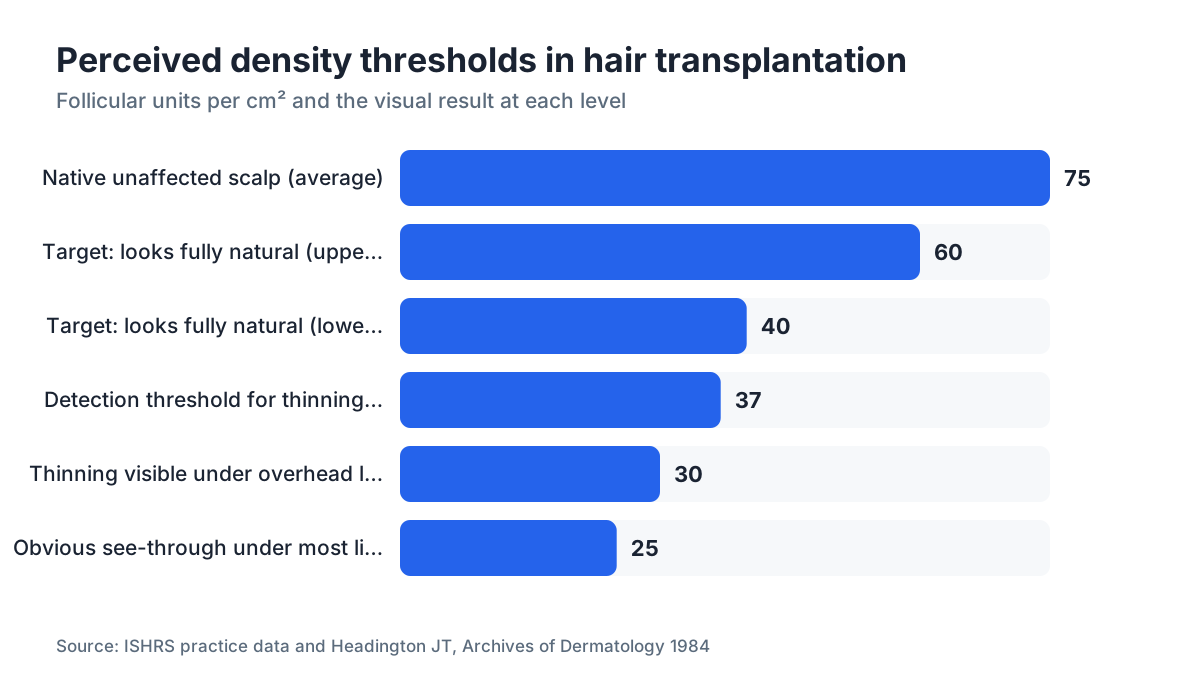
Here's what matters for anyone considering a transplant: 65 to 85 FU/cm² is what you were born with. Reproducing that with transplanted hair is biologically impossible in one session and usually unnecessary. The eye doesn't detect thinning until density drops below roughly 50% of baseline, which is around 30 to 40 FU/cm² for most people [3]. That optical threshold, not native density, is the real target.
What density actually looks natural after a hair transplant?
The consensus in the hair restoration literature sits at 40 to 60 FU/cm² for the frontal zone as the range that reads as full under normal social lighting [4]. At 45 FU/cm² the hairline looks dense in person and in photos. At 30 FU/cm² most patients notice thinning when the hair is wet. At 25 FU/cm² and below, the scalp shows through under overhead light.
That range is not one number for everybody. Hair caliber matters enormously. Patients with terminal fiber diameter above 80 microns can reach the look of full density at 35 to 40 FU/cm², while patients with fine hair below 50 microns may need 55 to 60 FU/cm² or more for the same visual result [4]. Skin-to-hair contrast is the other big variable. A person with light skin and very dark hair needs more grafts per cm² to hide the contrast than someone whose skin and hair sit close in tone.
Single-session frontal density above 60 FU/cm² is generally described as aggressive, meaning it raises the risk of poor graft survival and burns through donor supply you'll want for future sessions [5]. Good clinics front-load density where you look in the mirror every morning, the hairline and mid-scalp, and accept slightly lower density toward the crown. That's exactly how nature distributes hair.
If a clinic promises 80 to 100 grafts per cm² in one session, walk. The biology of oxygen delivery to the recipient scalp limits how many grafts survive at high concentrations.
How many total grafts do different bald areas need?
Density per cm² is only half the equation. You also need the area you're filling. Surgeons estimate the bald area in cm² using Norwood stage maps or direct scalp measurement, then multiply by the target density for a total graft estimate.
The table below gives rough ranges experienced clinics use. These are planning figures, not guarantees. Your surgeon should measure your actual bald area and calculate from that.
| Norwood Stage | Approximate Bald Area (cm²) | Grafts Needed at 40 FU/cm² | Grafts Needed at 55 FU/cm² |
|---|---|---|---|
| NW2 (early recession) | 20 to 40 | 800 to 1,600 | 1,100 to 2,200 |
| NW3 (moderate recession) | 50 to 80 | 2,000 to 3,200 | 2,750 to 4,400 |
| NW4 (bald top + recession) | 90 to 130 | 3,600 to 5,200 | 4,950 to 7,150 |
| NW5 (extensive bald) | 140 to 180 | 5,600 to 7,200 | 7,700 to 9,900 |
| NW6 to 7 (near-total loss) | 190 to 250+ | 7,600 to 10,000+ | limited by donor supply |
For NW5 and above, donor supply becomes the binding constraint before density does. A typical donor zone yields 5,000 to 8,000 total extractable grafts over a lifetime, depending on scalp laxity and hair characteristics [5]. Covering a NW6 at 55 FU/cm² throughout is mathematically impossible for most patients, which is why surgeons prioritize the frontal frame and accept lower density or slight crown thinning at the back.
Want to know where you fall on the Norwood scale before a consultation? The free AI scan at MyHairline gives a quick staging estimate from a photo, though in-person measurement by a surgeon is always the definitive step.
Does FUE or FUT affect the density you can achieve?
The extraction method, whether follicular unit excision (FUE) or follicular unit transplantation (FUT strip), doesn't directly change the density a surgeon can place in the recipient area. Both deliver the same follicular units to the same recipient sites. The difference is in how many grafts a single session can safely yield from the donor zone.
FUT strip procedures typically harvest 2,000 to 4,000 grafts in one session from a single donor strip, without the repeated small punches that thin the donor area. FUE sessions in experienced hands average 2,000 to 3,500 grafts per day, though some clinics report up to 4,000 [10]. Neither method physically caps recipient density, but a smaller session means either lower density or covering less area, so the method matters for planning across multiple sessions.
What does affect recipient density is the diameter of the recipient sites. Smaller gauge needles let sites sit closer together without the punches overlapping and cutting blood supply to nearby tissue. Many surgeons now use 0.6 to 0.9 mm recipient site tools specifically to allow denser packing. The limit above 50 to 55 FU/cm² is not the surgeon's willingness. It's the scalp's vascular supply. Too many holes too close together means grafts compete for the same capillaries.
The practical read: if you need high density in a small area, a skilled FUT surgeon can deliver a large graft count in one session. If your donor zone is already thin or you had a prior transplant, FUE lets a surgeon harvest more selectively without a linear scar.
What happens if you get grafted below 25 FU/cm²?
Density below 25 FU/cm² is where most people describe the result as thin or obviously transplanted under direct light. The scalp shows through when the hair is wet, and overhead lighting in offices or restaurants creates a halo of visible scalp. This is the range people associate with the old pluggy results from the 1980s, though plugs were a different procedure entirely. Low density isn't the same as plugs, but both let scalp show.
There are cases where accepting 25 to 35 FU/cm² is the right clinical call. A patient with very limited donor supply covering a large area is better served by lower density spread across the whole zone than by high density in a small patch that leaves the rest bare. A patient who'll continue medical therapy like finasteride or minoxidil for men may also accept lower transplant density if retained native hair fills the gaps.
The hairline is the exception. Even when the mid-scalp and crown run at 30 to 35 FU/cm² because of supply constraints, most surgeons protect the hairline itself at 40 to 50 FU/cm², because that's what the eye reads first. A softer, slightly irregular hairline at 45 FU/cm² looks more natural than a dense but geometrically perfect line. That's a design principle as much as a density one.
How does hair caliber change the density you actually need?
Hair shaft diameter is measured in microns. Fine hair runs 40 to 60 microns. Medium hair runs 60 to 80 microns. Coarse or thick hair runs 80 to 120 microns. The difference matters because optical coverage depends on the cross-sectional area of the fibers, not the count of follicles.
A patient with 90-micron shafts has roughly three times the cross-sectional coverage per strand of a patient with 50-micron hair at the same follicle count [6]. That first patient can look visually full at 35 to 40 FU/cm², a number that would look see-through on someone with fine hair. This is why Indian and African-descent patients with coarser hair often need fewer grafts than East Asian or Northern European patients with finer, straighter hair to reach the same perceived density.
Wave and curl add another multiplier. Curly hair covers more scalp per centimeter of shaft because it bends back over itself. A patient with tight curl can look fully covered at 30 FU/cm² in some zones. Fine, straight, dark hair on a light scalp is the hardest combination there is: scalp contrast is at its maximum and coverage per fiber at its minimum. These patients need the upper end of the 40 to 60 range and are often the best candidates for scalp micropigmentation as a complement to transplantation.
Your consultation should include a hair caliber measurement. Good clinics use a trichoscope or digital dermatoscope to measure fiber diameter before planning graft numbers. A graft estimate handed to you without a caliber measurement is a gap in the assessment.
What questions should you ask your surgeon about density?
The density conversation at your consultation tells you a lot about a clinic's competence. Here are the specific questions worth asking.
First, ask what FU/cm² they plan to place in your hairline, your mid-scalp, and your crown separately. A quality surgeon has different targets for each zone. If the answer is one number for everything, push back.
Second, ask what their graft survival rate is and how they measure it. The honest answer involves a follow-up protocol at 12 months and some form of density measurement, more than looking at photos. Average survival in published studies is 85 to 95% [1], so a clinic claiming 98% or guaranteeing exact outcomes is overstating.
Third, ask how they plan your second session if you need one. A surgeon who places grafts at 60 FU/cm² in session one may have closed off enough blood vessels that a second session in the same area is off the table. The best surgeons plan lifetime donor supply in advance.
Fourth, ask what they do differently for fine hair versus coarse hair. A density plan that doesn't vary by caliber isn't individualized.
Fifth, ask what happens if you keep losing hair in areas next to the transplant. The answer should involve medical maintenance with something like finasteride and minoxidil or a DHT blocker to protect native hair and preserve future sessions.
Knowing your current stage of loss before that consultation makes the conversation sharper. If you haven't had a professional assessment yet, the MyHairline AI scan is a no-cost starting point.
Can you increase density with a second transplant session?
Yes, and planned multi-session approaches are standard for anyone who starts with limited coverage. The key word is planned. A surgeon who placed grafts at 50 FU/cm² has left room in the recipient scalp for a second pass at 35 to 45 FU/cm² in the same zone, bringing combined density toward 80 to 90 FU/cm², which is close to native. This is called densification.
The biological limit is the same vascular one that caps single-session density. Freshly transplanted zones need time, usually 8 to 12 months, for the blood supply to stabilize before a second session in the same area is safe. Reputable surgeons won't rebook a second session in the same area before that window closes.
For patients with a progressive loss pattern, particularly younger men who are a Norwood 3 now but may reach Norwood 5 over a decade, a staged approach beats one aggressive session almost every time. Filling a Norwood 3 hairline at 55 FU/cm² looks great at 30 but leaves no donor supply for the expanding bald zone at 45. ISHRS guidance specifically cautions against attempting maximum density in young patients with progressive loss for this reason [5].
Medical therapy sits alongside the surgical plan here. Patients who commit to finasteride or minoxidil for men after a transplant keep more of their native hair, which means the transplanted grafts do less work, which means the result looks denser for longer. That's not a small point. It's the whole economics of long-term hair management.
Does graft density look different by ethnicity or skin tone?
Skin-to-hair contrast is the single most predictive factor for how many FU/cm² you need to match another patient's visual result. High-contrast combinations, dark hair on light skin or light hair on dark skin, make the scalp more visible between shafts and demand higher density to mask. Low-contrast combinations, dark hair on dark skin or medium-brown hair on medium-tan skin, are far more forgiving of lower graft counts.
Patients of African descent with tightly coiled hair reach visual fullness at densities 20 to 30% lower than Caucasian patients with straight fine hair, purely because the curl creates more surface coverage per follicle [4]. That's not a reason to assume African-descent patients need fewer grafts in absolute numbers. It means the density targets in the table above should shift down slightly for coiled hair and up for fine straight hair.
Native scalp density also varies by group. Mean follicular density runs about 66 FU/cm² in Korean subjects, 81 FU/cm² in European subjects, and 93 FU/cm² in African subjects, with real overlap across groups [6]. The 40 to 60 FU/cm² target zone holds across ethnicities as a threshold for looking natural, but fine-tuning that number requires knowing both your hair caliber and your skin-to-hair contrast.
A good clinic photographs your scalp under dermoscopy and reads your contrast before finalizing graft counts. Skip that step and they're estimating by eye, which is weaker.
What role do native hair and medical therapy play in perceived density?
Most people planning a transplant still have some native hair in the thinning zone. That hair contributes to perceived density and changes how many transplanted grafts you actually need. A zone with 20 native FU/cm² that you transplant at 30 FU/cm² has a combined density of 50 FU/cm², which usually looks fine.
The danger is that native hair in a thinning zone is already miniaturized, which makes it vulnerable to continued loss from DHT exposure if left untreated. If that hair dies over the next five years, your transplanted zone drops from 50 to 30 FU/cm² and looks thin again. This is the scenario that produces patchy, unnatural results in patients who got a transplant but never treated the underlying cause of loss.
Medical therapy is not optional maintenance for most transplant patients. It's the mechanism that keeps the transplant looking good. The FDA has approved finasteride 1 mg oral (Propecia) for male androgenetic alopecia [7] and minoxidil topical solution for both men and women [9]. Neither grows transplanted hair any better, because transplanted DHT-resistant follicles don't need pharmacological protection. But they protect the native hair filling the gaps between grafts, and those gaps are what make or break perceived density in years three through ten after surgery.
Patients who pair a well-planned transplant with ongoing medical therapy report better long-term satisfaction in the published literature. Worth understanding before you book anything.
Sources
- Bernstein RM, Rassman WR. Follicular transplantation, work cited widely for 85–95% graft survival in experienced hands (PubMed listing)
- Sperling LC. Hair density in African Americans. Archives of Dermatology, 1999
- Headington JT. Transverse microscopic anatomy of the human scalp. Archives of Dermatology, 1984
- International Society of Hair Restoration Surgery (ISHRS), practice census and patient outcomes data
- American Board of Hair Restoration Surgery (ABHRS), candidate information and standards
- Lee WS et al. East Asian hair studies, follicular density and shaft diameter (PubMed listing)
- FDA. Drugs@FDA database, Propecia (finasteride 1 mg) approval and prescribing information
- American Academy of Dermatology (AAD). Hair loss resource center
- FDA. Drugs@FDA database, minoxidil topical solution approval for men and women
- Rassman WR et al. Follicular unit extraction: minimally invasive surgery for hair transplantation. Dermatologic Surgery, 2002 (PubMed listing)