

TL;DR: Scalp micropigmentation (SMP) tattoos tiny dots that mimic a shaved head. A hair transplant moves real follicles that grow actual hair. Both can look convincingly natural, but they fit different people. SMP wins if you're happy keeping hair very short. A transplant wins if you want length and styling freedom. Neither is better across the board.
What is scalp micropigmentation and how does it work?
Scalp micropigmentation is a cosmetic tattooing procedure. A practitioner uses a fine needle to deposit pigment into the upper dermis in tiny circular dots, each roughly 0.1 mm across, designed to copy the cross-section of a shaved hair follicle. The goal is a density illusion. Your eye reads the pattern as stubble instead of bare scalp.
The process usually takes two to four sessions spread a week or two apart [1]. Each session runs two to five hours depending on the area treated. The pigment differs from standard tattoo ink. It's formulated to stay closer to the surface and resist the blue or green shift that body tattoos sometimes drift toward over years, though color change is still a long-term concern a good clinic should discuss honestly.
SMP does not produce hair. No growth. No texture. No movement in the wind. What you get is the visual impression of a very close shave across the treated scalp. If that's the look you already wear or want to wear, SMP can be remarkably convincing.
What is a hair transplant and how does it work?
A hair transplant moves living hair follicles from a donor zone, almost always the back and sides of the scalp, to areas where hair has thinned or stopped growing. Two techniques dominate. Follicular unit transplantation (FUT) removes a strip of scalp and dissects it into grafts. Follicular unit excision (FUE) punches individual follicles out one at a time.
Transplanted follicles shed their initial hair within two to four weeks of surgery. That's normal. The follicle is alive but cycling into a resting phase. Visible regrowth usually starts around month three to four, and a fair read on the final result takes 12 to 18 months [2]. The American Academy of Dermatology says most patients see 10 to 80 percent improvement in fullness, a wide range that reflects how much donor hair is available and how skilled the surgeon is [2].
This is surgery, with surgical risks: infection, scarring, poor graft survival, and an unnatural hairline if the design or implantation angle is off. FUT leaves a linear scar across the donor area. FUE leaves small round puncture scars, less visible but still real. Both matter if you want to wear your hair very short later.
The core advantage over SMP is simple. You end up with actual hair that grows, bends, catches light, and takes a style.
Which one looks more natural day to day?
This is the question most people are really asking, and the honest answer depends entirely on the hair length you plan to keep.
At a zero to number-one guard length (essentially shaved), high-quality SMP is very hard to tell apart from real stubble in normal lighting at social distance. The dots match your natural color, follow your original hairline density, and feather at the edges to kill any hard line. Across a room or in a photo, it reads as a shaved head with full coverage.
Anything longer than a tight buzz, and SMP gives itself away. The dots don't grow. Real hair around them gets longer, and the gap between hair shafts and flat pigment dots turns obvious. That's the ceiling of SMP. It's locked to the shaved-head look.
A well-done transplant at 12 to 18 months, on someone with enough donor density, can be genuinely indistinguishable from natural hair in most lighting. The hair grows, lies flat, moves in wind and water, and cuts and styles like anything else. It only carries a "transplant look" when the hairline was drawn too geometric, the grafts went in at a wrong angle, or the density came out too thin because the donor supply wasn't there.
Here's the honest caveat. Bad transplants look worse than bad SMP. A pluggy, badly designed hairline is recognizable and stigmatized in a way mediocre SMP usually isn't. Practitioner skill matters enormously for both, but the floor is lower for transplants.
How do the costs compare?
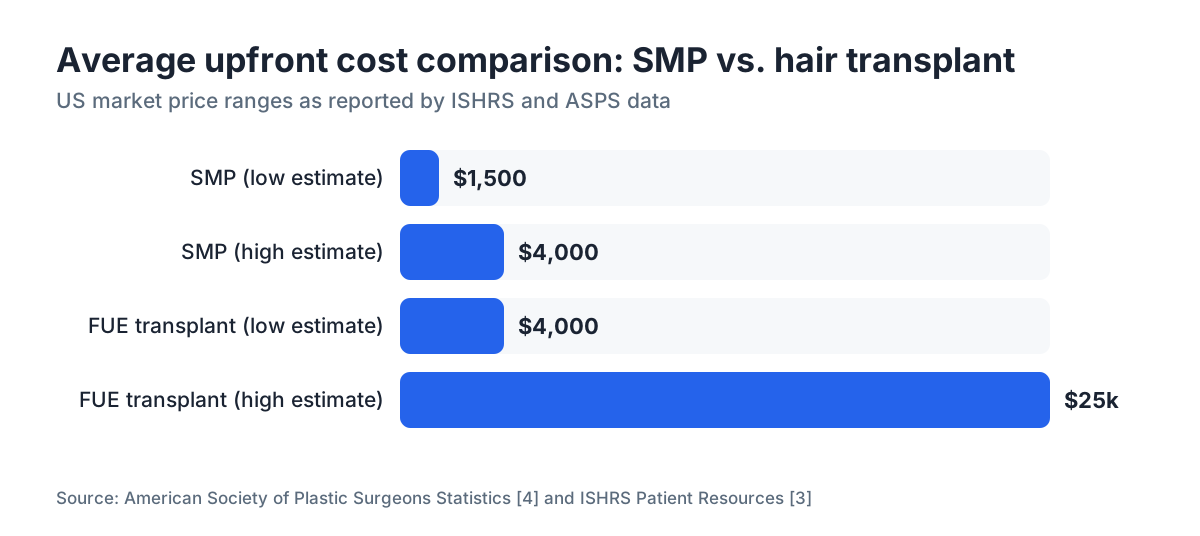
SMP in the US typically runs $1,500 to $4,000 for a full scalp across the standard two to four sessions [3]. Touch-ups every three to six years add a few hundred dollars each as the pigment fades. Over 20 years, total spend might land around $3,000 to $7,000 depending on how often you refresh.
Transplants cost more upfront. FUE in the US commonly runs $4,000 to $15,000 for a moderate session of 1,500 to 3,000 grafts. Larger sessions or big-city prestige clinics can hit $20,000 to $25,000 [4]. FUT often costs a few thousand less because it's faster to dissect. Medical tourism (Turkey, Thailand, parts of Eastern Europe) can slash the price, sometimes to $1,500 to $4,000 for a full FUE session, but you eat travel costs, distant aftercare, and the trouble of vetting a clinic from another continent.
Neither procedure is covered by insurance. Both are cosmetic. Some clinics offer financing.
Here's the context that changes the math. SMP is maintenance forever and commits you to a shaved head. A transplant is a one-time surgical spend (some people need a second session) that lets you grow hair. Over a decade the cost gap narrows more than people expect.
| SMP | Hair Transplant (FUE, US) | |
|---|---|---|
| Upfront cost | $1,500, $4,000 | $4,000, $25,000 |
| Ongoing cost | Touch-ups every 3 to 6 years | Usually none (medications optional) |
| Sessions | 2 to 4 (initial) | 1 to 2 surgical sessions |
| Results visible | Immediately | 12 to 18 months |
| Reversible? | Laser removal (difficult) | No |
| Scarring | None visible | Linear (FUT) or small dots (FUE) |
Does SMP look natural on a receding hairline specifically?
A receding hairline is one of SMP's stronger cases. A skilled practitioner can draw a new hairline that follows your original growth pattern, soften the temple recession with scattered dots instead of a hard edge, and rebuild the visual frame of the face. At buzz-cut length the result can look very natural, because receding hairlines and close-cropped hair coexist all the time in real life.
The problem is partial recession. Say a Norwood 2 or 3, where you still have several inches of hair on top. SMP can fill the receded corners, but the longer natural hair beside the pigmented scalp makes the dots pop, especially in certain light. Some practitioners handle it with an extremely soft, low-density feather at the border. There's a real limit.
For deeper recession (Norwood 4 and beyond) where someone already wears very short hair, SMP can be transformative. The density illusion is often striking. Whether it looks "natural" here is almost philosophical. It doesn't look like a full head of hair. It looks like a man with a naturally full buzz cut, which is different but more achievable and, arguably, more honest.
Can SMP and hair transplants be combined?
Yes, and it's underrated. Some people get a transplant to rebuild part of the hairline, then use SMP to fill density between transplanted hairs or hide the donor scar. FUT in particular leaves a linear scar that some men want to cover if they prefer a shorter style. SMP dots placed over and around that scar can make it much less visible [5].
Sequencing is the catch. Generally the transplant comes first, then SMP after the transplanted hair has fully settled (12 to 18 months post-surgery). Reverse that order and the transplant needles can disrupt the pigment.
Combining costs more than either alone. But for someone with some donor hair who wants both length capability and density coverage, it can reach a result neither procedure hits on its own. Have this conversation with both a hair restoration surgeon and an SMP practitioner before you commit to either.
What are the realistic risks and downsides of each?
SMP risks are mostly cosmetic and slow to show. Pigment can fade unevenly, turn slightly blue or gray over time (especially with cheap inks), or migrate a little and blur a crisp dot into a smudge [10]. If your natural hair keeps thinning after SMP, the contrast between pigmented areas and adjacent real hair shifts, so touch-ups become necessary to keep things matched. Laser removal is possible but takes multiple sessions and often leaves some residual pigment.
Transplant risks are faster and more medical. The American Academy of Dermatology lists infection, folliculitis (inflammation of transplanted follicles), shock loss of surrounding native hair in the first few months, and poor graft survival if aftercare slips [2]. Numbness in the donor area can linger for months. The biggest long-term aesthetic risk is design. A hairline that looks right at 30 can look strange at 55, because the surrounding native hair keeps thinning while the transplanted area doesn't. A good surgeon plans for future loss out loud, before cutting.
Finasteride or minoxidil often get recommended alongside a transplant to protect existing hair. If that's on your radar, the finasteride and minoxidil combination has the most evidence behind it for holding onto what you have.
How do you choose between them based on your stage of hair loss?
Stage of loss is probably the most useful filter you have.
For Norwood 1 to 3 (early recession, good donor density), a transplant is almost always the better long-term bet if you want hair longer than a buzz cut. The donor supply is there, the investment is proportionate, and results at this stage can look entirely natural for decades with maintenance meds.
For Norwood 5 to 7 (heavy baldness, large bald area), the math flips. You may not have enough donor hair to fill the crown and vertex, and transplanting a big area with thin supply risks a feathery, sparse look across the scalp. SMP's density illusion gets more competitive here because it covers the whole area evenly without running out of "supply."
Norwood 4 is the real decision point. Some Norwood 4s have excellent donor density and get a good transplant result. Others don't, and forcing a transplant with limited supply produces sparse coverage. This is where an in-person consult with a board-certified hair restoration surgeon (ideally an International Society of Hair Restoration Surgery member) earns its cost before you spend on anything.
Want a baseline on what your scalp is actually doing before you book consults? MyHairline's free AI scan at /scan gives you a starting read on your loss pattern.
If you're also dealing with active shedding from something like telogen effluvium, fix the underlying trigger before committing to either procedure. Pigment over a scalp that keeps thinning looks worse every year, and transplanted hair can outlast native hair that you lose to continued DHT-driven miniaturization if you skip a DHT blocker.
How long do the results last for each procedure?
SMP pigment starts fading noticeably within three to six years for most people, though sun exposure, skin type, and pigment quality all move that number [3]. You'll need touch-ups to hold density and color match. Some people find the fade gradual and easy to manage. Others find a two-year-old SMP that hasn't been refreshed looks obviously fake. It's a real ongoing commitment.
Transplanted hair is permanent in one specific sense. The relocated follicles keep the genetic programming of the donor zone. The back and sides resist DHT, the hormone that drives androgenetic alopecia, and transplanted follicles generally hold that resistance in their new spot [7]. Hair from a successful transplant does not fall out from pattern baldness.
The caveat matters. Native hair around a transplant is not protected. It keeps thinning [11]. That's why transplants look denser at year one than year ten if the surrounding hair goes and isn't replaced. Finasteride slows that loss in most men, which is why most hair restoration surgeons pair it with surgery. The finasteride evidence for slowing DHT-driven loss is well established.
What does the research say about patient satisfaction with each?
Head-to-head randomized trials comparing SMP with transplants don't really exist. The procedures serve overlapping but different populations, and the outcomes are subjective. What we have is satisfaction data for each on its own.
A 2019 study in the Journal of Cosmetic Dermatology surveyed 50 SMP patients and found 92 percent reported satisfaction with the cosmetic result at six months, and 84 percent said it still met expectations at two years [6]. Fading was the main complaint among the dissatisfied.
For transplants, the ISHRS 2022 practice census reported FUE now accounts for roughly 87 percent of procedures worldwide, and registry satisfaction data generally shows 70 to 90 percent satisfaction at 12 months when expectations were managed well before surgery [8].
The key word in that last line is expectations. Both procedures score worse in satisfaction surveys when patients wanted something the technique can't deliver. SMP patients who wanted longer-hair styling. Transplant patients who expected full coverage without the donor supply to reach it.
Is SMP detectable up close or in photos?
High-quality SMP is genuinely hard to spot in photos and at normal social distance (two feet or more). At buzz length, matched pigment, and skilled needle work, it reads as a shaved head with full coverage.
Under harsh direct light, magnification, or very close range, the dots can sometimes look flat instead of three-dimensional, especially once the pigment has aged and spread a little. Freshly done, premium SMP with correctly matched pigment is about as close to undetectable as the technique gets.
The situation most likely to expose SMP is blending it with longer surrounding hair. Real hair moves and catches light. Flat dots don't. That contrast is where the eye catches on.
Photo worries are common and fair. In a standard indoor or outdoor shot, good SMP reads as a shaved head. Flash can occasionally over-expose the scalp and make the lack of actual hair more apparent, but that hits genuinely shaved heads too.
What should you ask a clinic before committing to either procedure?
For SMP clinics, ask to see before-and-after photos of patients with your skin tone and hair color at six months and two years, more than fresh work. Ask what pigment brand they use and what longevity data backs it. Ask how they handle fading and what touch-ups cost. Ask about certification, because there's no universal US licensing body for SMP, so quality varies widely by state and operator [9].
For transplant clinics, ask whether the surgeon is board certified in dermatology or plastic surgery, and whether they're an ISHRS member. Ask their graft survival rate and how they measure it. Ask to see results on patients at a Norwood stage and hair type close to yours at 12 to 18 months. Ask flat out about shock loss risk and how they'd handle a poor result.
For both, be skeptical of any clinic that guarantees a specific density or leans on high-pressure sales. Results vary with biology, and an honest practitioner will tell you that to your face.
Still figuring out your loss pattern before booking consults? A free AI hair analysis through MyHairline at /scan can show you where you're starting from.
Sources
- Journal of Cosmetic Dermatology, Rassman et al., overview of scalp micropigmentation technique
- American Academy of Dermatology, Hair Loss / Hair Transplant overview
- International Society of Hair Restoration Surgery, Patient Resources on non-surgical options
- American Society of Plastic Surgeons, Plastic Surgery Statistics
- Journal of the American Academy of Dermatology, scar camouflage with tattooing techniques
- Journal of Cosmetic Dermatology, 2019, patient satisfaction study of SMP at 6 months and 2 years (n=50)
- U.S. National Library of Medicine / StatPearls, Hair Transplantation
- International Society of Hair Restoration Surgery, 2022 Practice Census
- U.S. Federal Trade Commission, consumer guidance (tattoo and permanent makeup licensing varies by state)
- FDA, Tattoos and Permanent Makeup safety information
- American Academy of Dermatology, Androgenetic Alopecia overview