

TL;DR: A Norwood 3 hairline usually needs 1,200 to 2,500 FUE grafts for a natural result, with most cases landing around 1,500 to 2,000. The number depends on your recession depth, donor density, how low you want the hairline, and whether you'll take finasteride or minoxidil to protect the hair you still have. US cost runs roughly $4,000 to $10,000.
What is Norwood 3 and why does the stage matter for graft counts?
The Norwood-Hamilton scale is the standard classification for male pattern baldness. It runs from stage 1 (no loss) through stage 7 (nearly complete loss). Norwood 3 is the earliest stage the scale's original authors called "clinically significant" hair loss. [1]
At Norwood 3, the temples have pulled back. The two frontal recession points are deep enough that if you drew imaginary lines connecting them to the top of the scalp, the exposed skin forms a visible M or U shape. There's also a Norwood 3 Vertex variant, where the crown starts thinning at the same time the temples recede.
The stage matters because it's the first thing a surgeon uses to estimate how much recipient area needs coverage. At Norwood 3 you haven't lost a huge amount of scalp yet. That's good news and a real constraint at once: you have to stay conservative enough to keep donor hair in reserve for the progression that comes without medical treatment.
If you're at Norwood 3 and still in your 20s, any honest surgeon factors in the odds you reach Norwood 5 or 6 over the next two decades. Spend your entire donor bank at 25 to restore a Norwood 3 hairline and you have nothing left when the loss keeps marching behind the transplant. That's one of the most common regrets in this surgery.
How many grafts does a Norwood 3 FUE transplant actually need?
Most Norwood 3 cases need 1,200 to 2,500 grafts. [2] Published planning guides and clinic data cluster Norwood 3 procedures in that window, with the median case around 1,500 to 2,000 grafts.
Here's what pushes the number up or down.
Hairline position. A lower, more aggressive hairline fills a larger recipient zone and eats more grafts. A mature, conservative design uses fewer.
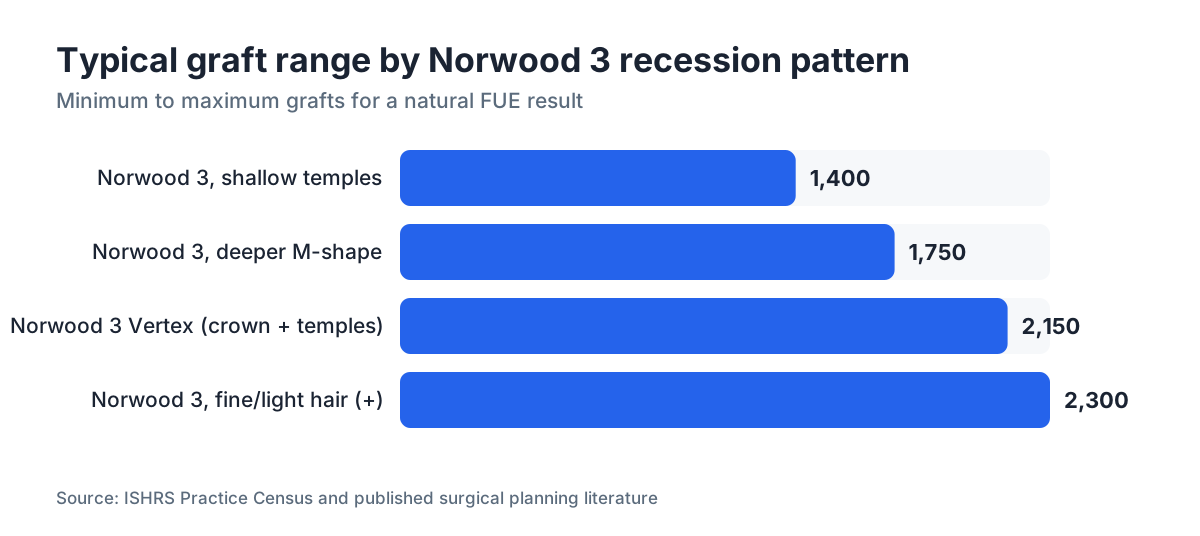
Recession depth. Norwood 3 covers a range. Shallow temporal recession might need 1,200 to 1,400 grafts. A deep Norwood 3 approaching the 3A boundary can push toward 2,000 to 2,500.
Native hair characteristics. Coarse, curly hair gives more optical coverage per graft than fine, straight hair. A patient with thick, wavy dark hair hits the same visual density with fewer grafts than someone with fine, light hair.
Density goal. The occipital scalp (the back and sides used as donor) averages roughly 60 to 80 follicular units per square centimeter naturally. [3] Surgeons transplant at 35 to 50 FU/cm² in the recipient zone for a natural look. Below 30 FU/cm² tends to look thin in raking light. Push too high and you risk poor blood supply and lower graft survival.
Vertex coverage. Norwood 3 Vertex patients need extra grafts for the crown, often 400 to 800 on top of the frontal estimate.
| Recession Pattern | Typical Graft Range |
|---|---|
| Norwood 3, shallow temples only | 1,200 to 1,600 |
| Norwood 3, deeper M-shape | 1,500 to 2,000 |
| Norwood 3 Vertex (crown + temples) | 1,800 to 2,500 |
| Norwood 3 with fine/light hair | Add 200 to 400 grafts |
These figures assume a naturally placed hairline, not an 18-year-old's hairline dropped onto a 35-year-old's head.
What is a natural-looking hairline at Norwood 3 and how does design affect graft count?
A natural hairline is not a straight line. It has micro-irregularity, a slight widow's peak tendency in most men, and a transition zone where single-hair follicular units sit in the front row before denser multi-hair units behind them. Surgeons call this the "feathering" zone. It's what separates a result that looks like a transplant from one that looks like hair.
The transition zone alone can consume 200 to 400 single-follicular-unit grafts (one hair each). These don't add density. They add realism. A surgeon who skips this to save grafts hands you a pluggy front no matter how good the density is behind it.
Hairline height matters too. The average male hairline sits roughly 7 to 9 cm above the glabella, the point between the eyebrows. [4] Place a transplanted hairline lower than that and it tends to look wrong as a man ages, because the face keeps changing while the transplant stays put. A conservative hairline uses fewer grafts and ages better.
For patients who insist on a very low or dense design, surgeons often use zone-by-zone planning: map exactly how many cm² need coverage and at what density, then multiply for a graft estimate. A 30 cm² recipient zone at 45 FU/cm² works out to roughly 1,350 grafts for that zone alone, before transition grafts.
How does FUE compare to FUT for a Norwood 3 case?
FUE (Follicular Unit Excision) removes individual follicular units straight from the donor area with a small circular punch, usually 0.8 to 1.0 mm across. FUT (Follicular Unit Transplantation) removes a strip of scalp from the back of the head, then a team dissects it under microscope into individual grafts.
A Norwood 3 case needing 1,200 to 2,000 grafts fits in a single session either way. The differences that actually matter:
Scarring. FUE leaves small dot scars scattered across the donor, invisible above a grade 3 clipper. FUT leaves a linear scar, which limits how short some patients can go. If you want to keep the sides short, FUE has a real edge.
Graft survival. Well-done FUE by an experienced team clears 90% survival. Botched FUE (blunt punches, too-deep extraction, long out-of-body time) can drop to 70% or worse. [5] Low survival means you didn't get what you paid for.
Cost. FUE costs more per graft in the US, typically $5 to $10 versus $3 to $7 for FUT. On a 1,500-graft procedure that adds up.
Session limits. FUE's practical single-session ceiling at most clinics is around 2,500 to 3,000 grafts. A Norwood 3 case rarely hits that, so it isn't a constraint here.
For most Norwood 3 patients who want short-hairstyle flexibility and aren't trying to squeeze 3,000-plus grafts from one session, FUE is the sensible default. The method doesn't change the graft count. It changes how the grafts come out.
Our guide to hair transplant surgery covers the full procedure and what to expect.
How does donor density affect whether you have enough hair to transplant?
You cannot transplant hair you don't have. Donor supply is the hard limit on everything.
The safe donor zone on the back and sides holds roughly 6,000 to 8,000 follicular units in a man with average density. [3] Surgeons generally recommend using no more than 50% of available donor hair over a lifetime, so you don't end up with a see-through donor zone.
A Norwood 3 case needing 1,500 to 2,000 grafts leaves an average-density man plenty of supply. The real worry is future sessions. Progress to Norwood 5 or 6 and restoring the midscalp and crown on top of the frontal work could take 3,000 to 4,000 more grafts. A surgeon who ignores this in the first plan is setting you up for an under-resourced second or third procedure.
Men with genuinely low donor density (common in diffuse thinning, worth flagging if your family history is diffuse loss rather than patterned loss) may be poor candidates at any stage. A trichoscopy or densitometry exam at consultation can measure your follicular units per cm² before anyone plans surgery. [6]
Should you take finasteride or minoxidil before or after a Norwood 3 transplant?
This is the part most people underestimate.
A transplant moves permanent, DHT-resistant follicles from the donor zone to the recipient zone. Those transplanted hairs won't fall out from male pattern loss. The native hairs still on your scalp absolutely can. A Norwood 3 patient has a lot of native hair left, and losing it over the next few years while the transplant holds means the overall look falls apart.
Finasteride (1 mg/day oral) cuts scalp DHT by roughly 60% and, in the original FDA-reviewed trials, halted progression and regrew hair in a large share of men. [7] The FDA approved finasteride 1 mg for male pattern hair loss in 1997. If you're not on finasteride or a topical DHT blocker before a Norwood 3 transplant, most experienced surgeons will push you to start, because protecting existing hair matters as much as adding new hair.
Minoxidil (topical 5% or low-dose oral) doesn't block DHT. It increases follicular blood flow and stretches the anagen (growth) phase. Paired with finasteride, the combination has better evidence than either alone. [8] The full breakdown is in our finasteride and minoxidil guide.
After surgery, expect shock loss in both native and transplanted hairs, starting around 2 to 6 weeks in. This is normal. It's telogen effluvium: surgery is a physical stressor that shoves hairs into the resting phase all at once. The transplanted hairs start regrowing around months 3 to 4, with final results usually visible at 12 to 18 months. [9] Our telogen effluvium article covers this temporary shedding in more depth.
For how DHT blockers work before and after surgery, see our DHT blocker guide. Our minoxidil for men guide covers dosing and evidence if you're weighing that option.
What does a Norwood 3 FUE transplant cost in the United States?
US pricing is almost always quoted per graft. Reputable clinics run $5 to $10 per graft for FUE. The low end is smaller or less central clinics; the high end is major urban centers with experienced surgeons. [10]
At 1,500 grafts, that's $7,500 to $15,000. At 2,000 grafts, $10,000 to $20,000.
Many clinics offer package pricing for graft tiers (say, a flat fee for up to 2,000 grafts), which can lower the effective per-graft cost. Always confirm what's included: anesthesia, post-op medications, follow-up visits, and any touch-up policy.
Overseas clinics, Turkey especially, quote much lower prices, sometimes $1,500 to $4,000 all-in for a Norwood 3 case. The quality range is enormous, from excellent to genuinely unsafe. The International Society of Hair Restoration Surgery (ISHRS) has documented concerns about unlicensed technicians performing extractions and implantations in some overseas markets. [11] If you go that route, verify the surgeon's credentials and confirm they're personally involved in every step.
Hair restoration surgery isn't covered by most US insurance because it's classified as cosmetic. No current FDA pathway changes that.
| Setting | Per-Graft Cost | 1,500 Graft Estimate | 2,000 Graft Estimate |
|---|---|---|---|
| US (mid-tier clinic) | $5 to $7 | $7,500 to $10,500 | $10,000 to $14,000 |
| US (premium clinic) | $7 to $10 | $10,500 to $15,000 | $14,000 to $20,000 |
| Turkey (reputable clinic) | $1 to $2 | $1,500 to $3,000 | $2,000 to $4,000 |
Turkey pricing often bundles accommodation. Verify surgeon credentials independently, no matter the setting.
How do you know if your Norwood 3 recession is the right time to get a transplant?
Timing is genuinely debated among surgeons.
The case for waiting: if you're under 30 and just reaching Norwood 3, your loss pattern isn't set. Transplant now and you may get a filled-in front with continuing loss behind it, an odd "island" effect a few years later. The case for acting: if your loss has held steady for two-plus years and medical treatment is slowing things down, a Norwood 3 transplant can restore your confidence without over-committing donor supply.
Most experienced surgeons weigh a mix:
- Age (cautious under 25, more comfortable at 28 or older)
- Loss stability (two or more years without meaningful progression)
- Treatment adherence (are you on finasteride or equivalent?)
- Family history (your father's and maternal grandfather's patterns hint at your trajectory)
The American Academy of Dermatology recommends medical treatment as first-line before surgery for most patients with androgenetic alopecia. [12] That's more than cautious boilerplate. For a Norwood 3 patient, finasteride and minoxidil might halt further loss and make a transplant unnecessary for years.
Trying to pin down where your hairline falls on the scale? A free AI scan at MyHairline gives you a Norwood stage estimate from photos before you spend time at consultations. It's not a substitute for an in-person exam, but it's a solid starting point.
Understanding what's driving your loss matters too. Our what causes hair loss guide covers the genetics and hormones behind androgenetic alopecia.
What questions should you ask at your FUE consultation for a Norwood 3 case?
A consultation is also an interview. Here's what separates a trustworthy surgeon from one who just wants your deposit.
Ask how many grafts they plan to use and why. If they name a number without measuring your recipient zone or discussing your hair characteristics, walk out. The estimate should come from a documented plan, not a gut guess.
Ask what your projected Norwood stage is at 55. If they can't or won't answer, they aren't thinking about your long-term outcome. Your donor supply has to cover more than today's Norwood 3. It has to cover a possible future Norwood 5.
Ask who performs the extractions and implantations. In FUE, some clinics have the surgeon design the hairline and supervise while technicians do the punching and implanting. That's a real quality variable. Know who is touching your head.
Ask to see before-and-after photos of Norwood 3 FUE cases specifically. Not their best Norwood 6 transformation. Cases like yours.
Ask about their graft survival protocol. How are grafts stored? In what solution? What's the maximum out-of-body time? Good clinics use chilled saline or specialized holding solutions (HypoThermosol is one commonly cited option) and keep out-of-body time under 4 to 6 hours.
Ask what happens if you need a second session. Will they map your current harvest so future procedures avoid double-punching the same follicles?
None of these are trick questions. A surgeon who's done this hundreds of times answers them without flinching. The ones who get defensive or vague are telling you something.
What results can you realistically expect from a Norwood 3 FUE transplant?
At 12 to 18 months post-op, a well-executed Norwood 3 FUE transplant with 1,500 to 2,000 grafts should restore a full, natural-looking hairline in photos and in person. The temporal angles fill in. The hairline carries the right irregularity and transition. Someone meeting you for the first time has no reason to suspect surgery.
That's the realistic ceiling. Not guaranteed, but achievable.
What isn't achievable: the density you had at 16. Transplanted hair grows at 35 to 50 FU/cm², genuinely lower than an untouched scalp's 60 to 80 FU/cm². The result looks full because of hair angle, styling, and the optical blending of transplanted and native hairs. Under harsh light or when wet, it may read thinner than before.
Graft survival isn't 100% either. Studies report a wide range, roughly 75% to 95%, depending on technique and surgeon skill. [5] A clinic quoting you a graft count should plan for realistic survival, not a best case.
Shock loss around the recipient and donor zones happens in most patients to some degree and usually resolves by months 3 to 6. The transplanted hairs shed in the first month, start regrowing by month 3, and aren't fully mature until month 12 to 18. Patience is genuinely part of the deal.
Weighing a transplant against staying on medication and monitoring? Our receding hairline guide covers the non-surgical options and what the evidence says about their timelines.
For the full picture on the finasteride regimen most surgeons recommend alongside surgery, that guide walks through the clinical trial data in detail.
Before you book a consultation, consider uploading a photo to MyHairline's free AI analysis to confirm your Norwood stage and see how much recession you're actually dealing with.
Does the graft count change if you also have crown thinning at Norwood 3?
Yes, meaningfully. The Norwood 3 Vertex variant adds crown involvement to the standard temporal recession. Crown restoration is more graft-hungry per square centimeter than the front, because the crown is a circular swirl and hair radiates outward from the vertex. Covering it well takes more grafts at lower density to avoid an unnatural whorl.
Surgeons often tell Norwood 3 Vertex patients to prioritize the frontal hairline in a first session and leave the crown for later if needed. The logic is practical and strategic. Frontal restoration does more for your appearance and self-perception, and the crown often responds better to finasteride and minoxidil than the temples do. Waiting to see how much crown hair medication brings back before committing grafts there is sound strategy.
If you decide to address both in one session, budget for 1,800 to 2,500 grafts minimum, and confirm your surgeon isn't over-extracting to hit that number. A slightly thinner result now beats a depleted donor area with nowhere to go later.
Sources
- Norwood OT. Male pattern baldness: classification and incidence. Southern Medical Journal, 1975
- International Society of Hair Restoration Surgery (ISHRS), Practice Census
- Headington JT. Transverse microscopic anatomy of the human scalp. Archives of Dermatology, 1984
- Rassman WR et al. Follicular unit extraction: minimally invasive surgery for hair transplantation. Dermatologic Surgery, 2002
- Beehner ML. Graft survival and follicular unit density. Hair Transplant Forum International, 2010
- Rudnicka L et al. Trichoscopy: a new method for diagnosing hair loss. Journal of Drugs in Dermatology, 2008
- FDA Drug Label: Propecia (finasteride) 1 mg, NDA 020788
- Khandpur S et al. Comparative efficacy of minoxidil and finasteride in androgenetic alopecia. Indian Journal of Dermatology, 2002
- Limmer BL. Elliptical donor stereoscopically assisted micrografting as an approach to further refinement in hair transplantation. Dermatologic Surgery, 1994
- American Society of Plastic Surgeons, Procedural Statistics Report
- ISHRS: Fight the FUTS Campaign on unlicensed hair transplant practitioners
- American Academy of Dermatology Association: Hair loss diagnosis and treatment guidelines