

TL;DR: A hairline design consultation is a pre-surgery meeting where you and a hair transplant surgeon draw, photograph, and agree on the exact shape, height, and density of your new hairline before a single graft is placed. It takes 30 to 90 minutes, costs nothing at most clinics, and decides whether your result looks natural or obviously done.
What actually happens during a hairline design consultation?
You sit in front of a mirror under clinical lighting, and the surgeon draws your proposed hairline directly on your scalp with a surgical marker. They photograph it from several angles, sometimes with a standardized camera setup, so both of you can review the line before committing. Some clinics use digital imaging software to overlay a proposed hairline on your photos, though that preview is illustrative, not a promise.
The session covers three things: where the hairline sits vertically on your forehead, the lateral shape on each side (whether it recedes into temples or runs straighter), and the microscopic irregularity built into the front edge so it does not look like a ruler was used. That last point matters enormously. A hairline with a perfectly straight front edge looks surgical from ten feet away. A good design staggers the most delicate single-hair grafts so the line feathers into the forehead skin.
Donor assessment happens in the same appointment at most clinics. The surgeon examines the back and sides of your scalp to count available follicular units, measure donor density, and estimate how many grafts are realistic. Typical donor density runs 60 to 100 follicular units per square centimeter, and most surgeons will only harvest roughly 50 percent of that to avoid a thinned-out look at the back [1]. Your donor supply shapes every decision about placement, because a low or aggressive hairline eats more grafts than you may have to spend.
Expect the consultation to run 30 to 90 minutes at a serious clinic. If a surgeon spends less than 20 minutes with you before recommending surgery, that is a warning sign, not efficiency.
Why does hairline design matter so much?
The hairline is the most scrutinized part of any transplant result because it sits at the border of your face. Errors in placement or shape are permanent without corrective surgery. A hairline set too low for your age looks unnatural on day one and gets harder to maintain decades later as native hair keeps thinning behind it. A hairline set too high can look equally odd and wastes the opportunity a transplant gives you.
Studies on facial aesthetics consistently find that observers judge a male hairline as natural when it sits roughly 6 to 9 centimeters above the glabella (the point between your eyebrows) and when it has visible micro-irregularity along the front edge [2]. Those numbers shift by face shape, forehead width, and age. A 28-year-old with a wide forehead and a 55-year-old with the same width should almost certainly get different hairlines even if their Norwood stage is identical.
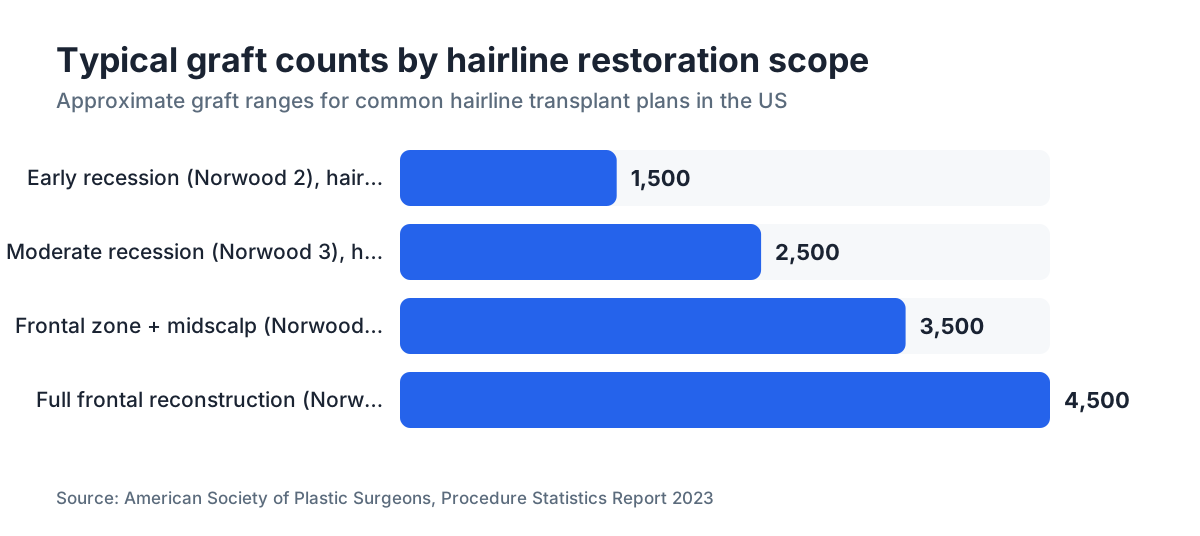
The design also sets graft count, which drives cost and recovery. A modest hairline restoration targeting the frontal third might use 1,500 to 2,500 grafts. A full frontal and midscalp reconstruction can reach 4,000 to 5,000 grafts in a single session [3]. Knowing the target design lets you project a realistic budget before you ever pay a deposit.
If you are still figuring out the extent of your hair loss before booking, a receding hairline assessment or a look at the Norwood scale helps you walk in with a realistic picture of where you stand.
What qualifications should a hairline design surgeon have?
Board certification in dermatology or plastic surgery is the baseline. In the United States, the American Board of Medical Specialties recognizes both as pathways into hair transplant practice, though neither specifically certifies hair restoration. The American Board of Hair Restoration Surgery (ABHRS) offers a dedicated credential that requires documented case volume and a written exam [4]. Membership in the International Society of Hair Restoration Surgery (ISHRS) is another marker of engagement with peer-reviewed standards, though membership alone does not guarantee skill.
Experience matters more than titles at this level. Ask how many hairline procedures the surgeon personally performs each year, not how many their clinic does. Some clinics use surgeons for the design and incision phase, then hand off graft placement to technicians. That is legal in most jurisdictions but worth knowing. The ISHRS has published position statements encouraging disclosure of who performs each surgical step [5].
Photograph review is your best quality signal. Ask to see at least 20 to 30 before-and-after cases with hairlines comparable to yours, at 12 months post-op minimum. Anything under 12 months is too early to show final density because grafts keep maturing for up to 18 months. If a clinic only shows results at three or six months, push back.
For context on the medical treatments that often run alongside transplant planning, reading about finasteride and minoxidil for men will help you understand what a surgeon means when they say you need to stabilize first.
How is the right hairline height and shape determined?
Surgeons use anatomical reference points, facial proportion guidelines, and your own preference together. The most cited reference is the midpoint of the forehead, measured as the vertical distance from the nasion (bridge of the nose) to the hairline. Classic facial proportion theory puts the hairline at one-third of total face height, which typically lands 6 to 8 centimeters above the glabella in adult men [2].
Temple angles matter separately. A hairline that is rebuilt across the front but left with deep temple recession looks inconsistent. The surgeon should explain whether the design closes the temples partially, fully, or not at all, and how many extra grafts each option costs. Closing the temporal peak fully on both sides can add 400 to 800 grafts to the estimate.
Face shape adjusts everything. A round face generally does better with a slightly higher, more squared hairline to add vertical length. An oblong face suits a softer, slightly lower line. An oval face is the most forgiving. Good surgeons explain these tradeoffs out loud. If yours does not, ask directly: "Given my face shape, what design would you recommend if I were your family member?"
Future hair loss is the most underrated design variable. Androgenetic alopecia progresses in most men. A surgeon who designs a hairline appropriate only for your current age, without accounting for likely progression in your 40s and 50s, is setting you up for an island of transplanted hair surrounded by thinning native hair. Ask for the design to be framed around your projected Norwood path, more than today's picture.
What is the difference between FUE and FUT and does it affect the consultation?
The design process is nearly identical for both techniques. What changes is how the donor grafts get harvested. Follicular Unit Excision (FUE) removes individual follicular units one by one from the donor zone, leaving small circular scars scattered across the scalp. Follicular Unit Transplantation (FUT) removes a linear strip of scalp from the back, which is then dissected into individual grafts. FUT leaves a single linear scar but can yield more grafts per session from the same donor area.
Your choice affects the donor-planning part of the conversation. FUE tends to suit patients who keep their hair short at the back. FUT allows a slightly higher total graft yield for patients who need a large restoration and do not mind a linear scar under longer hair. Some surgeons offer both; others specialize in one. Ask which technique the surgeon recommends for your specific plan and why, not which one they prefer in general.
Pricing differs. FUE is typically priced per graft in the US, running roughly $5 to $10 per graft at reputable clinics as of 2024, which makes a 2,000-graft procedure $10,000 to $20,000 [3]. FUT is often slightly cheaper per graft because the extraction phase is faster. International clinics, particularly in Turkey, advertise all-inclusive packages at $1,500 to $4,000 for similar graft counts, though quality control is inconsistent at the low end.
A full breakdown of what the procedure involves lives in our hair transplant guide.
What should you bring to a hairline design consultation?
Old photographs are the most useful thing most patients forget. Photos from your teens and early twenties, when your original hairline was intact, give the surgeon a reference for what was genetically yours. They also help sort out whether you are asking for a restoration or a reconstruction. Restoring your original hairline is one conversation. Designing a hairline you never had is another.
Bring a written list of every medication and supplement. Finasteride, minoxidil, anticoagulants, antidepressants, and even some supplements affect surgical planning. Finasteride use matters because a surgeon may want to confirm your hair loss is stabilized before proceeding. Anticoagulants affect bleeding risk and may require medical clearance. If you are on oral minoxidil, note the dose. Read about oral minoxidil if you are unsure how it differs from topical.
Note your family history of hair loss. Bring photos of your father and maternal grandfather if you have them. Male pattern baldness follows complex polygenic inheritance, and knowing whether your relatives progressed to Norwood 6 or 7 helps the surgeon plan conservatively.
Bring realistic expectations in writing if that helps you stay focused. These consultations can get emotional. Having your goals written down ("I want a hairline that looks natural at 50, not 25") keeps the conversation grounded and gives the surgeon clear parameters to work with.
What are the 12 most important questions to ask at the consultation?
These are the questions that separate informed patients from those who leave without the information they needed.
-
"What hairline height do you recommend for my face, and why?" Force a specific anatomical reason, not a vague aesthetic opinion.
-
"How many grafts does this design require, and how many do I have available in my donor zone?" If the answer is close or the surgeon seems uncertain, ask for a formal donor density count.
-
"What does my hair loss progression likely look like in 10 to 20 years, and how does this design account for that?" A surgeon who cannot engage with this is not thinking long-term.
-
"Who will perform each step of the surgery: the design, the incisions, and the graft placement?" Get this in writing if technicians are involved.
-
"Can I see 20 to 30 before-and-after cases at 12 months or more with hair loss similar to mine?" Anything shorter is not a mature result.
-
"What technique are you recommending, FUE or FUT, and why for my specific case?"
-
"Am I a good candidate right now, or should I stabilize my hair loss further before surgery?" A surgeon who says yes to everyone without hesitation deserves skepticism.
-
"Do you recommend I be on finasteride or minoxidil before or after surgery, and for how long?" Many surgeons recommend finasteride and minoxidil together as standard post-op protocol.
-
"What is the all-in cost including anesthesia, post-op care, and any touch-up sessions?"
-
"What is your revision policy if I am unhappy with the result?"
-
"How do you handle the temple points, and is that included in the graft count?"
-
"What causes my specific type of hair loss, and have you ruled out non-genetic causes?" Conditions like telogen effluvium can masquerade as permanent loss. A surgeon should rule those out before recommending surgery.
How do you evaluate the hairline drawing before agreeing to it?
Once the surgeon draws the proposed line, step back from the mirror and look at it from normal social distances, roughly 3 to 5 feet. Close-up scrutiny in a mirror is not how other people see your face. If the line looks right in the mirror but you cannot picture it at arm's length, ask to see photos taken from a few feet away before you agree.
Check symmetry carefully. Human faces are naturally asymmetric, and a perfectly mirrored hairline can actually look off. A small amount of natural asymmetry is correct. But meaningful asymmetry, where one side sits noticeably higher or the temporal peak is a different shape, needs correcting at this stage, not after surgery.
Ask the surgeon to lower or raise the line by a centimeter and photograph both options. The difference looks subtle in the drawing and significant in the final result. Most patients who later wish they had a lower hairline never asked for the comparison during the consultation.
If the clinic uses digital imaging software, ask to see both a conservative and an aggressive version of the design. Then ask the surgeon which they would recommend and why. The reasoning tells you a lot about their philosophy and their honesty. A surgeon who only shows you the most dramatic transformation is optimizing for your excitement today, not your 20-year result.
If you are unsure what your current stage of loss looks like on a standardized scale, the free AI scan at MyHairline can photograph and analyze your hairline before you walk into any clinic, giving you a baseline to reference during the conversation.
Should you get more than one hairline consultation?
Yes. Get at least two, ideally three, before committing. Hair transplant surgery is irreversible in the sense that placed grafts and made incisions cannot be undone, though corrective procedures exist. A second or third consultation costs zero or close to it at reputable clinics. A poorly planned surgery costs tens of thousands of dollars and years of recovery.
Different surgeons will often recommend meaningfully different hairline positions and graft counts for the same patient. A gap of 500 to 1,000 grafts between two estimates for the same design is worth questioning. A gap of 1,500 or more suggests the surgeons are proposing fundamentally different designs, or one is padding the count.
Second consultations also let you validate the first surgeon's read on your donor capacity. Donor density measurement should be roughly reproducible between two experienced surgeons. If one says you have 4,000 grafts available and another says 2,500, resolve that discrepancy before you book anything.
Online consults are increasingly common. Many clinics accept photos and videos for a preliminary remote assessment. These help narrow your shortlist but do not replace an in-person exam. Donor density, scalp laxity, and hair caliber are hard to judge accurately from photographs alone.
What red flags should you watch for at a hairline consultation?
Pressure to book on the day of the consultation is the biggest one. Legitimate surgeons understand this is a major decision and expect you to take time. Discounts that expire at midnight, limited-time package pricing, and deposit demands at the first appointment are sales tactics, not medical practice.
A surgeon who never discusses your long-term hair loss trajectory and only focuses on what can be done now is not planning for your best outcome. Androgenetic alopecia progresses in most men who have not been on finasteride long-term [6]. A hairline designed without accounting for that will eventually look stranded.
Vague answers about who performs the surgery are a problem. In many countries, including the United States, the surgeon is required to perform the key steps of a procedure they are billing for. But enforcement varies, and some clinics operate in legal gray areas by having technicians complete most of the physical work. The ISHRS has stated that patients should be informed of the role of non-physician assistants in their procedure [5].
No discussion of non-surgical options is another. A hairline that has only slightly receded may respond to minoxidil for men or finasteride well enough to delay surgery for years. A surgeon who jumps straight to transplant without asking about your medical treatment history or recommending stabilization first may be optimizing for revenue. Understanding what causes hair loss helps you judge whether surgery is genuinely the right next step or whether medical treatment never got a real chance.
Any claim of a guaranteed result is a red flag too. Hair transplants have real success rates, but individual outcomes depend on graft survival, blood supply, post-op care, and continued hair loss around the transplant zone. No ethical surgeon guarantees a specific cosmetic outcome.
How much does a hairline design consultation cost?
Most reputable clinics in the United States offer free consultations, in person or by video. Some charge $100 to $250 for an in-person consultation, which may be credited toward surgery if you book. Very few charge more than that as a standalone fee.
Be cautious with clinics that charge significant consultation fees upfront. It is not automatically a red flag, some premium surgeons charge to filter serious inquiries, but the fee should be fully explained before your appointment and credited against a future procedure.
The consultation itself is not where you spend money. Where patients get into financial trouble is agreeing to large deposits on the day of the consultation under sales pressure. Deposits of 20 to 30 percent of the total procedure cost are normal and reasonable once you have made a considered decision. Deposits taken at the first appointment, before you have had time to compare options, are a different situation.
If you are managing ongoing hair loss alongside planning a consultation, the comparative costs of medical treatments are useful context. Finasteride runs roughly $10 to $30 per month for generic versions, and minoxidil is available over the counter for $15 to $30 per month [7]. These are usually running costs alongside any surgical plan, not alternatives to it.
What happens after the consultation and before surgery?
Most surgeons require pre-operative lab work within 30 to 90 days of surgery. Standard panels check for clotting disorders, anemia, and general health markers. Some surgeons require medical clearance from your primary care physician if you have cardiovascular history or take anticoagulants.
Many clinics recommend starting or confirming you are stable on finasteride before surgery. The reasoning is that hair transplanted into an actively thinning scalp can look progressively patchy as native hair around it keeps shedding. A study published in the Journal of Dermatological Treatment found that patients on concurrent finasteride showed better long-term outcomes after hair transplant surgery compared to those who were not taking it [8]. That is not a unanimous consensus, but most experienced surgeons factor it into their pre-op recommendations.
Photographic documentation at the clinic, often standardized under controlled lighting and positioning, establishes your baseline. These photos become the legal and clinical record of what was agreed before surgery. Ask for copies.
After the consultation, think through recovery logistics too. FUE recovery typically allows return to a desk job within three to five days. Visible scabbing at the recipient area lasts seven to ten days. The transplanted hairs shed in weeks two through eight, which surprises many patients who were not warned. Final density is not visible until 12 to 18 months post-op. Planning your calendar around these milestones before you sign anything is practical, not pessimistic.
Sources
- International Society of Hair Restoration Surgery, ISHRS Practice Census
- Aesthetic Surgery Journal, Oxford Academic: Facial proportions and hairline design in hair restoration
- American Society of Plastic Surgeons, Procedure Statistics Report 2023
- American Board of Hair Restoration Surgery (ABHRS), Diplomate Certification
- International Society of Hair Restoration Surgery, Position Statement on Non-Physician Assistants
- American Academy of Dermatology, Androgenetic Alopecia Clinical Guidance
- U.S. Food and Drug Administration, Minoxidil OTC Drug Labeling and Approval History
- Journal of Dermatological Treatment, Finasteride co-administration and hair transplant outcomes
- U.S. National Library of Medicine, MedlinePlus: Finasteride
- American Academy of Dermatology, Hair Loss Diagnosis and Treatment
- National Institutes of Health, MedlinePlus Genetics: Androgenetic Alopecia
- U.S. Food and Drug Administration, Finasteride (Propecia) Approval History