
TL;DR: Hair concealer fibers are cosmetics, not FDA-approved treatments, and no long-term clinical safety trials exist. Short-term daily use looks safe for healthy scalps if you wash the fibers out every day. Real concerns are buildup, follicle occlusion, and reactions to preservatives, fragrance, and dyes. Fibers hide thinning. They do not treat it. Skip them on inflamed skin.
What are hair loss concealer fibers made of?
Most fiber products use one of three base materials: keratin (the same protein your hair shaft is built from), rayon (a plant-derived cellulose fiber), or cotton. A smaller number use wool or synthetic nylon. The fibers are milled to roughly the diameter of a human hair strand, 50 to 100 micrometers, and given an electrostatic charge so they cling to existing shafts and the scalp surface. [1]
Keratin fibers get marketed hardest because keratin sounds biologically familiar. Whether that matters for safety is a separate question. Your scalp does not absorb topical keratin in any real way. It sits on the surface and washes off. The ingredient that actually deserves your attention is everything else in the bottle: colorants, fixing sprays, binders, and preservatives.
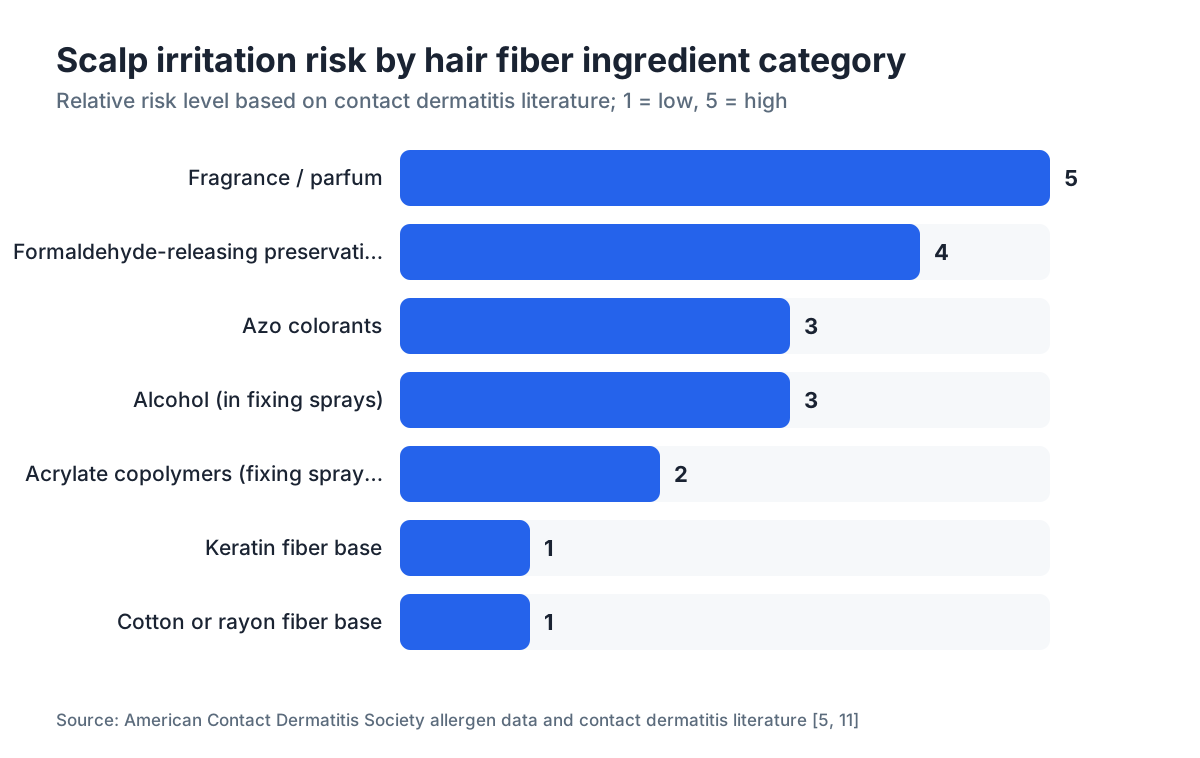
Many brands sell a companion "hold spray" to lock fibers in place. Those sprays often contain alcohol, acrylate copolymers, and fragrance, all more likely to irritate your scalp than the fibers themselves. React to a fiber product? The spray is usually the culprit, not the powder.
The FDA treats these products as cosmetics, not drugs. That classification carries weight. Cosmetics need no pre-market safety testing and no FDA approval before they hit shelves. The manufacturer is responsible for making sure the product is safe, but the practical bar for that is lower than most shoppers assume. [2]
Is there any clinical safety data on long-term fiber use?
Almost none. No randomized controlled trial has studied what daily hair fiber use does to the scalp over months or years. The dermatology literature covers short-term tolerability and the occasional case report of contact dermatitis. Nothing resembling a multi-year safety study exists. [3]
Here is what we do have. A review in the Journal of the American Academy of Dermatology on hair camouflage techniques noted that fiber products "have not been evaluated in rigorous clinical trials" and flagged follicular occlusion as a theoretical concern, mostly in patients with existing inflammatory scalp conditions. [3] That is about as candid as the literature gets.
Some manufacturers point to their own in-house testing. That testing usually means patch-test data on a small panel of subjects over 24 to 72 hours. It tells you about acute irritation. It tells you nothing about two or three years of daily application.
Nobody has good population-level data on this. The closest indirect signal comes from occupational studies on fine particulate exposure and skin, which show that repeated contact with fine particles can alter the skin barrier over time if the particles are not washed off thoroughly. Hair fibers are not industrial dust, and the comparison is loose, but the physics of repeated surface accumulation and removal are broadly similar. [4]
Can hair fibers clog follicles or make hair loss worse?
This is the question everyone actually types into Google. The honest answer: probably not in people with healthy scalps who wash regularly, but we cannot rule out trouble in people whose follicular environment is already compromised.
Fibers sit on the scalp surface and grab onto existing shafts. They do not push into the follicle opening (the infundibulum) under normal use. That opening runs roughly 100 to 200 micrometers wide, and commercial fibers are milled small enough to look natural but large enough that they do not behave like fine dust. [1]
The occlusion worry is about what builds up over a full day. Oils, sweat, and airborne debris bind to the fibers and form a film over the skin. Add a fixing spray and that film gets more cohesive. In someone with seborrheic dermatitis or folliculitis, that occlusive layer can plausibly worsen the inflammation already there. On a healthy scalp, it rinses off clean.
Dermatology guidance points to a simple routine: wash the fibers out daily or at least every other day, keep them off actively inflamed or broken skin, and never treat them as a stand-in for treating an underlying scalp condition. [3]
Dealing with telogen effluvium or an inflamed scalp already? Fix that first, then decide about fibers.
What scalp reactions have actually been reported?
Documented reactions fall into three buckets: irritant contact dermatitis, allergic contact dermatitis, and mechanical irritation.
Irritant contact dermatitis is the most common. It looks like redness, itching, or a burning feeling that starts within hours and clears once you wash. The usual triggers are fragrance, preservatives (formaldehyde-releasing agents like DMDM hydantoin especially), or alcohol in the companion spray. [5]
Allergic contact dermatitis is rarer but stubborn. It needs prior sensitization, so your first few uses might feel fine and the reaction shows up after weeks or months. The rash sits at the application site, can spread past it, and lingers longer than an irritant reaction. Colorants, specifically the azo dyes used to match darker shades, are a reported sensitizer across cosmetic products. [5]
Mechanical irritation gets talked about least, but it is real. Patting or pressing fibers into the scalp over and over can cause low-grade trauma to the outer skin layer, mostly in people with thin skin or a heavy hand. It rarely leaves lasting damage. It can leave your scalp tender for a day or two.
Case reports of nastier events, like acute folliculitis triggered by fiber use, exist in the literature. They are rare and almost always tied to a pre-existing scalp condition or very infrequent washing. There is no evidence that fibers cause permanent follicle damage on an otherwise healthy scalp.
Do hair fibers affect treatments like minoxidil or finasteride?
This gets overlooked. If you use topical minoxidil for men or any topical treatment, the order and timing of fiber application matters.
Minoxidil is a liquid or foam that has to reach the scalp surface and absorb. Apply fibers before the minoxidil dries and you lay a physical barrier over the exact spot the drug needs to reach. Apply minoxidil on top of fibers and you dilute the dose and smear the active drug unevenly across the scalp. Neither is likely to hurt you. Both cut how much drug reaches the follicle.
The guidance from most hair loss specialists is plain: apply minoxidil first, let it dry completely (about 4 hours for liquid formulations), then apply fibers. Never apply minoxidil over fibers already in place. [6]
Finasteride is oral, so there is no interaction with anything you put on your scalp. The drug works from the inside regardless of your surface routine.
Running both drugs together? See the sequencing notes at finasteride and minoxidil.
Using a topical DHT blocker like ketoconazole shampoo? Same rule: treatment first, fibers second.
Are some people at higher risk of scalp problems from fibers?
Yes. Several groups should use fibers cautiously or skip them.
People with seborrheic dermatitis. The Malassezia yeast that drives this condition thrives in oily, occluded skin. Fiber buildup on an already-irritated scalp tends to worsen flaking and inflammation. [7]
People with scalp psoriasis. Same logic. Anything that traps scale and adds mechanical irritation can set off a flare.
People with open wounds or active folliculitis. Putting any cosmetic on broken skin invites secondary infection. That is basic wound care, not something specific to fibers.
People with a history of hair dye allergy. Azo dyes appear in both hair color and in the colorants that tint fibers. If you have reacted to para-phenylenediamine (PPD), the most common hair dye allergen, cross-reactivity is plausible. [5]
People who sweat heavily at the scalp. Hard exercise, humid climates, or hyperhidrosis makes fibers migrate, clump, and sit wet against the scalp for hours. That is a worse setup than dry application followed by a normal day.
People in early-stage loss who are treating a receding hairline often reach for fibers during the treatment window. That is reasonable. Just keep an eye on scalp health while you do it.
How should you properly remove hair fibers to protect your scalp?
Removal is where people get lazy, and it matters more than how you apply them.
Water alone does not clear fibers. They carry an electrostatic charge and bind to oil, so you need a shampoo with enough surfactant to break that bond. If you use fibers daily, a clarifying shampoo once or twice a week works well, with a gentler shampoo on the other days so you do not strip the barrier completely.
Technique matters too. Scrubbing hard to dislodge fibers causes mechanical trauma, and people with androgenetic alopecia often panic about washing triggering extra shedding. To be clear: normal washing does not cause hair loss. Hairs that come out in the wash were going to shed anyway. [8]
Let the shampoo sit 30 to 60 seconds before you rinse. That gives the surfactants time to break the electrostatic bond holding fibers to the scalp. Follow with conditioner on the lengths, not the scalp, if you have oily skin or lean toward seborrheic dermatitis.
Do not make a habit of sleeping in fibers without washing between applications. Overnight is when scalp occlusion stacks up to a level that could actually cause problems, and warm climates make it worse.
How do hair fibers compare to other concealment options for safety?
Several methods camouflage thinning hair, and fibers are not the riskiest of the bunch.
| Concealment method | Mechanism | Main safety concern | Reversible? |
|---|---|---|---|
| Keratin/rayon fibers | Cling to existing hair shaft | Scalp irritation, occlusion if not washed out | Yes |
| Scalp micropigmentation | Tattoo ink in dermis | Infection risk (procedural), ink fading, granuloma | No (laser removal) |
| Hair toppers / wigs | Mechanical coverage | Traction alopecia from clips, heat damage | Yes |
| Scalp spray (pigmented aerosol) | Colored coating on scalp | Pore occlusion, allergen risk similar to fibers | Yes |
| Tinted dry shampoo | Bulk and color | Generally minimal; same allergen caveats | Yes |
Fibers land in the middle of the risk spectrum. They are more reversible and less invasive than micropigmentation, but they demand consistent removal to stay safe. Scalp sprays, the liquid tints applied straight to bare scalp, may carry a higher occlusion risk than fibers because they form a continuous film instead of discrete particles.
If you want to know what is actually happening to your density while you use a concealer, the free AI scan at MyHairline gives you a baseline before you start, so you have something objective to compare against later.
What does the FDA say about hair fiber safety?
The FDA regulates hair concealer fibers as cosmetics under the Federal Food, Drug, and Cosmetic Act. Under that framework, cosmetics need no pre-market approval and no clinical trial evidence of safety. The manufacturer is legally responsible for a safe product, but they do not have to hand the FDA any evidence before selling it. [2]
The FD&C Act says a cosmetic is adulterated if it "bears or contains any poisonous or deleterious substance which may render it injurious to users under the conditions of use prescribed in the labeling." That is the standard, and the FDA enforces it reactively, after complaints, rather than proactively. [2]
The Cosmetic Ingredient Review, an industry-run program, has assessed many common cosmetic ingredients but has not reviewed hair fiber formulations as a category.
Because fibers are not drugs, they cannot legally claim to treat, cure, or prevent hair loss. If a product says it "stimulates growth" or "reverses thinning," the labeling has crossed into drug-claim territory and is misbranded under FDA rules. Treat that language as a red flag about the company's honesty. [2]
If you want actual treatment rather than cover-up, start with what causes hair loss to understand which options have real evidence behind them.
Do hair fibers cause any type of permanent hair loss?
No published evidence shows hair concealer fibers cause permanent hair loss in people with otherwise healthy follicles. This is one of the most Googled fears about these products, and the science does not back it.
The theoretical routes to permanent loss would be sustained follicular occlusion leading to folliculitis and scarring, or mechanical traction if the fixing spray grips hard enough to pull hairs during removal. Neither has shown up as a meaningful real-world outcome in the literature.
What fibers definitely cannot do is worsen androgenetic alopecia at the follicular level. That process runs on DHT sensitivity in genetically predisposed follicles. A keratin fiber resting on the scalp surface has no plausible way to touch that pathway. [9]
The one scenario worth taking seriously is behavioral. If fibers hide the visual progression well enough that someone puts off treatment because the concealer feels like it is "handling it," they burn time during which minoxidil or finasteride could have saved follicles. That is not a direct effect of the fibers. It is what happens when you use concealment as a reason to skip treatment. The two are not mutually exclusive. The mistake is picking one to avoid the other.
For a straight look at the treatments with proven results, the minoxidil side effects article covers what you are signing up for.
What should you look for (and avoid) on a hair fiber ingredient label?
Reading a fiber label is worth the two minutes. Here is what to flag.
Ingredients to approach with caution: DMDM hydantoin, imidazolidinyl urea, and quaternium-15. These formaldehyde-releasing preservatives are established sensitizers, and the American Contact Dermatitis Society has named several among the most clinically significant allergens. [5] Fragrance (listed as "fragrance" or "parfum") is a high-frequency sensitizer, worth skipping if you have sensitive skin or a history of reactions.
Colorants: look for FD&C or D&C listings, which are FDA-approved for cosmetic use. Some products use colorants approved for hair but not for skin contact. That distinction matters when the product deposits material directly on the scalp instead of just on the shafts. [2]
What you want to see: a short ingredient list. Keratin or cotton as the primary fiber, plus a minimal colorant, is about as clean as these products get.
Fixing sprays get their own read. Their formulas are almost always busier than the fiber powder. Skip the spray and the fiber-only version is almost certainly the lower-risk choice.
People looking at overall hair health sometimes cross paths with hair loss supplements, though supplements and fibers work in completely different ways.
Sources
- Journal of Cosmetic Dermatology, Draelos et al., 'Hair cosmetics: an overview'
- U.S. FDA, Cosmetics Regulation Overview
- Journal of the American Academy of Dermatology, review on hair camouflage techniques
- NIOSH (CDC), Skin Exposures and Effects
- American Contact Dermatitis Society, Allergen of the Year resources
- FDA, Minoxidil Topical Solution labeling and prescribing information
- American Academy of Dermatology, Seborrheic Dermatitis Overview
- American Academy of Dermatology, Hair Loss resources
- National Library of Medicine (MedlinePlus), Androgenetic Alopecia
- Contact Dermatitis (journal), research on para-phenylenediamine hair dye allergy
- International Journal of Dermatology, review on hair loss management