
TL;DR: The biggest hair loss news of the last two years is the FDA approval of JAK inhibitors (baricitinib and ritlecitinib) for alopecia areata, giving people with severe patchy loss a real systemic option for the first time. Minoxidil, finasteride, and hair transplants stay the backbone of pattern hair loss treatment. Several pipeline drugs are in late-stage trials that could change the field by 2027.
What is the biggest hair loss treatment news right now?
The most consequential change in hair loss medicine in a decade is the arrival of JAK (Janus kinase) inhibitors for alopecia areata. The FDA approved baricitinib (Olumiant) in June 2022 for severe alopecia areata in adults, and ritlecitinib (Litfulo) in June 2023 for patients aged 12 and up [1][2]. These are the first systemic drugs ever approved specifically for alopecia areata. Before them, dermatologists worked off-label with corticosteroids and immunosuppressants that gave inconsistent results.
That matters because severe alopecia areata is not a cosmetic nuisance for the people who have it badly. Around 2% of people worldwide develop the condition at some point, and severe cases, meaning loss of more than 50% of scalp hair, affect hundreds of thousands of Americans [3]. Until baricitinib and ritlecitinib, those patients had almost nothing proven.
For androgenetic alopecia (the far more common male and female pattern baldness), the news is quieter but still real. Low-dose oral minoxidil has gained serious clinical traction. Published trials show meaningful regrowth at doses of 0.25 mg to 2.5 mg daily, far below the cardiovascular doses used for blood pressure [4]. That's useful for anyone who can't tolerate topical minoxidil's scalp irritation or who keeps forgetting the twice-daily routine.
Finasteride and its cousin dutasteride are not new, but the evidence keeps deepening. Dutasteride gets prescribed off-label for pattern loss after trials showed stronger DHT suppression than finasteride, and several countries including Japan have formally approved it for hair loss [5]. The U.S. hasn't followed. American dermatologists prescribe it anyway.
The pipeline beyond these approvals includes deuruxolitinib (another JAK inhibitor), KX-826 (a topical androgen receptor antagonist in Phase 3), and clascoterone cream, which the FDA approved for acne and researchers are now studying for hair. None of these are approved for hair loss as of mid-2025. Temper expectations.
What are the new FDA-approved treatments for alopecia areata?
Two drugs. Baricitinib (brand name Olumiant, from Eli Lilly) and ritlecitinib (brand name Litfulo, from Pfizer). Both block JAK enzymes that drive the autoimmune attack on hair follicles in alopecia areata [1][2].
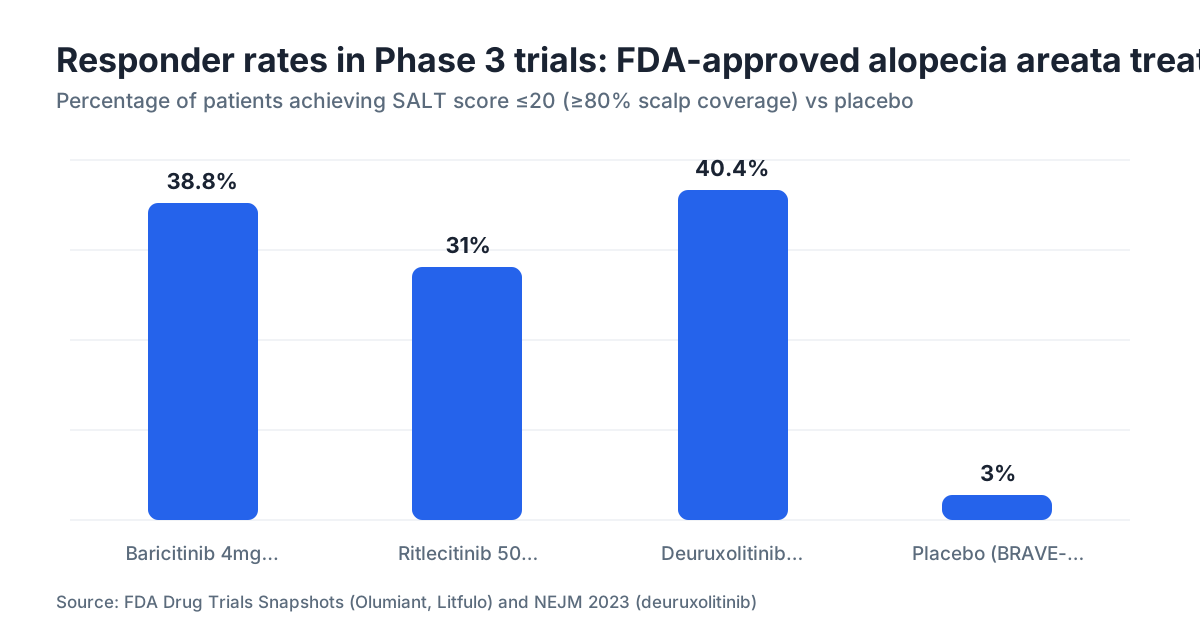
Baricitinib was tested in the BRAVE-AA1 and BRAVE-AA2 trials. In those trials, 38.8% of patients taking 4 mg daily reached a SALT (Severity of Alopecia Tool) score of 20 or less, meaning at least 80% scalp hair coverage, versus 3% on placebo [1]. That is not a cure. About a third of patients respond well, and the response usually needs ongoing treatment because the autoimmune process picks back up when the drug stops.
Ritlecitinib, a more selective JAK3/TEC-family inhibitor, was tested in the ALLEGRO trial. At the 50 mg dose, 23% of patients reached a SALT score of 20 or less at week 24, rising to 31% by week 48 [2]. The tighter selectivity is meant to trim some side effect risks compared to broader JAK inhibitors, and its approval down to age 12 makes it the only option for adolescents with severe disease.
The FDA's class-wide warning on JAK inhibitors covers serious infection, malignancy, major cardiovascular events, blood clots, and death, based on data from a large rheumatoid arthritis trial with tofacitinib [1]. That warning applies to both drugs on label. Dermatologists generally judge the risk-benefit balance acceptable for patients with severe, life-disrupting disease. These are not casual prescriptions.
Cost is the practical wall. Baricitinib and ritlecitinib list prices run into tens of thousands of dollars a year before insurance. Both manufacturers run patient assistance programs, but coverage swings hard by plan and payer. Check your insurer's prior authorization criteria before you see your dermatologist so you walk in ready.
| Drug | FDA approval date | Age range | Key trial response rate (SALT ≤20) | Mechanism |
|---|---|---|---|---|
| Baricitinib (Olumiant) | June 2022 | Adults (18+) | 38.8% at 4mg, week 36 | JAK1/JAK2 inhibitor |
| Ritlecitinib (Litfulo) | June 2023 | 12+ | 31% at 50mg, week 48 | JAK3/TEC inhibitor |
How do JAK inhibitors compare to older alopecia areata treatments?
The old standbys for alopecia areata were intralesional corticosteroid injections (triamcinolone acetonide), topical minoxidil, topical or systemic corticosteroids, contact immunotherapy with diphenylcyclopropenone (DPCP), and systemic immunosuppressants like methotrexate. None had FDA approval specifically for alopecia areata. Their evidence came from small, mostly uncontrolled studies.
Intralesional steroids work reasonably well for patchy, limited disease. A dermatologist injects triamcinolone straight into bald patches every four to six weeks. Regrowth in the treated spots is common. But the shots don't touch the underlying autoimmune process, they need repeat office visits, and they don't scale to totalis or universalis disease.
Systemic steroids (prednisone, dexamethasone pulses) can trigger regrowth but drag along the full steroid side effect profile: weight gain, bone loss, mood changes, adrenal suppression. Hair usually falls again once the course ends. Nobody serious uses long-term systemic steroids for this anymore.
Contact immunotherapy with DPCP still gets used at academic centers for treatment-resistant totalis and universalis. Response rates in published case series run roughly 17% to 78%, and a spread that wide tells you exactly how shaky the evidence is. It isn't sold as a finished pharmaceutical either. It's compounded and applied in-office, which limits access.
JAK inhibitors win on two counts. They have real FDA approval backed by large, randomized, placebo-controlled data, and they work systemically, so they can reach diffuse and extensive disease that injections never could. The downsides are cost, the need for ongoing treatment, and a real (if modest in dermatology terms) safety monitoring burden.
For patchy alopecia areata under 50% of the scalp, most dermatologists still start with intralesional steroids. JAK inhibitors get reserved for severe or refractory cases, which is also what insurance will pay for.
What's new in androgenetic alopecia treatment in 2025?
Androgenetic alopecia (AGA) hasn't had a new FDA approval in decades. Topical minoxidil (foam and solution) and oral finasteride 1mg are still the only FDA-approved AGA treatments. What's shifting is how those drugs get used, plus a handful of newer agents making noise.
Low-dose oral minoxidil is the most practice-changing thing to happen in AGA since the original finasteride trials. A 2021 systematic review in the Journal of the American Academy of Dermatology pooled 17 studies and found low-dose oral minoxidil (0.25 mg to 5 mg daily) improved hair density with a side effect profile that stayed mild at lower doses, with hypertrichosis (unwanted body hair) the most common complaint [4]. Dermatologists now prescribe it widely off-label for men and women. If you've read about oral minoxidil elsewhere, the evidence is real, but the FDA has not approved it for hair loss. Its approved use is hypertension at much higher doses.
KX-826 (proxalutamide) is a topical androgen receptor antagonist in late-stage trials for AGA in men. Phase 2 data looked good enough to move to Phase 3, but as of mid-2025 no Phase 3 results have been published and no FDA submission has been made. Don't buy anything sold online as "KX-826" right now.
Clascoterone (Winlevi) cream is FDA-approved for acne and blocks androgen receptors in the skin. Researchers are studying it for AGA because follicle miniaturization is androgen-driven. A Phase 3 AGA trial finished and the data have been shown at conferences, but there is no FDA approval for hair loss as of this writing.
Platelet-rich plasma (PRP) injections stay popular and stay controversial. A 2019 meta-analysis in Dermatologic Surgery found statistically significant density gains with PRP versus control, but trial quality came out consistently low and there's no standard protocol for preparation or dosing [6]. Worth raising with a dermatologist. Don't let anyone charge you $1,500 a session while promising a certainty they don't have.
If you're managing AGA and want to understand how the two mainstays work together, finasteride and minoxidil covers the combination evidence. For the bigger picture on what drives the loss, start with what causes hair loss.
Is there a new treatment for alopecia areata coming soon?
Yes, and a few are worth tracking. The furthest along is deuruxolitinib (CTP-543), developed by Concert Pharmaceuticals (later acquired by Sun Pharmaceuticals). It's a deuterium-modified form of ruxolitinib built for alopecia areata. Phase 3 data published in 2023 showed 40.4% of patients on 8 mg twice daily reached a SALT score of 20 or less at week 24 [7]. The company filed an NDA with the FDA in late 2023 with a PDUFA target action date set for 2024. Check the FDA's drug approval database directly for the current status rather than trusting any secondhand claim.
Brepocitinib, a TYK2/JAK1 inhibitor from Pfizer, is in Phase 2b/3 trials for alopecia areata. Early data showed dose-dependent improvement. Phase 3 results are expected in 2025 to 2026.
Research is also running on stem cell therapies and Wnt signaling activators that might regenerate follicles instead of just suppressing the immune attack. Most of this is preclinical or very early Phase 1. Interesting biology, nothing you should be making treatment decisions around now.
For people with mild to moderate alopecia areata who don't qualify for systemic JAK inhibitors under current payer rules, ruxolitinib 1.5% cream (Opzelura) is FDA-approved for atopic dermatitis and has been studied in the TRuE-AA Phase 3 program for alopecia areata. The trials showed statistically significant SALT improvements versus vehicle, and Incyte submitted an sNDA for the indication. Approval would give patients a topical JAK inhibitor, a real addition for anyone reluctant to take a systemic drug [8].
How well do current hair loss treatments actually work?
Here is honest data, drug by drug, for the treatments with the best evidence.
| Treatment | Condition | Best evidence outcome | Source |
|---|---|---|---|
| Minoxidil 5% topical | AGA (men) | ~40% show moderate to dense regrowth at 1 year | FDA label / clinical trials |
| Finasteride 1mg oral | AGA (men) | ~86% maintained or increased hair count at 2 years | FDA label (Propecia) |
| Dutasteride 0.5mg oral | AGA (men, off-label in US) | Superior DHT suppression vs finasteride; superior hair count in head-to-head RCT | Harcha et al., JAAD 2014 |
| Baricitinib 4mg | Alopecia areata (adults) | 38.8% achieved SALT ≤20 at week 36 | BRAVE-AA trials [1] |
| Ritlecitinib 50mg | Alopecia areata (12+) | 31% achieved SALT ≤20 at week 48 | ALLEGRO trial [2] |
| Hair transplant (FUE) | AGA (surgical) | Permanent in transplanted follicles; native hair loss continues | Multiple surgical series |
| PRP | AGA | Modest density improvement; evidence quality low | Meta-analysis, Derm Surgery 2019 [6] |
What that table hides: none of these fix the underlying cause. Stop finasteride and hair loss accelerates back to its pre-treatment path within months to a year. Same with minoxidil. JAK inhibitors for alopecia areata need continuous use. Transplants move permanent follicles, but the donor supply is finite and pattern baldness keeps working on the hair you didn't move.
Finasteride plus topical minoxidil is the most evidence-backed regimen for male AGA, and it's what most dermatologists would start a 30-year-old man with a receding hairline on. To understand the biology driving the loss, DHT blockers explains the androgen pathway. For the drug itself, see finasteride.
What does hair loss research say about treatments for women?
Women are consistently underrepresented in hair loss trials, which is a real problem for evidence quality. Here's what the data actually show.
For female pattern hair loss (FPHL), topical minoxidil 2% is FDA-approved, and minoxidil 5% foam is approved for women too. The 5% foam once daily showed non-inferiority to the 2% solution twice daily in the trial behind its label [9]. Women generally respond well to minoxidil, and with lower rates of the unwanted facial hair that worried people with older formulations.
Finasteride is not FDA-approved for women with hair loss. It's contraindicated in women who are or may become pregnant because of the risk of feminizing a male fetus. Postmenopausal women are sometimes prescribed it off-label. Spironolactone (an aldosterone antagonist with anti-androgen effects) is a common off-label choice for premenopausal women. The spironolactone evidence in FPHL is mostly retrospective and observational rather than large randomized trials, but clinical experience is broadly positive.
Low-level laser therapy (LLLT) devices are FDA-cleared (510(k) clearance, not approval) for hair loss in men and women. Clearance means a device showed safety and substantial equivalence to an existing product, not that the FDA judged it effective the way it does with drugs. The randomized evidence shows modest but statistically significant density gains. The absolute effect is small. These work best bolted onto medical therapy, not as a standalone.
For alopecia areata, both baricitinib and ritlecitinib are approved regardless of sex, and the trial populations included large proportions of women.
What is the latest research on alopecia areata hair regrowth treatment?
The mechanism behind alopecia areata is now understood well enough to design drugs against it. The disease comes from a breakdown of the immune privilege that normally shields hair follicles from T cell attack. CD8+ T cells recognize follicle antigens and start the attack, with JAK-STAT signaling (driven largely by interferon-gamma and interleukin-15) as the molecular engine [3].
That clarity is why JAK inhibitors work. They cut the signaling that recruits and activates the attacking T cells. The follicles themselves usually stay intact under the scalp, which is why regrowth can be complete once the autoimmune process is quieted.
Research published in Nature Medicine in 2022 identified that NKG2D ligands on hair follicle cells are what the CD8+ T cells recognize. That points toward therapies that could block the specific recognition without broadly suppressing the immune system the way current JAK inhibitors do. Still years from a clinical drug, but it's the kind of mechanistic progress that eventually produces better therapies.
Here's the practical takeaway from the current research: early, aggressive treatment for severe alopecia areata beats waiting. There's evidence that longer disease duration correlates with worse response to JAK inhibitors, so patients treated sooner tend to do better. That argues for prompt dermatologist referral when extensive alopecia areata shows up, not a "wait and see" delay.
If you're losing hair from a different cause, like a stretch of major stress or illness, telogen effluvium covers a common mechanism that trips up many people who suspect alopecia areata.
How do hair transplants fit into the current treatment landscape?
Hair transplants are not a treatment for alopecia areata. Full stop. Because alopecia areata is autoimmune, transplanted follicles would face the same attack as the native ones, so transplanting into active disease is contraindicated. Transplants are appropriate for androgenetic alopecia and some scarring alopecias, but only after the underlying disease is stable and ideally controlled.
For AGA, FUE (follicular unit extraction) and FUT (follicular unit transplantation) both give permanent results in the moved follicles, because those hairs come from the donor zone at the back and sides of the scalp, which is genetically resistant to DHT-driven miniaturization. The transplanted hair carries those genetic instructions with it.
The hard constraint is donor supply. Someone with Norwood 6 or 7 AGA simply doesn't have enough donor hair to cover all the bald scalp at full density. A skilled surgeon can build the look of coverage with strategic placement, but honest expectations depend on a real conversation about donor density, recipient area size, and the likely need for more than one session.
Cost in the U.S. runs roughly $4,000 to $15,000+ per session depending on graft count, technique, and the surgeon's market. Nobody should quote you a precise number without an in-person or detailed video consultation and a graft estimate. The hair transplant article covers how to vet a surgeon and evaluate clinics.
One thing worth saying plainly: keep taking your medical therapy (minoxidil, finasteride) after a transplant. Surgery doesn't stop the AGA process in the hair you didn't move. Men who drop their medication post-transplant and then shed native hair around the transplanted zones often think the result looks worse than they expected five years out.
Are there any hair loss supplements with real evidence?
Honest answer: not many, and none with FDA drug approval. A few have credible evidence worth understanding.
Nutritional deficiencies genuinely cause hair loss. Iron deficiency (even without full anemia), low ferritin, vitamin D deficiency, and zinc deficiency all link to increased shedding. Fix a real deficiency and hair can recover. Supplement without a deficiency and you generally get nothing. Get blood work before you buy anything.
Biotin is the most over-marketed supplement in this space. Biotin deficiency is rare, causes hair loss, and supplementing reverses it. But if you're not deficient, more biotin doesn't grow more hair. The AAD also notes biotin supplements can interfere with lab tests, including thyroid and troponin assays, which is a safety issue worth knowing [10].
Saw palmetto has some evidence as a weak 5-alpha reductase inhibitor, the same mechanism as finasteride but far milder. A few small randomized trials showed modest hair count gains versus placebo. The effect is probably real and much smaller than finasteride. A reasonable add-on for someone very reluctant to take a prescription, but not a replacement.
The hair loss supplements article reviews specific products in more detail. If you've seen ads claiming "clinically proven" results, check whether the study was industry-funded, controlled, and published in a peer-reviewed journal before spending money.
Myhairline.ai's free AI scan can be a useful first step if you're unsure whether what you're seeing is nutritional shedding, AGA, or something else, because the pattern and distribution of loss look distinctly different, and that changes what's worth trying.
What should someone actually do if they're losing hair right now?
See a dermatologist. That's the real answer, and any article that dodges it is doing you a disservice. Hair loss has many causes: some reversible (thyroid disease, iron deficiency, telogen effluvium, scalp infections), some autoimmune (alopecia areata, frontal fibrosing alopecia), some genetic (AGA). Treatment changes completely depending on cause, and diagnosing yourself from photos is unreliable.
Here's a reasonable first pass while you get that appointment on the calendar.
Document the pattern. Photos in good light, same angles, every few weeks. That gives your dermatologist useful data and gives you a baseline. Diffuse thinning all over points toward something systemic like a nutritional issue or a stress response. Loss at the temples and crown is AGA patterning. Round patches point to alopecia areata.
Get basic blood work if your GP will order it: complete blood count, ferritin, TSH (thyroid), vitamin D, and zinc. Those catch the reversible systemic causes.
Don't start finasteride or any systemic drug on internet research alone. Minoxidil for men is lower stakes and FDA-approved for AGA, so starting it topically while you wait for a dermatology appointment is more defensible. Just know that minoxidil side effects are real and worth reading before you start.
Be skeptical of any clinic or website handing out a diagnosis and prescription after a one-page questionnaire. Telehealth platforms that prescribe finasteride just because you ticked a "hair loss" box, with no proper assessment, are cutting corners that matter. Finasteride has real sexual side effects that call for informed consent based on your age, family history, and goals.
Want a structured starting point before your appointment? The free AI scan at myhairline.ai helps you characterize your pattern and figure out what questions to bring to a dermatologist.
Sources
- FDA Drug Trials Snapshots: Olumiant (baricitinib) for alopecia areata
- FDA Drug Trials Snapshots: Litfulo (ritlecitinib) for alopecia areata
- National Institute of Arthritis and Musculoskeletal and Skin Diseases (NIAMS): Alopecia Areata
- Randolph M, Tosti A. Oral minoxidil treatment for hair loss: A review of efficacy and safety. Journal of the American Academy of Dermatology, 2021
- Olsen EA et al. The importance of dual 5alpha-reductase inhibition in the treatment of male pattern hair loss: dutasteride versus finasteride. JAAD, 2006
- King B et al. Deuruxolitinib for alopecia areata: Phase 3 trial results. New England Journal of Medicine, 2023
- FDA: Opzelura (ruxolitinib) cream drug information
- FDA Label: Minoxidil 5% Topical Foam (Women)
- American Academy of Dermatology: Hair Loss Types: Alopecia Areata
- Harcha WG et al. A randomized, active- and placebo-controlled study of different doses of dutasteride versus placebo and finasteride in male androgenetic alopecia. JAAD, 2014
- National Library of Medicine / MedlinePlus: Finasteride (Propecia) drug information