

TL;DR: US hair transplants run $4,000 to $15,000 depending on graft count and technique. You can cut the total by timing your consult for slow months, comparing three to five written quotes, asking for package pricing, and paying cash. The danger is never the negotiation itself. It's the shortcuts a clinic takes to hit your number.
What does a hair transplant actually cost, and why does the price vary so much?
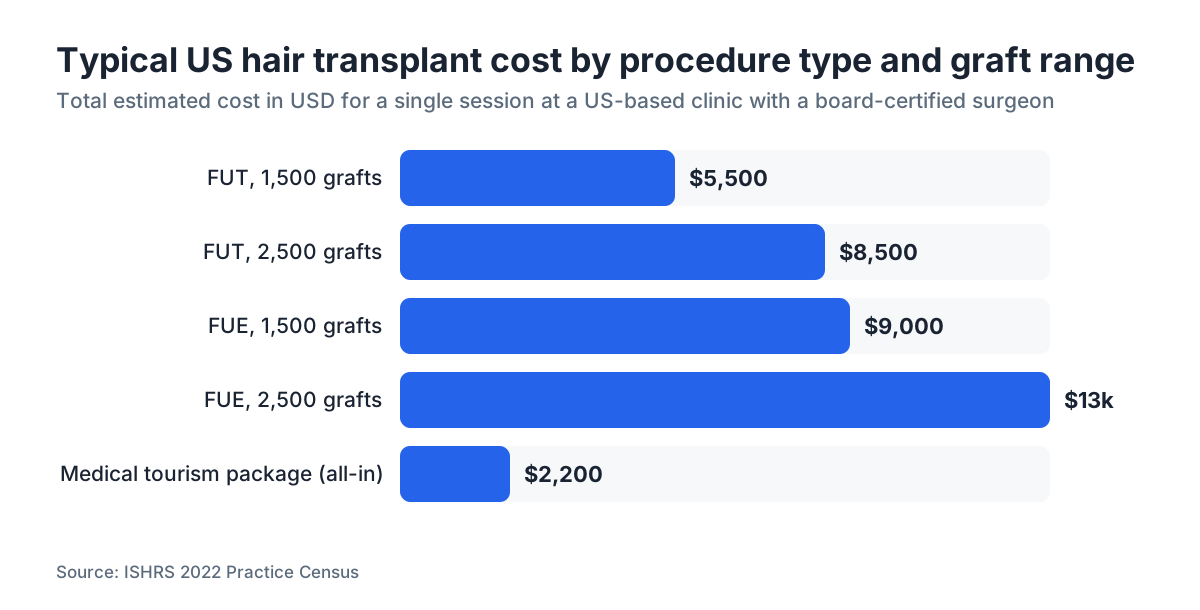
A US hair transplant runs $4,000 to $15,000 for a single FUE session, and that spread is real, not padding [1]. FUT, the strip method, tends to cost less per graft. The rest of the gap comes down to who holds the scalpel and how much of the work they actually do.
Most US clinics price FUE (follicular unit extraction) between $4,000 and $15,000 for a single session [1]. FUT (follicular unit transplantation) often runs $3 to $7 per graft versus $4 to $10 or more for FUE, but the range swings hard depending on where you go [1].
The main cost drivers are graft count, surgeon experience, clinic location, and whether the surgeon performs the whole procedure or hands extraction to technicians. A 1,500-graft FUE session in a major US metro with a board-certified plastic surgeon or dermatologist costs far more than the same count at a high-volume clinic abroad. Istanbul clinics advertise full packages (flights, hotel, 3,000+ grafts) for $1,500 to $2,500 [2]. Turkey is now the world's highest-volume transplant destination, mostly because of that gap.
Understand this before you negotiate anything. Much of the variance reflects real differences in surgeon involvement, graft survival, and what happens when something goes wrong. A $15,000 quote from a fellowship-trained surgeon and a $4,000 quote from a technician-heavy clinic are not the same product at two prices. They are two different products.
Know what the procedure involves before you walk into any price conversation. Our overview of hair transplant options covers the outcomes side.
Is it actually possible to negotiate a hair transplant price?
Yes, and more than most patients think. Clinics carry heavy overhead and real slack: empty chairs, cancellation slots, and slow winter months. That slack is your opening, as long as you ask in a way that lets them say yes.
Hair transplant clinics have surgical suites, technician salaries, marketing budgets, and consultant staff. Getting you in the door is expensive too; some clinics spend $500 to $1,500 just to book a single consultation [3]. That creates room to negotiate, if you do it right.
Here's the key. Clinics almost never lower their stated per-graft rate. What they do is offer package pricing, free add-ons, reduced graft minimums, or seasonal promotions that quietly drop your total. The conversation has to happen in a language that lets them say yes without cutting their advertised number in public.
Clinics in competitive cities, ones with several restoration options in the same market, bend on price more than the only provider in a small town. Medical tourism markets push harder still. Turkish clinics negotiate all-in package prices as routine.
One thing genuinely matters here. Negotiation works best when you're a good candidate with a simple case. Thin donor area, a complex multi-session plan, or a medical condition that slows healing all weaken your position, because your case means more risk and more chair time for them.
What are the most effective tactics for getting a lower price?
Get multiple written quotes before you negotiate. Three to five consultations isn't excessive. When a clinic knows you're holding competing numbers, the conversation shifts fast. You don't have to name the other clinic. "I have two other quotes in a similar range" is enough.
Ask about package pricing directly. Many clinics bundle post-op care, PRP (platelet-rich plasma) sessions, and medications into packages they rarely advertise. PRP alone runs $500 to $1,500 a session. Getting it thrown in free is real money.
Time your consultation. January and February are slow months for elective procedures. End-of-quarter timing matters for revenue targets. If a coordinator mentions availability in the next two weeks, that's a signal they have an empty chair. Empty chairs cost clinics money.
Ask it plainly: "Do you have any cancellation slots coming up?" Clinics often discount last-minute slots 10 to 20% rather than leave the OR time idle.
Pay cash or by bank transfer where you can. Clinics eat 2 to 3% in credit card processing fees. Offering cash is a fair basis for asking them to pass that back to you.
Negotiate graft count honestly. If your surgeon estimates 2,000 grafts but says 1,800 might do the job, ask what the 1,800 price looks like and what you'd lose aesthetically. Sometimes the honest answer is: not much in year one.
Ask about financing separately from price. Many clinics use third-party medical financing (CareCredit, Alphaeon Credit) with zero-interest promotional periods [4]. Getting 12 to 18 months interest-free isn't a price cut, but it changes the real cost if the alternative is a high-interest card.
Don't negotiate during the consultation while you're staring at photos of your own scalp and feeling raw about it. Go home. Get every quote in writing. Then call the coordinator. Phone calls negotiate better than emotional in-person moments.
What should you never trade away to get a lower price?
Surgeon involvement. This is the one that matters most and the one clinics hide most carefully.
In the US, state rules vary on who can legally perform extractions and implantations. The core question never changes: how much of the procedure does the named surgeon actually do versus supervise? Some high-volume clinics have the surgeon make incision sites and hand everything else to technicians. Others keep the surgeon in the room for the whole case. Graft survival, hairline naturalness, and complication rate all track operator skill [5].
Ask before you negotiate: "Who performs the extraction? Who places the grafts? Will you personally draw my hairline, or does someone else?" If the answer is hedged or vague, walk.
Don't negotiate away the follow-up protocol. Post-op visits, written aftercare instructions, and access to the surgeon if something goes wrong are part of what you're buying. A clinic that lowers price by cutting follow-up is just moving the cost onto you.
Don't chase artificially low graft counts. Some clinics quote a low number to hook you at a lower total, then under-deliver on density or push a second session. Ask the surgeon to show before-and-after photos of patients at your Norwood stage with similar graft counts to what they're proposing.
Avoid "unlimited grafts" flat-rate packages sold without a real in-person or high-resolution photo assessment. Graft count comes from examining your donor density and recipient area, not a brochure.
The International Society of Hair Restoration Surgery (ISHRS) publishes guidance on clinic quality and the role of non-physician technicians [5]. Their 2022 practice census is the clearest primary-source data on procedure volume and surgeon involvement.
How do medical tourism prices compare, and is it worth the risk?
Turkey is the clearest case. Istanbul clinics advertise all-inclusive packages (flights from Europe, hotel, 3,000 to 5,000 grafts, aftercare kit) for $1,500 to $3,000. Thai and Indian clinics run similar numbers [2]. Against a $10,000 to $15,000 US quote, the savings look enormous. The catch shows up later.
The real risk isn't primarily surgeon skill, though that varies. It's what happens when something goes wrong.
Develop an infection, poor graft survival, or an unnatural hairline after you fly home, and you have no local recourse. A US follow-up surgeon charges full price to assess and possibly correct someone else's work. Corrective procedures are harder and pricier than primary ones. The 2019 ISHRS World Congress named "hair transplant tourism" complications a growing clinical problem, with corrections often needing twice the graft count of the original [6].
The outcome data on medical tourism transplants is genuinely thin. There are no large randomized studies comparing complication rates across countries with real controls. What exists is case series and survey data, which suggest the complication rate isn't uniformly higher in Turkey than the US, but the variance is wider. More very good outcomes, more very bad ones.
If you're serious about medical tourism, the floor is this: verify the surgeon's credentials independently (not through the clinic's own site), find patient communities with unsponsored one-year follow-up photos (not three-month), and budget for a US post-op assessment no matter what.
For men who may need to preserve donor grafts for future sessions, a long-term relationship with a local surgeon beats the upfront savings. Sort out your receding hairline progression and whether medical management like finasteride and minoxidil comes first, before you spend a dollar on surgery.
What are the red flags that a low price reflects a quality problem, not a good deal?
Vague answers about surgeon involvement. If the coordinator can't tell you clearly who performs each step, assume technicians do most of it.
No in-person or detailed photo consultation before a quote. A real graft count estimate requires examining your donor density, scalp laxity, and hair characteristics. Any clinic quoting a flat package price without that isn't assessing you.
Pressure tactics and time-limited discounts. "This price is only good through Friday" is a sales mechanism, not a reflection of cost. Good surgeons don't expire their prices in 72 hours.
Before-and-after photos with no long-term follow-up. Photos at three to four months show early regrowth that looks impressive. Final results take 12 to 18 months. A portfolio made entirely of short-term photos is a deliberate choice [7].
No published complication rate or revision policy. Good clinics can state their graft survival rate (typically cited around 90 to 95% in well-run FUE) and what they do if the result is poor [5]. Can't answer that? Red flag.
High-volume, assembly-line scheduling. Clinics booking multiple patients per surgeon per day with 20-minute consultation slots are running a volume business. Not automatically wrong, but it doesn't square with the individualized assessment a complex procedure needs.
Not sure you even need a transplant yet? Get an objective read on your loss stage before spending thousands. The free AI hair analysis at MyHairline estimates your Norwood stage and whether a medical option like a DHT blocker should come first.
Does the FUE versus FUT choice affect how much you can negotiate?
Yes, meaningfully. Asking about FUT when you're open to it is one of the cleanest ways to get a genuinely lower price without touching surgical quality.
FUT (strip) is cheaper per graft because extraction is faster; the surgeon harvests a strip of scalp instead of pulling follicles one at a time. Per-graft costs for FUT typically run $3 to $7, versus $4 to $10 for FUE at comparable clinics [1]. On a 2,000-graft session, that's a $2,000 to $6,000 difference in total.
FUT leaves a linear scar at the donor site, hidden under longer hair but visible with very short cuts. FUE leaves small dot scars scattered across the donor area. For men who keep their hair short or want styling flexibility, FUE is often the practical choice despite the cost. For men who care more about graft yield and total cost than scar type, FUT stays clinically sound.
Some surgeons actually prefer FUT for large sessions because graft viability can be slightly higher when follicles spend less time outside the body.
Here's the tell. If you ask a clinic about FUT and the surgeon engages seriously with the comparison instead of brushing it off, that's a sign you're getting honest clinical guidance rather than a push toward the premium line item.
How do you evaluate a clinic's credentials before negotiating anything?
Start with board certification. In the US, hair restoration is performed by physicians from several specialties: dermatology, plastic surgery, facial plastic surgery, and otolaryngology. The American Board of Hair Restoration Surgery (ABHRS) offers a specific certification exam, and passing it is a meaningful signal [7]. The American Board of Medical Specialties (ABMS) is the parent body for verifying underlying board certifications [9].
Membership in the ISHRS doesn't guarantee quality by itself, but ISHRS members agree to a code of ethics and get ongoing education in the field [5].
Verify state medical license status through your state medical board's website. Most states publish a license lookup online. An active, unencumbered license is the baseline. Disciplinary actions are public record.
Search the surgeon's name in the FDA's adverse event reporting and in state court records. Neither is definitive, but both catch obvious problems.
Ask the clinic for references. Not testimonials on their own site, but two or three patients who've consented to contact and are at least 12 months post-op. Good clinics have patients willing to do this. If the answer is "we can't for privacy reasons" for every single patient, that's evasive.
Read unsponsored communities. The r/HairTransplants subreddit, the HairRestorationNetwork forum, and similar patient spaces carry real long-term results and honest bad experiences that clinic review pages never show. Filter for posts with timestamped photo progressions past 12 months.
Should you pay for PRP add-ons or other upsells during the negotiation?
PRP (platelet-rich plasma) is the most common add-on clinics push. The evidence for PRP as a standalone hair loss treatment is mixed. A 2019 meta-analysis in the Journal of the American Academy of Dermatology found statistically significant improvements in hair density but noted most studies were small and methodologically limited [10]. As an adjunct to transplant surgery, the theory is that growth factors in PRP may improve graft survival, but no definitive randomized trial proves a meaningful survival gain.
That doesn't make PRP worthless. It makes paying extra for it hard to justify on evidence alone. If a clinic offers PRP free during negotiation, take it. If they're adding $1,000 to $1,500 to your bill for it, that's where the evidence runs thin.
Laser therapy (LLLT) is another common add-on. The FDA has cleared certain laser devices for hair loss. Cleared, not approved as effective [11]. The evidence looks like PRP: suggestive, not conclusive, at the prices clinics charge.
Drug prescriptions, specifically finasteride for men, are a legitimate add-on conversation. If you're a man under 50 with androgenetic alopecia and no contraindications, starting finasteride post-transplant makes clinical sense to protect existing hair and hold your result. Worth raising with any transplant surgeon. Generic finasteride costs $15 to $30 a month, and many surgeons will prescribe it directly.
The honest rule on upsells: ask for them free before you agree to pay. Get PRP, aftercare kits, and follow-up visits folded into your base package during the negotiation. If they say no, you've lost nothing.
What is the right order of operations before committing to surgery?
Many men book a transplant consult before confirming their loss has stabilized and before they've tried or genuinely ruled out medical management. That's backwards.
Transplant into an area where loss is still active, with nothing slowing it, and you often get an unnatural result over time as native hair thins around the grafts. Most transplant surgeons will tell you this themselves. The ones who don't are a red flag.
Here's the realistic order.
First, get a clear diagnosis. What causes hair loss shapes your whole plan. Androgenetic alopecia (male or female pattern hair loss) is the most common cause and the only type where transplants are reliably indicated. Telogen effluvium can mimic permanent loss but often reverses on its own. A dermatologist can tell them apart.
Second, consider medical management. For men, generic finasteride (1 mg/day) has the strongest evidence for slowing androgenetic alopecia. Minoxidil for men works for many at the crown and vertex. The two together beat either alone [12]. That's $15 to $50 a month for generics, against thousands for surgery.
Third, if after 12 to 24 months of medical management your loss has stabilized and you're happy with your candidate status, then pursue transplant consultations in earnest.
Fourth, use the free tools and communities. The AI scan at MyHairline gives a quick Norwood stage estimate you can bring into consultations with better baseline context.
Skip these steps and you do more than weaken your negotiating position. You risk paying for surgery before it's even the right call.
What does the total cost of a hair transplant actually look like over time?
The upfront surgical fee is only part of the bill. A realistic total-cost picture for most men getting a single FUE session looks like this:
| Cost item | Typical US range |
|---|---|
| FUE surgery (1,500 to 2,500 grafts) | $6,000 to $12,000 |
| FUT surgery (same graft range) | $4,000 to $8,000 |
| Pre-op blood work / consultation fees | $100 to $300 |
| Post-op medications (antibiotics, etc.) | $50 to $150 |
| PRP add-on (if paid separately) | $500 to $1,500 |
| Finasteride (generic, 12 months) | $180 to $360 |
| Minoxidil (generic, 12 months) | $120 to $240 |
| Potential second session (not always needed) | $4,000 to $10,000 |
| Medical tourism package (all-inclusive) | $1,500 to $3,000 |
Sources: ISHRS 2022 Practice Census [1], CareCredit published financing terms [4].
The second-session line matters. Many patients at Norwood 3 to 5 end up wanting a second session 3 to 5 years after the first, either from continued loss in nearby areas or a wish for more density in the transplanted zone. Surgeons who don't mention this upfront aren't giving you the full picture.
Men who commit to finasteride long term cut the odds of needing a second session by slowing ongoing androgenetic loss. That $180 to $360 a year might save $5,000 to $10,000 over a decade. That's the math most transplant consultations skip.
Sources
- ISHRS, 2022 Practice Census Results
- ISHRS, Hair Transplant Tourism Awareness
- American Academy of Dermatology, Hair Loss: Diagnosis and Treatment
- CareCredit, Healthcare Financing Terms
- ISHRS, Code of Ethics and Technician Role Guidelines
- ISHRS, 2019 World Congress Proceedings on Complications from Hair Transplant Tourism
- American Board of Hair Restoration Surgery (ABHRS), Certification Standards
- American Board of Hair Restoration Surgery (ABHRS), Diplomate Lookup
- American Board of Medical Specialties (ABMS), Board Certification Verification
- Journal of the American Academy of Dermatology, 2019 PRP meta-analysis (Gupta AK et al.)
- US Food and Drug Administration, Medical Devices
- US National Library of Medicine, National Center for Biotechnology Information (PubMed Central)
- National Institutes of Health, MedlinePlus: Hair Loss