
TL;DR: A hair transplant moves healthy follicles from a donor area (usually the back of your scalp) to thinning or bald zones. FUE and FUT are the two main techniques. Most people see final results at 12 to 18 months. Cost runs $4,000 to $15,000 or more depending on graft count and clinic. It works best on stable hair loss, not actively progressing baldness.
What is a hair transplant procedure, exactly?
A hair transplant is a surgical procedure where a physician removes hair follicles from a part of your scalp, usually the back and sides, where hair is genetically resistant to DHT-driven loss, and places them into areas that have thinned or gone bald. The moved follicles keep their original genetic programming. They keep growing where they land. [1]
That's the whole idea, and it's been the foundation of surgical hair restoration since the 1950s. The mechanics have gotten far more refined since then, but the core biology hasn't changed: you're redistributing what you already have.
This matters for expectation-setting. A transplant doesn't create new hair. If your donor area is thin, you have limited supply. A good surgeon tells you that upfront. One who doesn't is a red flag.
The procedure is done under local anesthesia in an outpatient setting, meaning you go home the same day. It takes anywhere from 4 to 10 hours depending on how many grafts are being moved. Most people feel pressure and some discomfort but not sharp pain during the session. [2]
Learn what causes hair loss before you book anything. A transplant addresses the symptom (missing hair) but does nothing to stop the underlying hormone-driven process. If your loss is still progressing, transplanted hair can outlast your native hair and leave you looking patchy years later without medical support.
FUE vs FUT: what's the real difference and which one should you get?
Two methods dominate the field. FUE (Follicular Unit Extraction) and FUT (Follicular Unit Transplantation). They differ in how follicles come out of the donor area, not in how they go back in.
FUT takes a strip of scalp skin from the back of the head. The surgeon cuts out that strip, closes the wound with sutures (leaving a linear scar), and then technicians dissect the strip into individual follicular units under microscopes. The scar usually hides under surrounding hair, but if you ever want to shave your head very short, it will show.
FUE extracts follicles one by one with a small circular punch tool, typically 0.8 to 1.0 mm in diameter. No linear incision, no linear scar. You get hundreds of tiny dot scars instead, much less visible when hair is short. Donor recovery is faster. The tradeoff is more time in the operating chair and often a higher price, partly because it's more labor-intensive.
| Feature | FUT | FUE |
|---|---|---|
| Scarring | Linear scar at back of scalp | Scattered dot scars |
| Session length | 4-8 hours | 6-10 hours |
| Max grafts per session | 3,000-4,000+ | 2,000-3,500 typical |
| Donor recovery | 2-3 weeks | 1-2 weeks |
| Graft transection risk | Lower (controlled dissection) | Slightly higher (operator-dependent) |
| Cost | Generally lower | Generally higher |
| Good for | Large sessions, short hair OK long-term | Smaller sessions, short hair long-term |
Neither is universally better. FUT can yield more grafts in a single session, and some surgeons argue graft survival runs slightly higher because technicians see exactly what they're dissecting. FUE wins if you want to wear your hair very short, or if you're having a touch-up. Plenty of clinics now do both in the same session for patients who need maximum coverage. [3]
There's also robotic FUE, where a device called ARTAS uses image-guided robotics to assist extraction. It's available at some clinics, costs more, and the published data on whether it beats skilled manual FUE is thin. The International Society of Hair Restoration Surgery (ISHRS) has noted that surgeon skill remains the dominant variable in outcomes. [4]
How does the procedure work step by step?
Here's what a typical full-day session actually looks like.
The morning starts with photos, hairline design, and a conversation with your surgeon about where the new line will sit. This is not a minor discussion. The hairline you agree on that morning is permanent. A surgeon drawing a very low hairline on a 28-year-old with progressive loss is setting that person up for problems at 45, when the surrounding hair recedes further.
Next comes local anesthesia to the donor and recipient areas. This is the part most patients find hardest, a series of injections across the scalp. After that you feel pressure and movement but minimal pain. Some clinics use a nerve block or sedation to make it more tolerable.
For FUT, the strip is excised, the wound is closed, and technicians begin dissection while the surgeon moves on to recipient site creation. For FUE, extraction happens first, sometimes for 2 to 4 hours, with an assistant collecting grafts in chilled saline solution to keep them viable. Graft viability outside the body drops noticeably after 6 hours, which is why surgical team efficiency actually matters. [5]
Recipient sites are tiny incisions made with a blade or needle in the pattern the surgeon has designed. The angle, depth, and density of these cuts decide how natural the result looks. This is the most artistically demanding part of the procedure.
Implantation follows. Grafts go into each site with fine forceps. A team of trained technicians usually does this while the surgeon supervises. On a 2,500-graft session, that's 2,500 individual placements. It takes a while.
After implantation, the scalp gets cleaned and often covered loosely. You get written aftercare instructions and usually a small supply of saline spray. You leave looking like you've had minor surgery, red and swollen, with small crusts already forming around each graft.
What is the recovery timeline after a hair transplant?
Recovery runs longer than most people expect when they first start researching this.
Days 1 to 3 are the hardest cosmetically. Swelling peaks around day 2 or 3 and can track down to your forehead and around your eyes. This is normal and it resolves. Sleeping upright or semi-reclined helps. You avoid touching the grafts, wearing anything over your head, and any sun exposure.
Days 4 to 14 are the crust phase. Small scabs form around each graft. You'll be told to gently wash your scalp starting around day 3 or 4 with a technique your clinic specifies. Don't pick at the crusts. They fall off on their own around days 10 to 14.
Weeks 2 to 6: shock loss happens. Nobody warns patients about this adequately. The transplanted hairs shed. Yes, the hairs you just paid a lot of money for fall out. This is expected. The follicle bulb sits intact under the skin and is just resting. The surrounding native hair also sometimes sheds temporarily from the trauma of the procedure. [6] Our explanation of telogen effluvium covers what's happening to those shocked follicles in detail.
Months 3 to 6: early regrowth begins. You'll see thin, sometimes wiry new hairs emerging. The texture normalizes as they grow.
Months 9 to 12: you can have a real conversation about results. Most of the transplanted hairs are now visible and growing.
Months 12 to 18: final assessment territory. Hair caliber and density reach near their maximum. Some patients keep improving up to 18 months. [7]
For FUT, the donor scar takes 3 to 6 months to mature and fade. For FUE, the dot scars at the back of the head are usually barely visible by month 2 or 3 under the surrounding hair.
What does a hair transplant cost in 2025?
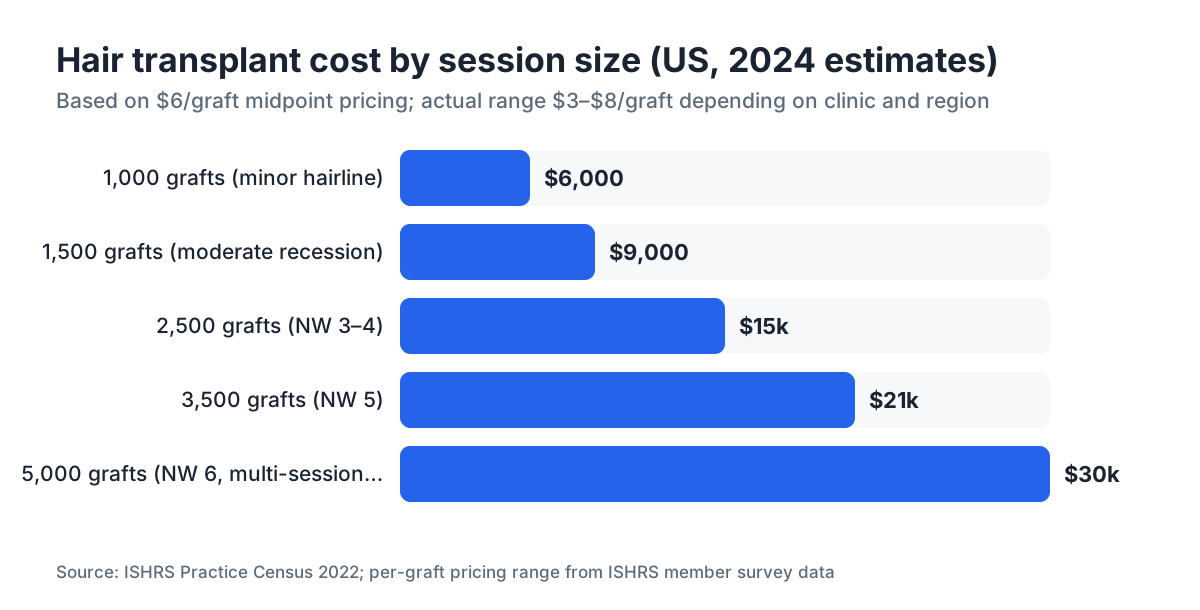
The honest range is $4,000 to $15,000 in the United States, with most procedures landing between $6,000 and $10,000 for a mid-size session. Clinics typically price by graft, somewhere between $3 and $8 per graft at reputable US practices. [8]
A 1,500-graft session at $6 per graft is $9,000. A 3,000-graft session at the same rate is $18,000. Some clinics quote an all-in procedure price instead. Always ask exactly what's included: anesthesia, post-op visits, the surgeon's fee versus the technician team, and whether touch-ups are discounted.
Overseas, the numbers look very different. Turkey in particular has built an enormous medical tourism industry around hair transplants, with prices of $1,500 to $3,000 all-in for large sessions at some clinics. Some patients have good outcomes. Others have had grafts extracted too aggressively, leaving visible donor-area depletion, or have had hairlines designed with no regard for future loss progression. The ISHRS has published warnings about this. [4] Travel and accommodation costs chip into the savings, and follow-up care if something goes wrong is far harder to access.
Most US health insurance plans won't cover hair transplants because they're classified as cosmetic procedures. FSA and HSA funds can sometimes be used depending on your plan administrator's classification. Medical financing through companies like CareCredit is widely offered at clinics.
A consultation with a board-certified surgeon is usually free or low-cost, and worth doing before you commit. Ask to see before-and-after photos of patients with a degree of loss similar to yours, not only the best outcomes.
How effective is a hair transplant, and what does the success rate actually mean?
Graft survival rate is the number most commonly cited, and at experienced clinics it runs around 85 to 95 percent. [9] That means 85 to 95 percent of the moved follicles survive and produce hair. The rest don't, which is why final density can come in slightly lower than the surgical design intended.
A 2019 review in the Journal of Cutaneous and Aesthetic Surgery found that modern FUE techniques achieved graft survival rates of 85 to 90 percent in experienced hands, with operator skill being the single largest variable. [9]
Graft survival isn't the only measure that matters. Aesthetic outcome, meaning how natural and dense the result looks, depends on hairline design, graft angle, density distribution, and what the surrounding native hair does in the years after surgery. If you're losing native hair around the transplant, results can change a lot even if every graft survived.
This is why most dermatologists and hair restoration surgeons recommend stabilizing your loss medically before or alongside a transplant. Finasteride is the most evidence-backed option for slowing DHT-driven loss in men, and minoxidil for men can help maintain surrounding native hair. The combination is the medical foundation that makes a transplant last. Without it, you might need another procedure in 5 to 10 years.
Nobody can guarantee a specific outcome. Anyone who does should be avoided.
Am I a good candidate for a hair transplant?
Good candidates share a few traits. Stable hair loss, meaning loss that hasn't changed much in the past 12 months, is the most important one. A transplant on actively progressing loss is like painting a house that's still on fire.
Adequate donor density at the back and sides of the scalp is the second requirement. If your entire scalp is diffusely thin, there may not be enough quality donor hair to make a meaningful difference. Some surgeons tell you this honestly in a consultation. If a surgeon is willing to operate on anyone with a credit card, walk away.
Age matters. Surgeons are generally cautious about operating on patients under 25 to 30 because the final pattern of loss isn't set yet. A 22-year-old with a Norwood 3 receding hairline might be a Norwood 6 by 35. A transplant designed for the earlier stage can look odd against severe later loss.
Health factors that complicate candidacy include bleeding disorders, active scalp conditions like alopecia areata, poorly controlled diabetes, and certain medications that affect healing or bleeding. Your surgeon reviews your medical history.
Women can have hair transplants too, though they come up less often in this context. Female-pattern hair loss tends to be diffuse rather than patterned, which makes donor area selection trickier. The best female candidates have localized thinning rather than diffuse loss across the whole scalp. [10]
Want an honest read on your hair situation before committing to a consultation? MyHairline's free AI hair analysis at /scan gives you a baseline read on your pattern and where you stand on the loss scale.
What are the risks and side effects of hair transplants?
Hair transplant surgery is generally safe when a qualified surgeon performs it, but it's still surgery, and the risk profile is real.
Common and expected effects include temporary swelling, redness, numbness in the recipient and donor areas, crusting, and the shock loss phase described above. These all resolve on their own.
Less common but documented risks include:
Infection. Rare at well-run clinics, but the scalp is being punctured thousands of times. Antibiotics are typically prescribed preventively.
Folliculitis. Inflammation of transplanted follicles showing up as small pimples weeks after the procedure. Usually mild and treatable.
Cyst formation. Occasionally a follicle becomes buried and forms a small inclusion cyst. Usually resolves on its own or with minor intervention.
Hypertrophic or keloid scarring. More common with FUT and more common in patients with a history of keloid formation. Ask about this if it's relevant to you.
Poor yield or graft failure. If grafts are handled poorly or dry out during the session, survival rates drop. This is an operator-quality issue more than an inherent risk.
Donor area depletion. Aggressive extraction in FUE, especially at lower-quality clinics doing very high graft counts without assessing donor density first, can leave the back of the scalp visibly thinned. [4]
Nerve damage. Persistent numbness beyond several months is uncommon but reported. Usually resolves within 6 to 12 months.
The FDA regulates the devices used in hair transplantation (the punch tools, implanter pens, and robotic systems) as medical devices under 21 CFR, but the procedure itself falls under state medical board oversight, not FDA approval. Choosing a surgeon board-certified by ABMS in dermatology or plastic surgery, or a member of ISHRS, is a meaningful quality signal. [11]
Should I use finasteride or minoxidil alongside my hair transplant?
Most hair restoration surgeons recommend medical therapy alongside surgery, and the evidence backs them up.
Finasteride (1 mg daily, branded as Propecia) reduces DHT levels in the scalp by about 60 to 70 percent and has Level 1 evidence for slowing or halting androgenetic alopecia in men. [12] It doesn't affect transplanted follicles, which are already DHT-resistant. But it protects the native hair around and behind the transplant. Losing that native hair over time is one of the main reasons transplant results deteriorate.
Minoxidil (topical 2 to 5%, or oral low-dose) improves blood flow to follicles and can extend the anagen growth phase. It's FDA-approved for hair loss at these doses. [13] Some surgeons recommend starting minoxidil a few weeks after the transplant (once the scalp has healed) to support regrowth of both transplanted and native hairs. The minoxidil side effects profile is mild for most people, though oral minoxidil carries more systemic considerations.
Using finasteride and minoxidil together has additive effects in trials. A 2003 paper in the Journal of the American Academy of Dermatology found that combination therapy outperformed either agent alone in men with androgenetic alopecia. The combination is generally considered the standard of care for maintaining results after a transplant. [12]
If you're looking at DHT blockers more broadly, finasteride is the one with the most clinical data for this application. Dutasteride blocks more DHT but is off-label for hair loss in the US. Hair loss supplements don't have the same level of evidence, and most surgeons don't treat them as equivalent substitutes for finasteride or minoxidil.
How do I choose a hair transplant surgeon and avoid bad clinics?
This is where the money gets protected or lost.
Board certification matters. In the US, look for a physician who is board-certified by the American Board of Medical Specialties in dermatology or plastic surgery. Membership in the International Society of Hair Restoration Surgery (ISHRS) is another meaningful signal, not a guarantee, but a meaningful signal. [4]
Ask who does what. At some clinics, the surgeon draws the hairline and makes incisions, but technicians handle all extraction and implantation. At others, the surgeon stays present for the entire procedure. Know what you're paying for.
Review the before-and-after photos critically. Look for patients with a loss pattern similar to yours. Look at hairline naturalness, more than density. Look for photos taken more than 12 months post-op. Be skeptical of clinics that only show dramatic transformations.
Get more than one consultation. Reputable surgeons sometimes give different recommendations, and understanding why helps you calibrate. If two surgeons say very different things about how many grafts you need, ask them both to explain their reasoning.
Be careful using price-per-graft as your only decision driver. A $2 per graft price means nothing if 30 percent of those grafts don't survive. A $7 per graft price at a clinic with a 93 percent survival rate and 15 years of documented outcomes is better value.
The ISHRS publishes a warning specifically about clinics that use non-physician technicians to perform surgical procedures without adequate supervision, which is illegal in the US but common in some overseas markets. [4] Read it before you book a trip abroad for a bargain session.
What happens if you need a second hair transplant?
Multiple procedures are common and not a sign that the first one failed. They're often planned from the start.
Most people with moderate to advanced hair loss (Norwood 4 to 6) don't have enough donor hair to fill all thinning areas in a single session without over-harvesting. A surgeon might do 2,000 to 2,500 grafts in session one, wait 12 to 18 months for results to mature and the donor area to recover, then do a second pass.
Sometimes a second procedure addresses progression of native hair loss that happened after the first transplant. Sometimes it's a touch-up for uneven density or a hairline refinement.
Your donor reserve is finite. A skilled surgeon plans sessions with that in mind, never harvesting so aggressively that future sessions become impossible. This is called donor management, and it's a topic worth raising explicitly in your consultation.
Occasionally, a patient seeks repair work after a bad result at another clinic. Repairing poorly designed hairlines (especially the unnaturally straight or too-low lines that were popular in the 1990s), or repairing over-harvested donor areas, is a specialty of its own. It can be done, but it's harder and more expensive than getting it right the first time. [3]
Tracking your loss pattern before you decide whether and when to proceed helps. Tools that assess where you are on the Norwood scale, like the free AI scan at MyHairline, give you a starting point for that conversation with a surgeon.
Sources
- American Academy of Dermatology (AAD) - Hair loss: diagnosis and treatment overview
- StatPearls, NCBI Bookshelf - Hair Transplantation
- International Society of Hair Restoration Surgery (ISHRS) - Surgical Techniques
- International Society of Hair Restoration Surgery (ISHRS) - Fight the FIGHT campaign on illegal practice
- PubMed - Follicular unit extraction: minimally invasive surgery for hair transplantation (Rassman et al., Dermatologic Surgery 2002)
- PubMed - Effluvium and shedding after hair transplantation (Bernstein Medical review, Dermatologic Surgery)
- ISHRS Practice Census 2022 - Hair restoration surgery pricing data
- Journal of Cutaneous and Aesthetic Surgery - FUE outcomes review (2019)
- American Academy of Dermatology (AAD) - Female pattern hair loss
- FDA - Medical Devices: 21 CFR regulation of surgical instruments
- Journal of the American Academy of Dermatology - Finasteride and minoxidil combination therapy for androgenetic alopecia (2003)
- FDA Drug Label - Minoxidil Topical Solution (Rogaine) prescribing information