
TL;DR: Hair transplants in the United States usually cost $4,000 to $15,000, with most patients paying $6,000 to $10,000. Price tracks the technique (FUE costs more than FUT), the number of grafts, the surgeon's experience, and where the clinic sits. Insurance won't touch it. Cheaper clinics abroad exist and carry real, specific risks.
What does a hair transplant actually cost?
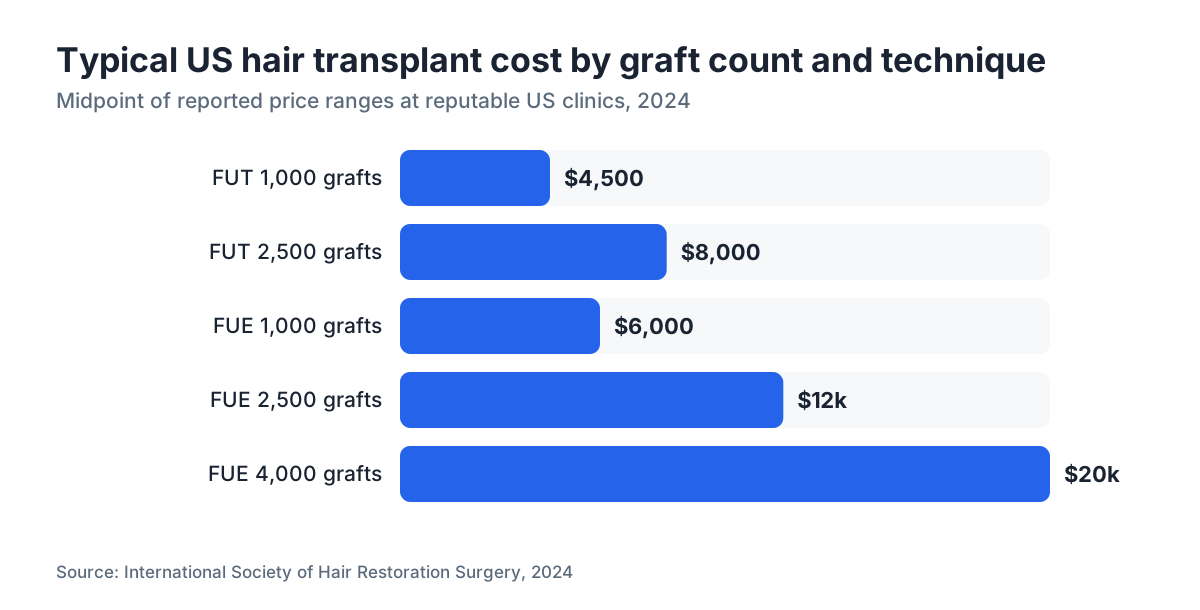
The honest answer is it depends enormously. Most US patients spend $6,000 to $10,000 for a single session. The low end, around $4,000, usually means a small graft count (under 1,000 grafts) at a mid-tier clinic in a lower-cost city. The high end, $15,000 to $25,000 and up, means a large bald area, a sought-after surgeon in New York or Los Angeles, and FUE (follicular unit excision).
Clinics price one of two ways. Per-graft pricing runs about $3 to $10 per graft at reputable US clinics [1]. Flat-fee pricing bundles everything into one number, which sounds simpler but makes comparisons harder because clinics define 'everything' differently.
A useful benchmark: a moderate Norwood III to IV pattern needing roughly 1,500 to 2,500 grafts generally costs $6,000 to $12,000 at a well-regarded US clinic using FUE. That's not a guarantee. It comes from published price ranges and survey data from the International Society of Hair Restoration Surgery [1].
Neither figure is your total. Add pre-op blood work (often $150 to $400), any prescribed post-op medications, and travel if you're going somewhere other than your nearest clinic. Those add-ons are easy to forget when you're staring at a headline quote.
FUE vs FUT: which technique costs more and why?
FUE (follicular unit excision) and FUT (follicular unit transplantation, also called the strip method) produce broadly comparable results in skilled hands, but FUE costs more. Expect to pay 20 to 30 percent more for FUE on the same graft count. The gap comes down to labor.
In FUE, a technician or surgeon pulls each follicular unit one at a time with a small punch tool. A 2,000-graft session can run eight to ten hours and needs more staff at the extraction stage. FUT removes a strip of scalp, which is faster to harvest, then dissects grafts from it under microscopes. FUT leaves a linear scar. FUE leaves small dot scars across the donor area, which is why patients who want to wear their hair short usually pick it.
Here's a rough side-by-side of typical US price ranges:
| Technique | Grafts | Typical US Cost Range |
|---|---|---|
| FUT | 1,000 | $3,000 to $6,000 |
| FUT | 2,500 | $6,000 to $10,000 |
| FUE | 1,000 | $4,000 to $8,000 |
| FUE | 2,500 | $8,000 to $15,000 |
| FUE | 4,000+ | $14,000 to $25,000+ |
Robotic FUE (the ARTAS system) sits at the higher end of FUE pricing because of equipment costs, but the evidence that it beats skilled manual FUE is limited [2].
For most people losing hair along the front and mid-scalp, a well-done FUT or FUE of 1,500 to 2,500 grafts covers the area. Knowing your receding hairline pattern before you get quotes helps you avoid paying for more grafts than you need.
What factors drive the price up or down?
Graft count is the biggest lever. Every clinic estimates how many follicular units you need at a consultation, and more grafts means more time and more money. A real estimate requires seeing your donor density under magnification, not eyeballing your bald spot.
Surgeon experience matters a lot. A board-certified dermatologist or plastic surgeon who has done thousands of transplants and publishes outcome data charges more than a general practitioner who tacked hair transplants onto a menu of cosmetic services. That premium is usually worth paying. Poor technique creates unnatural hairlines, wasted grafts, and scarring that is expensive or impossible to fix.
Geography shifts prices hard. Clinics in Manhattan, Beverly Hills, and Miami charge more than clinics in Dallas, Phoenix, or Columbus, partly because of real estate and staff costs and partly because of market positioning. Rural clinics run cheaper still, but lower overhead doesn't always mean comparable outcomes.
Overhead structure matters too. Some high-volume clinics use physician-supervised technicians for most of the extraction and implantation. Others have the surgeon doing the critical steps personally. Prices don't always reflect this difference clearly, so ask directly who performs each step.
Your hair itself affects cost indirectly. Coarse, curly hair covers more scalp per graft than fine, straight hair, so you may need fewer grafts. Dark hair on light skin creates high contrast, which demands more precise placement and can push graft counts up to keep the result natural.
How many grafts do most people need, and what does that cost?
Graft needs track closely with your Norwood stage. Norwood II to III (early hairline recession) typically needs 800 to 1,500 grafts. Norwood IV (real crown or mid-scalp loss) usually needs 1,500 to 3,000 grafts. Norwood V to VII (extensive loss across the crown and top) can require 3,000 to 6,000 or more, sometimes across multiple sessions.
At a per-graft rate of $5 (mid-range for a reputable US clinic), the math is simple:
| Norwood Stage | Approximate Graft Need | Mid-Range US Cost |
|---|---|---|
| II to III | 800 to 1,500 | $4,000 to $7,500 |
| IV | 1,500 to 3,000 | $7,500 to $15,000 |
| V to VII | 3,000 to 6,000+ | $15,000 to $30,000+ |
These are estimates, not quotes. Your donor density and whether the surgeon takes a conservative or aggressive approach will move these numbers.
One thing worth knowing: graft counts get inflated. Some clinics quote high counts to justify higher prices or imply their technique is more thorough. A second opinion isn't paranoid. It's sensible when you're talking about thousands of dollars and a permanent change to your scalp.
For more on the underlying loss driving these decisions, the what causes hair loss guide covers androgenetic alopecia, the condition behind the large majority of transplant candidates.
Does insurance cover hair transplant surgery?
No. For almost everyone, hair transplants count as elective cosmetic procedures and no health insurance covers them [3]. The narrow exception is transplants after documented medical hair loss from burns, trauma, or certain reconstructive surgeries, and even those need extensive documentation and get denied often.
Hair loss from alopecia areata, telogen effluvium, or androgenetic alopecia does not qualify under any major US insurer's standard policy.
So financing matters. Most clinics offer in-house payment plans or partner with medical financing companies like CareCredit or Prosper Healthcare Lending. CareCredit promotional periods (often 12 to 24 months at 0% if paid in full) come up a lot. Read the fine print. Deferred interest hits hard if you carry a balance past the promotional window.
Personal loans from banks or credit unions sometimes beat medical financing for patients with good credit. In 2024, unsecured personal loan rates ran roughly 7% to 20% APR depending on creditworthiness. That's not an endorsement of borrowing for an elective procedure. It's just the landscape.
How much does a hair transplant cost in other countries?
Medical tourism for hair transplants is real and heavily marketed. Turkey is the most popular destination by volume, with 3,000 to 5,000 FUE grafts running $1,500 to $3,500 all-inclusive (flight, hotel, procedure). India, Poland, Thailand, and Mexico show up often too.
These prices are genuinely lower, not a scam. But the risks are specific, and worth stating plainly.
High-volume discount clinics abroad sometimes let less-experienced technicians perform most of the surgery while a supervising physician is on-site but hands-off. That's legal there and common. Post-op complications like infection, folliculitis, and poor graft survival need follow-up care. If you're back home in the US when something goes wrong, your local dermatologist is treating someone else's work with no operative records. That's a real disadvantage. And poor outcomes from abroad are hard to reverse. Repair surgery is the most expensive category of hair restoration work.
The International Society of Hair Restoration Surgery, in its practice standards, points to one question that cuts through the noise for any clinic, domestic or foreign: is the operating physician physically performing the critical surgical steps [1]. Get a direct answer to that in writing before you book anything.
For how to decide what kind of hair transplant fits your situation before you price anything, that overview is worth reading first.
What ongoing costs come after the procedure?
The transplant fee is not the end of the spending. Here's what most patients face afterward.
Post-op medications are standard. Most surgeons prescribe a short course of antibiotics (typically $15 to $50 at a pharmacy) and an anti-inflammatory. Some prescribe finasteride to protect your non-transplanted native hair from further DHT-driven loss, which costs $10 to $30 per month as a generic [4].
Minoxidil often gets recommended to help blood flow to the grafts during healing and to slow ongoing loss in untreated areas. Generic topical minoxidil runs $10 to $25 per month. See minoxidil for men for a full breakdown of what the evidence says.
The transplanted grafts are permanent once they survive the initial shedding phase (which happens around weeks two to eight and is normal). But native hair around the transplant keeps thinning if you have androgenetic alopecia and aren't on medication. That can leave transplanted hair looking like an island, which usually means a second session years later.
A second session adds another $4,000 to $10,000 or more. Some patients never need one. Others plan for it from day one. That honest possibility is something many clinics don't volunteer.
To slow the progression that makes future sessions more likely, the finasteride and minoxidil combination is the most evidence-backed approach available for androgenetic alopecia.
Are cheaper hair transplants ever worth it?
Sometimes, with real caveats.
A lower price doesn't automatically mean worse results. A less-famous surgeon in a mid-sized city with a strong local reputation and verifiable before-and-after outcomes may charge $5,000 for a procedure that costs $12,000 in a major metro, with comparable quality. Overhead, not skill, is driving that gap.
Cheap becomes dangerous when it signals corner-cutting on surgeon involvement, graft handling, or sterile technique. Poorly handled grafts survive at lower rates. An inexperienced surgeon sets hairs at wrong angles and densities that look artificial. These aren't aesthetic preferences. They're permanent outcomes that need expensive repair surgery, and repair work is harder than a first transplant.
The American Academy of Dermatology recommends consulting a board-certified dermatologist or plastic surgeon for hair restoration [5]. That credential doesn't guarantee a great result, but it's a reasonable floor. Ask any clinic how many transplants their primary surgeon has personally performed, and ask to see documented outcomes (photos with consistent lighting over time) from patients whose loss looked like yours.
One practical signal: a clinic that quotes you a graft count and total price without ever seeing your scalp in person or in high-resolution photos is cutting corners at the assessment stage, which usually predicts what comes next.
For a starting point on your own pattern before you begin clinic consultations, the free AI hair analysis at MyHairline can help you identify your approximate Norwood stage from photos, which gives you useful context when a clinic quotes you a graft count.
What are alternatives to transplants and how do their costs compare?
For many people in early-stage loss, medication is a more rational first step than surgery, on both cost and risk.
Generic finasteride costs roughly $10 to $30 per month and has strong evidence for slowing and partially reversing androgenetic alopecia in men. A 2-year randomized controlled trial in the Journal of the American Academy of Dermatology reported that 83% of finasteride-treated men had no further hair loss, compared with progression in 72% of placebo patients [6]. That's a real number from a real trial. Side effects exist and are worth understanding. The finasteride guide covers them.
Topical minoxidil costs $10 to $25 per month for generics and is FDA-approved for androgenetic alopecia [7]. Oral minoxidil is increasingly used off-label at low doses (0.625 to 2.5 mg/day) and costs about the same or less. Oral minoxidil has its own side-effect profile worth reviewing.
Platelet-rich plasma (PRP) therapy sits in between. It's not surgery, but it's not cheap. A series of three treatments typically costs $1,500 to $3,500, with maintenance every six to twelve months. Evidence is mixed, there's no FDA-approved PRP product for hair loss, and study quality is inconsistent [8].
Low-level laser therapy (LLLT) devices for home use range from $200 to $900. Evidence for clinical benefit is modest and mostly from small, industry-funded trials [9].
For someone at Norwood II or III, two years of finasteride plus minoxidil costs roughly $600 to $1,200 and may preserve enough hair that a transplant becomes unnecessary, or smaller when you eventually want one. That math is worth sitting with before you commit to surgery.
If you're weighing supplements like saw palmetto or biotin, hair loss supplements is a good read. The short version: evidence for most supplements is thin next to finasteride and minoxidil.
How do you evaluate a hair transplant clinic before spending money?
Start with credentials. The surgeon should be board-certified in dermatology or plastic surgery, or a Fellow of the International Society of Hair Restoration Surgery (FISHRS). FISHRS membership requires documented experience and peer review, a higher bar than simply holding a medical license.
Ask about before-and-after photos. You want to see many patients, not a handful of curated best cases. Photos should show hair loss patterns like yours, consistent lighting, and outcomes at one year or more post-procedure (not three months, when early regrowth can look great before thinning continues).
Get at least two consultations, in person or by live video, with two different clinics before booking. Graft count estimates that differ by more than 30% between clinics should prompt questions about what's driving the gap.
Check reviews where the clinic can't curate the content: Google Maps, RealSelf, and state medical board records. A single malpractice filing isn't necessarily disqualifying. A pattern of complaints about results or missing surgeon involvement is.
Ask who physically performs each step: hairline design, graft extraction, channel creation (recipient site making), and implantation. You want the surgeon doing at minimum the hairline design and recipient site creation. Technician-performed implantation under surgeon supervision is common and acceptable. A fully tech-driven procedure with a physician just signing paperwork is a different thing.
Get the refund and revision policy in writing before you pay a deposit. Some clinics offer touch-up sessions at no charge if density falls below a defined threshold at twelve months. That's a sign they stand behind their work.
Is a hair transplant worth the cost?
For patients who are good candidates, the answer is often yes, but 'good candidate' is doing a lot of work in that sentence.
The best candidates are men or women with stable, well-defined androgenetic alopecia, enough donor density at the back and sides of the scalp, and realistic expectations about coverage. Transplants redistribute existing hair. They don't create new follicles. If your donor area is thin, a surgeon with integrity will tell you.
The worst outcomes come when patients with extensive diffuse loss push for maximum coverage on an inadequate donor supply, or when surgery goes ahead on someone still in active aggressive loss without medical therapy. Operating on an unstable hairline often means the transplant looks odd within a few years as surrounding native hair keeps receding.
That said, for a patient at Norwood III or IV who has been stable on finasteride for a year or more with good donor density, a single well-executed FUE session can produce results that are permanent and look natural. Multiple published outcome studies report patient satisfaction above 80% at five-year follow-up [1].
The American Academy of Dermatology's guidance acknowledges that surgical hair restoration can be effective when patient selection is appropriate and the procedure is done by a qualified physician [5].
The cost of a good transplant, $7,000 to $12,000 for a typical case, is real money. Weigh that against a lifetime of covering up or feeling self-conscious and you get a personal calculation. What makes the math easier is knowing you've done the homework: tried medical therapy, confirmed the loss is stable, gotten multiple quotes from credentialed surgeons, and gone in with accurate expectations.
The free AI scan at MyHairline is one low-stakes starting point: it can help you map your pattern before your first clinic consultation.
Sources
- International Society of Hair Restoration Surgery, Practice Standards and Census Data
- U.S. Food and Drug Administration, 510(k) database, ARTAS robotic system clearance
- U.S. Department of Health and Human Services, HealthCare.gov, essential health benefits
- U.S. Food and Drug Administration, Propecia (finasteride) prescribing information
- American Academy of Dermatology, Hair Loss: Diagnosis and Treatment
- Kaufman KD et al., Journal of the American Academy of Dermatology, 1998; finasteride 2-year RCT
- U.S. Food and Drug Administration, Rogaine (minoxidil topical) OTC labeling
- Gupta AK et al., Journal of Dermatological Treatment, PRP for androgenetic alopecia systematic review, 2019
- Avci P et al., Seminars in Cutaneous Medicine and Surgery, low-level laser therapy for hair loss, 2013
- IRS Publication 502, Medical and Dental Expenses