

TL;DR: Hair transplants in the USA usually cost $4,000 to $15,000, with most patients paying $6,000 to $10,000. FUE runs higher than FUT. Your price depends mainly on graft count, your surgeon's experience, and clinic location. Insurance never covers it. There is no single right number, but any full procedure quoted under $3,000 is a warning sign.
What is the average cost of a hair transplant in the USA?
There is no single average, because clinics price by the graft, not by the procedure. Most reputable US clinics charge $3 to $10 per graft for FUE (follicular unit extraction) and $2 to $5 per graft for FUT (follicular unit transplantation, the strip method) [1]. A typical session moves 1,500 to 3,000 grafts. That puts the total bill somewhere between $4,000 and $15,000 for most patients.
The American Society of Plastic Surgeons reported an average surgeon fee for hair transplants of roughly $3,400 in 2022 [1]. That number is only the physician's professional fee. It does not include the facility, anesthesia, or follow-up care. All-in costs at a legitimate US clinic are almost always higher than that headline figure.
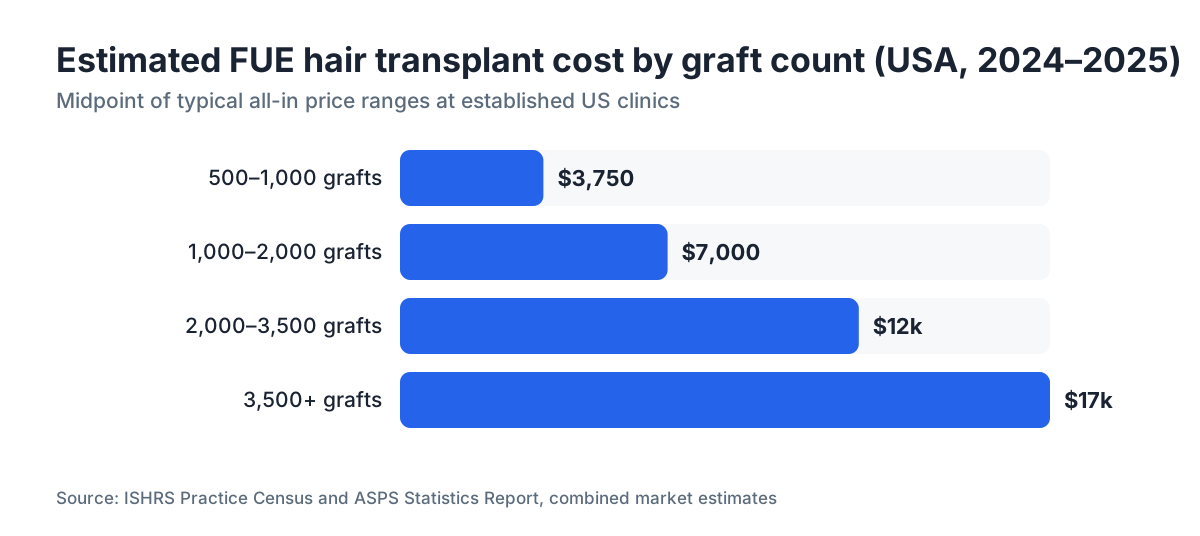
Here is what most patients actually pay by graft count at established US clinics in 2024 and 2025:
| Grafts needed | Typical hair loss stage | Estimated cost (FUE) | Estimated cost (FUT) |
|---|---|---|---|
| 500 to 1,000 | Early recession, temples | $2,500, $5,000 | $1,500, $3,500 |
| 1,000 to 2,000 | Moderate crown or frontal | $5,000, $9,000 | $3,000, $6,000 |
| 2,000 to 3,500 | Significant balding (NW4, NW5) | $9,000, $15,000 | $5,000, $10,000 |
| 3,500+ | Advanced balding (NW6, NW7) | $14,000, $20,000+ | $9,000, $15,000+ |
These are real market estimates, not guarantees. Your final quote depends on your scalp and your donor density.
What factors actually drive up the price of a hair transplant?
Graft count is the biggest lever. Every follicular unit adds technician time, consumables, and operating room hours. A surgeon moving 500 grafts is doing a half-day case. Move 3,000 grafts and you are looking at 8 to 10 hours. The math is direct.
Surgeon experience comes next. A fellowship-trained hair restoration specialist in Beverly Hills or Manhattan charges more than a general practitioner in a smaller market who added hair transplants to a cosmetic menu. That premium is often justified. Graft survival rates and natural hairline design vary a lot with skill [2].
Technique moves the price too. FUE leaves no linear scar and costs more per graft because it is slower and more hands-on. Robotic FUE (the ARTAS system) adds another layer of equipment cost. FUT is faster for the surgeon and cheaper per graft, but the horizontal scar limits very short haircuts. Neither method wins for every patient.
Geography is real. Clinics in New York City, Los Angeles, Miami, and Chicago carry higher overhead and charge for it. The same surgeon credentials in a mid-sized Midwest city can run 20 to 30% cheaper.
Then there is how the quote is built. Some clinics bundle pre-op labs, post-op PRP (platelet-rich plasma) therapy, and follow-up visits. Others quote the surgery alone and bill everything else separately. Ask for the total out-the-door number before you compare quotes. A bundled $9,000 can beat an itemized $7,000 once the extras land.
FUE vs. FUT: which technique costs more and why?
FUE costs more per graft at almost every clinic. The reason is time. Extracting follicular units one at a time with a small punch takes far longer than removing a strip of scalp and dissecting it under a microscope. Clinics pass that labor cost to you.
FUT is the older method. The surgeon removes a thin strip of scalp from the back of the head, sutures the wound closed, and a team dissects the strip into individual grafts. The scar is permanent and linear, usually 1 to 2 mm wide once healed. Wear your hair longer and it stays hidden. Prefer very short sides and it becomes a real drawback.
FUE leaves small round scars scattered across the donor area, each roughly 0.8 to 1.0 mm. Once hair regrows around them, they are essentially invisible. That advantage, plus the faster recovery, is why FUE now dominates the US market.
Robotic FUE runs on the ARTAS system, cleared by the FDA for follicular unit harvesting [3]. It adds roughly $1,000, $2,000 over manual FUE at many clinics. Whether the robot produces meaningfully better graft survival than a skilled manual surgeon is still an open question in the published evidence. It is a different tool, not a clear upgrade.
For most patients seeking 1,500 to 2,500 grafts who do not need an ultra-short haircut, both techniques produce excellent results in good hands. The choice should come down to your donor density, your hair loss pattern, and the surgeon's honest read. Not marketing.
Does insurance cover hair transplants in the USA?
No. Hair transplants for androgenetic alopecia (male-pattern or female-pattern baldness) are classified as cosmetic by US insurers and are excluded from virtually all commercial plans, Medicare, and Medicaid [4].
One narrow exception exists. Hair restoration performed to correct scarring from burns, accidents, or certain medical treatments (like chemotherapy-induced permanent alopecia) can qualify as reconstructive and get partial coverage. This hinges entirely on the plan, the insurer's medical policy, and the physician's documentation of medical necessity. The default answer is still no. Prior authorization is a long process most patients never pursue.
FSA and HSA funds cannot pay for cosmetic hair transplants either. IRS Publication 502 defines qualifying medical expenses and cosmetic procedures fall outside them [5]. Medically necessary reconstructive work is a separate case.
Financing is how most patients handle the cost. CareCredit, Alphaeon Credit, and in-house payment plans are common. Rates vary widely. Some clinics offer 0% for 12 months; others carry 18 to 29% APR. Read the terms. This is a large cosmetic purchase, and high-interest debt on it stops making sense fast.
How many grafts do I actually need?
It depends on how much you have lost and how dense you want the result. The Norwood scale grades male hair loss from NW1 (no loss) to NW7 (only a horseshoe of hair at the sides and back) [6]. Women use the Ludwig scale, stages I through III, but the same graft-count logic holds.
A rough planning guide:
- NW2, NW3 (early recession): 500 to 1,500 grafts usually restore a natural hairline
- NW3, NW4 (moderate frontal thinning or crown loss): 1,500 to 2,500 grafts
- NW4, NW5 (significant balding): 2,500 to 3,500 grafts
- NW6, NW7 (advanced): 3,500 to 6,000+ grafts, often across two sessions
Donor supply is the real ceiling. Most men have 6,000 to 8,000 extractable grafts in the safe donor zone over a lifetime [2]. Burn too many in one session and you shortchange future sessions once your hair loss keeps moving. That is exactly why a responsible surgeon will refuse to transplant the maximum number you are willing to pay for.
Not sure where you fall on the Norwood scale? MyHairline's free AI scan gives you a preliminary staging from a photo before you book. It does not replace an in-person exam, but it gets you a realistic starting point so you walk in with context.
For the mechanics behind the progression you are trying to treat, see what causes hair loss.
Are cheap hair transplants in the USA safe, and what are the red flags?
Some low-cost options are legitimate. Teaching clinics tied to academic medical centers and experienced surgeons in lower cost-of-living cities can both come in under the coastal average. But the safe floor has limits.
A full FUE procedure offered under $3,000 in the US should prompt hard questions. At that price, either the graft count is very small (which may be fine), the surgeon is inexperienced, technicians are doing most of the extraction and implantation, or sterile technique is getting shortchanged. Graft survival hangs on how fast grafts move from extraction to implantation and on proper storage solution. Both cost money.
Red flags worth taking seriously:
- Price per graft below $2.50 for FUE from a non-teaching clinic
- No way to meet your operating surgeon before the day of surgery
- No in-person or video consult before a quote is issued
- Pressure to book now for a "limited time" discount
- Before and after photos with mismatched lighting, angles, or grooming between the two shots
- A clinic that cannot state the surgeon's board certification or training
The American Board of Hair Restoration Surgery (ABHRS) and the International Society of Hair Restoration Surgery (ISHRS) both keep searchable directories of credentialed surgeons [7]. Cross-checking a clinic's claims against those registries takes about two minutes. Do it.
For what the full procedure involves medically, the hair transplant overview walks through the surgical steps.
How does the USA compare to going abroad for a hair transplant?
Medical tourism for hair transplants is huge. Turkey leads, with Istanbul clinics charging $1,500, $3,000 all-inclusive for procedures that run $8,000, $15,000 in the US. Mexico, India, and Thailand run established hair transplant industries at similar discounts.
The cost gap is real. So are the risks, and they deserve to be named.
First, when something goes wrong, corrective surgery back home can cost more than the original US procedure would have. The ISHRS has published warnings about complications from high-volume "hair mill" clinics abroad, where many patients are processed per day by technicians with minimal surgeon oversight [7].
Second, follow-up care across borders is hard. A 12-month relationship with a surgeon who monitors density, manages scalp health, and adjusts as needed is part of a good outcome. That relationship does not exist when you fly home two days after surgery.
Third, quality genuinely varies. Turkey and other hubs have excellent surgeons. They also have operations where the consulting surgeon never touches your scalp and quality control drifts from case to case.
Going abroad is not irrational if you do real due diligence, verify the actual operating surgeon through ABHRS or ISHRS, and have a concrete post-op follow-up plan. Skipping that homework because the photos looked good is how people end up paying more for corrections than the trip ever saved.
What are the ongoing costs after a hair transplant?
Surgery is not the end of the spending. Most surgeons want you on medical therapy afterward to slow the ongoing loss in your non-transplanted follicles. Skip it and the transplanted zone can start looking like an island of hair surrounded by advancing baldness.
Finasteride (Propecia) is the most common post-transplant maintenance drug for men. Generic finasteride runs roughly $10, $30 per month at US pharmacies. The FDA approved finasteride 1 mg for male-pattern hair loss in 1997 [8]. If you are weighing finasteride alongside other treatments, see finasteride and minoxidil for how the two work together.
Minoxidil (Rogaine and generics) is common after a transplant too, topical or oral. Topical 2% and 5% solutions are over the counter and cost $10, $30 per month. Oral minoxidil is off-label for hair loss but increasingly used, at $5, $20 per month as a generic. For how topical minoxidil works and what the data shows, see does minoxidil work.
PRP (platelet-rich plasma) injections often show up in post-op protocols to support graft survival and density. A single session runs $500, $2,000, and most protocols call for three in the first year. The evidence is positive but not settled, and PRP is not FDA-approved specifically for hair loss [9].
Post-op visits, medications, possible touch-up grafts for areas that did not take, and PRP can realistically add $1,000, $5,000 to your first-year total. Budget for it upfront.
Is a hair transplant worth the money?
This is the question that matters, and the honest answer depends on where you stand.
A hair transplant redistributes your own existing follicles. It does not create new hair. The transplanted grafts resist DHT (the hormone behind androgenetic alopecia) because they come from the back and sides of the scalp, where that resistance is encoded at the follicle [10]. Once they grow in around 9 to 12 months after surgery, they should stay for life. That is a real, lasting outcome.
The case for it is strong when your hair loss is stable (or managed with medication), your donor density is adequate, your expectations are grounded (a good transplant restores a natural hairline and coverage, not the density of a 19-year-old), and you can pay without financial stress.
The case for waiting applies if you are under 25, your loss is still moving fast, or your donor supply is thin relative to the coverage you want. Transplant too early, lose native hair around the grafts, and you can end up with an unnatural result that needs expensive correction.
For many men with a stabilized receding hairline at NW2 to NW4, a well-executed transplant is genuinely worth it. For someone at NW6 hoping for NW1 density, no single surgery closes that gap, and the cost-to-outcome math gets hard to defend.
If you are early and unsure surgery is the path, look at cheaper options first. Minoxidil for men and hair loss supplements are not the same outcome, but they cost a fraction and can slow progression while you decide.
How to get an accurate quote and compare surgeons fairly
A useful quote takes more than a phone call. Here is what to ask for and what to watch.
Insist on a consultation where the surgeon personally assesses your scalp, in person or by detailed video. Any clinic willing to quote a price off a web form alone is not doing real medical planning.
Ask directly: how many grafts are you recommending, why, and what density can I realistically expect in the recipient area? Ask what happens if you need a touch-up. Some clinics include one free correction session. Others charge full price.
Get two or three quotes. Not to grab the cheapest, but because the spread tells you a lot. If two experienced surgeons recommend 2,000 grafts and a third says 4,000 for the same scalp, that gap deserves a direct question.
Verify credentials. Is the surgeon ABHRS-certified or an ISHRS member? Those are the two bodies specific to hair restoration. Board certification in plastic surgery or dermatology is a baseline, but it does not prove hair transplant expertise on its own.
Look at unedited results. The ISHRS keeps a patient photo resource, and forums like the Hair Restoration Network let patients post their own progress over months without clinic involvement. Those are far harder to curate than clinic marketing.
Running MyHairline's free AI hair analysis before your consults helps you gauge your rough Norwood stage and graft range, so you can judge whether a surgeon's recommendation looks reasonable instead of walking in blind.
See hair transplant expenses for a line-by-line breakdown of everything you might find on a clinic invoice.
Sources
- American Society of Plastic Surgeons, Plastic Surgery Statistics Report 2022
- International Society of Hair Restoration Surgery, Practice Census Survey
- U.S. Food and Drug Administration, 510(k) Premarket Notification Database, ARTAS Robotic System
- Centers for Medicare and Medicaid Services, Medicare Benefit Policy Manual, Chapter 16: Exclusions from Coverage
- Internal Revenue Service, Publication 502: Medical and Dental Expenses
- American Academy of Dermatology, Hair Loss: Diagnosis and Treatment
- International Society of Hair Restoration Surgery, Patient Safety and Medical Tourism Guidance
- U.S. Food and Drug Administration, Drug Label: Propecia (finasteride) 1 mg
- Journal of the American Academy of Dermatology, Platelet-rich plasma for androgenetic alopecia: A review of the literature
- National Institutes of Health, National Library of Medicine: Androgenetic Alopecia, StatPearls